Quick Answer
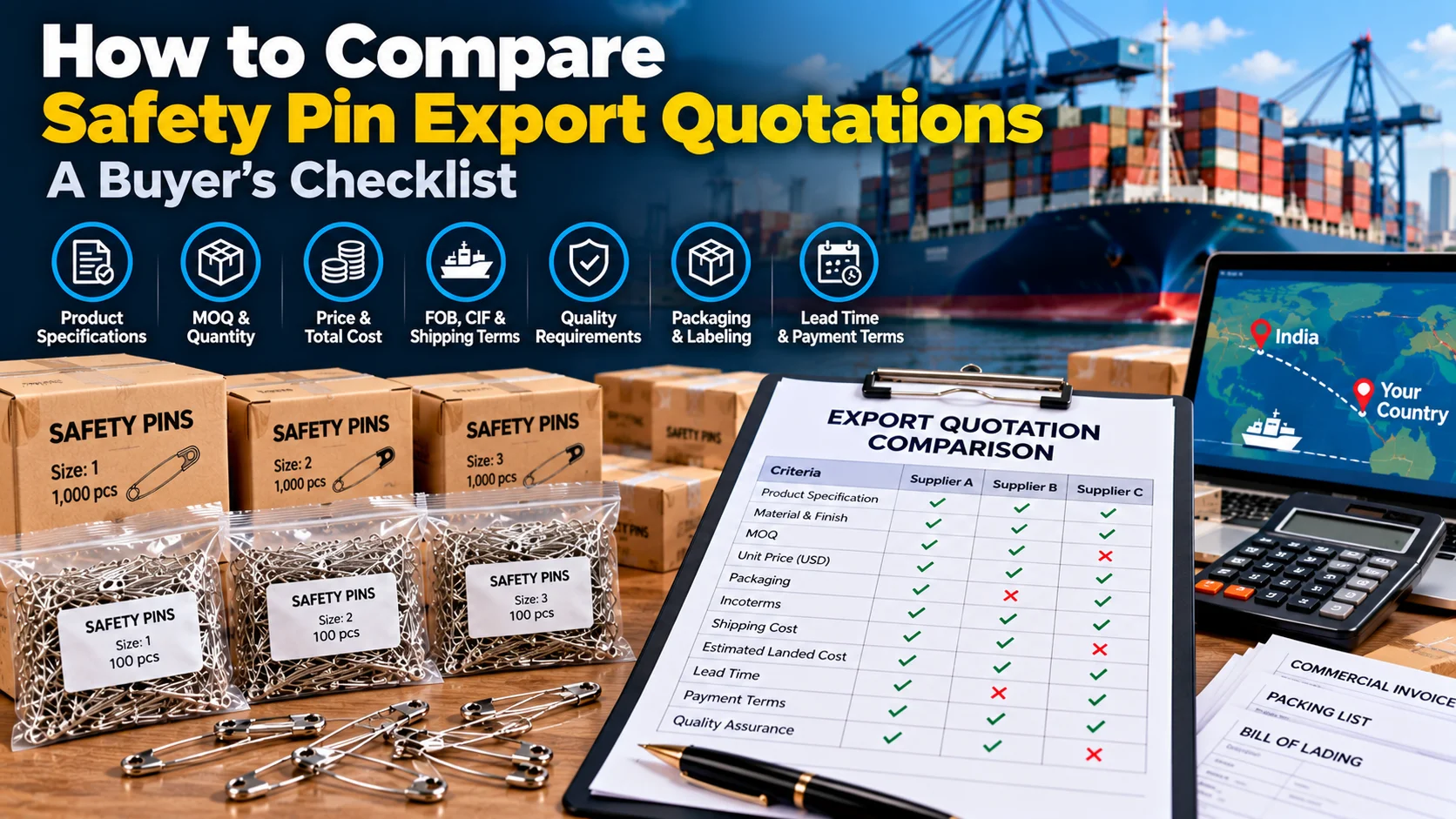
To compare safety pin export quotations accurately, buyers should evaluate more than the quoted price per box. Compare the exact product specifications, material, dimensions, quantity, packaging, minimum order quantity (MOQ), quality requirements, payment terms, production lead time, shipping terms, and destination costs.
A lower quotation may not represent the best value if it covers a different product specification, excludes important packaging costs, or uses different delivery terms. International buyers should request comparable quotations and confirm all commercial details in writing before placing a purchase order.
Why Comparing Safety Pin Export Quotations Matters
Importers and distributors often receive quotations from multiple manufacturers and trading companies. Although the prices may appear similar, the offers can differ in product specifications, packing configuration, shipping arrangements, and commercial conditions.
These differences can affect the actual cost of importing safety pins and the suitability of the goods for resale or industrial use.
A structured quotation comparison helps buyers:
Compare suppliers using the same product specifications.
Understand the total cost of acquiring goods.
Identify missing information before placing an order.
Evaluate quality-control arrangements.
Plan inventory and delivery schedules.
Reduce misunderstandings between the buyer and exporter.
The objective is not simply to find the lowest price. It is to select a supplier whose product, commercial terms, and delivery arrangements meet the buyer's requirements.
1. Confirm That Every Supplier Is Quoting the Same Product
The first step is to standardize the product specification.
Two suppliers may quote different prices because they are offering different materials, dimensions, finishes, or packaging configurations.
Before comparing prices, confirm the following information.
SpecificationWhat the buyer should confirmProduct typeStandard, specialty, or another required configurationSizeSize designation and actual dimensionsMaterialSteel, stainless steel, brass, or another specified materialWire thicknessRequired gauge or diameterSurface finishNickel-plated, gold-colored, black, or another agreed finishLocking mechanismRequired design and acceptable performancePackagingBulk, inner boxes, retail boxes, blister packs, or custom packagingQuantityPieces, boxes, gross, cartons, or another clearly defined unit
Do not assume that identical size numbers or product names always mean identical specifications across suppliers.
For example, if one supplier quotes standard steel safety pins and another quotes brass safety pins, the prices should not be compared as if the products were identical.
Ask both suppliers to confirm their specifications in writing and provide samples or technical details when necessary.
2. Compare MOQ and Order Configuration
Minimum order quantity, or MOQ, is the minimum quantity a supplier accepts for a particular order or product configuration.
MOQ can vary according to product type, packaging requirements, printing, customization, and production arrangements.
For Suvik Overseas, the standard MOQ is 750 boxes, and it can be discussed and adjusted after negotiation, depending on the order.
When comparing offers, ask:
What is the minimum order quantity for the selected product?
Can multiple sizes be combined in one order?
Can different materials or finishes be included?
Does custom packaging require a separate minimum quantity?
Is the quoted quantity measured in pieces, boxes, gross, or cartons?
Are sample orders available before bulk production?
Why the unit of measurement matters
A quotation for 500 boxes cannot be compared directly with one for 500 gross or 500 individual pieces.
The quantity, units per box, boxes per carton, and total shipment quantity should be clearly stated.
For Suvik Overseas, confirm the applicable MOQ directly with the export team for the required product and packaging configuration before finalizing the order.
3. Compare the Full Product Cost, Not Just the Unit Price
A supplier may quote an attractive product price while excluding other expenses that the buyer must pay.
For an import purchase, the buyer should distinguish between the product price, the export delivery arrangement, and the total estimated cost of receiving the goods.
Depending on the agreed transaction, additional costs may include:
Export packaging and labeling.
Inland transportation in the exporting country.
Export clearance.
International freight.
Cargo insurance, where applicable.
Destination handling charges.
Import duties and taxes.
Customs brokerage.
Transportation from the destination port to the buyer's warehouse.
Not every quotation will include the same costs. The buyer must identify which charges are included and which remain payable separately.
A simple landed-cost comparison
Use the following general calculation:
Estimated landed cost = Product cost + Applicable freight and insurance + Import charges + Handling and other relevant costs
Divide the estimated total by the quantity of saleable units received to estimate the landed cost per unit.
For accurate calculations, use the actual quantities and costs applicable to the transaction. Import duties and taxes depend on the product classification, destination country, and applicable rules; verify them with a qualified customs professional or the relevant authority.
4. Understand FOB, CIF, and Other Shipping Terms
Export quotations may use Incoterms such as FOB or CIF. Buyers should understand what each quoted term means before comparing offers.
FOB — Free On Board
Under FOB, the seller generally delivers the goods on board the vessel nominated by the buyer at the named port of shipment, and risk transfers according to the Incoterms rule.
The buyer generally arranges the main sea carriage and bears the associated costs after the relevant delivery point.
FOB is intended for sea and inland waterway transport. The named port and the specific Incoterms version should be stated in the contract.
CIF — Cost, Insurance and Freight
Under CIF, the seller arranges and pays the cost and freight to the named destination port and obtains the required cargo insurance under the rule.
However, the risk of loss or damage generally transfers when the goods are loaded on board the vessel at the port of shipment, not when they arrive at the destination.
CIF does not automatically mean that destination import duties, taxes, customs clearance, or final delivery to the buyer's warehouse are included.
How should buyers compare the terms?
Ask suppliers to quote using the same Incoterm, named port, and version wherever possible.
For example, comparing an FOB quotation with a CIF quotation without adjusting for the different cost coverage can produce a misleading result.
For containerized cargo, buyers should also discuss with their freight forwarder whether another rule, such as FCA or CIP, would be more appropriate for the shipment.
5. Evaluate Quality Control and Product Consistency
For wholesale and industrial purchasing, product consistency can be as important as price.
A buyer should establish the required acceptance criteria before production begins.
Consider checking:
Product dimensions and wire thickness.
Point finish and surface quality.
Locking-head fit and closure.
Spring action and opening-closing performance.
Surface finish and corrosion-related requirements.
Packaging accuracy and quantity.
Carton labeling and shipment identification.
The appropriate inspection method depends on the product specification and intended use.
Where corrosion resistance is important, specify the required material or finish and agree on a suitable test method. Do not rely on general marketing claims as a substitute for documented specifications or test results.
Buyers can also request pre-production samples, reference samples, inspection reports, or a mutually agreed inspection process.
See the safety pin quality-control guide for further information.
6. Check Production Lead Time and Delivery Commitments
A low quotation may not be useful if the goods arrive after the buyer's required date.
Ask each supplier to separate the relevant timeline into stages:
Sample approval, if required.
Final specification and artwork approval.
Production.
Quality inspection.
Packaging and export preparation.
Export clearance and dispatch.
International transportation.
Destination clearance and inland delivery.
Clarify when the production lead time begins. It may depend on advance payment, confirmation of specifications, approval of packaging artwork, or another contractual milestone.
International transit times can change because of vessel schedules, port congestion, customs procedures, and other logistics factors. Request an estimated schedule and confirm the delivery obligations in the contract.
For repeat orders, compare the supplier's actual performance against previous agreed schedules instead of relying only on estimated lead times.
7. Review Packaging and Private-Label Requirements
Packaging affects product protection, shipping efficiency, retail readiness, and the buyer's own brand presentation.
A distributor may require bulk-packed safety pins for repacking, while a retail chain may require printed boxes, barcode labels, or blister packs.
Before accepting a quotation, confirm:
The packaging format.
The number of pieces per pack or box.
The number of boxes per export carton.
Carton dimensions and gross weight, where available.
Label language and barcode requirements.
Brand artwork and printing specifications.
Whether packaging costs are included.
Whether customized packaging changes the MOQ or lead time.
For private-label orders, approve the final artwork and packaging specification before production.
Explore private-label safety pin manufacturing and custom safety pin packaging for relevant options.
8. Check Payment Terms and Commercial Conditions
A quotation should explain the payment arrangement and the conditions under which the order becomes binding.
Buyers should confirm:
Currency of the quotation.
Payment schedule and accepted payment method.
Quotation validity period.
Production start conditions.
Sample and tooling charges, if applicable.
Cancellation and order-change conditions.
Procedure for handling non-conforming goods.
Required commercial and export documents.
Payment terms can differ by supplier, transaction value, buyer relationship, and order type. Avoid assuming that one payment structure applies to every order.
For a new supplier, complete appropriate business verification and agree on the commercial terms in a written contract or purchase order before transferring funds.
9. Evaluate the Supplier, Not Just the Quotation
A competitive quotation is only one part of supplier selection.
International buyers should also assess whether the supplier can deliver the agreed product consistently and communicate clearly throughout the transaction.
A practical evaluation can include:
Manufacturing capability: Can the supplier explain the manufacturing process and confirm the required product specifications?
Quality systems: Can the supplier provide relevant certification or quality documentation that can be verified?
Export experience: Can the supplier clarify export packing, documentation, and shipping responsibilities?
Communication: Are technical and commercial questions answered clearly?
Customization: Can the supplier support the packaging, labeling, or product requirements needed for the order?
Order transparency: Are specifications, quantities, pricing, delivery terms, and payment conditions documented?
For a direct manufacturer, buyers may also ask about production capacity, sample availability, inspection procedures, and arrangements for repeat orders.
Avoid treating unverified claims, website badges, or generic promises as proof of performance. Request evidence relevant to the transaction.
10. A Practical Safety Pin Quotation Comparison Checklist
Use this checklist before selecting a supplier.
Evaluation itemSupplier ASupplier BExact product specificationConfirmConfirmMaterial and finishConfirmConfirmQuantity and measurement unitConfirmConfirmMOQConfirmConfirmPackaging configurationConfirmConfirmQuoted price and currencyRecordRecordIncoterm and named locationRecordRecordFreight and insurance coverageConfirmConfirmEstimated destination chargesEstimateEstimateQuality inspection requirementsConfirmConfirmProduction lead timeRecordRecordPayment termsRecordRecordExport documentsConfirmConfirmSample approvalConfirmConfirmTotal estimated landed costCalculateCalculate
Complete the comparison using written quotations and consistent assumptions. If a supplier has not provided a particular detail, mark it as pending rather than assuming it is included.
11. What Should Buyers Include in a Safety Pin RFQ?
A request for quotation (RFQ) should give suppliers enough information to price the correct product.
Include the following:
Company name and destination country.
Required safety pin type and application.
Size and dimensions.
Material and surface finish.
Estimated quantity and preferred unit of measurement.
Packaging and labeling requirements.
Private-label or OEM requirements, if applicable.
Destination port or delivery location.
Required delivery date.
Quality standards, testing, or documentation requirements.
Preferred Incoterm, if already determined.
The more precise the RFQ, the easier it becomes to compare quotations on an equivalent basis.
If the specifications are not finalized, explain what remains flexible and ask the supplier to identify available alternatives separately.
12. Request an Export Quotation from Suvik Overseas
Suvik Overseas Pvt. Ltd. is a safety pin manufacturer and exporter based in Kolkata, India. The company offers wholesale supply, OEM manufacturing, and private-label options for international buyers.
Buyers evaluating a potential order should share their required product specifications, quantity, packaging preference, destination, and any relevant quality requirements.
The export team can then review the requirement and confirm applicable product availability, MOQ, pricing, lead time, and shipping terms.
To begin, visit the wholesale safety pin manufacturer page or submit a request through the enquiry form.
Suggested RFQ message
Subject: Request for Export Quotation — Safety Pins
Dear Export Sales Team,
We are interested in sourcing safety pins for our business in [Country].
Please review the following requirements:
Product type and size: [Specify]
Material and finish: [Specify]
Estimated quantity: [Specify]
Packaging requirements: [Specify]
Destination port or delivery location: [Specify]
Required delivery timeline: [Specify]
Private-label or OEM requirements: [If applicable]
Please provide your quotation, applicable MOQ, production lead time, available packaging options, payment terms, and proposed shipping terms. Kindly identify any additional costs that are excluded from the quotation.
Please also advise whether samples and relevant quality documentation are available for evaluation.
Best regards,
[Name]
[Company]
[Country]
[Business Email]
Frequently Asked Questions
How do I compare safety pin export prices from different suppliers?
Standardize the product specification, quantity, packaging, Incoterm, and payment conditions first. Then compare the quoted product cost and estimate additional shipping, import, handling, and delivery expenses.
What information is needed for a safety pin export quotation?
Provide the product type, size, material, finish, quantity, packaging requirements, destination country or port, required delivery timeline, and any OEM or private-label specifications.
Does the lowest safety pin quotation always offer the best value?
No. A lower price may exclude packaging, freight, inspection, or other relevant costs. It may also refer to a different product specification or delivery arrangement.
What is the difference between FOB and CIF for safety pin imports?
FOB generally requires the buyer to arrange the main sea carriage after the seller delivers the goods on board at the named shipment port. CIF requires the seller to arrange and pay for freight and specified insurance to the named destination port, although risk generally transfers at the port of shipment. Confirm the precise Incoterm and location in the contract.
Should buyers request samples before bulk production?
Samples can help buyers evaluate dimensions, finish, locking performance, and packaging before approving a large order. Agree on sample availability, cost, and acceptance criteria with the supplier.
Can safety pins be supplied under a buyer's own brand?
Private-label and OEM arrangements may be available, subject to product requirements, artwork approval, MOQ, and production conditions. Confirm these details directly with the manufacturer.
What should be confirmed before placing a purchase order?
Confirm the approved product specification, quantity, price, currency, packaging, delivery terms, payment schedule, production timeline, quality requirements, and applicable export documents in writing.
Conclusion
Comparing safety pin export quotations requires a consistent approach to product specifications, quantity, packaging, quality, shipping terms, and total acquisition cost.
International buyers should request comparable offers, clarify exclusions, evaluate supplier capability, and document the agreed requirements before placing an order. This process supports more informed sourcing decisions and reduces the risk of unexpected costs or product discrepancies.
For wholesale, OEM, and private-label requirements, contact Suvik Overseas through the export enquiry page with your product specifications and destination details.
About Suvik Overseas Pvt. Ltd.
Suvik Overseas Pvt. Ltd. is a safety pin manufacturer and exporter based in Kolkata, India. The company serves international B2B buyers seeking wholesale supply and customized manufacturing or packaging arrangements.
Buyers can contact the export team to discuss specifications, MOQ, packaging, samples, and quotation requirements.
Commercial terms, product availability, lead times, certifications, and shipping arrangements should be confirmed for each order. This guide is general sourcing information and does not replace transaction-specific legal, customs, or logistics advice.