
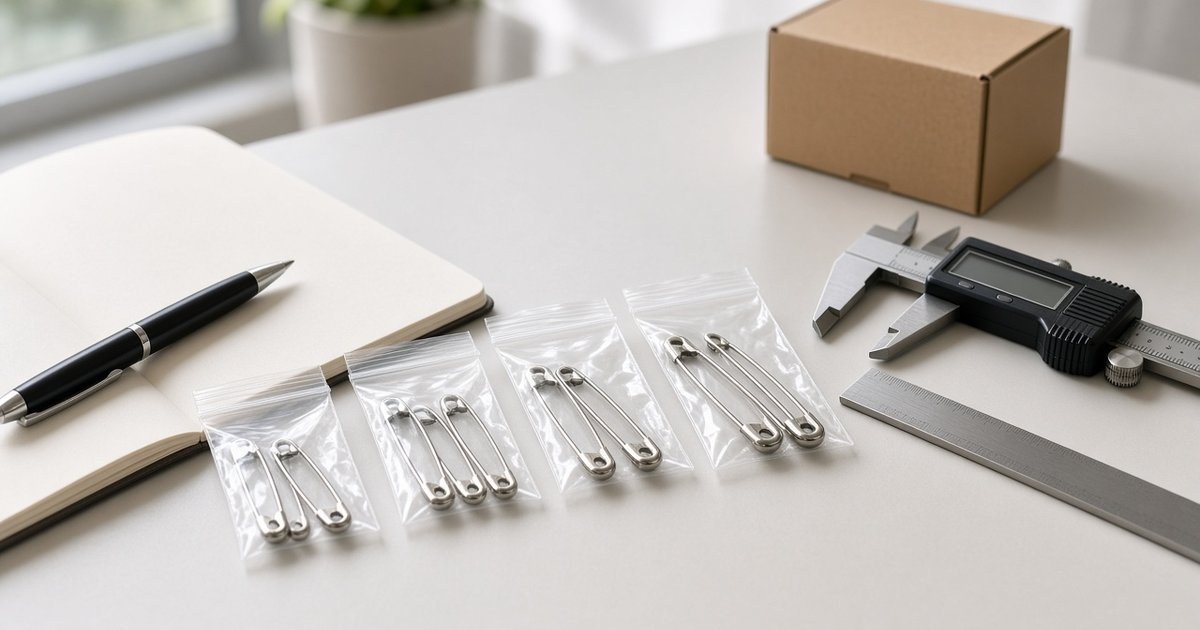
Most importers don't switch suppliers in one step. They ask for samples, place a small first order, check what arrives, and only then commit to regular volume. That first shipment, the trial order, is where you learn whether the pins, the packing, the paperwork and the communication all work for your business.
This guide is for distributors, wholesalers, brands and garment buyers outside India who are planning a first order of safety pins from an Indian manufacturer. It explains how to choose what goes into the trial, how to sequence samples and the order, which shipping method suits a small first shipment, which documents to agree in advance, and what to measure before you reorder.
This is general buyer information, not legal, customs or financial advice. Product, packing and shipping details are from Suvik Overseas product pages and its published shipping policy, checked on 24 November 2026. Duty and import rules depend on your country: see the country guides linked below and confirm with your customs broker.
The short answer
Samples first: approve physical samples of every size and finish before you place the trial order.
Keep the trial small but real: order enough of your best-selling sizes to test them with actual customers, in the pack format you will reorder.
Combine lines: put two to four sizes or pack formats in one shipment, so one set of freight and customs costs covers several tests.
Ship to match the size: air or courier for very small trials, LCL sea freight for a few cartons or more. Kolkata (INKOL) by sea or Kolkata Airport (CCU) by air.
Agree documents up front: commercial invoice, packing list, bill of lading or airway bill, certificate of origin, and any inspection report you need.
Measure before you reorder: sizes, closure, finish, counts, carton condition, documents, lead time and customer feedback.
First step: send your sizes in mm, finish, pack format, trial quantity and destination through the enquiry form.
Why a trial order is worth doing
A trial order tests things that samples can't:
Consistency at volume. Ten sample pins can be perfect; a carton of thousands shows whether sizes, finish and closure are consistent.
Packing and labelling. You see the actual pouches, boxes, inner cartons and outer cartons, and how they survive the journey.
Documents and clearance. Your broker clears a real shipment with real paperwork, so you find any gap before regular orders.
Lead time and communication. You see how long production and dispatch really take, and how quickly questions are answered.
Customer response. Your own buyers try the pins and tell you whether they would reorder.
It also limits your risk. If something needs to change, you change it on a small order rather than a container.
Step 1: Decide what the trial needs to prove
Before you choose quantities, write down what the trial is for. For example:
"Can this factory replace our current supplier for 28 mm and 35 mm pins?"
"Will our garment customers accept a pouch pack instead of loose boxes?"
"Do private-label boxes with our barcode clear customs and sell on our shelves?"
Each question tells you what to include and what to measure. A trial that tries to test everything usually tests nothing well.
Step 2: Choose the lines to combine
Pick the two to four lines that matter most to your sales. Order by length in millimetres, because size numbers vary between factories; see our safety pin sizes chart and the guide to size numbers 000, 00 and 0 in millimetres.
Examples from Suvik's product pages, all mild steel and most nickel-plated:
28 mm: LIBERAL Prime, 40 pouch, 1,000 pieces per box in 40 pouches of 25, 60 boxes per carton.
30 mm: AROMI size 0, 10 pouch, 1,000 pieces per box in 10 pouches of 100, 100 boxes per carton.
35 mm: AROMI size 1, 20 pouch, 1,000 pieces per box in 20 pouches of 50, 75 boxes per carton.
40 mm: MAJOR size 2, 20 pouch.
44 mm: LIBERAL size 3, 500 pieces per box in 50 bunches of 10, 60 boxes per carton.
53 mm: MAJOR size 4, 250 pieces per box in 25 bunches of 10.
Assorted: SALASAR assorted, 50 pouch, 1,000 pieces in 50 pouches of 20.
A good trial mix is usually your highest-volume size, one size you want to add, and the pack format you plan to reorder. If you want a custom pack or your own brand, see the custom packaging and private label pages, and allow for the longer lead time.
How much to order
There is no single right quantity. Order enough to:
fill at least one full outer carton of each main line, so you see real carton packing;
supply a few of your regular customers for one normal reorder cycle; and
make the freight and customs cost per pin acceptable for your market.
Suvik's shipping policy says MOQ is flexible and depends on size, finish and packaging, so tell us the trial quantity you have in mind and we'll confirm. Our guide to converting pieces, gross, boxes and cartons helps when your customers buy in gross and the factory quotes in boxes.
Step 3: Samples before the trial
Approve samples of each line before you confirm the trial order. Suvik's samples, quality and packing page says samples are available on request, and sample cost, courier and lead time are shared on enquiry.
When the samples arrive, check them with the same method you'll use on the trial shipment:
length and wire thickness with a caliper (see what gauge a safety pin is);
point smoothness and closure: the head should cover the point fully;
spring tension: the pin should stay closed when the fabric is moved;
finish: even, with no flaking or rough patches;
the pouch or box, if you sampled the pack too.
Keep a few approved samples sealed as your reference. Write in the order that the trial must match them. Our sample evaluation approach for UK buyers shows how to write a sample brief.
Ready to plan your trial?
Send the enquiry form with your sizes in mm, finish, pack format, trial quantity and destination country and port. Ask for samples at the same time, and tell us what the trial needs to prove so we can suggest a mix.
Step 4: Agree terms, price and payment
Incoterms
The Incoterms rules, published by the International Chamber of Commerce, set out who arranges and pays for each stage of transport and where risk passes. Suvik's shipping policy says it ships FOB Kolkata or CIF port of destination, with DDP available on request, and buyers may nominate their own forwarder.
FOB: you arrange the main freight from Kolkata. Good if you already have a forwarder.
CIF: the seller arranges freight and insurance to your port; you handle clearance.
DDP: the seller delivers with duties paid. Simplest for a first order, but the price includes the seller's cost of handling your import.
See FOB, CIF and DDP for safety pin orders.
Payment
Agree payment terms in writing before production. Our guide to payment terms for safety pin imports compares the common options. To compare more than one supplier fairly, use the same specification and terms for every quotation.
The purchase order
Put the details in the purchase order, not just in emails: sizes in mm, wire, finish, pack counts, carton marks, documents, terms, delivery date and what happens if the goods don't match the approved samples. Our purchase order clauses, RFQ template and specification sheet template give wording you can adapt.
Step 5: Choose how to ship a small first order
The shipping policy lists sea freight from Kolkata (INKOL) and air freight from Kolkata Airport (CCU).
Courier or air freight: suits very small trials of a few boxes, or when you need the goods quickly. The cost per kilogram is higher, and in some countries even small parcels now pay full duty and entry fees. U.S. buyers should read our guide to small shipments after the end of de minimis.
LCL sea freight: suits a trial of several cartons. You share a container and pay for the space you use, but allow for consolidation time and port charges at both ends.
FCL: usually more than a trial needs, unless you are combining the trial with other goods.
Our guide to LCL, FCL or air freight for bulk safety pins compares the options. Ask your forwarder for a door-to-door quote for each before you decide.
Lead time
Suvik's shipping policy gives:
Ready stock: dispatched within 3–5 business days of payment confirmation.
Made-to-order or custom packaging: 10–21 business days, depending on quantity and specification.
Large export consignments (FCL/LCL): 15–30 business days, including stuffing and documentation.
Peak season (October to January) can extend these, and transit time comes on top. A trial from ready stock in standard packs is the quickest. See lead time by order size.
Step 6: Agree documents in advance
The policy lists these as standard: commercial invoice, packing list, bill of lading or airway bill, certificate of origin, and GST/IGST documents, plus any country-specific certificates required. Tell us before production if you need:
a certificate of origin in a particular form, to claim a duty preference (see certificate of origin and duty preferences);
an inspection report, or access for your own inspection agency before dispatch;
specific carton marks, batch numbers or your own labels;
the HS code your broker has confirmed, shown on the invoice.
See export documents for safety pin orders. Send copies to your broker before the goods arrive, so any gap is fixed while the shipment is still at sea.
Duty at destination
Import duty, taxes and clearance at destination are the buyer's responsibility unless DDP is agreed. Our guides cover HS codes and duty for the US, UK, EU and UAE and country routes, including the UK, Canada, Australia, Saudi Arabia and the Gulf, Kenya, Nigeria, South Africa, Bangladesh and Vietnam. For a U.S. budget, see the landed cost worked example.
Step 7: Check the shipment on arrival
When the trial arrives, inspect it against the purchase order and your sealed reference samples:
Cartons: count them against the packing list; note any damage, wet or crushed cartons, and photograph them before opening.
Marks and labels: carton marks, batch numbers and any barcodes or origin marks.
Counts: open a few boxes from different cartons and count pouches and pins.
Dimensions: measure length and wire on a sample from each line.
Function: open and close a sample of pins; check the point, closure and spring.
Finish: look for uneven plating, rust spots or rough areas.
Our guide to how to inspect and store a bulk shipment gives a fuller checklist. If something is wrong, follow the quality claim process: photographs, batch numbers and a clear description, sent promptly.
Step 8: Measure before you reorder
Score the trial on the things that matter for regular business:
Product: did every line match the approved samples?
Packing: did cartons, pouches and labels arrive in good condition and as ordered?
Documents: did clearance go smoothly, with no missing or wrong papers?
Lead time: how did actual dispatch compare with the quoted time?
Communication: were questions answered clearly and on time?
Landed cost: what did each pin cost delivered to your warehouse, including freight, duty, fees and brokerage?
Customer feedback: did your buyers reorder, and did they ask for any change?
Write down what you would change for the next order: a different size mix, a pack format, a document, a shipping method. Then plan regular volume with our guide to planning stock for peak season and reorders.
Buying direct from the factory
Suvik Overseas Pvt. Ltd. manufactures safety pins in Howrah, India. The company was incorporated in 2006 and supplies buyers in 35+ countries. Buying from the manufacturer means your trial is made and packed by the same production team that will make your regular orders, and you agree sizes, packs, carton marks and documents directly with them. Our page on how safety pins are made shows the process from wire to packed carton.
Common mistakes
Skipping samples. A trial without approved samples has nothing to be measured against.
Too many lines. Testing ten sizes at once spreads the order too thin to learn anything.
A trial pack you won't reorder. Test the pack format you plan to sell.
Vague purchase orders. Put sizes, counts, marks and documents in writing.
Documents late. Send copies to your broker before the goods arrive.
No scorecard. Decide in advance what "good" looks like, then measure it.
Frequently asked questions
What is a trial order?
A first, smaller order placed after sample approval to test a supplier's product, packing, documents and lead time before regular volume.
How big should a trial order of safety pins be?
Big enough to test real cartons and real customer demand, and small enough to limit risk. MOQ is flexible and depends on size, finish and packaging, so tell us your quantity and we'll confirm.
Should a trial go by air or by sea?
Air or courier suits a few boxes or urgent needs; LCL sea freight usually suits several cartons. Compare door-to-door quotes, including duty and fees at destination.
Can I mix sizes in one trial order?
Yes. Combining two to four lines in one shipment spreads freight and customs costs across several tests.
Which documents come with the shipment?
The shipping policy lists the commercial invoice, packing list, bill of lading or airway bill, certificate of origin and GST/IGST documents as standard. Tell us up front if you need anything else.
Can I get samples before the trial?
Yes. Samples are available on request; cost, courier and lead time are shared when you enquire.
Next step
If you're planning a first order of safety pins from India, send your sizes in mm, finish, pack format, trial quantity and destination through the enquiry form or the contact page. Tell us what the trial needs to prove, and ask for samples at the same time.
Sources
International Chamber of Commerce, Incoterms rules. Read 24 November 2026.
Suvik Overseas, Shipping & Delivery Policy: lead times, Incoterms, ports of loading, documents, packing, MOQ, buyer's responsibility for import duties. Read 24 November 2026.
Suvik Overseas, Samples, quality checks and packing: samples on request. Read 24 November 2026.
Suvik Overseas, Custom safety pin packaging and Private label safety pins. Read 24 November 2026.
Suvik Overseas product pages linked above: lengths, wire thicknesses, material, plating, pack counts and carton quantities. Read 24 November 2026.