
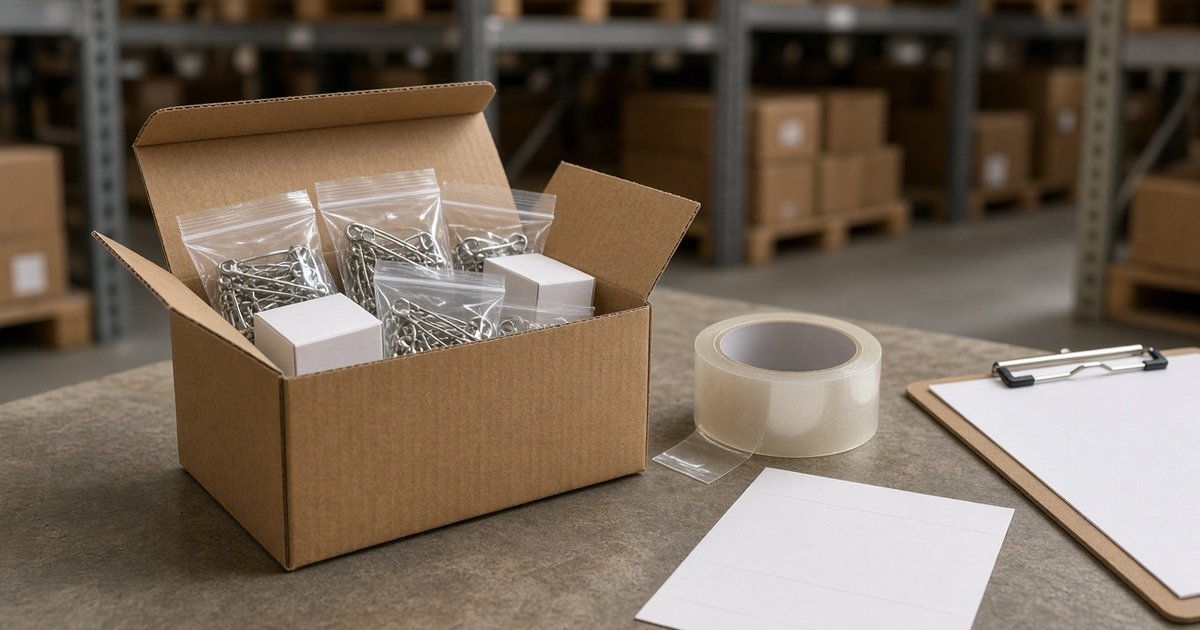
For years, a U.S. online seller could order a small carton of safety pins from overseas, have it couriered or mailed, and receive it without paying duty, as long as the shipment was worth $800 or less. That route has closed. Duty-free de minimis treatment has been suspended for all countries since 29 August 2025, CBP has written the suspension into its regulations, and the statutory exemption itself is due to end on 1 July 2027.
This guide is for online sellers, craft and haberdashery shops, and small distributors in the United States who buy safety pins in small quantities. It explains what changed, how a small shipment now enters the country, what duty and fees steel safety pins pay, and how to plan orders so small shipments don't eat your margin.
This is general buyer information, not customs or legal advice. Rules were read on official CBP, USITC and Federal Register-linked pages on 24 November 2026, and they have changed several times in the past year. Confirm the entry type, duty and fees for your own shipment with a licensed customs broker or your carrier's brokerage team before you order.
The short answer
De minimis is suspended: shipments valued at $800 or less no longer enter duty-free, by any mode, including mail. Narrow exceptions remain for genuine gifts and travellers' personal articles.
Entry still needed: shipments of $2,500 or less may generally use informal entry if eligible; above $2,500, formal entry is required.
Duty on steel safety pins: HTSUS 7319.40.20 has a 4.5% general duty, plus the 50% Section 232 steel duty on full value. That applies to a $200 parcel just as it does to a container.
Mail is harder for steel pins: since 22 October 2026, goods subject to Chapter 99 duties (which includes the Section 232 steel duty) are excluded from CBP's manual mail informal entry process and need another route, such as the Entry Type 13 test or a formal entry.
More change is coming: CBP has proposed further rules for low-value informal entries, and the statutory $800 exemption ends on 1 July 2027.
Practical answer: consolidate small orders into fewer, larger shipments, use a broker or carrier brokerage for every parcel, and budget duty and fees per shipment, not per unit.
What changed, step by step
29 August 2025: suspension for all countries
An Executive Order titled "Suspending Duty-Free De Minimis Treatment for All Countries" took effect on 29 August 2025. CBP says this suspension has applied since at least that date. Before it, low-value goods from most countries entered duty-free under the $800 exemption in 19 U.S.C. 1321.
24 June 2026: CBP's regulations
On 24 June 2026, CBP published two interim final rules. One suspended de minimis indefinitely for shipments arriving by any mode other than mail; the other did the same for international mail and set up a new mail informal entry process, which took effect on 24 July 2026. CBP's announcement says that all shipments valued at $2,500 or less are now subject to applicable duties, apart from genuine gifts of $100 or less and certain personal articles accompanying travellers.
22 October 2026: tighter rules for mail
From 22 October 2026, CBP excluded several kinds of goods from the manual mail informal entry process, including merchandise subject to duties under Chapter 98 or Chapter 99 of the HTSUS, goods claiming free-trade-agreement treatment, and goods subject to partner government agency requirements. Those goods must use another process, such as Entry Type 13 or formal entry.
This matters for safety pins. Steel safety pins pay the Section 232 duty through HTSUS heading 9903.82.02, which is in Chapter 99. Ask your broker how that affects a mailed parcel of pins; don't assume the simple mail process applies.
21 October 2026: a proposed rule
CBP has also published a proposed rule on low-value shipments. It would require informal entries of $2,500 or less to be filed electronically as Entry Type 11 on or before arrival, create a new electronic informal entry type for mail, and add bond requirements for some informal entries. Comments close on 7 December 2026. It is a proposal, not yet in force, but sellers who rely on small parcels should watch it.
1 July 2027: the statute changes
The One Big Beautiful Bill Act (Public Law 119-21, section 70531) ends the $800 exemption in the statute from 1 July 2027. From that date the exemption is gone by law rather than suspended by regulation.
How a small safety pin shipment enters the U.S. now
Courier and express parcels
Most small B2B shipments from India travel by express courier. The carrier, or a broker you appoint, files an entry, pays the duty and fees, and bills you or the shipper. For a shipment worth $2,500 or less, that is generally an informal entry if the goods are eligible; above $2,500, it is a formal entry, which CBP's fee table prices differently.
Ask your carrier before the parcel ships:
whether it will clear the goods itself or needs your broker;
whether it bills duty to you (the importer) or to the shipper;
what brokerage or disbursement fee it adds; and
what documents it needs from the shipper, such as the commercial invoice with the HTS code, value and country of origin.
International mail
CBP's mail informal entry process applies to eligible mail of $2,500 or less. CBP says only the owner, the purchaser or a licensed customs broker designated by them can file, a basic importation bond must be on file, duties are paid through Pay.gov by the 7th day of the month after arrival, and shipments without the required data or bond are held. Because steel safety pins are subject to a Chapter 99 duty, they are excluded from the manual process from 22 October 2026, so ask your broker about Entry Type 13 or formal entry instead.
For most sellers, mail is now the hardest route for a commercial carton of pins. Courier or consolidated freight is usually simpler.
Sea and air freight
Larger orders travel by air or sea cargo and enter as formal entries, usually through your own customs broker. A single planned shipment pays one set of entry fees instead of many. Our guide to LCL, FCL or air freight for bulk safety pins compares the options.
Duty and fees on steel safety pins
Duty
In the current Harmonized Tariff Schedule (2026 Revision 23, in effect from 10 November 2026), subheading 7319.40.20 "Safety pins" has a 4.5% general duty. India is not one of the special programmes listed for that line.
Steel safety pins are also listed as derivative steel articles under Section 232. Heading 9903.82.02 reads "the duty provided in the applicable subheading + 50%", so steel safety pins pay 4.5% + 50% = 54.5% of the customs value. Our guide to HS codes and import duty for safety pins explains the lines in more detail.
Illustration, using those rates only: a shipment of steel safety pins with a customs value of $1,000 would pay $45 in general duty and $500 in Section 232 duty, $545 in total, before fees and brokerage. Your broker confirms the actual figure on the day of entry.
Fees
CBP's user fee table lists:
Informal entries: a Merchandise Processing Fee of $2.77, $8.30 or $12.45 per entry, depending on how the entry is prepared.
Formal entries: 0.3464% of value, minimum $34.58, maximum $670.86.
Dutiable mail: a fee of $7.61 per dutiable package. CBP's FAQ says mail shipments are exempt from MPF except Inbound EMS.
Harbor Maintenance Fee: 0.125% of value on sea shipments.
Carrier brokerage and disbursement fees come on top and vary by carrier.
Country of origin marking
Imported articles, or their containers, must be marked with the English name of the country of origin so the ultimate purchaser can see it (19 CFR 134.11). For retail packs of pins, agree the "Made in India" marking with your broker before production. Suvik's custom packaging page lists country of origin stickers, retail boxes, blister packs and UPC or EAN barcodes.
What this means for online sellers
The per-unit cost of small parcels has risen
Every parcel now carries duty, an entry fee and usually a brokerage fee. A small parcel pays the same fixed fees as a larger one, so the cost per pin rises as the shipment gets smaller. Our U.S. landed cost worked example shows how to add these up.
Consolidate where you can
Combine SKUs. Order all sizes and pack formats you sell in one shipment instead of one parcel per product.
Order less often, in larger lots. Plan two to four shipments a year instead of monthly parcels.
Use air cargo or LCL for the base volume, and keep courier parcels for samples and genuine emergencies.
Hold a reorder point. Our guide to planning stock for peak season and reorders gives a simple method.
Decide who is the importer
Under FOB or CIF terms, you are the importer and you pay U.S. duty and fees. Under DDP, the seller arranges and pays them, and the price reflects that. Suvik's shipping policy says it ships FOB Kolkata or CIF port of destination, with DDP available on request, and that import duties and clearance at destination are the buyer's responsibility unless otherwise agreed. See FOB, CIF and DDP for safety pin orders.
Samples are not free of duty either
A sample parcel bought from a supplier is not a "bona fide gift", so de minimis-style treatment doesn't apply. Budget a small amount of duty and fees for samples, and ask your broker how the sample parcel will be entered. Our guide for UK buyers ordering samples from India shows how to write a sample brief; the same brief works for U.S. buyers.
Get the paperwork right first time
A held parcel costs time and storage. Make sure the commercial invoice shows a clear description ("steel safety pins"), the HTS code your broker confirms, the value, the quantity, the country of origin and the importer's details. See export documents for safety pin orders.
Ready to plan a consolidated order?
Send the enquiry form with your sizes in mm, pack formats, quantity per shipment, how many shipments a year, and your U.S. delivery city. Tell us whether you want FOB, CIF or DDP, and whether you need retail packs with barcodes.
Choosing sizes and packs for online sales
Online sellers usually stock a few sizes and one or two pack types. Suvik's product pages list mild steel pins from 23 mm to 53 mm, most of them nickel-plated, for example:
28 mm: LIBERAL Prime, 40 pouch, 1,000 pieces per box in 40 pouches of 25.
30 mm: AROMI size 0, 10 pouch, 1,000 pieces per box in 10 pouches of 100.
35 mm: AROMI size 1, 20 pouch, 1,000 pieces per box in 20 pouches of 50.
40 mm: MAJOR size 2, 20 pouch.
53 mm: MAJOR size 4, 250 pieces per box in 25 bunches of 10.
Assorted: SALASAR assorted, 50 pouch, a mixed pack that suits marketplace listings.
Order by length in millimetres; see the safety pin sizes chart. For your own brand, see the private label page.
Lead times
Suvik's shipping policy gives 3–5 business days for ready stock, 10–21 business days for made-to-order or custom packaging, and 15–30 business days for large FCL or LCL consignments, plus transit. Peak season (October to January) can extend these. Goods load at Kolkata (INKOL) by sea or Kolkata Airport (CCU) by air, and buyers may nominate their own forwarder. See lead time by order size.
Buying direct from the factory
Suvik Overseas Pvt. Ltd. manufactures safety pins in Howrah, India. It was incorporated in 2006 and supplies buyers in 35+ countries. MOQ is flexible and depends on size, finish and packaging, which helps online sellers who want several SKUs in one consolidated shipment. If this is your first order, our guide to planning a first trial order walks through the steps, and our guide for U.S. dry cleaners and tailoring supply distributors covers a trade buyer's view.
Common mistakes
Assuming small parcels are still duty-free. They are not, whatever the value.
Forgetting the Section 232 duty. Budget on 4.5% plus 50% for steel pins, then confirm with your broker.
Mailing commercial cartons of steel pins. Chapter 99 goods are excluded from the manual mail process; check the route first.
One parcel per SKU. Fixed fees repeat on every parcel.
Vague invoices. "Accessories" or "samples" without an HTS code and value invites a hold.
No origin marking. Retail packs need the country of origin in English.
Frequently asked questions
Is the $800 de minimis exemption gone for good?
It is suspended indefinitely in CBP's regulations, and the statute removes it from 1 July 2027. Exceptions remain for genuine gifts of $100 or less and certain travellers' personal articles.
Can I still use informal entry for a small shipment?
Generally yes, for eligible shipments of $2,500 or less. Steel safety pins sent by mail face extra restrictions because they are subject to a Chapter 99 duty, so ask your broker.
What duty do steel safety pins from India pay?
As read on 24 November 2026: 4.5% under HTSUS 7319.40.20, plus 50% under Section 232 (heading 9903.82.02), on the customs value.
Who pays the duty on a courier parcel?
Under FOB or CIF terms, you do, usually through the carrier's brokerage bill. Under DDP, the seller pays and builds it into the price.
Will the rules change again?
Possibly. CBP's proposed rule on low-value shipments is open for comment until 7 December 2026. Check with your broker before each order.
Can I get samples first?
Yes. Samples are available on request; cost, courier and lead time are shared when you enquire. Budget for duty and fees on the sample parcel.
Next step
If you sell safety pins online or supply small retailers in the United States, send your sizes, pack formats, quantity per shipment and delivery city through the enquiry form or the contact page. We'll help you plan fewer, larger shipments that keep duty and fees under control.
Sources
CBP, E-Commerce Frequently Asked Questions: suspension for $800 or less by all modes; gift and traveller exceptions; informal entry generally up to $2,500; mail informal entry from 24 July 2026; exclusions from 22 October 2026; filer, bond and Pay.gov rules; MPF exemption for mail. Read 24 November 2026.
CBP, "CBP modernizes low-value shipment processing" (24 June 2026): indefinite suspension; shipments of $2,500 or less subject to duties; Entry Type 13 test. Read 24 November 2026.
CBP, Customs Bulletin Vol. 60, No. 33 (21 October 2026): proposed rule on low-value shipments (comments by 7 December 2026); suspension since at least 29 August 2025; interim final rules of 24 June 2026; Public Law 119-21 section 70531(b), effective 1 July 2027. Read 24 November 2026.
CBP, User Fee Table: MPF for formal and informal entries, dutiable mail fee, Harbor Maintenance Fee. Read 24 November 2026.
USITC, Harmonized Tariff Schedule search, 7319.40: 7319.40.20 general duty 4.5%; 2026 HTS Revision 23. Read 24 November 2026.
USITC, Harmonized Tariff Schedule search, 9903.82.02: "+ 50%". Read 24 November 2026.
White House, Annex I-A (June 2026): 7319.40.20 "Iron or steel, safety pins" in the 50% list. Read 24 November 2026.
eCFR, 19 CFR 134.11, Country of origin marking required. Read 24 November 2026.
Suvik Overseas, Shipping & Delivery Policy and product pages linked above. Read 24 November 2026.