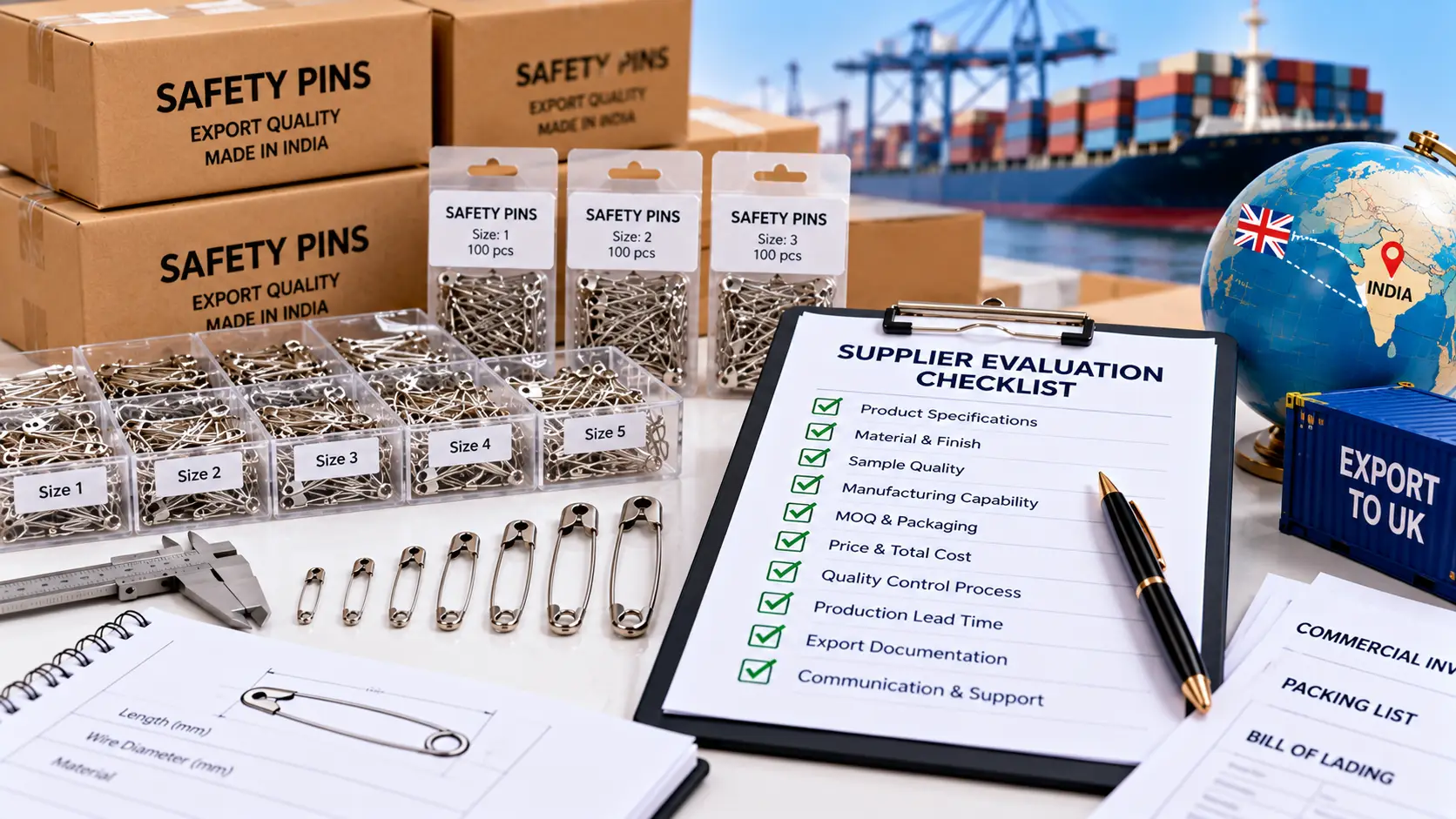
Choosing a safety pin supplier is about more than finding the lowest price. For importers, wholesalers, distributors, garment manufacturers and retail businesses, the right supplier must be able to meet the required product specifications, maintain consistent quality, provide suitable packaging and communicate clearly throughout the order process.
Before placing a bulk order, buyers should evaluate the supplier's product knowledge, quality-control procedures, minimum order quantity (MOQ), packaging capabilities, production timelines, export documentation and commercial terms.
Quick answer: To evaluate a safety pin supplier, confirm the material, dimensions and finish; inspect samples; review quality-control procedures; clarify MOQ and packaging quantities; compare quotations on equivalent terms; and agree on delivery, payment and defect-handling conditions in writing. For international orders, also confirm shipping responsibilities and destination-specific documentation requirements.
This guide provides a practical supplier evaluation checklist that businesses can use before requesting quotations, approving samples or committing to a purchase.
1. Why Is Supplier Evaluation Important for Bulk Safety Pin Buyers?
Bulk purchasing decisions can affect product consistency, inventory planning, retail presentation, delivery schedules and profit margins. A supplier that offers a low initial price may not be the most economical choice if the product specification is unclear, packaging is unsuitable or delivery arrangements are unreliable.
A structured evaluation helps buyers:
Compare quotations on a like-for-like basis.
Identify product and packaging mismatches before production.
Understand the supplier's minimum order requirements.
Reduce avoidable quality and communication problems.
Estimate the total cost of importing or distributing the product.
Establish clearer expectations for repeat orders.
The objective is not simply to identify the cheapest supplier. It is to find a supplier whose product, service and commercial terms match the buyer's requirements.
2. How Do You Check Whether a Safety Pin Supplier Is Suitable?
Start by asking the supplier to confirm the products and services it can actually provide. Do not assume that every supplier offers every material, size, finish or packaging configuration.
Before requesting a formal quotation, establish the following requirements.
Product specifications
Product type and intended application.
Required material, such as steel, stainless steel or brass, subject to availability.
Required length in millimetres and any relevant size designation.
Surface finish, colour or coating, where applicable.
Any customer-specific quality requirements.
Order requirements
Estimated quantity for the first order.
Expected frequency of repeat orders.
Required packaging format.
Destination country and delivery location.
Preferred delivery schedule.
Private-label or custom-packaging requirements, if applicable.
Ask the supplier to confirm these details in writing. A clear specification reduces the risk of receiving a product that differs from what the buyer expected.
For additional information about the business's manufacturing offering, review the safety pin manufacturing process page.
3. Should You Choose a Manufacturer or a Trading Company?
The right choice depends on your order requirements, the supplier's capabilities and the level of control or support your business needs.
A manufacturer may be suitable when you need detailed product specifications, repeat-order coordination or customised production arrangements. A trading company may be suitable when it offers dependable sourcing, consolidated purchasing or other services that match your requirements.
Neither category automatically guarantees better quality or reliability.
Evaluate the individual supplier against these criteria:
Evaluation criterionWhat to askProduct knowledgeCan the supplier explain the material, dimensions and available configurations?Supply capabilityCan it fulfil the required quantity and schedule?Quality arrangementsWhat checks are performed, and how are defects handled?CustomisationAre the requested packaging and branding options available?CommunicationAre questions answered clearly and consistently?DocumentationCan the supplier coordinate the documentation applicable to the order?Repeat ordersCan the agreed specifications be recorded and reused?
Ask whether the supplier manufactures the product, sources it from other manufacturers or provides a combination of services. The answer helps you understand its role and what evidence you should request before placing an order.
4. How Do You Evaluate Safety Pin Quality Before Ordering?
Quality should be evaluated against agreed product specifications, not just general descriptions such as “premium quality” or “export quality.”
Depending on the product, buyers can inspect samples for the following characteristics.
Dimensions and consistency
Check that the product matches the agreed length and other relevant dimensions. If you use a size designation, confirm the corresponding measurement rather than relying on the size label alone.
Pin alignment and clasp engagement
Inspect whether the pin aligns properly with its clasp and whether the point engages securely with the intended closure.
Opening and closing action
Check that the mechanism operates as expected and that there is no obvious deformation or malfunction.
Surface finish
Look for visible corrosion, scratches, coating defects or inconsistent finishing where relevant to the specified material and product.
Packaging condition
Check for damaged packaging, contamination, moisture exposure or incorrect product identification.
These checks are practical evaluation steps, not a substitute for applicable product standards, laboratory testing or customer-specific requirements.
Before approving a bulk order, ask the supplier to explain its inspection process and how it handles products that fail agreed acceptance criteria.
You can also review the safety pin quality-control page for further information.
5. Why Should Buyers Request Samples Before Bulk Production?
Samples allow buyers to examine the proposed product before committing to a larger quantity. They are particularly useful when the product will be sold under the buyer's brand, supplied to a demanding customer or used in a process where consistency matters.
A practical sample evaluation should include:
Confirming the material, size and finish.
Checking dimensions against the requested specification.
Examining pin alignment and clasp operation.
Reviewing the surface finish and visible defects.
Checking the proposed packaging.
Recording any changes required before approval.
After evaluating the sample, document the approved specification and any agreed reference sample.
Important: Sample approval does not automatically guarantee that the entire production batch will be identical. Buyers should agree on the applicable bulk inspection method and acceptance criteria before confirming production.
6. How Do You Compare Minimum Order Quantity and Packaging?
Minimum order quantity is an important consideration for wholesalers, distributors and first-time importers. However, MOQ figures are meaningful only when the packaging configuration is understood.
A supplier may quote a quantity in boxes, packs, cartons or another unit. These units are not automatically equivalent across suppliers.
Ask the supplier to confirm:
The minimum order quantity for the selected product.
What constitutes one box or pack.
The number of pins or retail packs per box, where applicable.
The number of boxes per master carton, where applicable.
Whether mixed sizes or different product configurations can be combined.
Whether custom packaging has a separate minimum order requirement.
For Suvik Overseas Pvt. Ltd., the standard MOQ communicated for enquiries is 750 boxes. Confirm the selected product, packing configuration and applicable commercial terms directly with the company before ordering.
Do not assume a particular number of pins per box unless the supplier has confirmed it in writing.
How does packaging affect purchasing decisions?
Packaging influences handling, storage, presentation and distribution.
Bulk packaging: May suit wholesalers, industrial buyers and businesses that repack products.
Retail-ready packaging: May suit distributors and retailers that need products prepared for sale.
Private-label packaging: May suit businesses selling products under their own brand.
Before approving custom packaging, confirm artwork, labelling, pack quantities, materials, any applicable barcode requirements and production lead time.
Explore the company's custom safety pin packaging and private-label safety pins pages.
7. How Should You Compare Safety Pin Supplier Quotations?
A fair comparison starts with equivalent product specifications. If suppliers quote different sizes, materials, packaging quantities or shipping arrangements, the prices may not be directly comparable.
Use the following table to standardise your comparison.
Quotation detailWhat to verifyProductSame type and intended applicationMaterialSame specified materialSizeSame dimensions and size designationFinishEquivalent finish or coating requirementsQuantitySame order quantity and packaging basisPackagingSame bulk, retail or private-label configurationUnit priceClear pricing unit and currencyCustomisationAny artwork, tooling or packaging chargesShipping termsNamed location or port and applicable IncotermLead timeSample, production and dispatch estimatesPayment termsDeposit, balance and payment conditionsDefect handlingAgreed process for non-conforming goods
Compare total purchasing cost, not only unit price
The quoted product price may not include all costs involved in receiving and selling the goods.
Depending on the transaction, consider:
Product cost.
Packaging or customisation charges.
Sample or tooling charges, if applicable.
Inland transport and export-related charges.
Freight and insurance, depending on the shipping terms.
Import duties and taxes applicable in the destination market.
Customs clearance, handling and local delivery costs.
For international transactions, clarify whether the quotation uses EXW, FOB, CIF or another Incoterm. Confirm the named place or port and the applicable Incoterms edition.
An FOB quotation and a CIF quotation should not be compared at face value because the included costs and responsibilities differ. Ask each supplier to identify the charges included and those that remain your responsibility.
8. How Can You Verify Export Readiness?
International buyers should establish whether the supplier can coordinate the information and documentation required for the intended shipment.
Depending on the transaction, destination and agreed shipping arrangement, documents may include:
Commercial invoice.
Packing list.
Transport document, such as a bill of lading where applicable.
Certificate of origin, where required or agreed.
Other documents required by the buyer, bank, carrier or importing country.
Not every document is mandatory for every shipment. Requirements can vary by destination, product classification, transport method and transaction terms. Confirm the applicable requirements with a qualified customs broker or trade adviser.
Also clarify the responsibilities of the buyer and supplier for booking transport, arranging insurance, preparing documents and coordinating dispatch.
Do not rely on a general promise of “export documentation available.” Ask which documents can be provided for your specific transaction and when they will be available.
9. How Do You Assess Delivery Time and Repeat-Order Reliability?
Delivery planning requires more than a single estimated number of days. Ask the supplier to separate the major stages of the order.
StageConfirmation neededSample preparationExpected time to provide samples, if requiredSample approvalWhether production depends on written approvalArtwork approvalWhether packaging artwork must be finalised firstProductionEstimated lead time after agreed starting conditionsDispatchExpected timing after production and documentationTransitEstimated shipping time under the proposed route
Confirm what starts the production lead time. It may depend on order confirmation, advance payment, specification approval or final packaging approval.
For repeat orders, ask whether the supplier can retain the approved specifications and packaging details for reference. Any changes in product requirements, quantity or packaging should be recorded before production.
Treat estimates as estimates unless a specific delivery commitment has been agreed.
10. What Commercial Terms Should You Confirm Before Ordering?
A supplier can meet your product requirements and still be unsuitable if the commercial terms are unclear.
Before issuing a purchase order, confirm:
Currency and pricing basis.
Payment schedule and accepted payment method.
Order confirmation requirements.
Production start conditions.
Packaging and artwork approval procedures.
Inspection arrangements and acceptance criteria.
Treatment of defective or non-conforming products.
Cancellation and order-change conditions.
Shipping responsibilities and delivery estimates.
Required commercial and shipping documents.
Record the final agreement in the quotation, purchase order or other written order documentation.
Avoid relying on verbal assumptions for important issues such as product dimensions, box quantities, custom packaging or responsibility for freight and insurance.
11. Supplier Evaluation Checklist for Importers and Wholesalers
Use this checklist before approving a new safety pin supplier.
Product material and size are clearly specified.
Finish and any special requirements are documented.
Supplier capabilities match the required order.
Samples have been evaluated where appropriate.
Quality checks and acceptance criteria are agreed.
MOQ and packaging units are clearly defined.
Custom packaging requirements are confirmed.
Quotations are comparable on the same specification.
Applicable freight, insurance and import costs have been considered.
Production and transit estimates are documented.
Payment and defect-handling terms are clear.
Applicable export documents have been identified.
Final specifications are recorded in writing.
A simple supplier scoring method
If you are comparing several suppliers, score each one against your purchasing priorities. For example, assess specification fit, quality evidence, packaging capability, cost transparency, delivery planning and communication.
You can use a 1–5 scale for each category, provided you define what each score means. Treat mandatory requirements—such as a particular material or required packaging—as pass-or-fail checks instead of allowing a high score elsewhere to compensate for a failure.
This creates a more consistent basis for supplier selection than choosing the lowest quotation.
12. Common Mistakes to Avoid When Selecting a Safety Pin Supplier
Buyers can reduce avoidable purchasing problems by avoiding these mistakes:
Choosing on price alone: A low unit price may exclude important packaging, freight or other costs.
Comparing different product specifications: The same product description does not guarantee equivalent dimensions, material or finish.
Ignoring the packaging unit: A quoted number of boxes is not meaningful without the agreed packing configuration.
Skipping sample evaluation: Where samples are appropriate, inspect and approve them before bulk production.
Leaving quality expectations vague: Agree on measurable specifications and a process for handling non-conforming goods.
Assuming delivery dates are guaranteed: Clarify the production start conditions and distinguish production time from transit time.
Ignoring destination requirements: Verify the documents and import obligations relevant to the specific shipment.
Relying only on verbal commitments: Record product, packaging, pricing and commercial terms in writing.
A disciplined evaluation process makes supplier offers easier to compare and helps identify questions that need to be resolved before an order is placed.
13. Request a Safety Pin Quotation from Suvik Overseas Pvt. Ltd.
Suvik Overseas Pvt. Ltd. is based in Kolkata, India, and supplies safety pins for B2B buyers. Businesses interested in bulk supply can submit their requirements for discussion with the company.
To help the team assess your enquiry, include:
Destination country.
Required material, size and finish.
Estimated order quantity.
Preferred packaging format.
Private-label or custom-packaging requirements, if any.
Target delivery schedule.
Specific quality or documentation requirements.
Providing these details helps establish whether the proposed product and commercial terms match your purchasing needs.
Request a safety pin quotation from Suvik Overseas Pvt. Ltd.
You can also review the company's wholesale safety pin manufacturer information before submitting your enquiry.
Frequently Asked Questions
How do I evaluate a safety pin supplier?
Confirm the supplier can meet your material, size, finish and packaging requirements. Review samples where appropriate, ask about quality-control procedures, clarify MOQ and compare quotations on equivalent terms. Before ordering, document delivery expectations, payment conditions and the process for handling non-conforming goods.
What should I ask a safety pin manufacturer before placing an order?
Ask about available materials and sizes, minimum order quantity, packing configuration, sample availability, quality checks, production lead time, custom packaging, payment terms and export documentation. Confirm which requirements the supplier can meet for your specific order.
What is the minimum order quantity for Suvik Overseas Pvt. Ltd.?
Suvik Overseas Pvt. Ltd. has communicated a standard MOQ of 750 boxes. Buyers should confirm the selected product, packing configuration and applicable order conditions directly with the company before placing an order.
Should I choose the supplier with the lowest safety pin price?
Not necessarily. Compare the same product specifications and packaging basis, then account for applicable customisation, freight, insurance, import charges and delivery considerations. Quality evidence, communication and fulfilment capability should also inform the decision.
What quality checks should be performed on safety pins?
Depending on the agreed specification, inspect dimensions, pin alignment, clasp engagement, opening and closing action, surface finish and packaging condition. Any specific standards, tests or customer acceptance requirements should be identified and agreed before production.
What information is needed for a bulk safety pin quotation?
Provide the required product type, material, dimensions, finish, quantity, packaging format, destination country, delivery schedule and any custom-label requirements. Clear specifications make quotations easier to compare and reduce the risk of mismatched offers.
Can I order private-label safety pins?
Private-label availability depends on the supplier's capabilities, the product configuration and packaging requirements. Confirm minimum quantities, artwork approval, labelling, packaging materials and lead time before placing the order.
What export documents should I confirm with a supplier?
Depending on the transaction and destination, documents may include a commercial invoice, packing list, transport document and certificate of origin where applicable. Verify the actual requirements with your customs broker or trade adviser.
About Suvik Overseas Pvt. Ltd.
Suvik Overseas Pvt. Ltd. is an India-based supplier of safety pins for business buyers. Importers, wholesalers and distributors can contact the company to discuss product specifications, bulk order requirements and available packaging options.
For enquiries, visit Suvik Overseas Pvt. Ltd..