
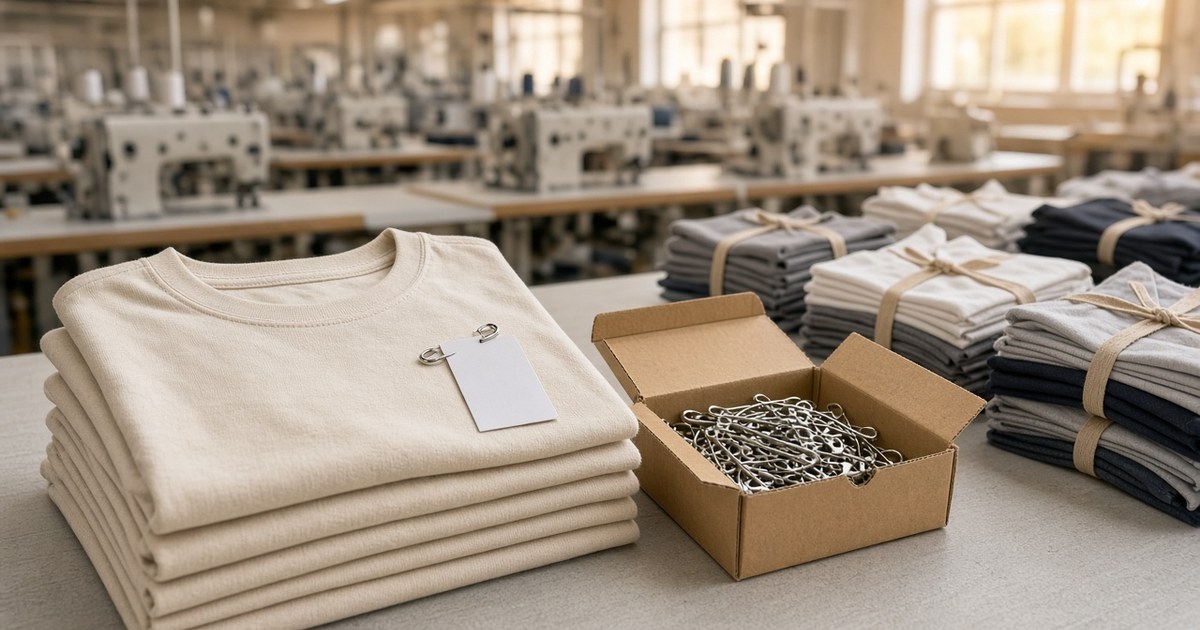
South African clothing factories and CMT (cut, make and trim) units use safety pins every day: to tag cut bundles, hold folds for packing, pin tickets and samples, and secure garments through finishing. Buying them direct from a manufacturer in India can give you a steady supply in the sizes and pack formats your lines actually use.
This guide is for production, procurement and trims managers. It covers where pins are used in a clothing factory, which sizes and finishes to choose, pack formats and cartons, how to plan reorders around retailers' fast replenishment, and what to put in your enquiry. For the customs side (SARS registration, duty, VAT and ports), see our step-by-step guide to importing safety pins from India to South Africa.
This is general buyer information, not legal, tax or customs advice. Industry context is from the Department of Trade, Industry and Competition (the dtic) and tariff and VAT facts from the South African Revenue Service (SARS), read on 23 November 2026. Product details are from Suvik Overseas product pages and its published shipping policy, checked the same day. Confirm the tariff and VAT position for your arrival date with your clearing agent.
The short answer
Sizes by job: 28–30 mm (size 0) for tagging and light fabric, 35–40 mm (sizes 1 and 2) for general use, and 53 mm (size 4) for denim, workwear and heavy bundles.
Material: nickel-plated mild steel for production use; brass in 19 mm and 23 mm, with black, gold and nickel-free silver finishes, for fine fabric and fashion details.
Packs: loose boxes of 1,000 for production lines, or pouches and bunches inside a box of 1,000 (fewer per box for sizes 3 and 4). Cartons hold 50 to 100 boxes, depending on the line.
Duty: steel safety pins (HS 7319.40) are free under the General rate in the SARS tariff; 15% import VAT applies. Details in our South Africa import guide.
Lead time: 3–5 business days from payment for ready stock, 10–21 for custom packing and 15–30 for FCL/LCL consignments, plus sea transit.
First step: send your size, finish, quantity and destination (city and port) through the enquiry form, and ask for samples at the same time.
Why sourcing matters for South African factories now
The South African Retail-Clothing, Textile, Footwear and Leather (R-CTFL) Value Chain Master Plan to 2030, published by the dtic, sets the goal of raising the share of locally manufactured clothing and footwear in local retail sales to 65%, from 44% by value in 2016. The dtic described this as a commitment to increase the proportion of locally produced fashion sold in South African retail stores.
The Master Plan also notes that many domestic retailers buy from local suppliers on rapid replenishment, Quick Response and fast-fashion models. For a factory or CMT unit, that means short, repeated runs where small trims can't be allowed to run out. Safety pins are cheap per piece but they stop a finishing line if the box is empty, so the aim is a supplier you can reorder from on a predictable cycle.
Where safety pins are used in a clothing factory
Suvik's product pages describe its pins as made for garment manufacturing, tailoring, packaging, laundry tagging and commercial fastening. In a clothing factory that usually means:
Bundle tickets in the cutting room. Pinning a ticket to each cut bundle so it can be tracked through sewing.
Holding folds for packing. Pinning shirts and formal wear in shape for display or boxed packing.
Tags and labels. Attaching temporary tickets, size markers or swing tags during finishing.
Samples and fit sessions. Pinning pattern pieces, alterations and sample garments.
Laundry and wash units. Tagging garments through washing and finishing.
One check before you order: your retail customers may have rules about pins in finished garments or in packed cartons. Ask your customer whether pins may leave the factory in the garment, and if not, how they must be removed and counted. That decides whether you need pins for internal use only or for packing as well.
Choosing sizes, wire and finish
Here's what Suvik's product pages listed when checked on 23 November 2026. All are mild steel with nickel plating unless marked brass. Size numbers differ between manufacturers, so always put the length in millimetres on your purchase order.
Size 0 (28–30 mm, 0.70 mm wire): tagging and light fabric
LIBERAL loose size 0: 28 mm, 1,000 loose pieces per box, 100 boxes per carton. Suits cutting rooms and packing tables.
AROMI size 0, 10 pouch: 30 mm, 1,000 pieces per box in 10 pouches of 100, 100 boxes per carton.
LIBERAL Prime 40: 28 mm, 1,000 pieces per box in 40 pouches of 25, 60 boxes per carton.
Sizes 1 and 2 (35–40 mm, 0.80–0.90 mm wire): general use
AROMI size 1, 20 pouch: 35 mm, 1,000 pieces per box in 20 pouches of 50, 75 boxes per carton.
SALASAR size 2, 20 pouch: 40 mm, 1,000 pieces per box in 20 pouches of 50, 75 boxes per carton.
Size 3 and 4 (44–53 mm): denim, workwear and heavy bundles
LIBERAL size 3: 44 mm, 0.90 mm wire, 500 pieces per box in 50 bunches of 10, 60 boxes per carton.
MAJOR size 4: 53 mm, 1.10 mm wire, 250 pieces per box in bunches of 10, 100 boxes per carton.
LIBERAL size 4: 53 mm, 1.02 mm wire, 300 pieces per box in bunches of 10, 60 boxes per carton.
Brass for fine fabric and fashion details
Brass size 000: 19 mm, 0.66 mm wire, 1,000 pieces per packet.
Brass size 00: 23 mm, 0.67 mm wire, 1,000 pieces per packet.
Finishes listed include black, gold and nickel-free silver.
Fine pins leave smaller holes in delicate fabric; thicker wire stays straight in heavy bundles. Test both on your own fabrics. See what safety pin size numbers mean in millimetres, what gauge a safety pin is, and coilless against standard safety pins for garment tagging.
Rust resistance
Durban and Cape Town are coastal, and pins may sit in a store room before use. Suvik's product pages describe the nickel-plated steel pins as rust-resistant, with anti-corrosion testing among the quality checks. If you need a specific test result, put the method in your enquiry and confirm with our team what report can be supplied. For the material choice, see brass against nickel-plated and stainless pins.
Get a quote for your sizes
Use the enquiry form and include the size in mm, finish, quantity per month and your city and port (Durban, Cape Town or Ngqura). Ask for samples at the same time so your production team can test them while the quotation is prepared.
Pack formats and cartons
Choose the pack to match how pins are handed out on the floor:
Loose boxes of 1,000 suit cutting rooms and packing tables where pins are used in volume.
Pouches (10 × 100, 20 × 50, 40 × 25 per box) make it easier to issue a fixed quantity to each line or operator.
Bunches of 10 suit size 3 and 4 pins and smaller workstations.
Assorted boxes of sizes 0, 1 and 2 (for example SALASAR assorted, 50 pouch, 30, 35 and 40 mm) suit sample rooms.
Suvik's shipping policy says pins are packed in polybags or branded pouches, consolidated in inner cartons and then in double-wall corrugated outer cartons. Each carton is labelled with product details, quantity, batch number and destination, and cartons are strapped and palletised where required. Custom and private-label packaging is offered; see the custom packaging page.
Planning reorders
Fast replenishment by retailers means your pin stock should be planned, not bought in a panic. A simple approach:
Work out monthly use per size from your last few months of production.
Add the full cycle time: Suvik's policy gives 3–5 business days for ready stock after payment, 10–21 business days for made-to-order or custom packing, and 15–30 business days for FCL/LCL consignments, then sea transit and clearance. The policy notes peak season (October to January) can extend lead times.
Hold a buffer for that cycle plus a safety margin, and reorder when stock drops to that level.
Combine sizes in one shipment where you can, so freight and clearance costs are shared.
Our guide to planning safety pin stock for peak season has a worked method, and lead time by order size explains carton, pallet and container timing. For shipping modes, see LCL, FCL or air freight; air suits samples and urgent top-ups.
Importing: the key points
Our South Africa import guide covers each step with official sources. In brief:
The importer of record needs a SARS customs code, registered on the RLA eFiling system.
Steel safety pins are classified under 7319.40; the General rate, which applies to goods from India, is free in the SARS tariff. Brass pins aren't under heading 73.19, so ask your clearing agent how to classify them.
Import VAT is 15% on the customs value plus a 10% upliftment plus any duty.
South Africa values imports on an FOB basis, so ask for freight and insurance to be shown separately on a CIF invoice.
Suvik's shipping policy lists FOB Kolkata and CIF port of destination as typical terms (DDP on request), Kolkata (INKOL) as the sea port of loading, and the commercial invoice, packing list, bill of lading or airway bill, certificate of origin and GST/IGST documents as standard. Import duties, taxes and clearance at destination are the buyer's responsibility. See export documents for safety pin orders and payment terms for safety pin imports.
Samples and quality checks
Samples: available on request; cost, courier and lead time are shared when you enquire. A written brief (sizes, finish, pack format, how you use the pins) gets you samples that match your real order. See samples, quality and packing.
What to test: point sharpness on your fabrics, closure strength when bundles are handled, plating finish, and the count per box and pouch.
Documents: buyers can ask for documents such as an inspection report, mill test certificate, packing list and certificate of origin.
Inspection: see third-party pre-shipment inspection, how to inspect and store a bulk shipment and the quality claim process.
Buying direct from the factory
Suvik Overseas Pvt. Ltd. is a manufacturer of safety pins and dress hooks, incorporated in 2006 and registered as an MSME manufacturing enterprise, with its registered office in Kolkata and factory in Howrah, West Bengal. It supplies buyers in 35+ countries, and its African markets page sets out supply for garment manufacturers, importers and wholesalers in South Africa and across Africa. Buying from the manufacturer means you agree sizes, pack counts, carton marks and documents directly with production. MOQ is negotiable and depends on size, finish and packaging.
What to put in your enquiry
Your company name, city, and whether you're a clothing factory, CMT unit, trims supplier or wholesaler.
Each size: length in mm (and size number), wire thickness if you have a preference.
Material and finish: nickel-plated steel, or brass in black, gold or nickel-free silver.
Pack format: loose box, pouches, bunches, assorted or private label.
Quantity per month and per order, and how often you reorder.
Terms (FOB Kolkata or CIF) and the port: Durban, Cape Town or Ngqura.
Whether you need freight and insurance shown separately, and a certificate of origin.
Whether you want samples first.
Our RFQ template and purchase order clauses give a fuller format.
Common mistakes
Buying by size number only. Write the length in mm.
One size for everything. Light fabric and heavy denim bundles need different wire.
Ordering when the box is empty. Plan reorders around the full cycle, including sea transit and clearance.
Not asking the retailer about pins in finished garments. It changes how many you need and where.
Mixing brass and steel on one invoice line. They aren't classified under the same heading.
Frequently asked questions
What size safety pins do clothing factories use?
It depends on the job. Size 0 (28–30 mm) suits tagging and light fabric, sizes 1 and 2 (35–40 mm) general use, and size 4 (53 mm) heavy fabric and bundles. Sample two sizes on your own fabric.
Is there import duty on safety pins in South Africa?
Steel safety pins under 7319.40 are free under the General rate in the current SARS tariff; 15% import VAT applies. See our South Africa import guide and confirm with your clearing agent.
Can you supply loose pins in bulk for production lines?
Yes. LIBERAL loose size 0 (28 mm) comes in boxes of 1,000 loose pieces, 100 boxes per carton. Other sizes come in pouches or bunches.
How long does delivery to Durban take?
Suvik's policy gives 3–5 business days for ready stock after payment and 15–30 business days for FCL/LCL consignments, before sea transit. Ask your forwarder for current transit times from Kolkata.
Do you supply black or gold safety pins for fashion brands?
Brass pins are listed in black and gold finishes in 19 mm and 23 mm. Confirm colour and quantity with our team after you see samples.
Can I get samples first?
Yes. Samples are available on request; cost, courier and lead time are shared on enquiry.
Next step
If you run a clothing factory, CMT unit or trims business in South Africa, send your sizes in mm, finish, monthly quantity and port through the enquiry form or the contact page. Ask for samples at the same time so your team can test them while the quotation is prepared. MOQ is negotiable.
Sources
the dtic, South African R-CTFL Value Chain Master Plan to 2030 (November 2020), PDF: 65% target for local share of CTFL retail sales (2016: 44% by value); retailers buying locally on rapid replenishment, Quick Response and fast-fashion models. Read 23 November 2026.
the dtic, Master Plans: list including the R-CTFL Value Chain Master Plan to 2030. Read 23 November 2026.
the dtic, Localisation plan in the clothing, textile, footwear and leather industry set to accelerate: commitment to raise locally produced fashion sold in retail stores from 44% to 65% by 2030. Read 23 November 2026.
SARS, Schedule No. 1, Part 1, Chapters 1 to 99 (dated 13 November 2026): 7319.40 "Safety pins and other pins", General rate free. Read 23 November 2026.
SARS, Value-Added Tax Levied on the Importation of Goods into South Africa (guide): 15% rate and 10% upliftment. Read 23 November 2026.
SARS, Registration, Licensing and Accreditation: importer registration on RLA eFiling. Read 23 November 2026.
SARS, SC-CR-A-05 Method 1 Valuation of Imports (external policy): FOB basis of valuation. Read 23 November 2026.
Suvik Overseas, Shipping & Delivery Policy: lead times, peak season, Incoterms, port of loading, documents, packing, MOQ, buyer's responsibility for import duties. Read 23 November 2026.
Suvik Overseas, Samples, quality checks and packing: samples on request; documents buyers can ask for. Read 23 November 2026.
Suvik Overseas product pages linked above: lengths, wire thicknesses, materials, finishes, pack counts and carton quantities. Read 23 November 2026.