
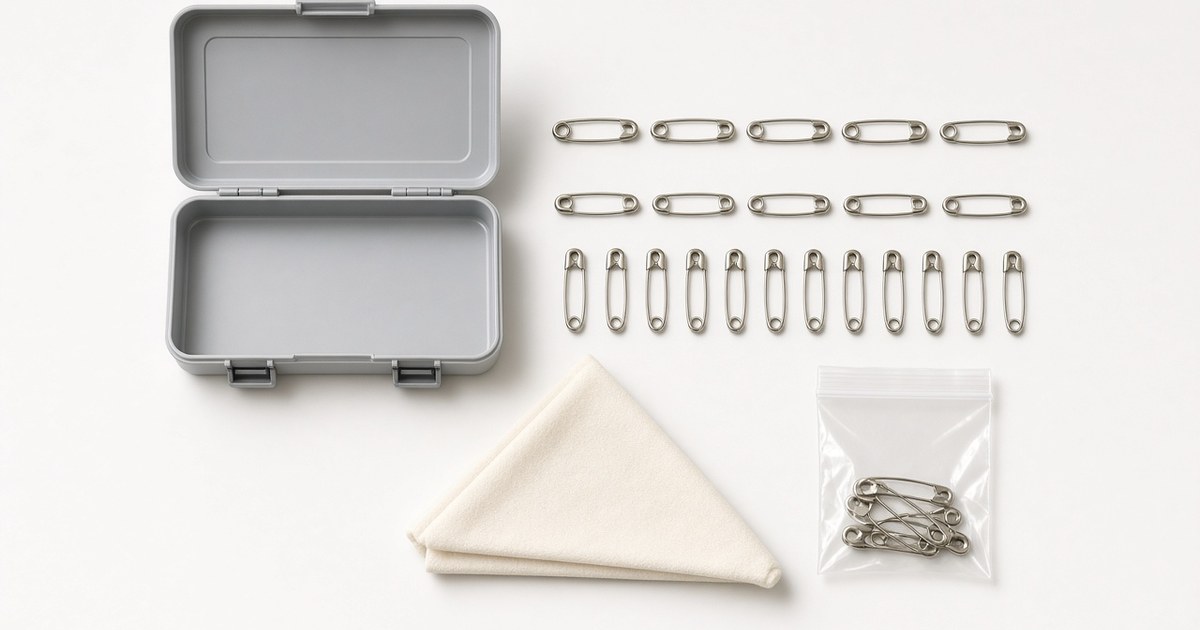
Safety pins are one of the small items that turn up in almost every first-aid kit. They hold triangular bandages and slings in place, and kit assemblers, medical supply distributors and workplace-safety wholesalers buy them by the thousand.
This guide is for those buyers. It covers what official first-aid guidance says about safety pins, the medical-device question you need to answer for your own kit, how to choose the size, material and finish, which pack formats suit kit assembly, and what to put in your enquiry so you get samples and a quotation that fit your kit.
This is general buyer information, not medical, legal or regulatory advice. Guidance and regulations were read on official HSE, OSHA, Safe Work Australia, St John Ambulance, EUR-Lex and FDA pages on 23 November 2026. Product details are from Suvik Overseas product pages and its published shipping policy, checked the same day. Suvik's pins are general-purpose fastening products: this article makes no claim that they are medical devices, sterile, or certified to any medical standard.
The short answer
Where pins appear in guidance: the UK HSE's suggested low-hazard workplace kit lists six safety pins, and its suggested travelling kit lists two.
What they are for: St John Ambulance's arm-sling instructions use a safety pin, as one option, to secure the bandage at the elbow.
Medical-device status: in the EU and the USA, whether a product is a medical device depends on its intended purpose as set by the manufacturer who places it on the market. Settle this for your own kit with your regulatory adviser.
Typical pins to sample: nickel-plated mild steel in 35 mm or 40 mm (sizes 1 and 2), or 53 mm (size 4) for heavier bandage fabric. Brass with a nickel-free silver finish is available in 19 mm and 23 mm.
Packs: bunches of 10, pouches of 20 to 100, or loose boxes of 1,000. Smaller kit-ready packs: confirm with our team.
First step: send your size, finish, quantity and destination country through the enquiry form, and ask for samples at the same time.
Who buys safety pins for first-aid use
First-aid kit assemblers who build workplace, vehicle, travel and sports kits and buy every component separately.
Medical and surgical supply distributors who sell kit refills and loose consumables to clinics, pharmacies, schools and employers.
Workplace-safety and PPE wholesalers who supply first-aid refills alongside other safety products.
Private-label brands that sell first-aid kits under their own name and source the contents from several factories.
Each has a slightly different question. Assemblers care about count accuracy and how pins feed into the kit line. Distributors care about refill pack sizes and shelf life in storage. Private-label brands care about the documents behind every component.
What first-aid guidance says about safety pins
United Kingdom: HSE L74
The Health and Safety Executive's guidance First aid at work (L74, third edition, reissued with amendments in 2024) says there is no mandatory list of items for a first-aid container. What you provide should follow the employer's first-aid needs assessment.
As a guide, Appendix 2 suggests a minimum stock for low-hazard workplaces that includes:
20 individually wrapped sterile plasters;
two sterile eye pads;
two individually wrapped triangular bandages, preferably sterile;
six safety pins;
large and medium sterile wound dressings;
at least three pairs of disposable gloves.
For travelling workers, the suggested kit includes two safety pins alongside two triangular bandages. HSE's first-aid FAQs give the same list and say employers may wish to refer to British Standard BS 8599-1 for more information on workplace kit contents.
Note the wording: HSE lists the plasters and dressings as sterile, and the triangular bandages as "preferably sterile". It lists safety pins with no sterility wording. If your own kit specification asks for more, that's a decision for you and your regulatory adviser.
United States: OSHA and ANSI Z308.1
OSHA's first-aid standard for general industry, 29 CFR 1910.151, requires first-aid supplies to be readily available. Its non-mandatory Appendix A points to the American National Standard ANSI Z308.1, "Minimum Requirements for Workplace First-aid Kits", as an example of minimal contents, and says employers should add supplies to suit their own workplace risks.
We haven't quoted the ANSI contents list here, because the standard is a paid document. If you build kits to ANSI/ISEA Z308.1, check the current edition for whether your kit class includes safety pins and in what quantity.
Australia: Safe Work Australia
Safe Work Australia publishes a model Code of Practice: First aid in the workplace (July 2019) that covers first-aid kits, procedures, facilities and training. Safe Work Australia notes that you should check with your local regulator whether the code has legal effect in your state or territory.
How the pins are used
St John Ambulance's guide to making an arm sling tells the first aider to secure the edge of the bandage by the elbow by twisting the fabric and tucking it in, or using a safety pin to fasten it. That's the main job a first-aid pin does: it holds a triangular bandage firmly, it must open and close easily, and it mustn't spring open.
The medical-device question
Buyers often ask whether a safety pin in a first-aid kit is a "medical device". There's no single answer, because it depends on how the product is placed on the market.
EU: Regulation (EU) 2017/745 (the MDR) defines a medical device by what it is "intended by the manufacturer" to be used for, such as the treatment or alleviation of an injury. The regulation also covers accessories that are intended to enable a medical device to be used.
USA: the FDA says a product is regulated as a device if it meets the definition in Section 201(h) of the Food, Drug, and Cosmetic Act, and that you start by defining the product's intended use and indications for use. The FDA lists ways to check existing product classifications and a route to ask for a formal determination.
In practice, the company that puts the finished kit on the market (often the kit brand or assembler) decides the intended purpose and labelling, and takes advice on the rules in each market.
What that means for your purchase from Suvik:
Suvik's product pages describe its pins as fasteners for garment manufacturing, tailoring, packaging, laundry tagging and commercial use. They make no medical-device, sterility or medical-certification claims.
If your kit needs pins supplied sterile, or with medical-specific documents, say so in your enquiry, and confirm with our team what can and can't be provided before you order.
If you sterilise kit components yourself, that process and its validation are part of your own quality system.
Choosing the pin: size, material and finish
Kit buyers usually want two or three sizes at most. Here's what Suvik's product pages listed when checked on 23 November 2026. Size numbers differ between manufacturers, so always write the length in millimetres on your purchase order.
Nickel-plated mild steel
Size 1, 35 mm, 0.80 mm wire: for example AROMI size 1, 20 pouch: 1,000 pieces per box in 20 pouches of 50, 75 boxes per carton.
Size 2, 40 mm, 0.90 mm wire: for example AROMI size 2, 20 pouch or MAJOR size 2, 20 pouch: 1,000 pieces per box in 20 pouches of 50, 75 boxes per carton.
Size 3, 44 mm, 0.90 mm wire: LIBERAL size 3: 500 pieces per box in 50 bunches of 10, 60 boxes per carton.
Size 4, 53 mm: for heavier bandage fabric, for example LIBERAL size 4 (1.02 mm wire, 300 pieces per box in 30 bunches of 10) or SALASAR size 4, 25 pouch (1.10 mm wire, 250 pieces per box in 25 pouches of 10).
Assorted boxes (30, 35 and 40 mm): for refill packs that need mixed sizes, for example SALASAR assorted, 50 pouch: 1,000 pieces in 50 pouches of 20.
None of the guidance cited above sets a pin size. Test two sizes against your own triangular bandage: the pin should pass through the folded fabric at the elbow without forcing, and the head should close fully over the point.
Brass, nickel-free silver finish
For kits sold to users with nickel sensitivity, Suvik lists brass pins with a nickel-free silver finish in 19 mm (size 000) and 23 mm (size 00), 1,000 pieces per packet. These are small pins, so check that they hold your bandage before you switch.
"Nickel-free" can mean different things in a purchase order. Our guide to nickel-free safety pins and how to specify them explains what to write and which test to ask for. For the wider material choice, see brass against nickel-plated and stainless pins.
Rust resistance and storage
First-aid kits sit for months in vans, workshops and damp rooms, so corrosion matters more than in most uses. Suvik's product pages (for example AROMI size 0) describe the nickel-plated mild steel pins as rust-resistant and list anti-corrosion testing among the quality checks. If your kit specification sets a test (for example a humidity or salt-spray duration), put the method and pass level in your enquiry and confirm with our team whether a report can be supplied. Check the wire thickness guide if your spec is written in gauge rather than millimetres.
Closure and point
Ask for samples and check that the head covers the point fully when closed, that the spring holds the pin shut when the bandage is moved, and that points are smooth. Our coilless against standard safety pins guide explains the two designs if you're comparing them.
Ready to compare samples?
Send the enquiry form with your size in mm, finish (nickel-plated steel or brass nickel-free), quantity per year and destination country. Ask for samples at the same time so you can test them on your bandages while the quotation is prepared.
Packaging for kit assembly and refills
Kits need small, exact counts: six pins for one kit, two for another. The standard formats on Suvik's product pages are:
Bunches of 10 (LIBERAL, MAJOR and SALASAR lines), which suit refill packs.
Pouches of 20, 25, 50 or 100 pins inside a box of 1,000.
Loose boxes of 1,000 (for example LIBERAL loose size 0, 28 mm), which suit automated or hand counting on your own line.
Packets of 1,000 for the brass lines.
Counts of two or six pins per bag, private-label packs and your own barcodes aren't standard catalogue items. Suvik's custom packaging page and private label page describe what's offered; confirm with our team whether your exact count, bag type and label can be made, and how that changes the lead time.
Suvik's shipping policy says pins are packed in polybags or branded pouches, consolidated in inner cartons, then in double-wall corrugated outer cartons, and each carton is labelled with product details, quantity, batch number and destination. The batch number on the carton is useful if your quality system needs traceability from a kit back to a pin lot: ask for it to appear on the packing list too.
Samples, quality checks and documents
Samples: available on request. Sample cost, courier and lead time are shared when you enquire. Our samples, quality and packing page explains what to put in a sample brief.
Quality documents: the samples page says buyers can ask for documents such as an inspection report, mill test certificate, packing list and certificate of origin. Tell us which you need up front.
Inspection: if you use an inspection agency, see third-party pre-shipment inspection. For checks on arrival, see how to inspect and store a bulk shipment.
Shipping documents: the policy lists the commercial invoice, packing list, bill of lading or airway bill, certificate of origin and GST/IGST documents as standard, plus country-specific certificates as required. See export documents for safety pin orders.
Lead times and shipping
Suvik's published shipping policy gives:
Ready stock: dispatched within 3–5 business days of payment confirmation.
Made-to-order or custom packaging: 10–21 business days, depending on quantity and specification.
Large export consignments (FCL/LCL): 15–30 business days, including stuffing and documentation.
Peak season (October to January) can extend these, and transit time comes on top. Goods ship FOB Kolkata or CIF port of destination, with DDP on request; the port of loading is Kolkata (INKOL), or Kolkata Airport (CCU) for air freight, and buyers may nominate their own forwarder. Import duties, taxes and clearance at destination are the buyer's responsibility.
Air freight suits samples and urgent refills; sea freight suits planned annual volumes. See LCL, FCL or air freight for bulk safety pins, lead time by order size and HS codes and import duty for safety pins. Country guides cover the UK, the EU, Australia and South Africa.
Buying direct from the factory
Suvik Overseas Pvt. Ltd. is a manufacturer of safety pins and dress hooks, incorporated in 2006 and registered as an MSME manufacturing enterprise. Its registered office is in Kolkata and its factory is in Howrah, West Bengal. It supplies buyers in 35+ countries. Buying from the manufacturer means you agree sizes, pack counts, carton marks, batch labelling and documents directly with production. MOQ is negotiable and depends on size, finish and packaging.
What to put in your enquiry
Your company name, country, and whether you assemble kits, distribute refills or sell under your own brand.
Size: the length in mm (and size number if you use one), and how many sizes.
Material and finish: nickel-plated mild steel or brass with nickel-free silver finish.
Quantity per order and per year, and the kit formats you build.
Pack format: bunches, pouches, loose boxes, or a custom count per bag.
Any test or document your kit file needs (corrosion test, inspection report, mill test certificate, certificate of origin).
Whether the pins need to be traceable by batch.
Terms (FOB Kolkata, CIF or DDP), the destination country and port.
Whether you want samples first.
Our RFQ template and purchase order clauses give a fuller format.
Common mistakes
Assuming a general-purpose pin carries medical claims. Decide your kit's regulatory position first, and ask for anything extra in writing.
Ordering by size number only. Size 2 at one factory isn't size 2 at another. Use millimetres.
Skipping the bandage test. Try samples on your actual triangular bandage before fixing the size.
Ignoring storage conditions. Kits sit for a long time; agree a corrosion test if your customers need one.
Leaving pack counts vague. Say exactly how many pins per bag and per carton.
No batch number on documents. If you need traceability, write it into the purchase order.
Frequently asked questions
How many safety pins go in a first-aid kit?
There's no single rule. The UK HSE's suggested minimum for a low-hazard workplace kit includes six safety pins, and its suggested travelling kit includes two. Other standards and markets differ, so check the one you build to.
Are your safety pins sterile or approved as medical devices?
Suvik's product pages make no sterility or medical-device claims for its pins. If your kit needs sterile pins or medical documents, say so in your enquiry and confirm with our team what can be supplied.
What size safety pin is best for a triangular bandage?
The guidance cited here doesn't set a size. A practical approach is to sample 35 mm and 40 mm pins, or 53 mm for heavy fabric, and test them on your own bandage.
Do you have nickel-free safety pins for first-aid kits?
Suvik lists brass pins with a nickel-free silver finish in 19 mm and 23 mm. Agree in the purchase order what "nickel-free" means for your market.
Can you pack two or six pins per bag?
These aren't standard catalogue packs. Tell us the count, bag type and label you need, and confirm with our team whether it can be made and the lead time.
Can I get samples before ordering?
Yes. Samples are available on request; cost, courier and lead time are shared on enquiry.
Next step
If you assemble first-aid kits or supply medical consumables, send your size in mm, finish, quantity and destination country through the enquiry form or the contact page. Ask for samples at the same time so you can test the pins on your bandages while the quotation is prepared. MOQ is negotiable.
Sources
HSE, First aid at work: L74 (third edition, reissued with amendments in 2024), PDF: Appendix 2, no mandatory list; low-hazard minimum stock including six safety pins; travelling kit including two safety pins; reference to BS 8599. Read 23 November 2026.
HSE, First aid at work: L74 publication page. Read 23 November 2026.
HSE, First aid at work: frequently asked questions: suggested contents including safety pins; reference to BS 8599-1. Read 23 November 2026.
OSHA, 29 CFR 1910.151, Medical services and first aid. Read 23 November 2026.
OSHA, Appendix A to 1910.151, First aid kits (non-mandatory): reference to ANSI Z308.1 as an example of minimal contents. Read 23 November 2026.
Safe Work Australia, Model Code of Practice: First aid in the workplace (1 July 2019). Read 23 November 2026.
St John Ambulance, How to make an arm sling: securing the bandage at the elbow by tucking or with a safety pin. Read 23 November 2026.
EUR-Lex, Regulation (EU) 2017/745 on medical devices: Article 2 definitions of "medical device" and "accessory for a medical device". Read 23 November 2026.
FDA, How to Determine if Your Product is a Medical Device: Section 201(h), intended use and indications for use. Read 23 November 2026.
Suvik Overseas, Shipping & Delivery Policy: lead times, Incoterms, ports of loading, documents, packing, MOQ, buyer's responsibility for import duties. Read 23 November 2026.
Suvik Overseas, Samples, quality checks and packing: samples on request; documents buyers can ask for. Read 23 November 2026.
Suvik Overseas product pages linked above: lengths, wire thicknesses, materials, finishes, pack counts and carton quantities. Read 23 November 2026.