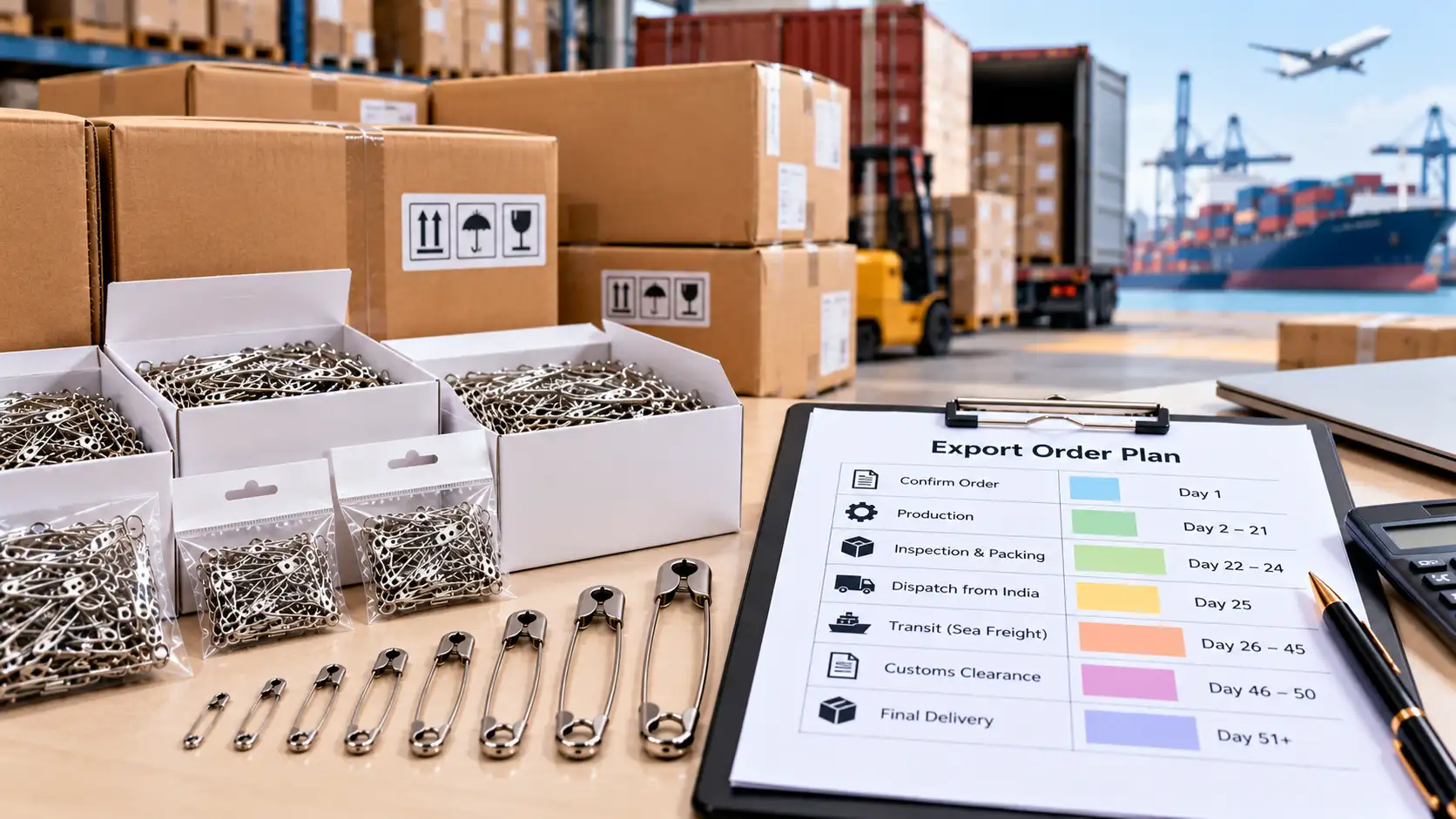
When importing safety pins, choosing the right supplier is only part of the purchasing decision. Buyers must also determine when to place the order, how long production and packaging will take, and when the shipment is expected to arrive.
For wholesalers, distributors and retail businesses, a delayed shipment can affect inventory availability, customer commitments and replenishment plans. This makes lead-time planning an important part of international procurement.
The most reliable approach is to work backward from the date the products are needed, allow time for production and shipment, and obtain a confirmed schedule from the supplier before placing the order.
This guide explains how international buyers can plan bulk safety pin orders from India and which details to confirm before production begins.
What Is the Lead Time for a Bulk Safety Pin Order?
Lead time is the period between a defined starting point and a specified completion or delivery milestone. In export purchasing, it is important to distinguish production time, dispatch time, transit time and final delivery time.
Suvik Overseas' published shipping policy provides the following indicative timelines:
Order typePublished indicative timelineReady-stock ordersDispatch within 3–5 business days after payment confirmationMade-to-order or custom packaging10–21 business days, depending on quantity and specificationsLarge export consignments (FCL/LCL)15–30 business days, including stuffing and documentation
These are published indicative timelines, not guaranteed delivery dates. The applicable schedule should be confirmed with the supplier for the specific order. The categories may involve different stages and should not automatically be added together or treated as interchangeable.
International transit and destination customs clearance can require additional time.
Before committing to a delivery date, ask the supplier to confirm the expected production completion date, dispatch date and estimated arrival window separately.
1. Confirm Whether the Products Are in Stock or Made to Order
The first step is to determine how the supplier will fulfil your order.
Ready-stock orders
If the required products and packaging are available, the supplier may be able to prepare the shipment without waiting for a full manufacturing cycle.
However, availability should be confirmed for the exact size, material, finish, quantity and packaging configuration. A supplier having one product variation in stock does not mean the complete order is ready to dispatch.
Made-to-order products
Orders requiring production to a specific specification may need additional time for material preparation, manufacturing, inspection and packing.
The schedule can depend on order quantity, the required product configuration and production capacity.
Custom or private-label packaging
Custom labels, printed boxes, barcodes and approved artwork can introduce additional steps.
To avoid unnecessary delays, provide packaging artwork early and confirm when the final files must be approved. Ask whether packaging materials must be manufactured or sourced specifically for your order.
2. Calculate Your Required Order Date
A useful way to plan an import order is to start with the date the goods need to be available and work backward.
Consider these milestones:
Required stock-availability date.
Expected international transit and destination clearance.
Dispatch and export preparation.
Production and packaging.
Sample or artwork approval, if required.
Purchase order confirmation and agreed payment milestones.
The buyer should obtain realistic estimates for each applicable stage from the supplier and logistics provider.
For example, if your warehouse needs the shipment by a particular date, the dispatch date must allow sufficient time for transit, customs clearance and inland delivery. Production must then be completed early enough to meet that dispatch date.
Do not assume that the supplier's production lead time includes international shipping or final delivery.
3. Allow Time for Samples and Product Approval
Buyers sourcing a new product configuration may want to evaluate a sample before approving bulk production.
Depending on the order, the approval process may involve checking:
Product dimensions and size.
Material and finish.
Closure and spring action.
Packaging configuration.
Printed labels and artwork.
Product identification and barcode placement.
The time required will depend on whether samples are already available, whether changes are needed and how quickly the buyer provides feedback.
Where a sample or artwork approval is required, agree on the approval milestone before finalising the production schedule.
For repeat orders using an already approved specification, confirm whether the previous approval remains applicable to the new order.
4. Understand Minimum Order Quantities Before Planning Production
Order quantity can affect purchasing decisions and the supplier's production schedule.
Before confirming the order, establish:
The minimum order quantity for each product variation.
Whether different sizes can be combined in one order.
Whether customised packaging has a separate MOQ.
The quantity per box and the number of boxes per carton.
Whether the requested order can be supplied from stock or requires production.
Suvik Overseas has communicated a standard MOQ of 750 boxes. Buyers should confirm the applicable MOQ for the requested products and packaging configuration before preparing their final order.
Avoid basing your schedule on an assumed quantity or packaging arrangement. Obtain confirmation for the actual order.
5. Confirm the Export Shipment Schedule
Production completion is not the same as shipment arrival.
For international orders, confirm the key milestones with the supplier:
MilestoneWhat to confirmOrder confirmationAccepted specifications, quantity and commercial termsProduction completionExpected date when manufacturing will be finishedInspection and packingApplicable checks and packing completionDispatch readinessWhen goods and export paperwork will be readyShipment departureExpected departure date and transport arrangementArrival estimateEstimated arrival window at the destinationFinal deliveryWhether destination clearance and inland delivery are included
For larger consignments, ask who is coordinating the freight booking and which documents will be provided.
The shipping arrangement matters. A quotation under one Incoterm may cover different responsibilities from a quotation under another. Confirm the named place or port, the party responsible for freight and insurance, and the destination responsibilities under the agreed terms.
6. Plan Around Seasonal Demand
Distributors often need to increase inventory before a busy sales period or a major customer order.
If your purchasing calendar includes a seasonal peak, do not wait until stock is nearly depleted to request a quotation.
Instead:
Review historical sales and confirmed customer commitments.
Estimate the inventory required during the replenishment period.
Check current stock and outstanding purchase orders.
Obtain a confirmed production and dispatch estimate.
Allow for transit and clearance uncertainty.
Agree on a reorder point for repeat purchases.
These steps do not guarantee that delays will be avoided, but they make the purchasing plan more realistic.
For recurring orders, ask the supplier whether a repeat-order schedule or advance production planning arrangement is feasible.
7. Account for International Shipping and Customs Clearance
International delivery depends on more than manufacturing.
Transit time may vary with the transport mode, route, carrier schedule, port conditions and destination. Customs clearance may also depend on the accuracy of the documentation and the requirements of the importing country.
Before the shipment is dispatched, confirm the applicable documentation with the supplier and your customs broker.
Depending on the transaction, documents may include a commercial invoice, packing list, bill of lading or air waybill, certificate of origin where required, and other destination-specific documents.
Check that the product descriptions, quantities, packaging counts and commercial values are consistent across the relevant documents.
Avoid promising customers a fixed arrival date based only on a supplier's production estimate.
8. Build a Replenishment Plan for Repeat Orders
For a wholesale business, order planning should continue after the first shipment.
Track sales and supplier lead times for each important product configuration.
A basic reorder point can be calculated as:
Reorder point = Average daily demand × Total replenishment lead time + Safety stock
For example, if a distributor sells 20 boxes per day and the total replenishment lead time is 20 days, expected demand during replenishment is 400 boxes.
If the distributor maintains an additional safety stock of 100 boxes, the illustrative reorder point is 500 boxes.
This is a mathematical example, not a forecast for safety pin demand. Use your own sales data and actual replenishment times to determine a suitable stock level.
For international orders, the replenishment period should include the relevant production, dispatch, transit and clearance stages.
9. What to Include When Requesting a Delivery Estimate
A supplier can provide a more relevant schedule when the buyer supplies complete order details.
Include:
Product sizes and dimensions.
Material and finish requirements.
Quantity by product variation.
Packaging and private-label requirements.
Required sample or artwork approvals.
Destination country and delivery location.
Preferred shipping method, if known.
Target date when the goods must be available.
Any inspection or documentation requirements.
Ask the supplier to identify which dates are estimates and which milestones can be confirmed after order acceptance.
If the requested delivery date is fixed, mention it at the beginning of the enquiry rather than after the quotation has been issued.
Frequently Asked Questions
How long does a safety pin export order take?
The timeline depends on stock availability, production requirements, packaging, shipment arrangements and destination clearance. Request a schedule specific to your order rather than relying on a general estimate.
How long does ready-stock dispatch take from Suvik Overseas?
Suvik Overseas' published shipping policy states that ready-stock orders are dispatched within 3–5 business days after payment confirmation. Confirm current availability and the applicable schedule with the team.
How long does custom safety pin packaging take?
The published policy gives an indicative range of 10–21 business days for made-to-order products or custom packaging, depending on quantity and specifications. Confirm the schedule for your exact requirements and whether international transit is excluded.
Does production lead time include international shipping?
Not necessarily. Production, dispatch, transit, customs clearance and final delivery are separate milestones unless the supplier explicitly defines an inclusive timeline.
When should an importer place a repeat order?
Calculate the reorder point using average demand, total replenishment lead time and appropriate safety stock. Adjust the plan using actual sales, supplier performance and destination shipping conditions.
What can delay a bulk safety pin order?
Potential causes include incomplete specifications, delayed payment, sample or artwork approval, production scheduling, packaging availability, shipment booking and destination clearance. Confirm the relevant milestones with the supplier.
Plan Your Next Safety Pin Export Order
Suvik Overseas Pvt. Ltd. supplies safety pins for wholesale and export requirements. Buyers planning a new or repeat order can share their required sizes, materials, quantities, packaging configuration and destination country to request a quotation and confirm the applicable schedule.
Request a wholesale safety pin quotation
For the most useful delivery estimate, include your target availability date and explain whether the order requires standard packaging, custom packaging or a specific product configuration.
A realistic order schedule starts with confirmed specifications, clear approval milestones and a delivery plan that accounts for production and international logistics.