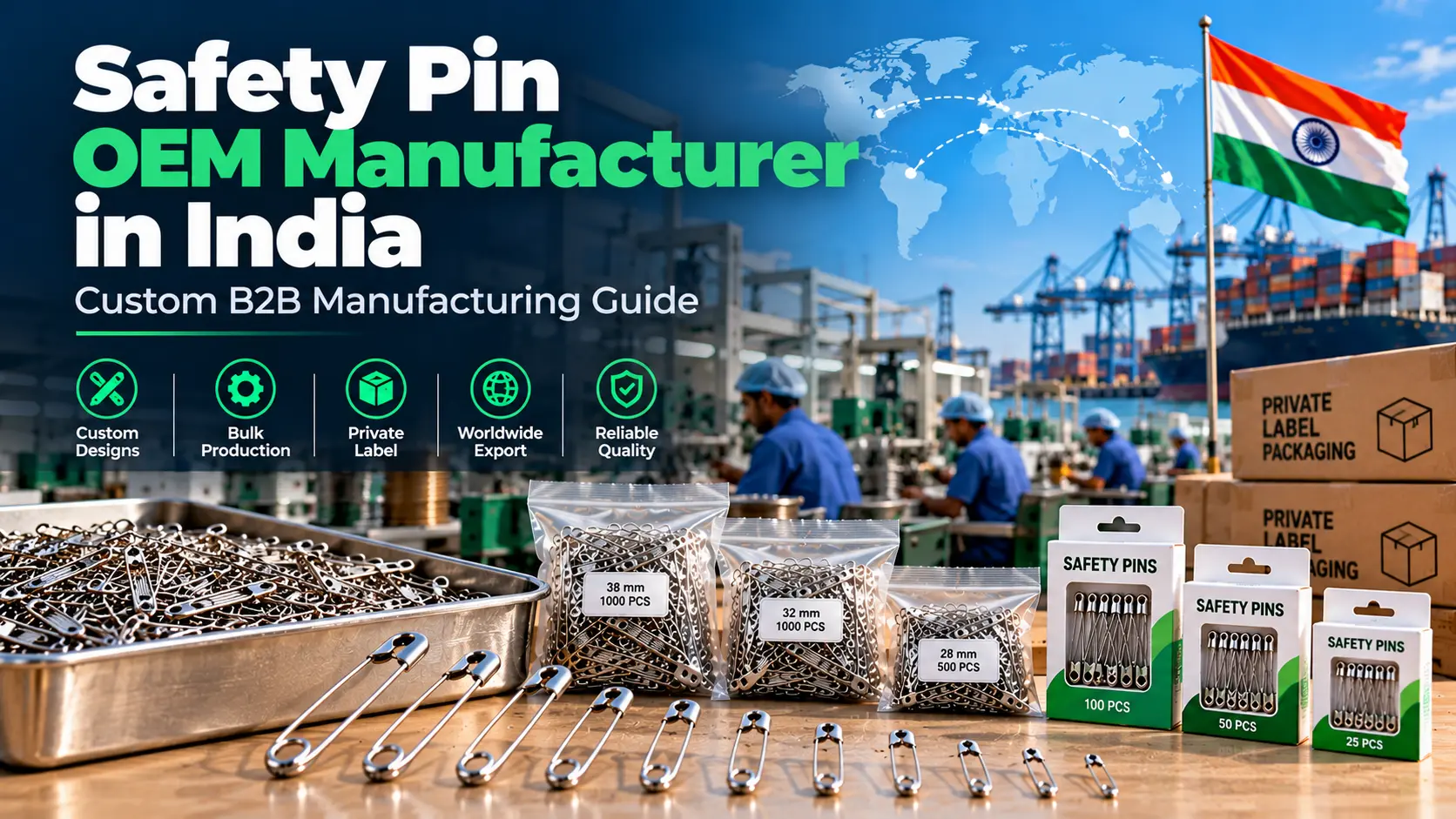
If your business needs safety pins made to specific requirements, working with an OEM safety pin manufacturer in India can provide more flexibility than purchasing standard products from a distributor.
OEM manufacturing can be useful for importers, wholesalers, apparel companies, retailers, private-label brands, and industrial buyers that need specific sizes, materials, finishes, packaging, or product specifications.
This guide explains what buyers should know before working with an Indian safety pin OEM manufacturer.
What Is OEM Safety Pin Manufacturing?
OEM, or Original Equipment Manufacturing, generally means producing a product according to a buyer's specifications.
Instead of purchasing a standard safety pin from available inventory, an OEM buyer can provide requirements such as:
Product dimensions
Material
Wire specification
Finish
Packaging
Quantity
Branding
Application requirements
The manufacturer then evaluates the requirements and determines the appropriate production process, MOQ, pricing, and lead time.
Who Needs OEM Safety Pins?
OEM manufacturing can be useful for businesses with specific product requirements or established product lines.
Typical buyers include:
U.S. importers
Wholesale distributors
Retail brands
Apparel manufacturers
Garment companies
Textile businesses
Sewing supply distributors
Private-label brands
Industrial suppliers
International sourcing companies
For companies placing recurring orders, OEM manufacturing can also help establish a consistent product specification.
Why Work With an OEM Manufacturer in India?
India can be considered by international buyers looking for manufacturing and export capabilities.
Potential advantages of direct OEM sourcing include:
Custom Specifications
Buyers can discuss specific dimensions, materials, finishes, and packaging requirements rather than selecting only from standard products.
Bulk Production
OEM manufacturing is designed around commercial production rather than individual consumer purchases.
Packaging Options
Depending on the manufacturer, buyers may be able to request bulk, distributor, retail, or private-label packaging.
Repeat Manufacturing
Once a product specification is approved, the same specification can potentially be used for future production runs.
International Supply
Manufacturers with export experience may be able to support shipments to international markets.
What Can Be Customized?
The available customization depends on the manufacturer's production capabilities.
Size
Buyers can specify the required dimensions instead of selecting only standard sizes.
For international orders, providing measurements in both millimeters and inches can help avoid misunderstandings.
Material
The required material should be specified before production.
Material selection can affect:
Strength
Durability
Appearance
Corrosion resistance
Cost
Finish
The required surface finish should also be agreed upon before production.
If the product is being sold under a brand, the finish can be an important part of the final appearance.
Packaging
OEM orders can potentially include customized packaging such as:
Bulk cartons
Polybags
Inner boxes
Retail packs
Custom boxes
Private-label packaging
Branding
Depending on the project, manufacturers may support branded packaging and other private-label requirements.
OEM Safety Pin Manufacturing Process
A typical OEM project can follow several stages.
1. Share Your Product Requirements
Start by providing your specifications.
Include:
Safety pin type
Dimensions
Material
Finish
Quantity
Packaging
Branding requirements
Destination market
If you have an existing product sample or technical specification, provide it to the manufacturer.
2. Technical Review
The manufacturer reviews the requirements and determines whether the requested product can be produced.
At this stage, the manufacturer may clarify:
Dimensions
Material
Production method
Packaging
MOQ
Lead time
This is also the right time to discuss any special requirements.
3. Sample Development
For a new OEM product, a sample or pre-production sample can be useful.
The buyer should review:
Size
Material
Construction
Finish
Opening and closing mechanism
Overall appearance
Packaging
Any required changes should ideally be finalized before bulk production.
4. Approve the Specification
Once the sample meets the requirements, approve the final product specification.
The approved specification should become the reference point for production.
5. Bulk Production
The manufacturer begins production according to the approved specifications.
Production timing depends on:
Quantity
Product complexity
Material availability
Packaging
Production schedule
Customization requirements
6. Quality Inspection
Quality checks can be performed during or after production.
Depending on the buyer's requirements, checks may cover:
Dimensions
Material
Finish
Product function
Quantity
Packaging
Product consistency
For large international orders, buyers may also arrange independent pre-shipment inspection.
7. Export and Delivery
After production and inspection, the order can be prepared for international shipment.
The shipping arrangement depends on:
Destination
Shipment size
Delivery timeline
Freight method
Commercial terms
OEM vs. Standard Safety Pins
Not every buyer needs OEM manufacturing.
RequirementStandard ProductOEM ProductStandard specificationYesNot requiredCustom sizeLimitedPossibleCustom materialLimitedPossibleCustom finishLimitedPossibleCustom packagingSometimesYes, depending on supplierPrivate labelSometimesCommonLarge production runsYesYesProduct developmentLimitedMore flexible
If your requirements match an existing product, a standard bulk order may be more efficient.
If you need a specific specification or branded product, OEM manufacturing may be more appropriate.
What Is the MOQ for OEM Safety Pins?
OEM orders generally require a commercial production quantity, but there is no universal MOQ.
For Suvik Overseas, the standard MOQ is 750 boxes, and it can be discussed and adjusted after negotiation, depending on the order.
The minimum quantity can depend on:
Product size
Material
Customization
Packaging
Production setup
Private labeling
Order complexity
Ask the manufacturer to quote your required quantity and, where possible, provide pricing at several volume levels.
For example:
50,000 pieces
100,000 pieces
250,000 pieces
500,000 pieces
1 million pieces
This allows you to compare the economics of different production volumes.
OEM Safety Pins for U.S. Buyers
For U.S. importers and brands, OEM sourcing can be useful when the product needs to fit an existing product line or packaging program.
Before placing an order, U.S. buyers should consider:
Product specifications
Packaging requirements
Country-of-origin information
Applicable labeling requirements
Product classification
Import requirements
Freight
Customs brokerage
Applicable duties or tariffs
Domestic delivery
Importers should verify the current requirements applicable to their specific product and sales channel.
For larger shipments, working with an experienced customs broker or freight forwarder can help coordinate the import process.
Private-Label OEM Safety Pins
OEM and private-label manufacturing can work together.
For example, a U.S. retailer may want:
Product: Safety pins
Specification: Custom size and material
Quantity: 250,000 pieces
Packaging: Retail boxes
Brand: Retailer's own brand
Market: United States
The manufacturer produces the product according to the approved specification and packaging requirements.
Before production, the buyer should approve the final product and packaging samples.
Quality Control for OEM Orders
Quality control is particularly important for customized products.
The manufacturer and buyer should agree on the important product characteristics before production.
These can include:
Overall dimensions
Wire diameter
Material
Finish
Pin tension
Closure
Surface quality
Packaging
Quantity
A clear specification reduces the possibility of disagreements between the buyer and manufacturer.
How to Choose an OEM Safety Pin Manufacturer
When comparing manufacturers, consider more than price.
Manufacturing Capability
Can the manufacturer actually produce the specification you require?
Production Capacity
Can they handle your expected order volume?
Quality System
How are products checked during production?
Sample Process
Can they provide samples before bulk manufacturing?
Packaging
Can they support your required packaging format?
Lead Time
Can they meet your purchasing schedule?
Export Experience
Do they have experience handling international B2B orders?
Repeat Orders
Can they reproduce the same specification for future orders?
For a long-term OEM relationship, these factors can be more important than the initial unit price.
What Should You Include in an OEM RFQ?
A detailed RFQ helps the manufacturer understand your requirements.
Include:
RequirementDetailsProductSafety pin typeSizeDimensions in mm/inchesMaterialRequired materialFinishRequired finishQuantityInitial order quantityPackagingBulk, retail, or customBrandingBrand/private labelDestinationCountry and locationTarget marketUSA, Europe, etc.DeliveryRequired timelineSpecial requirementsTechnical specifications
If you have a sample, drawing, specification sheet, or packaging design, include it with your inquiry.
Example OEM RFQ
A U.S. buyer could send:
We are looking for an OEM safety pin manufacturer for a private-label product. Our initial requirement is 250,000 pieces. Please provide available material and size options, MOQ, sample process, bulk pricing, custom packaging options, production lead time, and shipping options to the United States.
This gives the manufacturer a clear starting point for evaluating the project.
What Makes a Good OEM Supplier?
A good OEM supplier should be able to communicate clearly about:
Product specifications
Production feasibility
MOQ
Pricing
Samples
Quality control
Packaging
Lead time
Shipping
The supplier should also be able to explain any limitations before production begins.
Clear communication at the beginning of the project can prevent costly changes later.
Frequently Asked Questions
What is an OEM safety pin manufacturer?
An OEM safety pin manufacturer produces safety pins according to a buyer's specified requirements, which may include size, material, finish, packaging, and branding.
Can I order custom safety pins from India?
Depending on the manufacturer's capabilities, custom safety pin manufacturing may be available. Buyers should provide detailed specifications when requesting a quotation.
Can OEM safety pins be private labeled?
Yes, OEM projects can include private-label packaging and branding depending on the manufacturer's capabilities and order requirements.
What is the MOQ for OEM safety pins?
There is no universal MOQ. It depends on the product, material, customization, packaging, and production requirements.
Should I approve a sample before production?
Yes. Approving a sample is a useful step for confirming product specifications before committing to a large production run.
Can an Indian OEM manufacturer ship safety pins to the U.S.?
Manufacturers and exporters may support international shipments. U.S. buyers should confirm shipping arrangements and verify the applicable import requirements for their specific shipment.
How long does OEM safety pin production take?
Production time depends on the product specification, order quantity, materials, packaging, and the manufacturer's production schedule. Request a production timeline before confirming the order.
Request an OEM Safety Pin Quote
Looking for a safety pin OEM manufacturer in India?
Whether you need custom sizes, specific materials, bulk production, private-label packaging, or export supply, share your requirements with Safety-Pins.com.
Provide your:
Product specifications
Required quantity
Material
Size
Packaging requirements
Branding requirements
Destination market
Request an OEM Quote to discuss your requirements.