Quick Answer
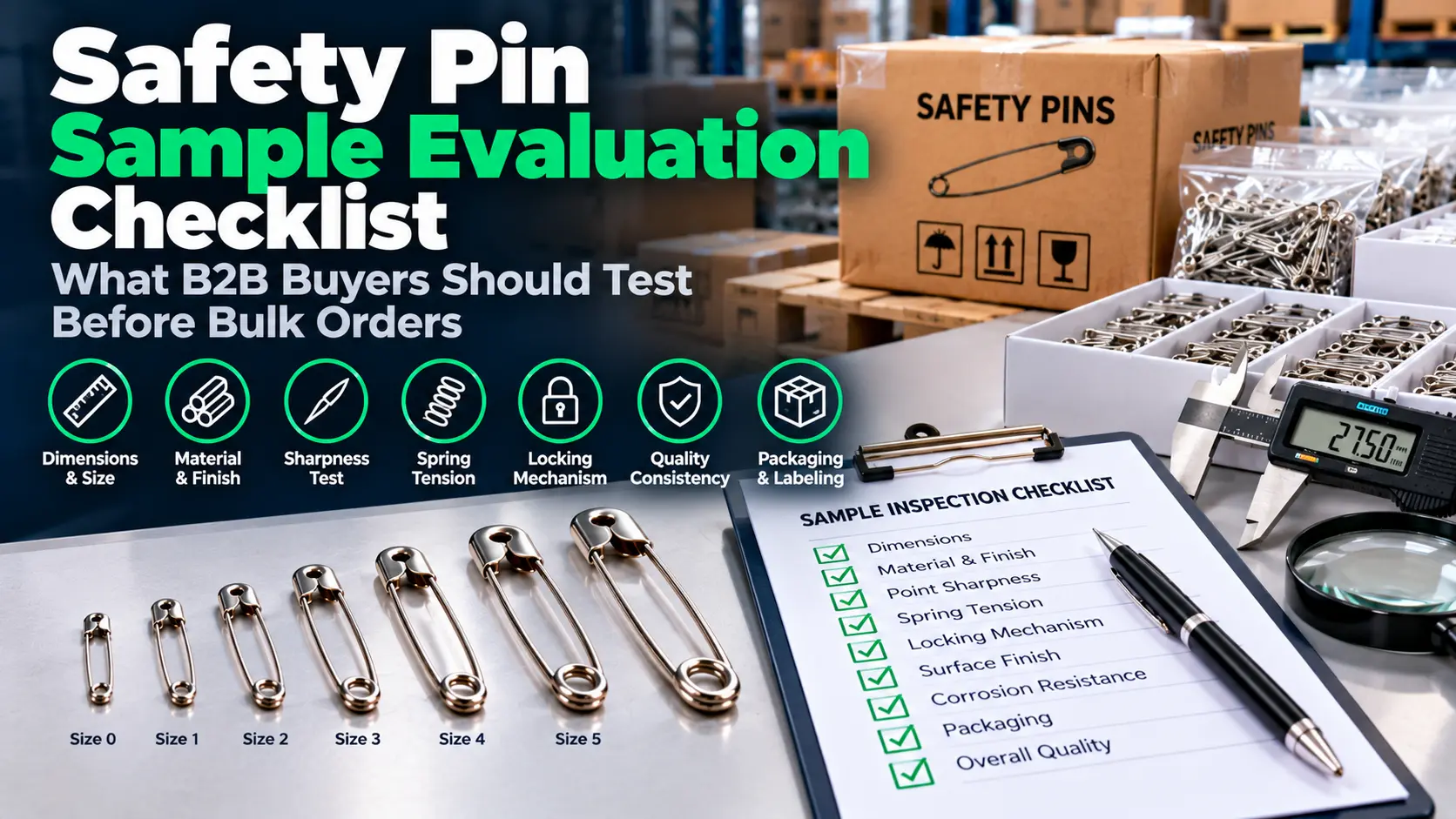
Before placing a bulk safety pin order, buyers should evaluate product dimensions, material, wire thickness, point sharpness, spring tension, locking performance, surface finish, corrosion resistance, and packaging. Compare multiple samples against the agreed product specifications and document approval before authorizing mass production.
For importers, wholesalers, distributors, garment manufacturers, and private-label brands, a structured safety pin sample evaluation helps identify quality issues before they affect a commercial shipment.
Why Should You Evaluate Safety Pin Samples Before Bulk Ordering?
A product photograph or supplier quotation cannot confirm every aspect of safety pin quality. Two pins that look similar may differ in wire diameter, material, finish, spring performance, or locking reliability.
Evaluating samples helps buyers determine whether the proposed product meets their intended application and purchasing requirements.
Sample evaluation is particularly important when sourcing:
Wholesale safety pins for distribution
Safety pins for garment and textile applications
Stainless steel, brass, or nickel-plated safety pins
Custom sizes and wire gauges
OEM and private-label safety pins
Retail-ready packaging and branded products
Before requesting samples, review the manufacturer's safety pin manufacturing process to understand the production stages and quality checks relevant to your order.
Safety Pin Sample Evaluation Checklist
1. Verify Safety Pin Dimensions and Size
Start by checking whether the sample matches the size and dimensional requirements in your quotation or technical specification.
Inspect the following:
Overall length when closed
Wire diameter
Spring-coil dimensions
Head and clasp dimensions
Point alignment
Consistency between samples
Ask the supplier to specify the actual length in millimeters rather than relying exclusively on a size number. Different products and manufacturers may use different dimensional conventions.
For reference, consult the safety pin sizes guide and chart. Confirm the required dimensions and tolerances with your supplier before approving production.
2. Confirm the Material and Surface Finish
The material should match the specification agreed upon with the manufacturer.
Common safety pin material options include:
Carbon steel: Used in many standard safety pin applications.
Nickel-plated steel: Offers a bright metallic finish for common commercial applications.
Stainless steel: May be suitable where enhanced corrosion resistance is required.
Brass: Used for applications requiring brass construction and particular finish characteristics.
For stainless steel products, specify the required grade where applicable, such as 304 or 316. Request suitable material documentation when grade verification is important.
Also inspect the finish for uneven plating, discoloration, scratches, rough areas, and other unacceptable defects.
For broader product and material options, visit the wholesale safety pin manufacturer page.
3. Test Point Sharpness and Alignment
The pin's point should be properly formed and aligned with the clasp.
During inspection, check whether:
The point enters the clasp correctly.
The tip has visible burrs or irregularities.
The pin closes without obvious misalignment.
The sample pierces the intended fabric or material without unacceptable damage.
Use representative fabric when evaluating safety pins intended for garments or textiles. Handle samples carefully because exposed points can cause injury.
Point sharpness should be suitable for the intended application, while the closed pin should not present avoidable sharp-edge hazards.
4. Evaluate Spring Tension
Spring tension affects how a safety pin opens, closes, and retains its shape during normal use.
Check each sample for:
Smooth opening and closing
Consistent spring action
Excessive looseness or stiffness
Visible deformation during normal operation
Cracks, damage, or inconsistent spring behavior
Compare several samples rather than relying on a single pin.
For high-volume or repeated-use applications, agree on a suitable functional test and measurable acceptance criteria with the manufacturer.
5. Inspect the Locking Mechanism
The clasp should receive the pin's point correctly and cover it securely when closed.
Inspect whether:
The point seats properly inside the clasp.
The clasp remains secure during ordinary handling.
The point is fully covered when closed.
The clasp is free from visible deformation.
The closure works consistently across multiple samples.
If the safety pins will be used in a demanding application, define the expected locking performance before approving the sample.
The manufacturer's safety pin quality control page provides further information about dimensional checks, spring tension, locking performance, surface finish, and related inspection procedures.
6. Check Corrosion Resistance
Corrosion resistance depends on the material, surface finish, manufacturing process, storage conditions, and intended environment.
For sample evaluation, inspect the pins for visible rust, discoloration, uneven plating, or exposed areas.
However, a visual inspection cannot establish long-term corrosion resistance. If corrosion performance is important to your application, agree on a suitable test method, exposure conditions, and acceptance criteria.
For example, buyers may request relevant corrosion testing for products intended for humid environments or applications involving repeated exposure to moisture.
Do not assume that every stainless steel grade, plated finish, or brass product has identical corrosion performance.
7. Compare Multiple Samples for Consistency
One sample does not necessarily represent the quality of an entire production batch.
Where practical, inspect multiple samples and record differences in:
Dimensions and wire diameter
Point alignment
Spring tension
Locking performance
Surface finish
General appearance
If the samples show significant variation, request clarification before approving production.
For larger orders, discuss a pre-shipment inspection plan with the supplier. Agree on the sampling method, defect categories, acceptance limits, and corrective-action process.
8. Evaluate Packaging and Labeling
Packaging is an important part of sample approval, particularly for distributors, retailers, and private-label brands.
Confirm the following details:
Number of pins per box or pack
Inner packaging and outer carton specifications
Protection during storage and transport
Product labels and brand artwork
Barcode placement and readability, where applicable
Shipping marks and destination requirements
For custom packaging, approve the artwork and packaging specification before production begins.
Review the available custom safety pin packaging options, including bulk packaging and retail-oriented formats.
If you are developing a branded product, also review the company's OEM safety pin manufacturing capabilities.
Safety Pin Sample Evaluation Checklist Table
Use this checklist to record inspection results before approving a sample.
Inspection itemWhat to verifyResultDimensionsMatches approved specificationPass / FailMaterialMatches confirmed materialPass / FailWire diameterWithin agreed tolerancePass / FailPoint alignmentProperly aligned with claspPass / FailSpring tensionConsistent opening and closingPass / FailLocking mechanismPoint seats securelyPass / FailSurface finishNo unacceptable visible defectsPass / FailCorrosion resistanceMeets agreed test criteria, if applicablePass / FailPackagingMatches approved requirementsPass / FailSample consistencySamples meet acceptance criteriaPass / Fail
This checklist is a general procurement aid. It should be adapted to the product, application, and buyer's technical requirements.
What Should Buyers Ask a Safety Pin Manufacturer Before Approving Samples?
Before approving a sample, request written clarification on the following questions:
What are the specified material, dimensions, wire diameter, and surface finish?
Can you provide samples matching the proposed production specification?
What quality inspections are performed during manufacturing?
How are spring tension, point alignment, and locking performance checked?
Can you provide relevant material or inspection documentation?
Can you reproduce the approved packaging and labeling?
What is the production lead time after sample approval?
What is the minimum order quantity for the selected product and packaging?
How will a discrepancy between the approved sample and delivered order be handled?
What inspection records can be provided before shipment?
A clear written specification helps both parties understand what has been approved and what is expected from the final order.
How Does Sample Approval Fit Into the Bulk Ordering Process?
A structured procurement process reduces ambiguity between the buyer and manufacturer.
Step 1: Submit Your Product Requirements
Specify the safety pin type, intended application, size, material, finish, target quantity, packaging, and destination country.
Step 2: Confirm the Technical Specification
Agree on dimensions, tolerances, material requirements, finish, functional expectations, and packaging details.
Step 3: Request and Inspect Samples
Evaluate the samples using the checklist in this article. Record any defects or differences and request clarification where necessary.
Step 4: Approve the Sample in Writing
Record the approved sample reference and final specification. If packaging is customized, document its approval separately.
Step 5: Confirm the Purchase Order
Include the agreed product specification, quantity, packaging, price, payment terms, delivery schedule, and inspection requirements.
Step 6: Confirm Production Requirements
Document any changes before manufacturing begins. Avoid making informal changes that could create differences between the approved sample and production goods.
Step 7: Inspect the Finished Order
Where appropriate, arrange an agreed pre-shipment inspection and review the results before dispatch.
International buyers should also confirm export documentation, shipping arrangements, and destination-specific import requirements.
Does Sample Approval Guarantee Bulk Production Quality?
No. Sample approval confirms that the evaluated sample meets the buyer's requirements at the time of inspection. It does not automatically guarantee that every unit in a later production batch will be identical.
Buyers can reduce this risk by:
Retaining the approved sample or reference record
Documenting the final specification
Agreeing on inspection criteria
Confirming how defects will be classified
Establishing a process for handling nonconforming products
Recording changes to materials, dimensions, finishes, or packaging
For repeat orders, reference the previously approved specification and confirm whether any production changes have occurred.
What Is the MOQ for Safety Pin Samples and Bulk Orders?
Sample availability, sample charges, and shipping costs should be confirmed directly with the supplier.
For bulk orders, the standard minimum order quantity for this sourcing program is 750 boxes, subject to confirmation of the selected product and packaging configuration. The number of pins per box depends on the agreed pack specification. Custom OEM and private-label requirements may involve additional conditions.
Before approving a sample, confirm whether the quoted MOQ applies to the selected size, material, finish, and packaging. Request a formal quotation through the wholesale safety pin manufacturer page.
Frequently Asked Questions
Should I request safety pin samples before placing a bulk order?
Yes. Samples allow buyers to check dimensions, material, finish, spring action, locking performance, and packaging before committing to a larger order.
How many safety pin samples should I test?
There is no universal sample count for every order. The appropriate quantity depends on product risk, order size, expected variation, and the agreed inspection plan. Discuss the sampling method with the supplier.
How do I test safety pin spring tension?
Open and close the sample under normal operating conditions and observe whether the spring action is consistent. Look for excessive looseness, deformation, or damage. For demanding applications, agree on a defined functional test and acceptance limits.
Can visual inspection prove that a safety pin is corrosion-resistant?
No. Visual inspection can identify visible corrosion or finish defects, but it cannot establish long-term corrosion performance. Where required, request suitable documentation and agree on a relevant corrosion test.
Should I approve packaging separately from the safety pin sample?
Yes, especially for retail and private-label products. Confirm the packaging format, quantity per pack, artwork, labels, barcodes, and carton requirements before production.
What should I do if the delivered safety pins differ from the approved sample?
Document the differences with photographs and inspection records. Compare the shipment against the approved specification, purchase order, and agreed acceptance criteria. Contact the supplier promptly and follow the corrective-action terms in your purchase agreement.
What is the minimum order quantity for bulk safety pins?
The standard MOQ for this sourcing program is 750 boxes, subject to confirmation of the product and packaging configuration. Request a written quotation to confirm the exact requirements for your order.
Can I request customized safety pin samples for OEM production?
Discuss the required dimensions, material, finish, and packaging with the manufacturer. Custom samples and production feasibility should be confirmed based on the technical requirements and commercial terms.
About Suvik Overseas Pvt. Ltd.
Suvik Overseas Pvt. Ltd. is a safety pin manufacturer and exporter based in Kolkata, India. The company's website describes its wholesale, OEM, and private-label capabilities, including product specifications, manufacturing, quality control, and packaging options. It also identifies ISO 9001:2015 certification.
B2B buyers can share their required pin size, material, quantity, packaging preferences, and destination country through the Suvik Overseas enquiry page to discuss sample availability and request a quotation.
Final Safety Pin Sample Approval Checklist
Before authorizing bulk production, make sure you have:
Verified dimensions, wire diameter, and material
Evaluated point alignment and spring tension
Checked the locking mechanism
Inspected surface finish and relevant corrosion requirements
Compared multiple samples where appropriate
Approved packaging and labeling
Documented the final technical specification
Confirmed MOQ, lead time, and commercial terms
Agreed on inspection and defect-handling procedures
A documented safety pin sample evaluation process helps B2B buyers make informed sourcing decisions, clarify expectations with manufacturers, and reduce avoidable quality disputes.