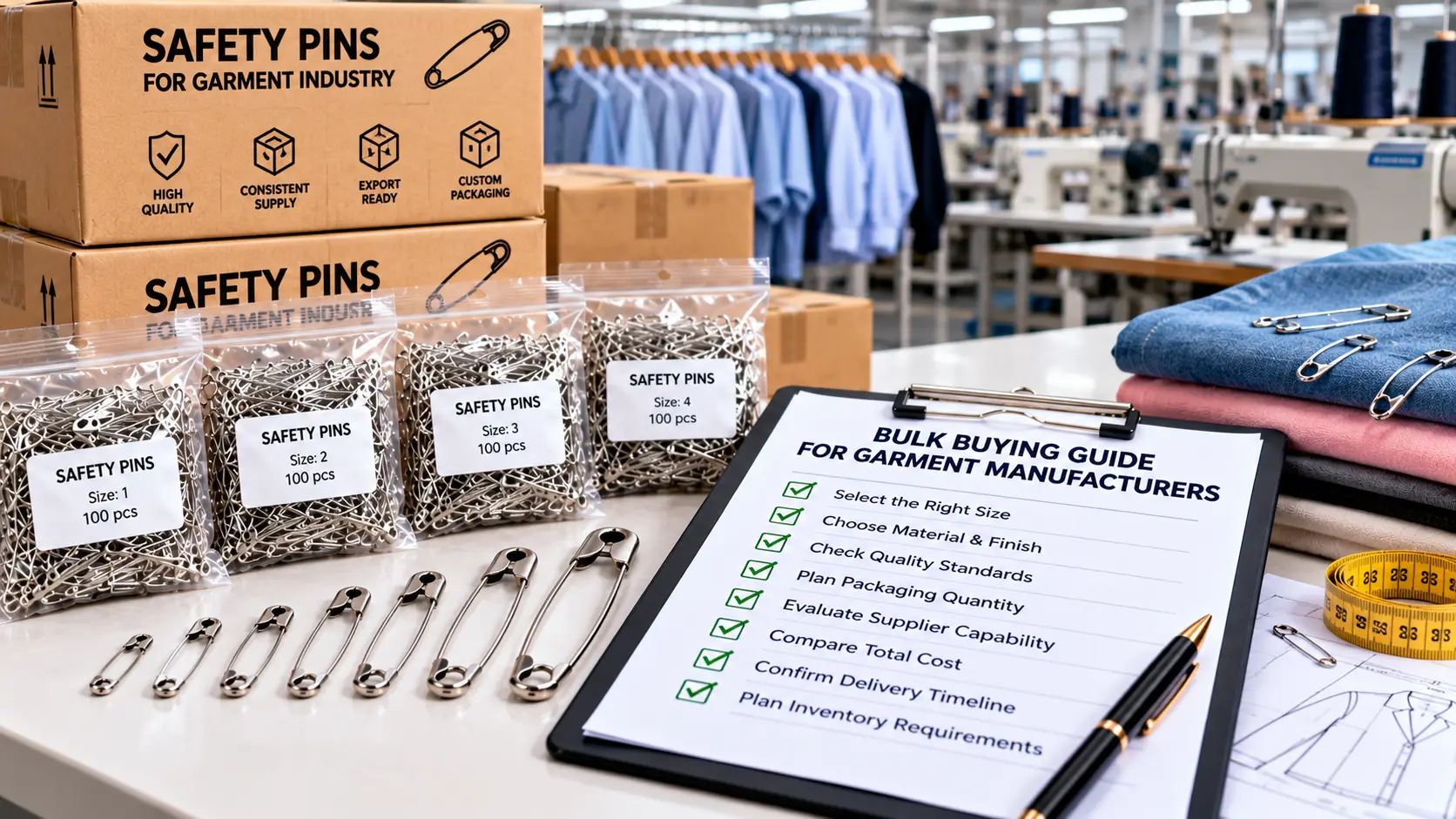
Garment manufacturers and textile businesses need reliable accessories to support production, garment handling, sampling, packaging and distribution. Safety pins can serve several practical purposes, but the right purchasing specification depends on how the pins will be used, how they will be packed and how consistently they must meet the buyer's requirements.
For garment factories, apparel exporters, clothing wholesalers and textile procurement teams, buying safety pins in bulk requires more than comparing unit prices. Buyers should consider product dimensions, material, finish, clasp performance, packaging quantities, quality-control requirements and supplier fulfilment capability.
Quick answer: To source safety pins for garment manufacturing, define the intended application, specify the required size and material, evaluate samples, confirm packaging quantities, establish quality acceptance criteria and compare supplier quotations on equivalent terms. Before placing a bulk order, document the approved specification and delivery requirements in writing.
This guide explains how garment manufacturers and textile buyers can prepare a clear purchasing specification and assess potential safety pin suppliers.
1. How Are Safety Pins Used in Garment Manufacturing?
Safety pins can support different activities across the apparel supply chain. Their suitability depends on the product design, intended use and the manufacturer's operating procedures.
Potential applications include:
Garment sampling: Temporarily positioning fabric or components during sample development.
Garment handling: Holding designated fabric layers or components temporarily where appropriate.
Packaging and presentation: Supporting specific bundling or presentation tasks when the application permits.
Textile distribution: Supplying accessories to garment workshops, tailoring businesses or other textile customers.
Retail and resale: Providing safety pins as separately packaged accessories for clothing and sewing customers.
Not every safety pin is suitable for every application. Buyers should assess whether the product's dimensions, clasp design, material and finish are appropriate for the intended task.
Where pins are used near finished garments, sensitive fabrics or customer-facing products, confirm that the product will not cause unacceptable snagging, staining, surface damage or other problems. Conduct application-specific checks before approving bulk supply.
2. Which Safety Pin Specifications Should Garment Manufacturers Provide?
A clear specification helps suppliers quote the correct product and reduces the risk of mismatched deliveries.
Size and dimensions
State the required length in millimetres and, where useful, the relevant commercial size designation. If a buyer uses a standard size number, confirm the actual measurement with the supplier rather than assuming that every supplier uses identical dimensions.
For example, a purchasing specification might state:
Required length in millimetres.
Permitted dimensional variation, if defined by the buyer.
Pin design or clasp configuration.
Intended application.
The exact measurements and tolerances should come from the buyer's requirements and the supplier's confirmed product specification.
Material
Depending on availability, buyers may consider steel, stainless steel or brass safety pins. Material selection should account for the intended application, expected handling, storage conditions, finish and any relevant customer requirements.
Do not assume that a material name alone establishes corrosion resistance or suitability for a particular use. Ask the supplier to confirm the offered material and any relevant finish or coating details.
Finish and appearance
Where the pins will be supplied with finished garments or used in presentation packaging, visual consistency may be important. Define the required appearance and inspect samples for visible defects or unacceptable variation.
Clasp and point
Confirm that the pin closes and engages correctly, and that its point and clasp are suitable for the intended use. If the customer has specific safety or quality criteria, communicate them before placing the order.
3. How Should Buyers Choose Safety Pin Sizes for Apparel Work?
There is no single safety pin size that is best for every garment-manufacturing task. The required size depends on the material, application and handling requirements.
When selecting a size, consider:
The thickness and characteristics of the fabric or material.
Whether the pin needs to hold one or multiple layers.
The amount of temporary holding strength required for the task.
Whether the pin could mark, snag or damage the material.
The available space and handling requirements.
The buyer's inspection and acceptance criteria.
Request samples of the proposed size where the application is sensitive or the purchase quantity is substantial. Test them on representative materials before confirming the order.
For repeat purchases, maintain a record of the approved product, dimensions and supplier reference. This can help reduce confusion when replenishing stock.
4. What Should Garment Manufacturers Check About Safety Pin Quality?
A product description does not replace a defined quality specification. Before ordering in bulk, agree on the characteristics that matter for the intended application.
Quality considerationWhat to evaluateDimensionsWhether the product matches the specified sizeAlignmentWhether the pin and clasp align correctlyClosureWhether the point engages securely with the intended claspOperationWhether opening and closing work as expectedFinishWhether visible defects, corrosion or coating issues are acceptableConsistencyWhether samples and production goods meet the approved specificationPackagingWhether the product is protected and correctly identified
These are practical inspection considerations rather than a claim that the product meets any particular safety standard.
If safety pins are intended for use with delicate textiles or finished garments, conduct checks on representative materials. Where a buyer requires a specific standard or test, state it explicitly and agree on how compliance will be demonstrated.
Buyers can review the safety pin quality-control page for additional information.
5. How Much Packaging Should You Order?
Packaging requirements affect stock management, handling, storage and distribution. Before comparing quotations, confirm the exact packaging configuration.
Ask the supplier to specify:
The number of pins per inner pack, where applicable.
The number of packs per box, where applicable.
The number of boxes per master carton, where applicable.
The dimensions and approximate gross weight of cartons, if needed for logistics planning.
Whether bulk or retail-ready packaging is available.
Whether custom labelling or private-label packaging is possible.
Do not assume that a box represents the same quantity across different suppliers. The packaging unit and the quantity contained within it should be recorded in the quotation and purchase order.
For Suvik Overseas Pvt. Ltd., the standard MOQ communicated for enquiries is 750 boxes. Buyers should confirm the product configuration, packing quantities and applicable terms directly before ordering.
Bulk packaging or private-label packaging?
Bulk packaging may suit factories, distributors and businesses that manage their own inventory or repack products. Private-label packaging may be useful for buyers selling under their own brand.
If you need branded packaging, confirm artwork, labelling, packaging materials, approval procedures and any additional minimum order requirements before production.
Learn more about custom safety pin packaging and private-label safety pins.
6. How Can Garment Manufacturers Calculate Their Bulk Requirements?
Demand planning should be based on actual usage, production schedules and inventory policies rather than a guess about how many boxes to buy.
A useful starting point is to estimate expected usage over a defined period.
Estimated requirement = expected usage per production unit × planned production volume
For example, if a garment manufacturer expects to use a specified number of safety pins for each production batch, it can multiply that quantity by the planned number of batches. This calculation must reflect the actual application: some operations may use pins intermittently, while others may not require them at all.
The buyer should then account for:
Current usable stock.
Confirmed purchase orders already in transit.
Expected consumption before the next replenishment.
Supplier lead time.
Storage capacity.
The business's chosen contingency stock policy.
A simple replenishment approach is to reorder when the available inventory approaches expected usage during the replenishment lead time, adjusted for the company's desired buffer.
Avoid overstocking products with uncertain demand or purchasing a larger quantity solely to obtain a lower unit price. Compare the price benefit against the cost of tied-up capital, storage and possible changes in requirements.
7. How Should Buyers Compare Safety Pin Supplier Quotations?
Ask each supplier to quote against the same specification. Otherwise, a lower price may reflect a different size, material, finish, packaging configuration or shipping arrangement.
Use this comparison table when reviewing offers.
Quotation itemWhat to confirmProductType and intended applicationMaterialRequired and offered materialSizeDimensions and applicable tolerancesFinishSurface or coating requirementsQuantityTotal quantity and pricing unitPackagingInner packs, boxes and master cartons, as applicablePriceCurrency and unit basisCustomisationArtwork, packaging or other applicable chargesDeliveryProduction and dispatch estimatesShipping termsAgreed Incoterm and named locationPaymentDeposit and balance conditions, where applicableQualityApproved specification and defect-handling process
Look beyond the quoted unit price
For international purchases, the total cost may include product charges, custom packaging, inland transportation, freight, insurance, customs clearance, import duties, taxes and local delivery, depending on the transaction.
Clarify the Incoterm used in each quotation and the named place or port. Do not compare FOB and CIF quotations as if they include identical services or responsibilities.
For any destination-specific customs or regulatory requirements, consult a qualified customs broker or trade adviser.
8. How Can Garment Manufacturers Evaluate a Safety Pin Supplier?
The supplier should be able to explain its available products, clarify the order requirements and confirm the conditions under which it can fulfil the purchase.
Ask the following questions before placing an order:
Can you supply the specified material, dimensions and finish?
Can you confirm the packaging configuration in writing?
What is the MOQ for the selected product?
Are samples available for evaluation?
What quality checks are performed?
What is the expected production lead time after all approvals?
Can you support the required bulk or private-label packaging?
Which commercial and shipping documents can be provided for the transaction?
How are specification deviations or defective products handled?
Can the approved specifications be referenced for repeat orders?
A supplier should not be considered reliable solely because it provides quick responses or an attractive price. Evaluate the evidence available, the clarity of its commitments and its ability to meet your documented requirements.
For further details about wholesale supply, visit the wholesale safety pin manufacturer in India page.
9. What Should Be Included in a Garment Manufacturer's Safety Pin RFQ?
A request for quotation (RFQ) should contain enough information for the supplier to understand the requested product and commercial requirements.
Include:
Company and buyer contact details.
Intended application.
Required material and dimensions.
Finish or other product requirements.
Estimated quantity.
Packaging format and quantities.
Destination country and delivery location.
Target delivery date.
Quality or inspection requirements.
Custom packaging or private-label requirements.
Requested shipping terms.
Any required export documentation.
A concise, complete RFQ helps suppliers respond more accurately and allows the buyer to compare offers more fairly.
Before placing the purchase order, ensure that the selected quotation and approved specification agree on the product, quantity, packaging and delivery terms.
10. Common Mistakes When Buying Safety Pins for Garment Production
Garment manufacturers and textile buyers should avoid these common purchasing errors:
Ordering based on a size number without confirming the dimensions.
Selecting a material without considering the intended application.
Assuming that all suppliers use the same packaging units.
Comparing quotations with different product specifications.
Skipping sample evaluation when product suitability needs to be tested.
Failing to establish acceptance criteria for bulk deliveries.
Ordering more stock than the production plan reasonably requires.
Ignoring packaging and logistics costs when comparing prices.
Leaving production lead times or delivery responsibilities unclear.
Relying on verbal commitments rather than written order details.
A consistent purchasing process makes repeat orders easier to manage and reduces the likelihood of avoidable misunderstandings.
11. Request a Bulk Safety Pin Quotation from Suvik Overseas Pvt. Ltd.
Suvik Overseas Pvt. Ltd. is based in Kolkata, India, and supplies safety pins for B2B buyers. Garment manufacturers, wholesalers, distributors and other businesses can submit their requirements to discuss product specifications, bulk quantities and available packaging options.
To help the team assess your enquiry, provide:
Required safety pin material and size.
Estimated order quantity.
Preferred packaging configuration.
Intended application.
Destination country.
Expected delivery schedule.
Any quality, labelling or private-label requirements.
Confirm product availability, packing quantities, MOQ and commercial terms directly with the company before placing an order.
Submit your safety pin enquiry to Suvik Overseas Pvt. Ltd.
Frequently Asked Questions
Which safety pins are suitable for garment manufacturing?
The appropriate safety pins depend on the application, fabric characteristics, dimensions, material and finish. Buyers should specify the intended use, assess samples where necessary and confirm that the product meets their requirements before ordering in bulk.
How do garment manufacturers specify safety pin sizes?
Provide the required length in millimetres and any relevant commercial size designation. Confirm the dimensions with the supplier and state any required tolerances. Do not assume that size numbers correspond to identical measurements across all suppliers.
What is the standard MOQ for Suvik Overseas Pvt. Ltd.?
Suvik Overseas Pvt. Ltd. has communicated a standard MOQ of 750 boxes. Confirm the selected product, packing configuration and applicable order conditions directly with the company before committing to a purchase.
Can safety pins be ordered with custom packaging?
Custom packaging depends on the supplier's available services and the requirements of the order. Buyers should confirm packaging formats, artwork, labelling, minimum quantities and production timelines before approving the final specification.
How do I compare bulk safety pin prices?
Compare quotations for the same material, size, finish, quantity and packaging configuration. Consider applicable customisation, freight, insurance, import costs and delivery arrangements alongside the quoted unit price.
What should a safety pin supplier confirm before production?
The supplier and buyer should agree on product specifications, quantity, packaging, quality acceptance criteria, pricing, payment terms and production lead time. Any required artwork, sample approval or transaction-specific documentation should also be confirmed.
How can garment manufacturers manage safety pin inventory?
Estimate usage from actual production requirements, review available stock and incoming orders, and account for replenishment lead time. Establish a reorder point and buffer appropriate to the business's demand variability and storage capacity.
About Suvik Overseas Pvt. Ltd.
Suvik Overseas Pvt. Ltd. is an India-based supplier of safety pins serving business buyers. For enquiries about bulk supply, product specifications and available packaging options, contact the company through its enquiry page.