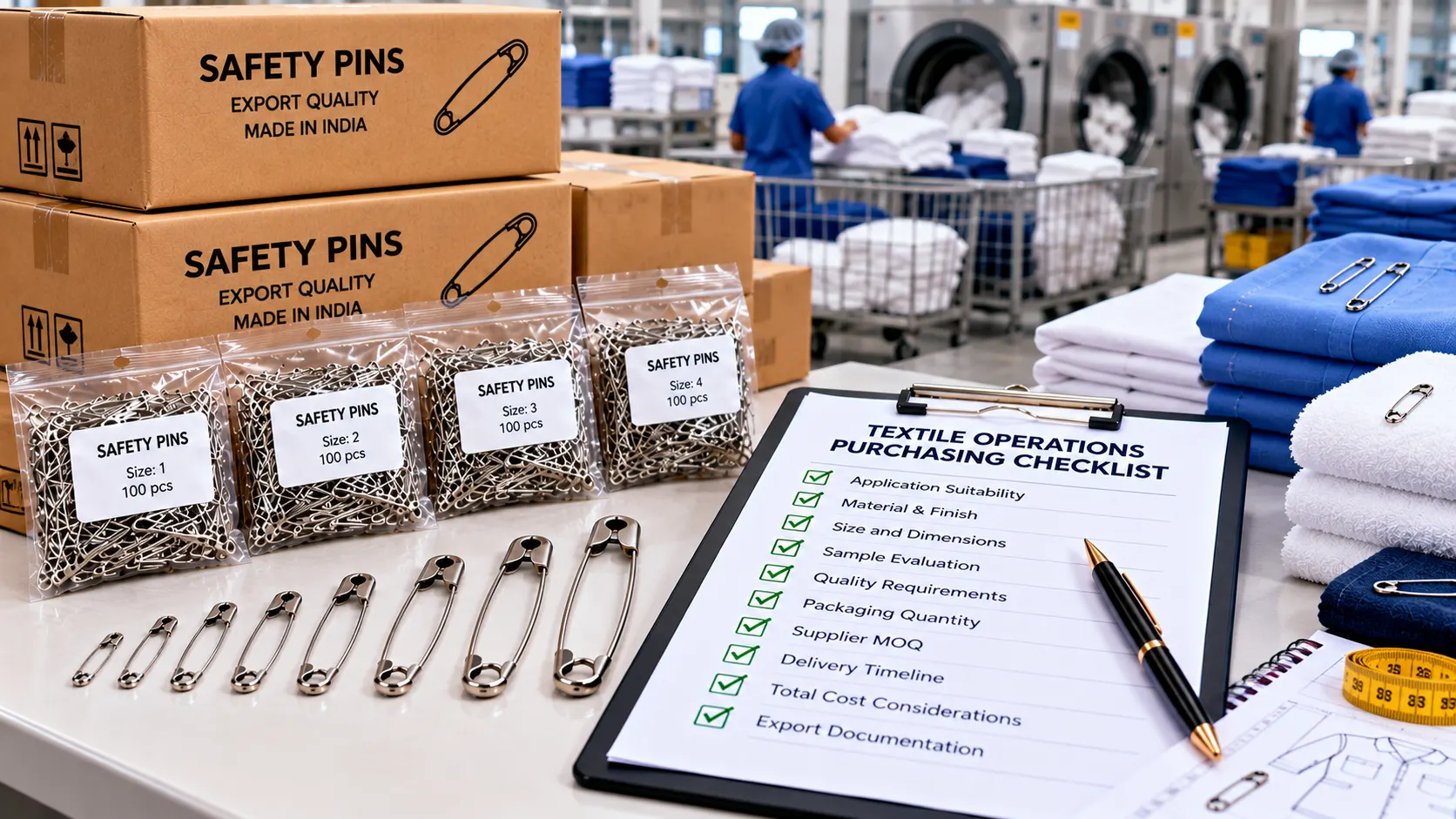
Industrial laundry businesses, uniform rental providers and textile service companies handle large volumes of garments and reusable textiles every day. Their purchasing decisions must account for operational safety, textile protection, handling procedures and the requirements of their customers.
Safety pins may be useful for certain approved textile-handling or garment-identification tasks. However, they are not appropriate for every industrial laundry workflow. Loose metal fasteners can create hazards or damage equipment if they enter washing, drying, finishing or other automated processes.
For textile businesses considering safety pins as a supply item, the first step is to establish the intended application and confirm that the product is permitted under the facility's operating procedures.
Quick answer: Before purchasing safety pins for an industrial textile operation, define the exact application, confirm that metal pins are permitted in that workflow, specify the required dimensions and material, evaluate samples where appropriate, and document packaging and quality requirements. Never introduce loose safety pins into industrial laundry equipment or processing lines unless the facility's approved procedures explicitly permit their use.
This guide helps procurement teams assess product suitability and prepare a clear bulk purchasing enquiry.
1. Where Might Safety Pins Fit into Textile Service Operations?
Industrial textile businesses can include commercial laundries, uniform rental services, hospitality textile providers, healthcare linen operators and garment-service companies.
These operations have different procedures and risk controls. A fastening accessory that is acceptable for one activity may be prohibited in another.
Potential uses should be evaluated individually, such as:
Temporary fastening during an approved garment preparation task.
Non-production handling activities where a metal fastener is explicitly permitted.
Garment or textile work conducted outside automated processing equipment.
Supply to tailoring or textile-repair teams operating under appropriate procedures.
These examples are not recommendations to use safety pins on every type of textile or in every facility.
Before adopting a safety pin for any workflow, consult the facility's safety procedures and the equipment or process requirements. Where a metal fastener could be left in an item entering a commercial washing, drying or finishing line, an alternative identification or fastening method may be more appropriate.
2. Why Is Application Suitability the First Purchasing Decision?
Procurement teams often begin by comparing dimensions, material and price. For industrial textile environments, application suitability should come first.
Before requesting a quotation, establish:
What task will the pin perform?
Will the textile subsequently enter an automated machine?
Could the pin remain attached during washing, drying or finishing?
Is a metal fastener permitted under the facility's procedures?
Could the fastener damage the textile, equipment or another product?
Is there an approved alternative for the same task?
If the proposed application creates an unacceptable risk, selecting a different size or material does not necessarily solve the problem.
Document the intended use before selecting a product. This gives the purchasing team a clearer basis for evaluating supplier recommendations.
3. Which Product Specifications Should Buyers Confirm?
Once the intended application has been approved, define the product requirements clearly.
Dimensions
Specify the required length in millimetres and any relevant commercial size designation. Confirm the actual dimensions with the supplier rather than relying on a size number alone.
Material
Depending on availability, safety pins may be offered in materials such as steel, stainless steel or brass. Confirm the offered material and any applicable finish or coating.
Do not assume that a material name alone guarantees suitability for moisture exposure, repeated handling or a particular operating environment.
Finish
Identify any requirements concerning surface appearance, coating or finish. If corrosion resistance is important for the intended application, specify the required performance and ask what supporting evidence is available.
Closure and construction
Where safety pins are approved for use, assess alignment, clasp engagement and opening and closing action against the agreed product specification.
Packaging
Specify the purchasing unit, quantity per pack or box where applicable, and master-carton configuration. Clear packaging specifications help prevent misunderstandings between the supplier, warehouse and purchasing team.
The exact requirements should reflect the approved application rather than a generic assumption about industrial use.
4. How Should Buyers Evaluate Product Quality?
Quality checks should be based on written acceptance criteria. General descriptions such as “premium quality” are not enough for a controlled procurement process.
Depending on the product specification, buyers may assess:
Inspection areaWhat to confirmDimensionsProduct matches the agreed measurementsMaterial and finishOffered material and finish match the specificationAlignmentPin and clasp align as intendedClosureClasp engages correctlyOperationOpening and closing work as expectedSurface conditionNo unacceptable visible defectsPackagingProduct is correctly packed and identifiedConsistencyDelivered goods match the approved specification
These checks do not establish compliance with any particular safety standard. If the buyer requires a specific test, standard or certificate, that requirement should be stated and verified separately.
For additional purchasing context, review the safety pin quality-control guide.
5. How Should Textile Businesses Plan Bulk Quantities?
Bulk ordering should reflect actual demand and the approved use of the product.
Before placing an order, estimate:
The quantity needed for the intended activity.
How frequently the activity occurs.
Current usable stock.
Expected usage before the next replenishment.
Supplier lead time.
Storage capacity.
The minimum order quantity and packaging configuration.
Avoid purchasing large quantities simply because the unit price appears attractive. If the application is occasional or uncertain, a large order can leave the business holding stock that is not needed.
For repeat purchases, maintain a record of the approved product specification, supplier reference and packaging details. This can help ensure that future orders use the same agreed requirements.
6. What Should Buyers Know About Minimum Order Quantity?
Minimum order quantity (MOQ) affects purchasing budgets, inventory levels and the cost of replenishment.
Before comparing offers, confirm what each supplier means by a box, pack or carton. Different suppliers may use different packaging configurations, so an identical box count does not necessarily represent an identical product quantity.
Ask the supplier to clarify:
MOQ for the selected product.
Quantity contained in each packaging unit.
Whether multiple sizes can be combined.
Whether custom packaging has a separate MOQ.
Expected production and dispatch lead time.
Pricing basis and payment terms.
For Suvik Overseas Pvt. Ltd., the standard MOQ communicated for enquiries is 750 boxes. Confirm the applicable product, packaging configuration and commercial terms directly before placing an order.
7. How Should Buyers Compare Supplier Quotations?
A useful quotation comparison requires equivalent specifications and clearly defined costs.
Compare suppliers using the following criteria:
CriterionInformation to compareProduct specificationMaterial, dimensions and finishApplicationConfirmed suitability for the intended approved useQuantityTotal quantity and pricing unitPackagingPacks, boxes and cartonsQualityInspection process and acceptance criteriaPriceCurrency and unit basisLead timeProduction and dispatch estimatesShippingAgreed Incoterm and named locationDocumentationDocuments applicable to the transactionCommercial termsPayment, order changes and defect handling
For international purchases, consider applicable freight, insurance, customs clearance, duties, taxes and local delivery costs.
Confirm the shipping term, named place or port, and which charges are included in the quotation. FOB and CIF offers should not be compared as if they cover identical services or responsibilities.
8. What Should Be Included in a Bulk Purchase Enquiry?
A clear request for quotation helps the supplier assess the product and commercial requirements.
Include:
Company name and contact information.
Intended application.
Required product dimensions.
Material and finish requirements.
Estimated order quantity.
Packaging requirements.
Destination country and delivery location.
Required delivery schedule.
Any applicable inspection or documentation requirements.
Also explain any unusual operating conditions that could affect product selection. The supplier can then clarify which product options it offers and which requirements need additional confirmation.
For international transactions, consult the relevant customs broker or trade adviser about destination-specific import documentation.
9. Questions to Ask Before Choosing a Supplier
Before placing an order, procurement teams should ask:
Can the supplier provide the specified product and material?
Are samples available for evaluation?
Can the supplier confirm dimensions and packaging in writing?
What quality checks are performed?
What is the MOQ for the selected configuration?
What production lead time applies after approval?
Which shipping and commercial terms are available?
What documents can be provided for the transaction?
How are non-conforming products handled?
Can the approved specifications be referenced for repeat orders?
Evaluate the supplier's actual capabilities and written commitments. Do not assume that a product is appropriate for an industrial workflow merely because it is marketed for commercial or textile applications.
10. Request a Safety Pin Supply Quotation
Suvik Overseas Pvt. Ltd., based in Kolkata, India, supplies safety pins for B2B buyers. Businesses considering a bulk purchase can contact the company to discuss product specifications, available configurations and packaging requirements.
When submitting an enquiry, include your required material, dimensions, quantity, packaging preferences and destination country. If the product is intended for a specialised industrial workflow, describe the application so that suitability can be assessed before an order is placed.
Contact Suvik Overseas Pvt. Ltd. for a bulk safety pin enquiry
Buyers can also review the company's wholesale safety pin manufacturer information.
Frequently Asked Questions
Can safety pins be used in industrial laundry operations?
Only where the specific task and facility procedures permit them. Loose metal pins can create hazards or damage equipment if they enter automated laundry or textile-processing systems. Buyers should confirm the approved workflow before selecting a fastening accessory.
What should textile service companies check before buying safety pins?
Confirm the intended application, product dimensions, material, finish, closure, packaging and quality acceptance criteria. Establish whether the fastener is permitted in the relevant workflow before comparing suppliers or placing a bulk order.
Which safety pin material is best for industrial use?
There is no universally best material. Selection depends on the application, required dimensions, finish, environmental exposure and other product requirements. Buyers should confirm the offered material and any necessary performance evidence with the supplier.
What is the MOQ for Suvik Overseas Pvt. Ltd.?
Suvik Overseas Pvt. Ltd. has communicated a standard MOQ of 750 boxes. Confirm the selected product, packing configuration and applicable commercial conditions directly with the company before ordering.
How can buyers compare safety pin supplier quotations?
Compare quotations for the same dimensions, material, finish, quantity and packaging. Also assess quality arrangements, lead time, shipping terms, applicable additional costs and the supplier's ability to fulfil the documented requirements.
What information should an international buyer provide in an enquiry?
Provide the intended application, product specification, estimated quantity, packaging requirements, destination country and delivery schedule. Include any relevant inspection or documentation requirements so the supplier can assess the proposed order.
About Suvik Overseas Pvt. Ltd.
Suvik Overseas Pvt. Ltd. is an India-based safety pin supplier serving B2B buyers. Importers, wholesalers and distributors can contact the company to discuss available products, bulk requirements and packaging options.
For product enquiries, visit the Suvik Overseas enquiry page.