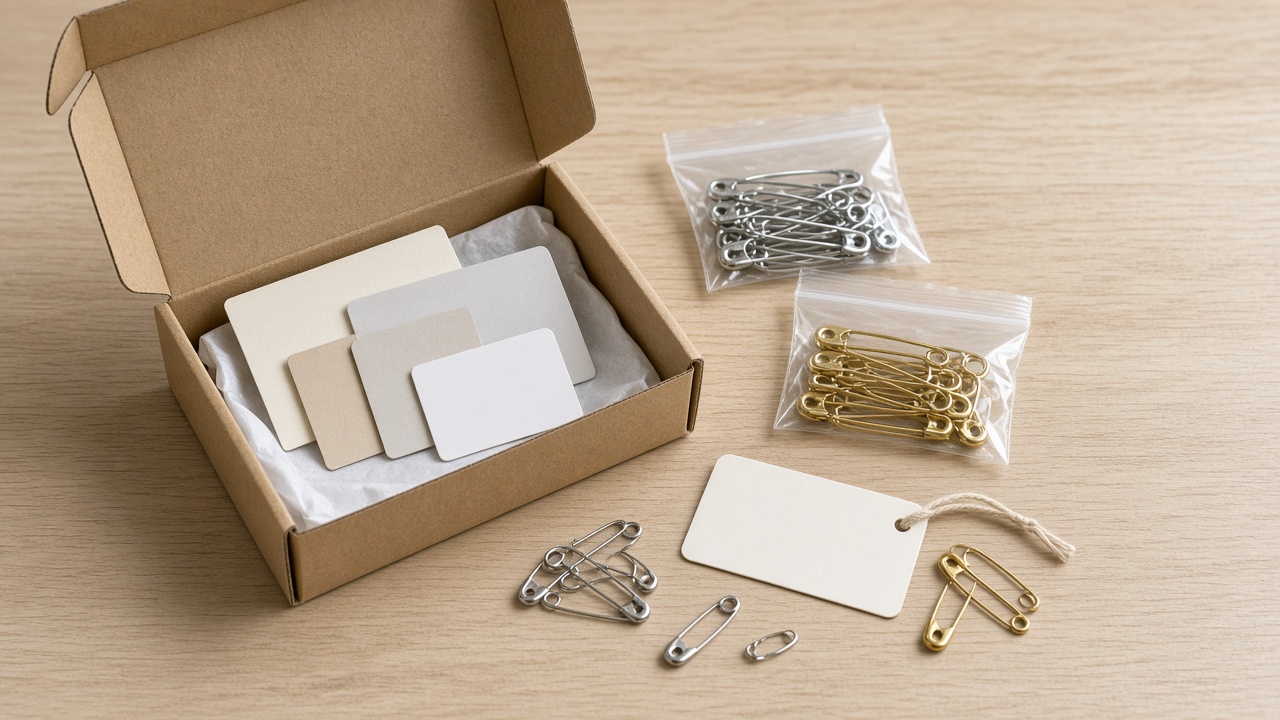
For a UK buyer sourcing safety pins from India for the first time, samples are the cheapest way to reduce risk before a bulk order. They let you see and handle the product, show it to your own customers or buying team, and agree a physical reference that the bulk order must match. This guide explains how to request samples from an Indian manufacturer and get them delivered to the UK without avoidable delays.
It is a practical planning guide for importers, wholesalers, distributors and retailers. It does not cover how to judge the pins once they arrive; our separate sample evaluation checklist does that. Any customs, duty or VAT points below are general only, so check the current rules on official UK government sources (GOV.UK) or with your courier or customs agent.
Why Samples Matter for UK Buyers
Product photos and specification sheets rarely tell you everything. Finish, spring tension, point sharpness, coil shape and packaging quality are much easier to judge in your hand. For UK buyers, samples also help with decisions that are specific to your market, such as how a pack will look on a UK shelf or whether the product suits your customers' uses.
They confirm that the supplier can make what you have described.
They give you something to show colleagues, customers or a private-label client.
They help you and your customs agent describe and classify the product accurately.
They become the agreed reference for checking the bulk order later.
Step 1: Decide Exactly What You Want to See
A vague request such as "please send samples" usually produces a box of whatever is to hand. Before you contact the supplier, decide what you need to judge. A short written brief saves time on both sides and makes it more likely the samples reflect your real order.
What to include in your sample brief
Material you are interested in, for example steel or brass.
Finish or plating options you want to compare.
The sizes or size range you are considering, described in the way you sell them.
How the pins will be sold: loose in bulk, on cards, in boxes or in retail packs.
Any private-label or packaging ideas you want to discuss.
Your likely order pattern, such as a trial order followed by repeat orders.
If you already know your end customers, mention who they are. A garment factory, a craft retailer and a dry cleaner may all need different products, and a good manufacturer will suggest options to match.
Step 2: Send a Clear Sample Request
Send your request by email so there is a written record. Introduce your business briefly, explain your market in the UK, attach your sample brief and give the full delivery address, including a contact name and phone number for the courier. Ask the supplier to confirm what they can send and whether anything you asked for is not available.
Ask about the terms up front rather than assuming them. Sample policies differ between manufacturers, so check with your supplier:
Whether there is a charge for the samples themselves.
Who pays for courier delivery to the UK, and how.
Whether you can use your own courier account if you have one.
How long it will take to prepare the samples before dispatch.
Whether custom packaging or private-label mock-ups are possible at sample stage.
Ready samples or custom samples?
Ready samples come from existing stock or standard production and can usually be sent more quickly. Custom samples, made to a new specification or in new packaging, may take longer and may be treated differently on cost. If time matters, consider asking for ready samples first to judge the basic product, then custom samples for the details.
Step 3: Agree How the Samples Will Travel
Most sample parcels from India to the UK travel by international express courier, because it is fast and gives tracking from door to door. Postal services can be cheaper for very small, light parcels but may be slower and offer less tracking. For a few cards or boxes of safety pins, a courier is usually the practical choice.
Agree in writing who books the shipment and who pays. If you use your own courier account, give the supplier your account details and instructions. If the supplier books it, ask for the tracking number as soon as the parcel is collected.
Make sure the parcel is properly described
A sample parcel still crosses a border. Ask the supplier to include a commercial or proforma invoice that describes the goods accurately, for example steel safety pins as product samples, with quantities and a realistic value. Vague descriptions can lead to questions or delays at the border. Do not ask your supplier to under-value or misdescribe a parcel; it can cause problems with customs and with your first bulk import.
Step 4: Plan for UK Customs on Sample Parcels
Samples entering the UK can be subject to customs checks and import charges in the same way as other goods, depending on their value, how they are sent and the rules in force at the time. GOV.UK publishes guidance on importing goods, including commercial samples and parcels sent by courier or post.
In practice, the courier often handles the customs formalities for small parcels and then asks the receiver to pay any duty, import VAT and handling fees before delivery. To avoid surprises:
Check the current UK rules for low-value and commercial sample imports on GOV.UK.
Ask the courier how they will clear the parcel and what fees they may charge.
Have your business details, and your EORI number if relevant, ready in case the courier asks for them.
Keep the invoice, tracking and any charges paid with your import records.
Treat the sample shipment as a small rehearsal for your bulk import. If the description on the invoice causes questions, fix it now rather than on your first container.
Step 5: Receive, Record and Share the Samples
When the parcel arrives, check that the contents match the invoice and your request. Label each sample clearly with the supplier's reference, the date received and any notes on the option it represents. Take clear photos so you can refer to them in emails.
Then evaluate the samples properly. Our safety pin sample evaluation checklist covers what to look at, from finish and function to packaging. Share the results with the supplier in writing, separating must-have changes from nice-to-have ideas.
Step 6: Approve a Reference Sample for Bulk
Once you are happy, agree an approved reference sample. Ideally both you and the supplier keep a matching, labelled set. Refer to it on your purchase order and in your quality checks, so that everyone is clear about what the bulk order must match.
Note the approved material, finish, sizes and packaging in writing.
Confirm any changes the supplier agreed to make for bulk production.
Ask for pre-shipment photos or a pre-shipment sample if the order is large or new.
Use the approved sample when you inspect the bulk shipment on arrival.
Common Mistakes to Avoid
Requesting samples with no brief, then judging products you would never order.
Not confirming who pays for the samples and courier until the parcel is held.
Accepting a misleading description on the sample invoice.
Approving samples by email without keeping a physical reference.
Moving to a bulk order before packaging and labelling for the UK market are agreed.
Frequently Asked Questions
Are safety pin samples from India free?
It depends on the manufacturer and on what you ask for. Some suppliers charge for samples or courier costs, and custom samples can be treated differently from ready samples. Ask your supplier to confirm the terms in writing before they dispatch.
How long do samples take to reach the UK?
Timing depends on whether the samples are ready or custom, how they are shipped and how quickly customs clearance goes. Ask your supplier for a preparation time and your courier for a transit estimate, and allow extra time for clearance.
Will I pay duty or VAT on sample parcels?
You may. Samples can be subject to import charges depending on their value, how they are sent and the rules in force at the time. Check the current guidance on GOV.UK and ask your courier how they will handle clearance and any fees.
Should I use my own courier account?
If you import regularly, using your own account can give you more control over cost, service and clearance. If not, the supplier can usually arrange delivery. Either way, agree who books and who pays before dispatch.
How many sample sets should I ask for?
Ask for enough to evaluate, share with colleagues or customers, and keep an untouched set as a reference. Agree with the supplier that they will keep a matching set too.
Can I get private-label packaging at sample stage?
Sometimes. Some manufacturers can provide packaging mock-ups or printed samples, while others confirm artwork at the bulk order stage. Ask your supplier what is possible for your timescale.
Request Safety Pin Samples from Suvik Overseas
Suvik Overseas manufactures steel and brass safety pins in Kolkata, India, for importers, wholesalers, distributors, retailers and private-label buyers worldwide. If you are a UK buyer planning a first order, tell us what you sell, who your customers are and which products you would like to see.
Send us your sample brief and UK delivery details, and our export team will confirm the options, terms and next steps. Contact Suvik Overseas today to get your samples moving.