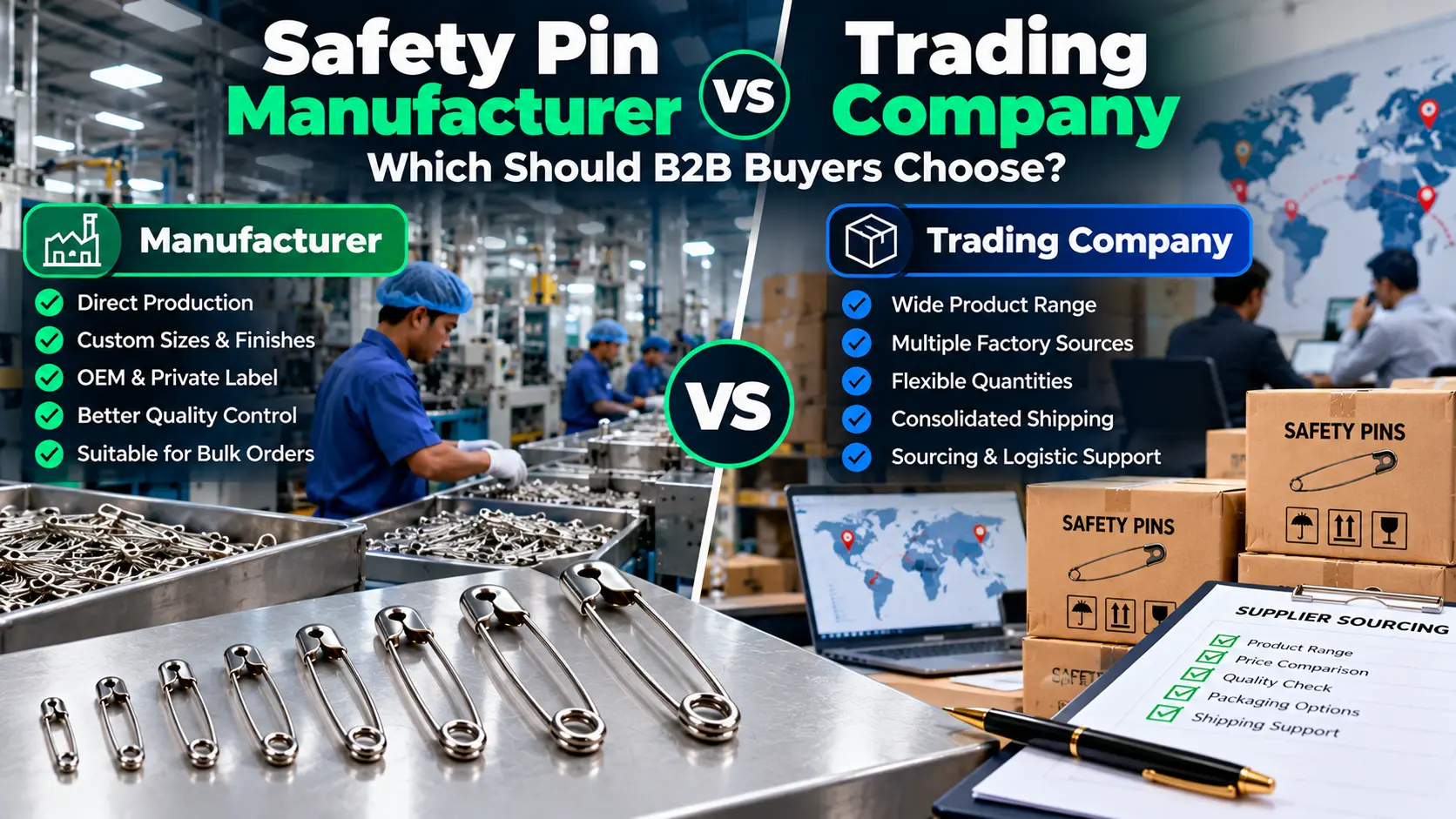
Quick Answer: Should you buy safety pins from a manufacturer or a trading company?
A safety pin manufacturer produces the product and may offer more direct control over manufacturing specifications, production planning and customization. A trading company sources products from manufacturers or other suppliers and resells them to customers.
Buying directly from a manufacturer can be advantageous for repeat bulk orders, OEM requirements and private-label projects. A trading company can be useful when buyers need products from multiple factories, a consolidated order or sourcing support.
Neither option is automatically better for every buyer. The right choice depends on order volume, product complexity, price, quality requirements, lead time and the supplier's actual capabilities.
For importers, the most important step is to verify what the supplier does, what it provides and who is responsible for product quality and delivery.
What Is the Difference Between a Safety Pin Manufacturer and a Trading Company?
A manufacturer operates or manages production of the product. It may procure raw materials, form the pins, apply finishing processes, inspect products and package finished goods.
A trading company generally purchases products from manufacturers or other suppliers and sells them to customers. It may coordinate specifications, packaging, inspection, logistics and export documentation without operating the production facility itself.
The distinction is not always absolute. Some businesses manufacture certain products and trade others. Some trading companies also maintain quality teams, warehouses and strong supplier relationships.
Buyers should therefore verify the supplier's actual operating model instead of relying only on the business name or website description.
Manufacturer vs. Trading Company: Key Differences
FactorManufacturerTrading CompanyProductionProduces or manages its own manufacturing operationsUsually sources from external manufacturersSpecificationsMay coordinate directly with production teamsCoordinates requirements with its supplier networkCustomizationCan be suitable for OEM and custom productionDepends on factory relationships and capabilitiesQuality controlMay conduct checks within its production processMay inspect products through suppliers or third partiesProduct rangeDepends on its own production capabilitiesMay offer products from multiple manufacturersMOQDepends on product and production setupDepends on supplier terms and stock availabilityPricingMay offer direct factory pricingMay include sourcing and service marginsConsolidated sourcingMay be limited to its product rangeCan be useful for multiple product categoriesCommunicationMay offer direct technical coordinationMay simplify communication across several suppliersExport supportDepends on the manufacturer's export capabilitiesDepends on its logistics and documentation services
These are general tendencies, not guarantees. A well-managed trading company may offer better service than an inexperienced manufacturer.
1. Which Option Offers Better Safety Pin Pricing?
Price depends on more than whether the supplier owns a factory.
A manufacturer may avoid an intermediary margin, but production costs, material prices, packaging, order volume and operating efficiency still determine the quotation.
A trading company may charge more for sourcing and coordination, but it may also provide value through consolidated shipments, inventory availability, quality inspections or access to multiple factories.
When comparing prices, request quotations using the same specification.
Confirm:
Safety pin size
Material
Wire gauge, where relevant
Surface finish
Pieces per box
Packaging
Total quantity
Shipping terms
Destination
Payment terms
A quotation for 1,000 pieces per box should not be compared directly with a quotation for a different packing configuration without adjusting for the actual quantity.
The best comparison is the total cost of receiving the same product under the same commercial terms.
2. Which Supplier Is Better for Bulk Orders?
For buyers placing recurring bulk orders, a manufacturer can be a strong option when its production capacity and commercial terms match the requirement.
Direct manufacturing relationships may help buyers coordinate:
Repeat-order specifications
Production schedules
Material requirements
Quality standards
Packaging configuration
Volume planning
However, buyers should not assume every manufacturer can fulfill every quantity or deadline.
A trading company may be better suited to buyers who need a smaller assortment of products from different manufacturers or who prioritize sourcing convenience over direct production coordination.
Before choosing, estimate your annual demand and ask the supplier how it handles repeat orders, stock availability and production planning.
3. Who Offers Better Quality Control?
Quality depends on the actual inspection process, agreed specifications and accountability—not simply on the supplier category.
A manufacturer may inspect products at different stages of production. A trading company may use its own inspection team, appoint a third-party inspector or rely on the manufacturer's quality controls.
Either arrangement can work if the responsibilities are clearly defined.
For safety pins, relevant inspection points may include:
Overall length and dimensions
Wire diameter
Point sharpness
Spring tension
Locking mechanism
Surface finish
Plating consistency
Corrosion resistance, where relevant
Packaging accuracy
Before placing an order, ask for the inspection criteria and agree on the acceptable product specification.
For high-volume or sensitive orders, consider sample approval and pre-shipment inspection.
See the Safety Pin Quality Control & Testing Guide for additional information.
4. Which Is Better for OEM Safety Pins?
OEM manufacturing involves producing products according to a buyer's specifications.
Requirements can include:
Custom dimensions
Wire gauge
Material selection
Surface finish
Special product configurations
Packaging requirements
Technical tolerances
A manufacturer with suitable production capabilities can be advantageous because technical requirements can be discussed closer to the production process.
A trading company can also coordinate OEM orders if it has a reliable manufacturing partner and manages specifications properly.
Before committing to either supplier, ask:
Who will manufacture the product?
Can the requested specification be produced?
Who approves the production sample?
Who verifies quality?
Who is responsible for nonconforming products?
Can the same specification be maintained for repeat orders?
Written specifications and sample approval are particularly important for customized orders.
5. Which Option Is Better for Private-Label Safety Pins?
Private-label buyers sell products under their own brand.
Their requirements may include custom retail boxes, printed cards, barcodes, product labeling and brand-specific packaging.
A manufacturer may provide private-label packaging directly or work with packaging partners. A trading company may coordinate the same process through its supplier network.
The supplier's ability to manage the complete project matters more than the label it uses.
Ask for confirmation of:
Packaging specifications
Artwork approval process
Barcode requirements
Printing costs
Packaging MOQ
Production lead time
Quality checks
Ownership and handling of supplied artwork
Repeat-order consistency
For branding projects, request a packaging proof or sample before approving mass production.
Explore Private Label Safety Pins for further information.
6. How Does MOQ Differ Between Manufacturers and Trading Companies?
Minimum order quantity depends on the product, supplier, inventory model and packaging requirements.
A manufacturer may set an MOQ based on production setup, material procurement and packaging requirements.
A trading company may offer different quantities depending on existing inventory, the manufacturer's minimum or the ability to combine products.
For Suvik Overseas, the standard MOQ used in this buyer guide is 750 boxes. Buyers should confirm the applicable MOQ for their selected size, material, packaging and order configuration.
For customized OEM and private-label orders, request a separate confirmation because the standard wholesale quantity may not apply to every configuration.
Do not compare MOQ figures without checking the number of pieces per box and the product specification.
7. Which Supplier Is Better for International Exports?
International sourcing requires more than manufacturing or buying the product.
The supplier must be able to coordinate the commercial order, packaging, shipment and required documentation.
Depending on the arrangement, relevant responsibilities may include:
Commercial invoice
Packing list
Transport coordination
Certificate of origin, where required
Product specifications
Cargo information
Shipping terms
Export documentation
Communication with the freight forwarder
A manufacturer with export experience may be well suited to direct international orders. A trading company may provide value by consolidating products from several suppliers or managing complex sourcing arrangements.
In both cases, verify who will appear as the exporter, who prepares the documents and who is responsible for resolving shipment issues.
8. How Can Buyers Verify Whether a Safety Pin Supplier Is a Manufacturer?
A website description alone is not enough to establish a supplier's manufacturing capabilities.
Use a practical verification process.
Check company information
Review the registered business name, address, contact information and relevant company records.
Ask about production capabilities
Request details about the manufacturing processes, product range and specifications the supplier can actually produce.
Request a factory tour or video call
Where feasible, arrange a visit or a live video call to understand the production and inspection setup.
Request product samples
Evaluate the actual safety pins against the agreed size, material, finish and performance requirements.
Ask for technical documentation
Request product specifications and relevant quality documentation for the order.
Confirm the contracting party
Make sure the purchase order, quotation, invoice and payment instructions identify the correct legal entity.
Review references where appropriate
For a substantial order, ask for suitable trade references or other evidence of relevant export experience.
These checks reduce uncertainty but do not guarantee future performance. Use a purchase contract and appropriate inspection arrangements for significant orders.
9. What Are the Advantages of Buying Directly From a Safety Pin Manufacturer?
Direct manufacturer sourcing can provide several benefits when the manufacturer is a good fit.
Direct specification discussions
Buyers may be able to coordinate size, material, finish and packaging with the production team.
Customization opportunities
A suitable manufacturer may offer OEM and private-label options.
Repeat-order consistency
Documented specifications can help support repeat orders.
Production planning
Buyers may be able to coordinate expected volumes and lead times with the manufacturer.
Direct quality discussions
Quality requirements and inspection findings can be addressed with the manufacturing organization.
These benefits depend on the supplier's capabilities, communication and quality-management practices. Buyers should confirm them rather than assume they are automatically available.
10. When Should You Choose a Trading Company?
A trading company can be the right choice in several situations.
Consider one when:
You need products from multiple manufacturers.
You want to consolidate several product categories into one shipment.
You require local sourcing support.
The trading company has established quality inspection processes.
You need stock availability across a wider assortment.
Its service and logistics capabilities justify the commercial terms.
A good trading company can simplify procurement and reduce the amount of supplier coordination a buyer must manage.
The key is to understand the company's role and how it manages production, quality and delivery through its suppliers.
11. How Should Buyers Compare Supplier Quotations?
Use a structured comparison instead of selecting the lowest price immediately.
Evaluation FactorQuestions to AskProduct specificationAre size, material and finish identical?Packing configurationIs the quantity per box the same?PriceIs the price quoted per piece, box or carton?MOQWhat minimum applies to the exact product?QualityWhat inspection criteria are agreed?SamplesCan samples be evaluated before production?Lead timeIs the production and dispatch schedule confirmed?PackagingAre printing and customization included?ShippingAre the quotations based on the same Incoterm?DocumentationWhich export documents are included?PaymentAre payment terms and beneficiary details verified?SupportWho handles defects, delays and claims?
For international orders, compare the expected landed cost as well as the factory price.
12. Manufacturer vs. Trading Company: Decision Checklist
A manufacturer may be the better fit when you need:
Recurring bulk supply
Direct manufacturing coordination
OEM specifications
Private-label production
Documented repeat-order requirements
A long-term production relationship
A trading company may be the better fit when you need:
Multiple product categories
Consolidated sourcing
A broad supplier network
Local procurement support
Products from several factories
Inventory or sourcing services
These are starting points, not fixed rules. A supplier should be selected based on verified capability, commercial suitability and delivery performance.
Safety Pin Supplier Evaluation Checklist
Before confirming a supplier, check:
Legal business identity verified
Manufacturer or trading role understood
Product specifications documented
Material and finish confirmed
Quantity per box confirmed
MOQ confirmed
Sample evaluated
Quality inspection requirements agreed
Packaging confirmed
Production lead time confirmed
Shipping terms agreed
Export documentation responsibilities defined
Payment instructions independently verified
Claims and defect-resolution process documented
Frequently Asked Questions
Is buying directly from a safety pin manufacturer always cheaper?
No. A manufacturer may offer direct pricing, but the total cost depends on production efficiency, order volume, packaging, shipping and commercial terms. Compare equivalent quotations before deciding.
Can a trading company provide OEM safety pins?
Yes, if it has a capable manufacturing partner and can manage specifications, sampling, production and quality requirements effectively.
Is a manufacturer better for private-label safety pins?
A suitable manufacturer can be a good choice for direct coordination of product and packaging specifications. A trading company can also manage private-label projects through qualified suppliers.
How do I verify a safety pin manufacturer's quality?
Review the specifications, request samples, agree on inspection criteria and obtain relevant quality documentation. For larger orders, consider a pre-shipment inspection.
What MOQ should I expect for bulk safety pins?
MOQ depends on the product, packaging and supplier. For Suvik Overseas, the standard MOQ used in this guide is 750 boxes. Confirm the exact configuration and any customization requirements before ordering.
Can a trading company export safety pins internationally?
A trading company may coordinate international orders, but buyers should confirm the legal exporter, shipping arrangements, documentation responsibilities and contracting entity.
What should I include in a safety pin RFQ?
Include the required size, material, finish, quantity, pieces per box, packaging, destination, preferred shipping terms and any OEM or private-label requirements.
About Suvik Overseas
Suvik Overseas Pvt. Ltd. is a safety pin manufacturer and exporter based in Kolkata, India. The company serves international B2B buyers with wholesale supply, OEM production and private-label packaging options.
When evaluating Suvik or another supplier, buyers should confirm the product specification, applicable MOQ, packaging, quality requirements and shipping terms in the formal quotation.
Related Safety Pin Buying Guides
Conclusion
Choosing between a safety pin manufacturer and a trading company depends on the buyer's order volume, customization needs, supplier verification, quality requirements and sourcing priorities.
Direct manufacturing can be advantageous for recurring bulk orders and custom specifications. A trading company can be valuable when a buyer needs consolidated sourcing or a broader product range.
The strongest purchasing decision comes from comparing equivalent quotations, evaluating samples, confirming quality requirements and verifying the supplier's responsibilities before placing the order.