Quick answer: how are safety pins checked for quality?
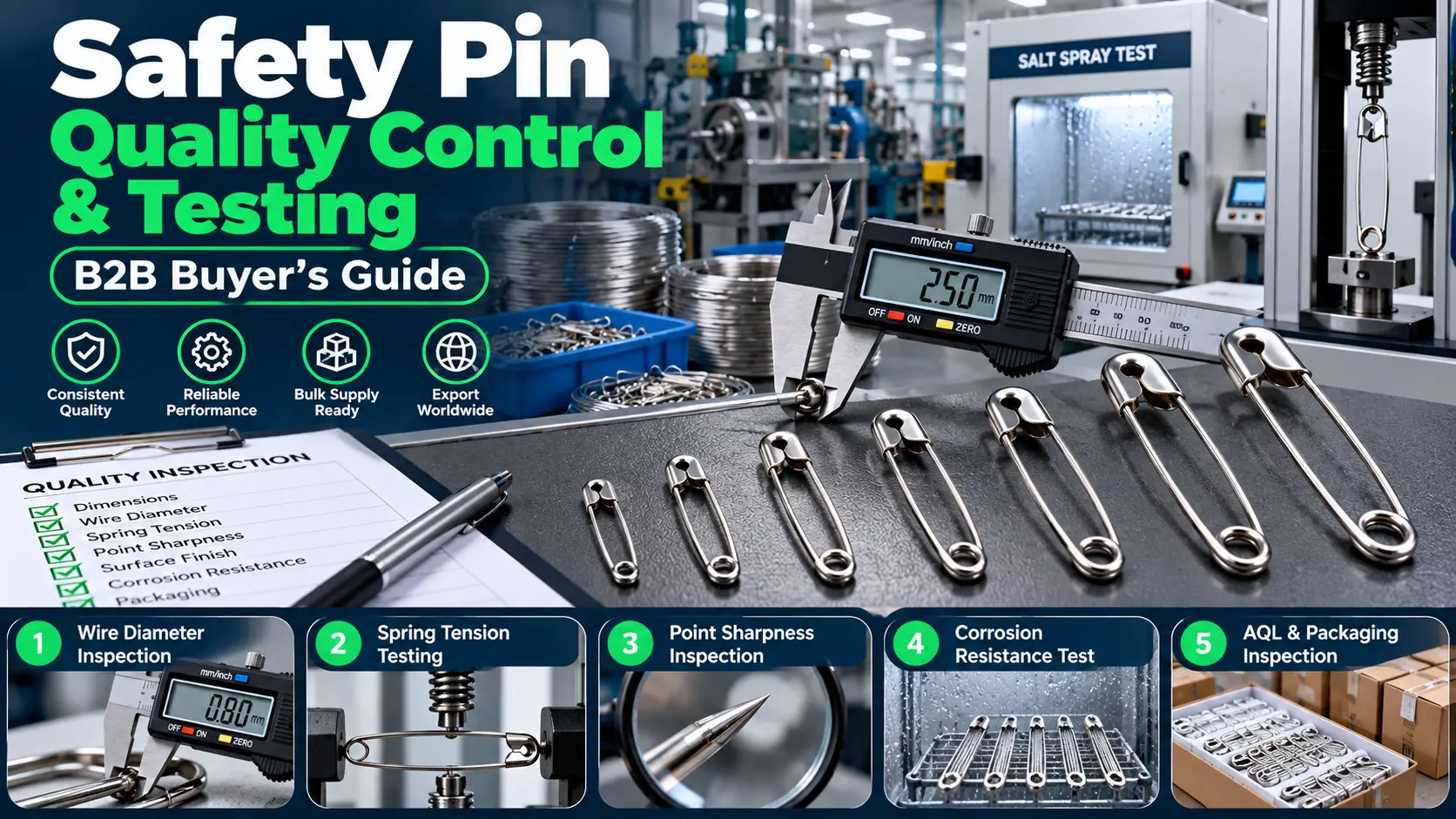
Safety pin quality can be checked at several points: incoming wire, wire diameter, dimensions, point sharpness, spring tension, opening and closing action, locking mechanism, surface finish, corrosion resistance and packing accuracy. Which tests apply depends on the material, product type, your application and your specification. Importers should agree the checks and the acceptance criteria in writing before production, and ask the supplier for the inspection records that support them.
Why quality control matters for export buyers
A poor pin can bend, fail to close, open unexpectedly, rust or damage fabric. For an importer, the cost of a defective batch includes freight, duty, customer claims and delayed replenishment. Because the goods are produced far from you, written specifications and inspection agreements are your main protection.
Key checks for safety pins
1. Raw material
Check the wire material and diameter against your specification. Ask whether incoming wire is inspected and whether you can see the supplier's records.
2. Wire diameter
Wire thickness influences strength and how the pin passes through fabric. Specify the thickness you need instead of relying on the size number only.
3. Dimensions
Measure overall length and compare it with your specification. Sample several pieces to see how consistent they are.
4. Point sharpness
The point should be sharp enough to pass through the fabric without snagging, and free of burrs.
5. Spring and opening action
Open and close a sample of pins repeatedly. The action should be smooth and consistent, and the pin should return to its closed position.
6. Locking mechanism
The point should seat securely in the clasp. Check that it does not open under light pull.
7. Strength
If strength matters to your application, define a test method and acceptance level with the supplier.
8. Surface finish
Check plating or finish for even coverage, discolouration, roughness and flaking.
9. Corrosion resistance
A visual check cannot prove corrosion resistance. If it matters, ask what corrosion test is used, such as a salt-spray test, and for the result on your product.
10. Packing and counts
Check pieces per box, box labels, carton marking and total quantity against the purchase order.
Steel, brass and other materials
Steel pins are commonly nickel-plated to protect them. Brass pins resist corrosion differently and are often chosen for appearance or specialist uses. If you need another material, confirm availability with the supplier. Whatever you choose, put the material, finish and tolerance requirements in the purchase order.
How to approve a sample
Compare the sample with your written specification.
Measure length and check wire thickness on several pieces.
Open and close at least a few dozen pins and note any weak springs or sticking clasps.
Inspect points and finish under good light.
Test on your actual fabric.
Keep the approved sample as your reference for later orders, and record approval in writing.
Our sample evaluation checklist goes into more detail.
Inspection for export orders
For larger orders, agree the inspection approach before production. Many buyers use a sampling plan based on an acceptable quality level (AQL), which sets how many defects in a random sample are acceptable. You can ask the supplier to inspect and share a report, or hire a third-party inspector to check the goods before shipment. Agree how defects are classified, and what happens if the batch fails.
Quality certificates and management systems
A quality management system certificate, such as ISO 9001, shows that a company has documented processes. It does not prove that a specific batch meets your specification. Ask any supplier for a copy of its current certificate and check the issuing body and validity dates. Always combine this with product inspection.
Market compliance for consumer packs
If you sell safety pins to consumers, ask your compliance adviser which chemical, labelling and product-safety rules apply in your market, for example in the EU, UK or United States. This is separate from factory quality control.
What to put in a quality specification
Size designation and length in millimetres, with tolerance
Material and wire thickness
Finish and appearance standard
Spring and locking requirements
Packing: pieces per box, boxes per carton
Sampling plan and acceptance criteria
Reports required, such as an inspection report
Quality questions for private-label buyers
Private-label products carry your name, so also approve packaging text, barcode scan, carton marking and pack counts before production. See the private-label guide.
Questions to ask a manufacturer
Which checks do you carry out during and after production?
Can you share inspection records for my order?
How do you keep size and finish consistent from batch to batch?
What is your process for complaints and replacements?
Can I send a third-party inspector?
Frequently asked questions
How do you check safety pin quality?
Measure dimensions, check wire thickness, test the spring and clasp, inspect the point and finish, and compare packing counts to the order.
What makes a good safety pin?
Correct size, consistent wire thickness, a sharp point, a smooth spring, a secure clasp and a clean, even finish.
Does ISO 9001 guarantee product quality?
No. It relates to the management system. You still need product specifications, samples and inspection.
Do I need third-party inspection?
It is optional but common for larger first orders. Decide based on order value and risk.
What if the goods differ from the approved sample?
Your purchase order should state how differences are handled. Document the issue with photos and counts, and contact the supplier promptly.
Request samples and a specification
Send your specification through the Suvik Overseas enquiry form and ask for samples. For help with sizing, see the size and specification guide, and for what to include in your enquiry see the RFQ template.