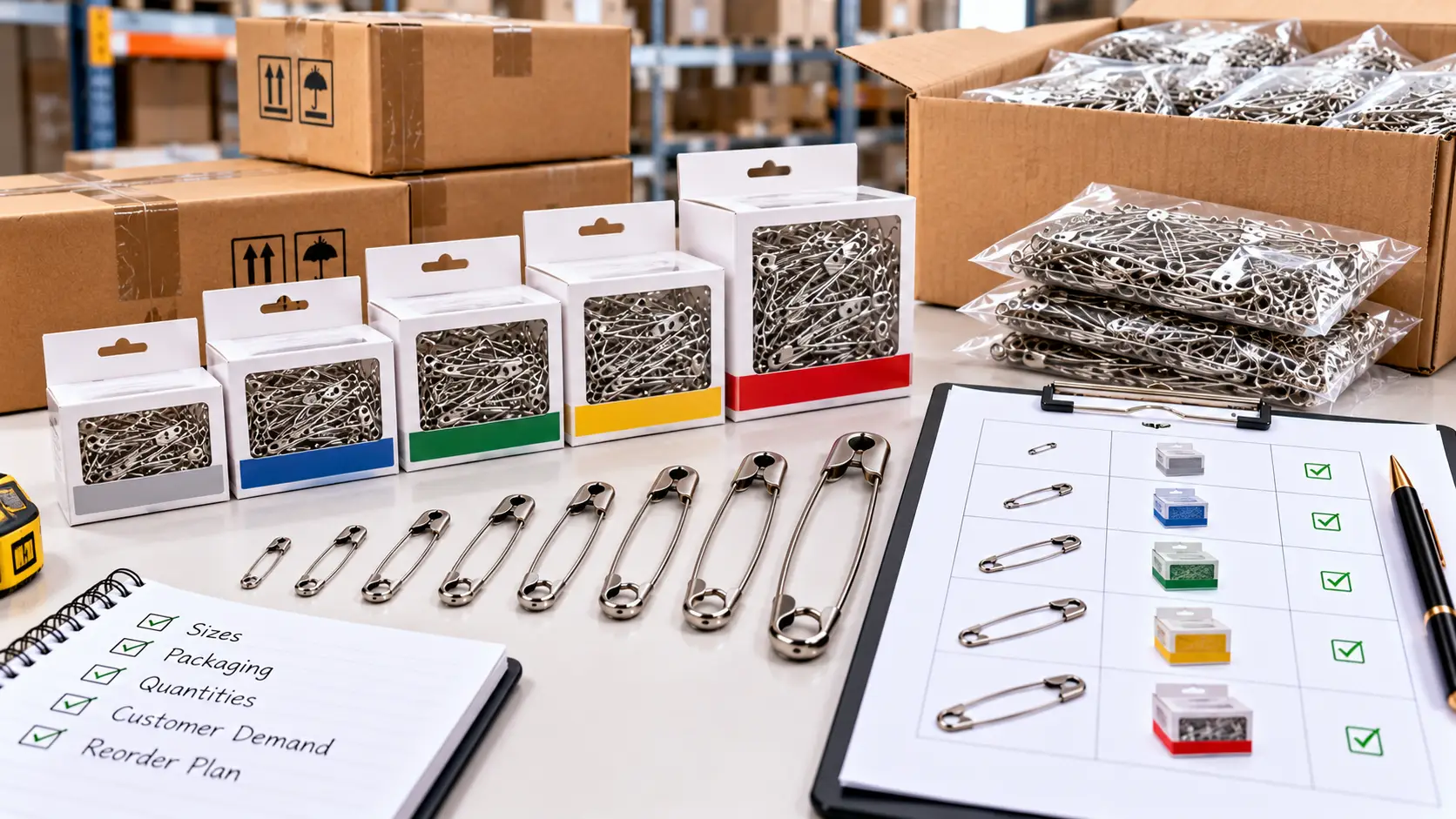
Choosing the right safety pin assortment is an important purchasing decision for wholesalers, importers and distributors. Ordering too many product variations can tie up working capital, while stocking too few may limit your ability to serve different customer requirements.
A well-planned assortment balances customer demand, product specifications, packaging options, minimum order quantities and replenishment lead times.
For businesses sourcing safety pins in bulk, the objective is not simply to purchase more products. It is to select a practical range that meets customer needs and can be replenished reliably.
This guide explains how distributors can plan their safety pin assortment, evaluate suppliers and prepare a more effective wholesale purchasing enquiry.
1. Start With Your Target Customers
Before selecting product sizes or quantities, identify the customers your distribution business serves.
Different customer groups may require different product configurations and packaging.
Retailers and general merchandise stores
Retailers may prefer individually packaged products, labelled boxes or assorted packs. Packaging should suit the retailer's shelf space, pricing structure and customer expectations.
Garment and textile businesses
Garment manufacturers, tailoring suppliers and textile businesses may prioritise specific dimensions, material requirements, consistent quality and packaging suited to their operational needs.
Wholesalers and regional distributors
Distributors supplying multiple retailers may need several sizes or packaging formats. Their product range should be based on customer orders and purchasing history rather than assumptions about which products are most popular.
Private-label businesses
Companies selling under their own brand may require customised packaging, printed labels, barcode placement or other agreed presentation details.
Practical takeaway: Review customer enquiries, repeat orders and sales records before deciding which products to include in your opening assortment.
2. Select Safety Pin Sizes Using Verified Specifications
Safety pin size selection should be based on the buyer's intended application and the manufacturer's actual product dimensions.
Size numbers alone may not be sufficient for international procurement because buyers need to understand the physical dimensions and specification of the product being quoted.
Before selecting a range, confirm:
The actual length of each size in millimetres.
The material and finish available.
The intended application and relevant product requirements.
Whether the supplier can consistently meet the agreed specification.
Whether customers require individual sizes or assorted packs.
Do not assume that all sizes will have equal demand. A distributor supplying tailoring businesses may require a different assortment from a retailer serving general merchandise customers.
Ask the supplier for a current size chart and confirm the required dimensions before approving a bulk order.
For further information, see the safety pin sizes chart.
3. Choose Packaging That Matches Your Sales Channel
Packaging influences product presentation, storage, handling and distribution. The right format depends on how the buyer intends to sell or use the products.
Packaging optionConsiderations for buyersBulk packagingSuitable where the customer's purchasing process supports bulk handlingStandard retail boxesConsider labelling, shelf presentation and pack quantitiesAssorted packsConfirm the number of sizes and quantity of each sizePrivate-label packagingAgree on artwork, branding, labels and approvalsCustom-labelled cartonsConfirm carton markings and identification requirements
These are purchasing options to discuss with the supplier; actual availability depends on the product range and manufacturing capabilities.
Before confirming an order, establish the exact quantity per box, the number of boxes per carton, outer-carton details and any labelling requirements.
For private-label orders, approve the final artwork and packaging specification before production begins.
4. Plan Your Opening Order
A first wholesale order should reflect expected demand, available capital, storage capacity and the supplier's minimum order quantity.
A practical approach is to divide the planned assortment into three categories.
Core products
Products supported by confirmed customer demand, repeat orders or reliable historical sales.
Additional products
Other sizes or packaging formats requested by customers but ordered less frequently.
Trial products
New variations you want to test before committing to larger quantities.
This approach helps distributors avoid spreading their purchasing budget too thinly across products without demonstrated demand.
Before placing the order, ask the supplier:
Does the MOQ apply to the complete order or each product size?
Does customised packaging have a separate MOQ?
Can quantities be divided across sizes?
What is the exact number of pieces per box?
What is the total number of boxes and cartons?
Are samples or pre-production approvals available?
Suvik Overseas has communicated a standard MOQ of 750 boxes. Buyers should confirm the current MOQ for their requested product sizes, quantities and packaging configuration before placing an order.
5. Compare Wholesale Suppliers on a Like-for-Like Basis
The lowest unit price is not always the most useful basis for choosing a supplier. Quotations may differ in product specifications, packaging, inspection requirements and shipping terms.
Use the following checklist when comparing suppliers.
Evaluation factorWhat to verifyProduct specificationDimensions, material, finish and agreed tolerancesPackagingQuantity per box, carton configuration and labellingQuality requirementsInspection process and agreed acceptance criteriaMOQMinimum quantities by size and packaging formatLead timeConfirmed production and dispatch scheduleShippingQuoted Incoterm, destination and freight responsibilitiesDocumentationCommercial invoice, packing list and other required documentsRepeat ordersAbility to reproduce the approved specification
For a fair comparison, send each supplier the same requirements and ask them to quote against the same configuration.
For example, two quotations should not be compared solely on unit price if one includes retail packaging and the other covers bulk packaging.
Buyers can explore Suvik Overseas' wholesale safety pin manufacturer page to learn more about its wholesale supply offering.
6. Establish Quality Requirements Before Ordering
A clear product specification helps buyers and suppliers understand what is expected from the order.
Depending on the product and application, buyers may need to evaluate dimensions, material, surface finish, point condition, closure alignment, spring action, visible defects and packaging consistency.
Before approving a large order:
Request product samples where appropriate.
Check the samples against the agreed specification.
Confirm which inspection criteria will apply to bulk production.
Agree on how defects or specification deviations will be handled.
Retain the approved specification for repeat orders.
Where testing or inspection reports are required, confirm the scope and availability with the supplier. Do not assume that every product has undergone a particular test unless the supplier provides evidence.
A documented approval process can help reduce ambiguity when ordering the same product again.
7. Calculate When to Reorder
Distributors need to plan replenishment before stock runs out. This requires tracking sales, available inventory and the time needed to receive a new shipment.
A basic reorder point can be calculated as:
Reorder point = Average daily demand × Replenishment lead time + Safety stock
For example, suppose a distributor sells an average of 20 boxes per day and the total replenishment lead time is 15 days.
Average daily demand: 20 boxes
Replenishment lead time: 15 days
Expected demand during replenishment: 300 boxes
If the distributor maintains an additional safety stock of 50 boxes, the illustrative reorder point would be 350 boxes.
These numbers are examples, not a sales forecast for safety pins. Buyers should calculate their own reorder point using actual sales, supplier lead times and demand variability.
For international orders, account for production, dispatch, transit and applicable destination clearance when estimating the full replenishment period.
8. Prepare a Complete Wholesale Enquiry
A detailed enquiry helps suppliers assess requirements and prepare a relevant quotation.
Include the following information wherever available:
Company name and destination country.
Intended application or target customer group.
Required sizes and dimensions.
Material and finish preferences.
Quantity required for each size.
Packaging format and quantity per box.
Private-label, barcode or custom-labelling requirements.
Destination port or delivery location.
Preferred shipping terms, if known.
Required delivery schedule.
Sample, inspection or documentation requirements.
If you are still deciding on the assortment, explain your intended sales channel and ask the supplier to confirm available product configurations and minimum order quantities.
The clearer the enquiry, the easier it is to compare quotations and identify the configuration that meets your purchasing needs.
Frequently Asked Questions
How should wholesalers choose a safety pin assortment?
Wholesalers should review customer demand, sales history, required dimensions, packaging preferences, available capital and supplier minimum order quantities before choosing their assortment.
Which safety pin sizes should a distributor stock?
The appropriate sizes depend on the distributor's customer base and intended applications. Request a current size chart and confirm actual dimensions with the supplier before ordering.
Should distributors buy assorted packs or individual sizes?
Assorted packs may suit customers who want several sizes together. Individual sizes may be preferable where customers have specific requirements. Confirm demand and packaging availability before deciding.
What is the MOQ for wholesale safety pins from Suvik Overseas?
Suvik Overseas has communicated a standard MOQ of 750 boxes. The applicable MOQ should be reconfirmed for the requested sizes, packaging and order configuration.
How can importers compare safety pin suppliers?
Compare product specifications, packaging, quality requirements, minimum quantities, production lead times, shipping terms and documentation. Request comparable quotations using the same requirements.
What should buyers include in a wholesale safety pin RFQ?
Include your destination country, required sizes, material preferences, quantities, packaging requirements, target delivery schedule and shipping preferences. Mention any inspection or documentation requirements as well.
Can buyers request customised safety pin packaging?
Custom packaging may be possible depending on the supplier's capabilities and order requirements. Confirm artwork approval, labelling, packaging specifications, applicable MOQ and lead time before placing the order.
Request a Wholesale Safety Pin Quotation
Suvik Overseas Pvt. Ltd. works with buyers seeking safety pins for wholesale, distribution and packaging requirements.
When contacting the team, share your target sizes, material preferences, packaging requirements, estimated quantities and destination country. This allows your requirements to be reviewed against the available product configurations.
Request a wholesale safety pin quotation
A well-planned wholesale assortment begins with customer demand, verified specifications and a clear understanding of the supplier's commercial terms.