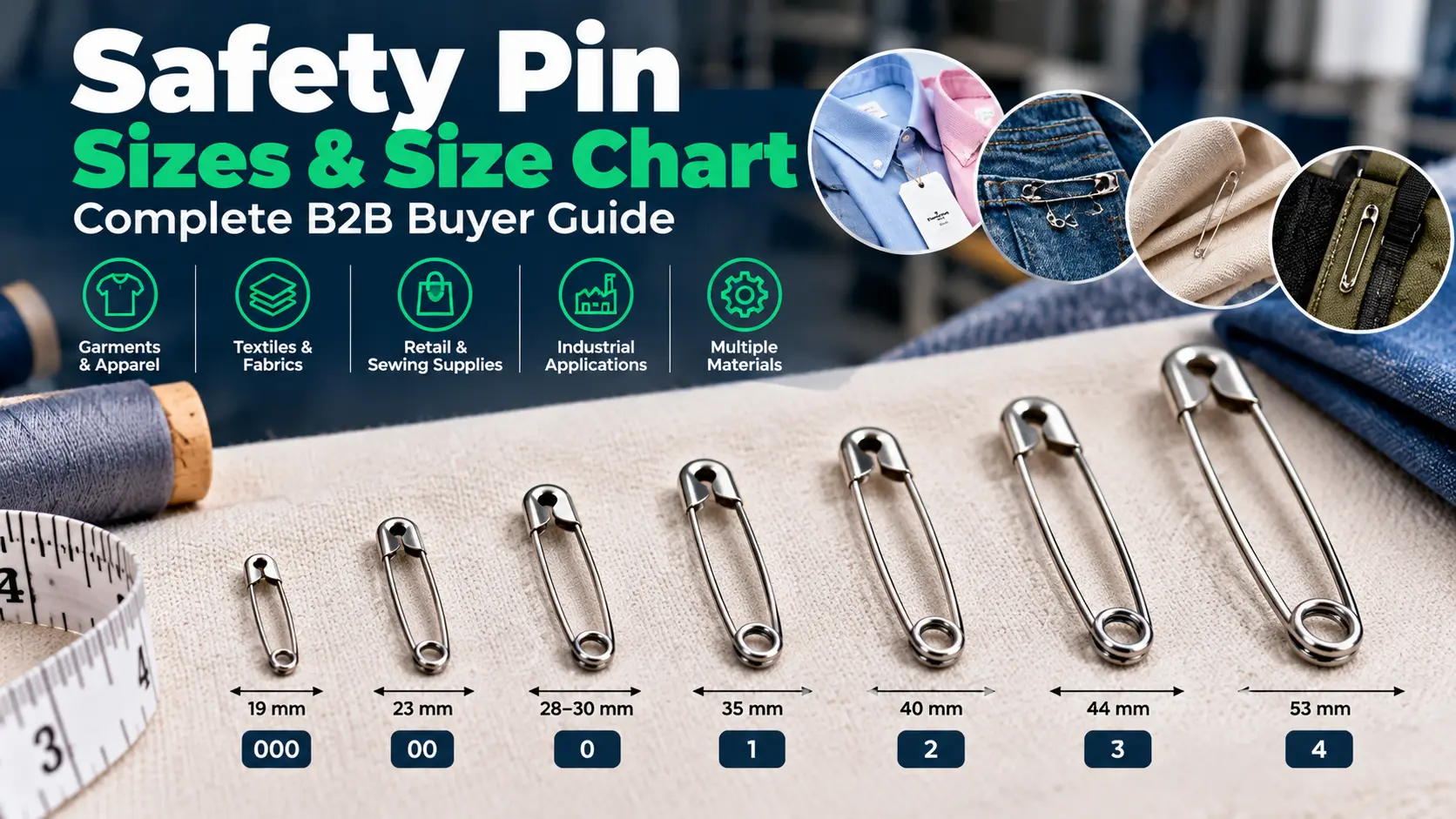
Quick answer: how do you specify safety pin size for an export order?
Safety pins are commonly numbered from 000 (smallest) to 4 (largest), and a higher number generally means a longer pin. But size numbers are not a universal standard. Different manufacturers and product series can use different lengths for the same number. For an export order, specify the size designation, the length in millimetres, the wire thickness, the material and the finish, and ask the supplier to confirm them against its specification sheet.
How size numbering works
The usual range runs 000, 00, 0, 1, 2, 3 and 4. The smaller numbers are used for light fabrics and tags. The larger numbers are used for heavier textiles and general fastening. Because the numbers are conventions, not standards, "size 2" from two suppliers may not be the same length. That is why buyers should always add a length in millimetres to the RFQ and compare against a datasheet.
Length is only one part of the specification
Length: overall length in millimetres.
Wire thickness: the diameter of the wire. Two pins of the same length can have different strength if the wire thickness differs.
Material: steel or brass. State this in the RFQ.
Finish: for example nickel-plated, brass, gold or black.
Spring and clasp: they affect how the pin holds.
Packing: pieces per box and boxes per carton.
Size alone does not determine strength. A larger pin with thinner wire can be weaker than a shorter pin with thicker wire.
Choosing size by application
Use these as starting points, then test on your fabric.
Tags and delicate fabrics: smaller sizes such as 000, 00 and 0.
General clothing and sewing: mid sizes such as 0, 1 and 2.
Garment production and medium textiles: sizes such as 1, 2 and 3.
Heavy textiles, upholstery and industrial laundry: larger sizes such as 3 and 4.
The right choice depends on fabric thickness, how long the pin stays in, and whether the point or finish may mark the material. Test samples on your own fabric before you order in bulk.
Suggested assortment for distributors and retailers
Retailers and distributors that serve mixed customers often stock a small, a medium and a large size group. A basic range could include very small sizes for tags, general clothing sizes and larger sizes for heavy-duty use. Private-label brands can build an assortment around their customers. See the wholesale assortment guide.
Inches and millimetres
Buyers in the US often think in inches, while factories specify millimetres. One inch equals 25.4 millimetres. To convert millimetres to inches, divide by 25.4. Put both units in your RFQ if your customers use inches.
Materials: steel, stainless steel and brass
Steel pins are commonly nickel-plated. Brass pins are chosen for appearance and for corrosion resistance in some uses. If you need stainless steel, ask the supplier to confirm the grade it can supply, for example whether 304 or 316, and confirm availability for your size. Do not assume that every material is available in every size.
How to write the size in an RFQ
Instead of "size 4 safety pins", write: size 4, length in millimetres, wire thickness in millimetres, steel, nickel-plated, bulk packed, pieces per box, destination port. Ask for the supplier's size and wire chart in its reply and keep it with the purchase order.
Ask for the official size and wire chart
Each series in the Suvik Overseas product range has its own product pages. Ask for the current specification sheet for the series you want, with length and wire thickness for each size, before you finalise your order.
Common mistakes
Comparing two suppliers by size number only
Ignoring wire thickness
Not stating the pieces per box
Choosing size without testing on the real fabric
Accepting a sample, then receiving a bulk order with different dimensions
Frequently asked questions
What are the standard safety pin sizes?
The common range is 000, 00, 0, 1, 2, 3 and 4, but the exact lengths vary by manufacturer and series.
What is the smallest safety pin size?
000 is usually the smallest in the common numbering range.
What size is best for heavy fabric?
Larger sizes such as 3 and 4 are common starting points, together with thicker wire. Test on your fabric.
What size is best for delicate fabric?
Smaller sizes with fine wire, to limit marks. Test first.
Can I order a custom size?
Custom dimensions may be possible under OEM supply. Send a technical specification and request a sample. See OEM safety pin manufacturing.
Request a specification sheet and quote
Tell us the size, material, finish, quantity, packaging and destination through the Suvik Overseas enquiry form. Use the RFQ template to write your request, and read safety pin MOQ explained for quantities.