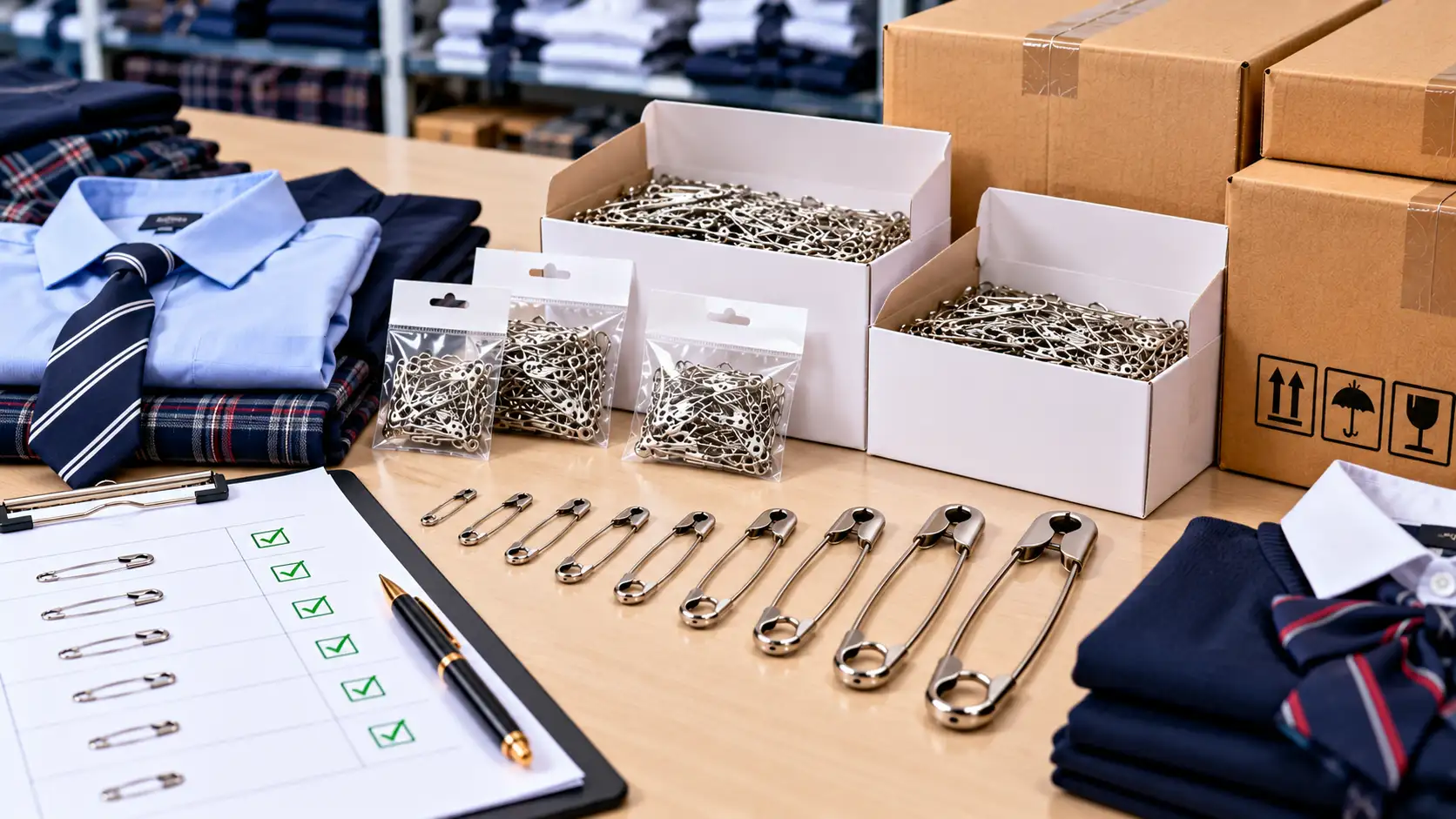
School uniform suppliers and garment distributors often manage multiple product categories, seasonal orders and delivery deadlines. When safety pins are part of their purchasing requirements, selecting the right product configuration and ordering the correct quantities can help simplify procurement.
The requirements depend on how the pins will be used. A uniform supplier may purchase them for garment tags, packaging, temporary fastening or resale as a separate accessory. Each application can require a different size, material, packaging format and quantity.
For businesses sourcing safety pins in bulk, the best starting point is to define the intended application, confirm the product specification and request a quotation based on the actual purchasing requirements.
This guide explains what school uniform suppliers and garment distributors should consider before ordering safety pins from a manufacturer or exporter.
1. Define How the Safety Pins Will Be Used
Before requesting a quotation, identify the intended application.
For example, a uniform supply business may need safety pins for:
Attaching temporary identification or price tags where appropriate.
Packing and organising garment-related items.
Supplying sewing and tailoring accessories to customers.
Reselling packaged safety pins through its distribution network.
These are potential applications, not recommendations for every garment or product. The suitability of a safety pin depends on the material, intended use and relevant safety requirements.
If the pins will be supplied with uniforms, consider whether the end user is expected to use them and whether suitable instructions or warnings are necessary.
Purchasing tip: Explain the intended application to the supplier instead of requesting a generic product without context.
2. Select the Required Size and Specification
Safety pin size should be selected according to the application rather than choosing a size based on price alone.
Before ordering, confirm the following:
Size number and actual length in millimetres.
Material and finish.
Wire thickness, where relevant.
Closure and locking requirements.
Any agreed tolerances or inspection criteria.
A numbered size does not always provide enough information for commercial purchasing. Dimensions and other specifications can vary between manufacturers.
Request the current manufacturer size chart and confirm the exact product specification before approving the order.
Use the safety pin sizes chart as a starting point for comparing available sizes.
3. Decide Whether You Need Bulk or Retail Packaging
Uniform suppliers may purchase safety pins for internal business use, distribution or resale. The packaging requirement should reflect the intended sales channel.
Packaging optionWhen to consider itBulk packagingFor buyers who handle or distribute larger quantitiesStandard boxesFor wholesalers and resellers needing defined pack quantitiesRetail-ready packagingFor products intended for individual retail salePrivate-label packagingFor businesses selling under their own brandCustom-labelled cartonsFor buyers requiring specific shipment identification
Actual packaging options depend on the supplier's capabilities and the product configuration.
Before confirming the order, establish the number of pieces per box, the number of boxes per carton and any required labels or markings.
If your business needs private-label packaging, confirm artwork, barcode requirements, printing details, approval milestones and any separate minimum order quantity before production begins.
4. Estimate Quantities From Actual Demand
Purchasing too much stock can tie up working capital, while ordering too little may require an additional purchase sooner than expected.
Estimate your requirement using available sales data, confirmed customer orders and expected replenishment time.
A basic calculation is:
Required order quantity = Expected demand during the planning period + Desired closing stock − Available inventory − Confirmed incoming stock
For example, suppose a distributor expects to need 1,200 boxes over a planning period, wants to retain 200 boxes at the end, has 300 boxes in stock and has 100 boxes already on order.
The estimated additional requirement would be:
1,200 + 200 − 300 − 100 = 1,000 boxes.
These numbers are illustrative. Use actual demand, stock levels and confirmed incoming orders for your purchasing decision.
If you are ordering several sizes or packaging configurations, calculate the quantities separately for each product.
5. Confirm the Minimum Order Quantity
The minimum order quantity (MOQ) determines the smallest order a supplier will accept under the applicable conditions.
Ask the supplier whether the MOQ applies to:
The complete purchase order.
Each size or product variation.
Each packaging configuration.
Custom or private-label packaging.
A particular material or finish.
Suvik Overseas has communicated a standard MOQ of 750 boxes. Confirm the applicable MOQ for your requested products and packaging before finalising the purchasing budget.
Also confirm the number of pieces per box and the number of boxes per carton. Do not assume that all packaging configurations contain the same quantity.
6. Compare Supplier Quotations Properly
A useful quotation should specify the product being offered, the quantity, packaging and commercial terms.
When comparing suppliers, check the following:
FactorWhat to verifyProduct specificationSize, dimensions, material and finishQuantityBoxes, cartons or pieces, with the unit clearly statedPackagingPieces per box and boxes per cartonQualityAgreed inspection requirements and product criteriaPriceUnit price, currency and total order valueMOQMinimum quantity for the requested configurationLead timeProduction and dispatch estimatesShippingDelivery terms, destination and freight responsibilitiesDocumentationInvoice, packing list and other applicable documents
Request comparable quotations using the same specifications. A lower price per box may not represent better value if the box contains a different number of pieces or uses a different packaging configuration.
For supplier information, visit the wholesale safety pin manufacturer page.
7. Check Product Quality Before Bulk Purchasing
Before placing a large order, decide which product characteristics matter for the intended application.
Depending on the product specification, these may include:
Dimensional consistency.
Material and finish.
Closure alignment and locking function.
Spring action.
Point condition and visible defects.
Packaging consistency.
Request a sample when appropriate and compare it with the agreed specification.
If your business requires documented inspection or particular quality criteria, discuss these requirements with the supplier before production. Do not assume that a particular test or certification applies unless the supplier provides supporting evidence.
Record the approved product specification so that future orders can be checked against the same requirements.
8. Plan Purchases Around Your Uniform Supply Calendar
Uniform suppliers may experience changes in demand around school-year starts, customer contracts or other purchasing cycles. The actual timing and scale of these changes depend on the business and its market.
Use your own order history rather than assuming a fixed seasonal pattern.
To prepare a purchasing schedule:
Review confirmed customer requirements.
Estimate the quantities needed during the replenishment period.
Check available inventory and outstanding orders.
Confirm the supplier's current stock and lead time.
Allow time for packaging approval, production and shipment where applicable.
Place the order early enough to meet your required availability date.
For international orders, distinguish production completion from dispatch, transit and final delivery. Ask the supplier to confirm each relevant milestone.
9. Prepare a Clear Wholesale Enquiry
A complete enquiry helps a supplier determine whether the requested products and quantities can be supplied.
Include:
Company name and destination country.
Intended application.
Required size and dimensions.
Material and finish preferences.
Quantity by size or product variation.
Packaging format and quantity per box.
Private-label or labelling requirements.
Target delivery date.
Preferred shipping terms, if known.
Inspection or documentation requirements.
If you are unsure which configuration is suitable, explain the intended application and ask the supplier to confirm the available options.
For international purchases, specify the destination port or delivery location and ask which shipping costs and responsibilities are included in the quotation.
Frequently Asked Questions
Which safety pins should school uniform suppliers purchase?
The appropriate product depends on the intended application, required dimensions, material and packaging. Confirm the actual specification with the manufacturer before placing a bulk order.
Can uniform suppliers purchase safety pins in bulk?
Wholesale buyers can enquire about bulk safety pin supply. The available sizes, packaging options and minimum quantities should be confirmed with the supplier.
What is Suvik Overseas' standard MOQ?
Suvik Overseas has communicated a standard MOQ of 750 boxes. Buyers should reconfirm the applicable MOQ for their selected product and packaging configuration.
Should uniform suppliers choose bulk or retail packaging?
Bulk packaging may suit business distribution, while retail-ready packaging may be more appropriate for resale to end customers. The right option depends on the buyer's sales channel and handling requirements.
How can buyers compare safety pin quotations?
Compare equivalent product specifications, quantity units, pieces per box, packaging, inspection requirements, lead time and shipping terms. Do not compare unit prices without checking what each quotation includes.
What should be included in a safety pin wholesale enquiry?
Include the required size, dimensions, material, quantity, packaging, destination country and delivery requirements. Mention any private-label or inspection requirements before requesting a final quotation.
Request a Wholesale Safety Pin Quotation
Suvik Overseas Pvt. Ltd. supplies safety pins for wholesale and export requirements. Businesses evaluating a new supplier can share their intended application, required sizes, quantities, packaging preferences and destination country to request a quotation.
Request a wholesale safety pin quotation
Before placing an order, confirm the exact product specification, applicable minimum quantity, packaging configuration and expected delivery schedule with the supplier.