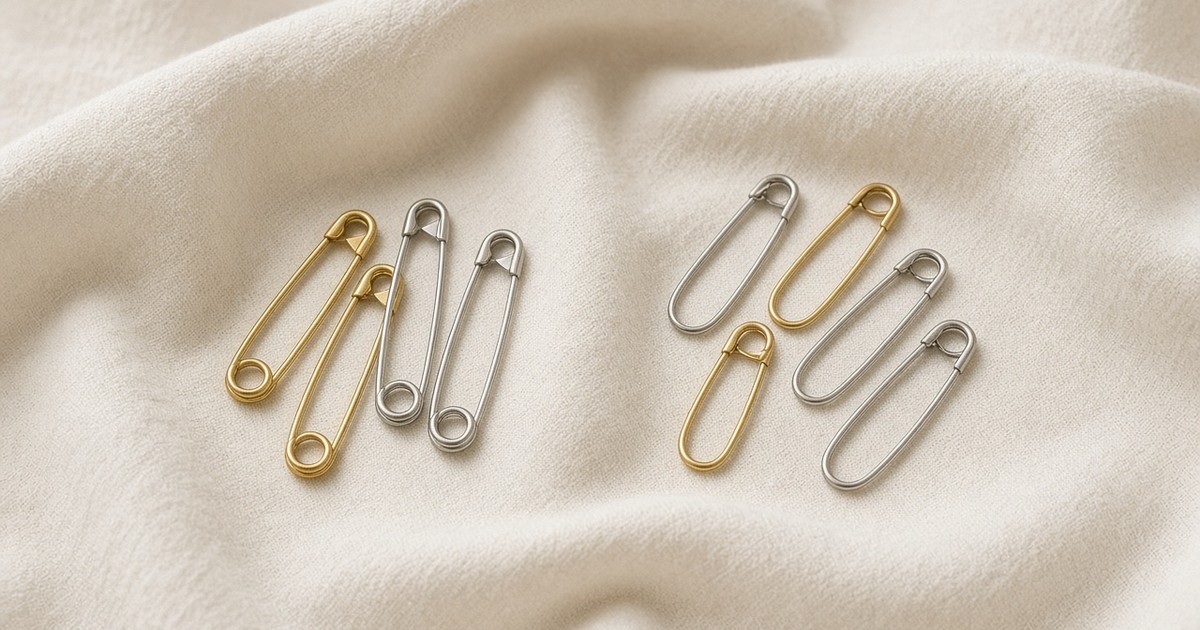
When a garment factory, laundry or brand buyer asks for "safety pins", most catalogues will show a standard coiled pin: a straight shaft, a spring coil at the base and a clasp that covers the point. That construction is the everyday workhorse for tagging, tailoring and general fastening. It is not the only construction. A coilless pin — also written coil-less, and described on some product guides as a French pin — has no spring loop at the bottom. The wire is smoothly bent instead, so fine threads, yarns or beads are less likely to catch in a coil.
This guide is for buyers who need to choose which construction to put on a purchase order, especially for garment tagging, and for related uses in babywear, medical handling, industrial laundry and crafts. It complements our types of safety pins for clothes page, a fabric-pairing overview, and the types of safety pins and applications guide, which surveys many pin styles in short sections. The question here is narrower: what the two constructions are, when the coil is a snag risk, how to specify the choice in an RFQ, and what to check on a sample.
This is general buyer guidance, not legal, medical or laboratory advice, and it is not a statement that any named manufacturer holds ISO 9001 or any other certificate. It does not assign prices, test results, capacities or a fixed minimum order quantity to any product. Linked Suvik pages were checked on 14 November 2026. Agree the construction, size, material and sample standard in the purchase order.
Quick answer
A standard coiled safety pin has a spring coil at the base. That is the traditional design in the anatomy guide and the engineering and design guide. The types of safety pins for clothes page cites the Salasar and Liberal series as examples of this staple.
A coilless safety pin has no bottom spring loop. The types and applications guide describes it as a pin whose wire is smoothly bent instead, also calling the style a French pin. The usual reason to specify it is to reduce the chance that fine threads, yarns or beads catch in the coil.
Construction, material and size are three separate specifications. A coilless pin is not automatically rust-proof, nickel-controlled or the right length. Use the materials comparison, the nickel-free specification guide and the sizes and uses guide for those decisions.
For garment tagging, choose construction from the fabric and how long the pin stays on the garment. Delicate knits, lace, silk and chiffon are the uses where buyers most often specify coilless pins. Everyday cotton and similar apparel are often tagged with a standard coiled pin. Confirm on a sample of your actual fabric.
As of 14 November 2026, the public catalogue has no dedicated coilless product page. The FAQ lists coil-less pins among the types Suvik manufactures, but there is no SKU URL to order from. If you need that construction, write it in the RFQ and ask through the enquiry form.
Minimum order quantity is negotiable. Confirm the figure with the quotation. Approve a sample of the actual construction before the bulk order, using the sample evaluation checklist plus a fabric-catch check on your own material.
What the two constructions are
Standard coiled safety pins
The standard pin is the design most people picture: a pointed shaft, a spring coil at the base, and a stamped clasp that covers the point. The anatomy guide and the engineering and design guide describe the coil as a torsion spring that stores opening force and spreads bending stress along the coiled wire. That spring is useful in tailoring, packing and repeated tagging. It is also a physical loop, and any loop can catch a fine yarn if the fabric is dragged across it.
Suvik's public catalogue is organised by brand lines and sizes rather than by this construction. The clothes types page points to the Salasar assorted listing and the Liberal assorted listing as examples of the standard coiled staple. Treat those pages as listings of standard lines, and still write size, material and finish on the order. Browse the current range on the products index.
Coilless (coil-less) safety pins
A coilless pin keeps the pointed shaft and the protective clasp, but it has no traditional spring coil at the base. The types and applications guide describes it as a pin without the bottom spring loop, with the wire smoothly bent instead, and also uses the name French pin. The shorter types overview and the anatomy guide describe the style as eliminating the coiled spring in favour of an alternative locking arrangement, sometimes noted for reduced bulk.
Spelling varies: coilless, coil-less and French pin can refer to the same idea. If you and a supplier might not share a term, add a short description: "no spring coil or loop at the base." Do not assume that a pin called "mini", "gold" or "decorative" is coilless, or that a coilless pin is made of a particular metal. With no coil loop, there is one fewer place for a fine thread, yarn or bead to catch. The types guides discuss the style for jewellery, tagging delicate knits, and silk, chiffon or lace. Those are use descriptions, not a test result for your fabric, and a dull point or oversized wire can still snag a delicate cloth.
On 14 November 2026 the English sitemap listed 33 product URLs under /product/. None of them is named coilless, coil-less or French pin, and the catalogue download page is organised around the existing brand lines. The FAQ does say that Suvik manufactures coil-less pins for delicate fabrics. Read that as a reason to ask, not as a substitute for a specified product. If you need the construction, say so in the RFQ, request a sample, and confirm size and finish through the enquiry form.
Snag and fabric-catch: what actually differs
Most damage complaints about safety pins are not about the coil alone. A pin can leave a visible hole if the wire is too thick, tear a yarn if the point is blunt, stain a garment if a steel pin rusts, or pull a thread if the clasp catches. The coil is an extra, specific risk: a loop that can hook a fine stitch.
That loop matters most on fine knits, lace, silk, chiffon or similar cloth; when the pin stays on the garment through packing, wear or steaming; or when beads or loose yarns can run into the loop. A standard coiled pin is often adequate on a stable woven such as cotton shirting used for ordinary price-ticket tagging, or when the pin is used briefly and then removed.
Do not turn this into a single rule. Use the fabric-pairing table on the clothes types page as a starting point, then pin a sample through the actual fabric. If a yarn catches in the coil, specify coilless or change size or point quality. If it does not, a standard coiled pin may be the simpler stock item.
Keep material out of this decision. Brass, nickel-plated steel and stainless steel are about rust, wear and strength, as the materials comparison explains. A coilless steel pin can still rust, and a standard brass pin can still catch a fine knit in its coil. Write both requirements if you need both. Brass product listings describe a material family, not a construction.
Which construction suits which job
Garment tagging and retail labels
Tags and brand cards are often attached with a small safety pin at packing or in the store. The garment industry page and the garment manufacturers article note that smaller apparel sizes are the usual starting point, and that coilless pins are often recommended for delicate knits to prevent thread catching.
Choose from the fabric, how long the pin will stay on the garment, and whether rust or nickel is a separate requirement. A delicate knit, lace or silk ticket is a stronger case for coilless than a cotton shirt. A pin removed after a fitting behaves differently from one that travels through a carton and a changing room. If the pin may stay on a garment in humidity, or the line is a baby or skin-contact product, specify material and any nickel-release wording separately. The clothes types page also mentions U-shaped or tagging pins, and the types and applications guide describes bulb or pear-shaped pins. Those are further constructions, not product SKUs. If you want a particular shape, describe it and ask for a sample.
Babywear
Baby garments and some children's knitwear combine two risks: a fabric that can catch, and skin contact. Coilless construction addresses the first, not the second. If you need a nickel-controlled pin, use the nickel-free specification guide and write the test method on the order. If you need both, write both. This article does not set a children's product standard or claim that a particular pin is approved for infant use. Approve a garment sample.
Medical and healthcare handling
Safety pins are used to secure bandages and slings, and in hospital laundry and garment handling. The medical uses page describes some of those applications. Skin-contact uses may drive a nickel-release requirement; wet service may drive a rust-resistant material; a snag-sensitive textile may drive a coilless request. Do not classify safety pins as medical devices unless your own product is one and your adviser has told you to do so, and do not invent a sterilisation claim. If a healthcare specification names a construction, material or test, copy that wording into the order.
Industrial laundry and textile rental
Commercial laundry puts pins through repeated opening, heat and moisture. The industrial laundry article covers that use as a supply problem. Repeated opening can stress the coil, as the materials and engineering guides already note, but that is not evidence that a coilless pin lasts longer or shorter in a laundry. Specify material for wet service first, then size and holding power, then construction if the textile can catch in a coil. Test samples in your own process, and approve in writing.
Crafts, haberdashery and related styles
Craft and haberdashery buyers often meet coilless pins in knitting, jewellery and fine sewing, where a coil can catch yarn or beads. Curved or quilting pins, heavy-duty kilt pins and decorative finishes are different choices, not synonyms for coilless. Specify construction and size for each item rather than packing an unspecified assortment. The UK haberdashery and craft retailers article covers the retail-supply context; use this page for the construction choice.
How to specify the construction in an RFQ
The RFQ template already asks for product and size, material and finish, quantity, packaging, application, samples and quality checks. Add a clear construction line so the quotation cannot be filled with the wrong style.
Useful wording, to adapt:
Construction: standard coiled safety pin, with a spring coil at the base; or coilless (coil-less / French pin) safety pin, with no spring coil or loop at the base. If you use a supplier's catalogue name, still add the short description.
Intended use and fabric: for example, garment tagging on fine knitwear, packing tags on cotton shirting, babywear, hospital garment handling, laundry identification, or craft retail.
Size and packing: refer to the sizes and uses guide and state the size mark, plus whether you need a mixed assortment or a single size.
Material and finish: brass, nickel-plated steel, stainless steel or another named finish, plus any nickel-release wording if you need it. Do not bury this inside the construction line.
Whether the pin remains on the garment through packing, shipping, display or washing.
Sample and acceptance checks: a sample of the actual construction, size and finish, approved in writing, including a fabric-catch check on a named cloth if snagging is the reason for the choice.
Do not write only "safety pins for garments" or "pins for tagging". Those phrases describe a use, not a construction. Minimum order quantity is negotiable; ask for it on the quotation rather than assuming a fixed figure. The MOQ article explains how order quantity is usually discussed. Send the RFQ through the enquiry form or the contact page.
What to check on the sample
Use the sample evaluation checklist for the shared checks: dimensions, material and finish, point sharpness and alignment, clasp lock, consistency between pieces, and packing. Then add checks that belong to this comparison.
Confirm the construction. On a standard pin you should see and feel the spring coil at the base. On a coilless pin the base should be a smooth bend with no loop that can hook a thread. If the sample does not match the RFQ, stop there.
Do a fabric-catch check on your own material. Fasten the sample through the actual fabric, move the cloth against the base, and open and close the pin as you will in production. Look for yarns entering the coil, or for catching on a burr or a rough clasp. Record the fabric, the pin size and the result. Check the point and the clasp on both constructions: a coilless pin with a blunt point can still tear a knit, and a standard pin with a loose clasp can still drop a tag.
Match the mechanical check to the construction. The sample checklist's spring-tension step is written for a coiled pin. It is a fair check on a standard sample, but not a complete description of a coilless pin, which has no traditional coil to test in the same way. For a coilless sample, check how the pin closes, whether it stays shut, whether the arms line up with the clasp, and whether any residual kink at the base can catch a thread.
Approve the sample in writing, and name the construction, size, material and finish you have accepted. If you will use a third-party inspection on the bulk lot, the pre-shipment inspection article explains how to point an inspector at the approved sample. An inspector can check that packed goods match that sample, not invent a snag standard you have not written down.
Frequently asked questions
What is a coilless safety pin?
It is a safety pin without the traditional spring coil, or loop, at the base. The pointed shaft and the clasp are still there; the wire at the bottom is smoothly bent instead. Guides also use the spelling coil-less and the name French pin. The usual reason to specify one is to reduce the chance that fine threads, yarns or beads catch in a coil.
Are coilless pins better for garment tagging?
Not in every case. They are often the better construction when you are tagging a delicate knit, lace or silk, especially if the pin will stay on the garment. For everyday cotton and similar apparel, a standard coiled pin is widely used and may be the simpler stock item. Choose from the fabric, the time the pin stays on the garment, and a sample check.
Does Suvik list coilless pins as a product I can order from a catalogue page?
Not as a dedicated product URL. On 14 November 2026 the public catalogue and sitemap had no coilless, coil-less or French-pin product page. The FAQ lists coil-less pins among the types manufactured. If you need that construction, write it in your RFQ, ask via the enquiry form, and approve a sample.
Does coilless mean the pin is rust-proof or nickel-free?
No. Coilless describes the shape at the base of the pin, not the metal or the finish. Rust performance depends on the material. A nickel-controlled requirement has to be written and evidenced separately.
What should I write in the RFQ if I need one construction or the other?
Name the construction in plain words: "standard coiled safety pin, with a spring coil at the base" or "coilless (coil-less) safety pin, with no spring coil or loop at the base." Add the intended use and fabric, the size, the material and finish, whether the pin stays on the garment, and a request for an approval sample.
How should I check a coilless or standard sample?
Confirm the base matches the construction you ordered, then run the shared checks on the sample evaluation checklist: size, point, clasp, finish and consistency. Add a fabric-catch check on your own material. Use a spring-tension check for standard coiled samples; for coilless samples, check closure, alignment and any catch at the bent base.
Specify the construction, then approve the sample
If you buy safety pins for garment tagging, babywear, laundry, medical handling or crafts, do not leave construction unsaid. Write which one you need, keep material and size as separate lines, and approve a sample on the cloth you will actually use.
Minimum order quantity is negotiable. To discuss a construction or a quotation, use the enquiry form or the contact page.
Sources
Live Suvik Overseas pages linked in the body, each checked HTTP 200 on 14 November 2026 (results recorded in the fields file for this draft)
English product entries in the sitemap, checked 14 November 2026: 33 URLs under /product/, none named coilless, coil-less or French pin