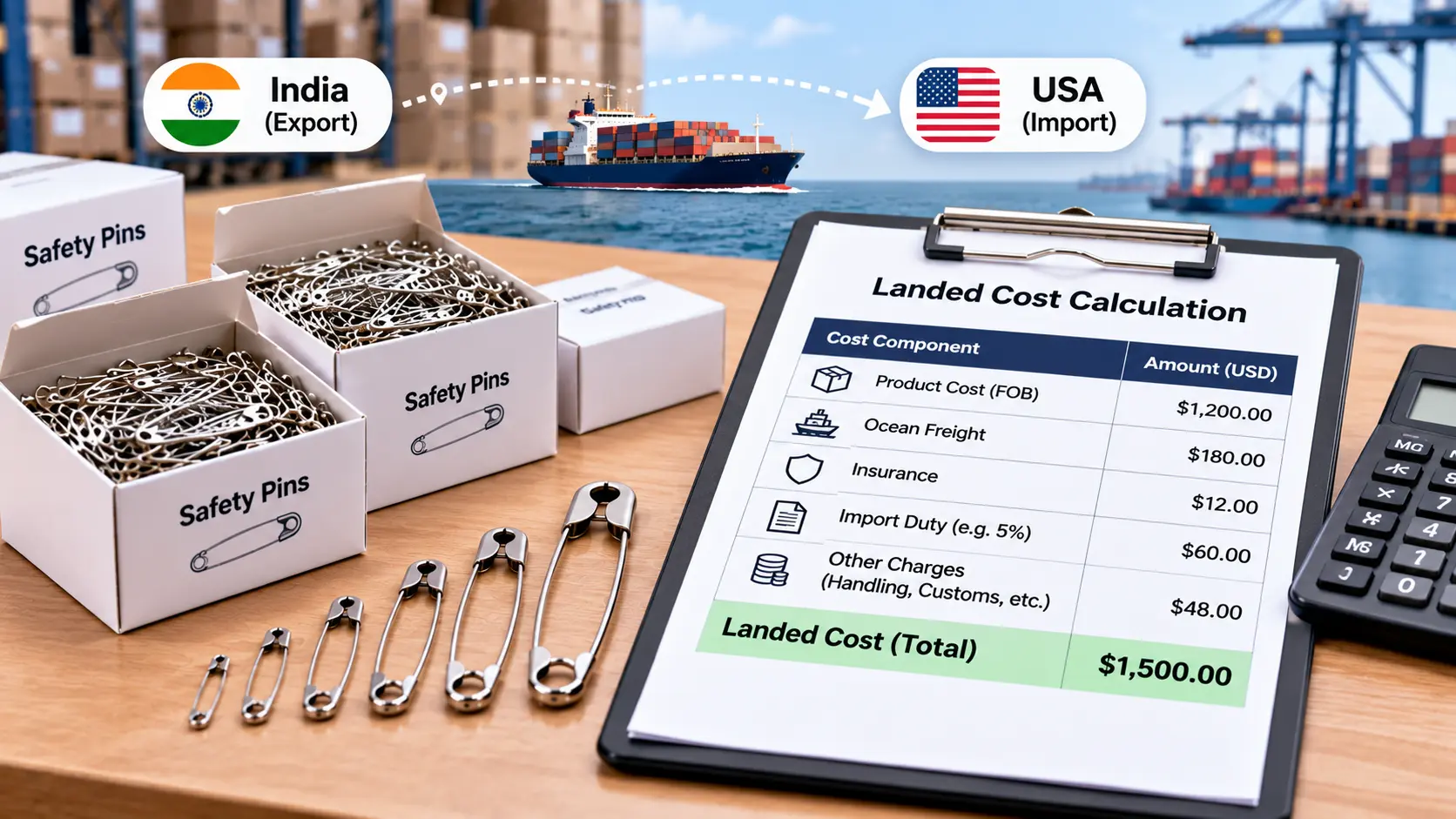
The unit price on a quotation is only the start. What a US importer actually pays for safety pins from India is the landed cost: the goods plus freight, insurance, US duties, CBP fees, the customs broker and the costs to get the cargo to your warehouse. This guide works through one illustrative shipment line by line so you can rebuild the sum with your own quote. For the wider buying process, see our bulk safety pins guide for U.S. buyers.
Every figure in the worked example below is an illustrative assumption, not a Suvik Overseas price, freight quote or duty ruling. Duty rates and CBP fees were read on official US government sources on 2 November 2026 and can change at any time. Confirm classification and duty with a licensed US customs broker before you order.
What landed cost includes
For a shipment of safety pins from Kolkata, India to the United States, landed cost usually covers:
The goods value (the price on your commercial invoice)
International freight (sea or air) and origin charges, depending on the Incoterm
Cargo insurance
US import duty: the regular tariff rate plus any additional duties in force on the date of entry
The Merchandise Processing Fee (MPF) charged by US Customs and Border Protection (CBP)
The Harbor Maintenance Fee (HMF), for ocean cargo only
Customs broker fees and a customs bond
Destination port, terminal and delivery charges to your door
Step 1: Classify the product and find the duty rate
In the Harmonized Tariff Schedule of the United States (HTSUS), safety pins sit under subheading 7319.40.20, "Safety pins", in chapter 73 (articles of iron or steel). The published general duty rate is 4.5% ad valorem. Statistical suffixes split safety pins "on cards" (7319.40.20.10) from "other" (7319.40.20.50), both reported in gross. India is not among the special-rate programs listed for this line, so the general rate applies.
The Section 232 steel tariff: the big one for safety pins
Steel safety pins are on the US list of steel derivative articles under Section 232. Subheading 7319.40.20, described as "Iron or steel, safety pins", is listed in Annex I-A ("50% Section 232 Tariff on Full Value") of Proclamation 11021 of 2 April 2026 (published 9 April 2026), and again in Annex I-A of Proclamation 11032 of 1 June 2026 that updated those lists. Under the April proclamation, the Section 232 duty applies to the full customs value of the product, not just its metal content, from 6 April 2026.
The current HTSUS entry for heading 9903.82.02 shows the duty for these articles as "the duty provided in the applicable subheading + 50%". In practice, steel safety pins from India currently pay the 4.5% regular duty plus a 50% Section 232 duty on the same customs value. Your broker reports the chapter 99 heading alongside 7319.40.20 on the entry.
Section 301 and IEEPA: why they don't stack here
Section 301 (forced labor) duty: from 24 July 2026, the US Trade Representative imposed a 10% additional duty on products of India (Federal Register, 91 FR 47318, 28 July 2026), reported under HTS heading 9903.05.44. That 10% doesn't apply to everything, though. Annex I of the notice says these duties "shall not apply to" articles of steel and derivative steel articles provided for in headings 9903.82.02 and 9903.82.04 to 9903.82.26. Because steel safety pins fall under 9903.82.02, they pay the Section 232 duty and not the 10% Section 301 duty. We found no later USTR notice in the Federal Register changing this action up to 2 November 2026.
IEEPA duties: these no longer apply. Executive Order 14384 ended the extra 25% duty on Indian goods from 7 February 2026. Executive Order 14389 ("Ending Certain Tariff Actions") then ended IEEPA duties more broadly, and CBP's CSMS #67834313 confirms they are not collected on goods entered from 24 February 2026.
If your pins are not iron or steel (for example brass), the classification and duty treatment may differ. Ask your broker.
Step 2: Know your customs value
US duty is assessed on transaction value: the "price actually paid or payable" for the goods. Under US customs regulations, that price excludes charges for transportation, insurance and related services incident to the international shipment to the US (19 CFR 152.102(f) and 152.103). That is why US importers often ask suppliers for an FOB price. If you buy CIF, ask your supplier to show freight and insurance as separate lines so your broker can deduct them to reach the dutiable value.
Step 3: Add the CBP fees
Merchandise Processing Fee (MPF): for formal entries, 0.3464% of the customs value, with a minimum of $34.58 and a maximum of $670.86 per entry. These limits apply for fiscal year 2027, from 1 October 2026 (CBP user fee table and CBP's Federal Register notice of 31 July 2026). They are adjusted each fiscal year.
Harbor Maintenance Fee (HMF): 0.125% ad valorem of the cargo value, on ocean shipments only. It does not apply to air cargo.
Step 4: Add broker, bond and logistics costs
You need a customs bond to make a formal entry. A single-entry bond covers one shipment, while a continuous bond covers a year of entries and suits regular importers. Brokers charge an entry fee, and ocean shipments also need an Importer Security Filing (ISF), which brokers usually file for a fee. These costs vary by broker and port, so the example below uses placeholder figures. Ask for written quotes.
Incoterms: FOB vs CIF vs DDP
The Incoterm on your quotation decides which of these costs your supplier's price already covers:
FOB (Free On Board), Kolkata port: the supplier delivers the goods onto the vessel at origin. You pay ocean freight, insurance, US duty, fees and everything after. This gives you the most control and the clearest customs value.
CIF (Cost, Insurance and Freight), US port: the supplier pays freight and minimum insurance to the US port. You still pay duty, CBP fees, broker and destination charges. Check what the insurance actually covers.
DDP (Delivered Duty Paid): the seller pays everything, including US duty, and has to arrange to clear goods into the US. It is simple on paper, but the price includes their estimate of duty and fees, which is significant for steel safety pins. Ask about DDP availability directly rather than assuming it.
Sea vs air freight
Sea freight (LCL or FCL): much lower cost per kilo for bulk orders, but slower, and HMF applies. Smaller first orders often travel LCL in a shared container. For more detail, see our guide to LCL, FCL and air freight for safety pins.
Air freight: faster and no HMF, but freight is charged on actual or volumetric weight, which usually makes it far more expensive for metal goods. It suits samples and urgent top-ups.
Transit times depend on the carrier, route and season. Ask your forwarder for current schedules.
The worked example
Rates checked 2 Nov 2026; verify before shipping. All other numbers below are illustrative assumptions chosen to show the method. They are not Suvik prices, minimum order quantities, freight rates or broker quotes.
Assumptions
Product: steel safety pins, HTSUS 7319.40.20, product of India
Quantity: 2,000 gross (288,000 pieces). This is an example only. Suvik's minimum order quantity is negotiable, so confirm it with Suvik.
Goods value, FOB Kolkata: US$10,000 (assumed). It is quoted in US dollars, so no exchange-rate step is needed. If you are quoted in INR, convert at the rate on your payment date.
Mode: sea freight, LCL
Ocean freight and handling to a US port: US$1,200 (assumed)
Cargo insurance: US$50 (assumed)
Customs broker entry fee: US$150 (assumed)
Single-entry customs bond: US$75 (assumed)
ISF filing: US$35 (assumed)
Destination port and terminal charges: US$300 (assumed)
Inland delivery to your warehouse: US$250 (assumed)
The formula
Landed cost = goods value + freight + insurance + regular duty + Section 232 duty + MPF + HMF + broker, bond and filing fees + destination and delivery charges
Step-by-step calculation
Customs value (FOB, which excludes international freight and insurance): US$10,000.00
Regular duty at 4.5% of US$10,000: US$450.00
Section 232 steel duty at 50% of US$10,000: US$5,000.00
Section 301 duty: US$0, because steel derivative articles under 9903.82.02 are excluded from it
MPF at 0.3464% of US$10,000 = US$34.64. That is above the US$34.58 minimum, so US$34.64 applies.
HMF at 0.125% of US$10,000: US$12.50
Freight and insurance (assumed): US$1,250.00
Broker, bond and ISF (assumed): US$260.00
Destination and delivery (assumed): US$550.00
Total landed cost: US$17,557.14
Per-unit result
Per gross: US$17,557.14 ÷ 2,000 = about US$8.78
Per piece: US$17,557.14 ÷ 288,000 = about US$0.061
In this example, the goods are about 57% of the landed cost, and duties and CBP fees are about 31%. Most of that comes from the Section 232 steel duty. Freight, insurance, brokerage and delivery make up the rest. Because the 50% duty is charged on the customs value, every dollar saved on the FOB price also saves 54.5 cents of duty. That makes accurate, itemised quotations especially worthwhile.
First-order checklist for US importers
Confirm the HTS classification (7319.40.20 for steel safety pins) and the chapter 99 headings with a licensed customs broker
Check Section 232 and any other additional duties in force on your expected entry date
Ask for quotes on FOB and CIF terms so you can see freight and insurance separately
Confirm the order quantity with Suvik. The MOQ is negotiable
Agree packaging, cartons and any labelling for your sales channel
Arrange a customs bond (single-entry or continuous)
Make sure the ISF is filed in time for ocean cargo
Check that the commercial invoice, packing list and bill of lading match
Mark goods or their containers with the country of origin as US rules require (see 19 CFR Part 134), and confirm the details with your broker
Get written quotes for freight, brokerage and delivery before you place the order
FAQ
What is the US duty on steel safety pins from India?
Steel safety pins are classified under HTSUS 7319.40.20, with a general duty rate of 4.5%. As of 2 November 2026, they are also listed as a steel derivative article subject to a 50% Section 232 duty on full customs value, so the combined rate is 54.5% of the customs value. Confirm with your customs broker on the date of entry.
Does the 10% Section 301 duty on Indian goods apply to safety pins?
Not to steel safety pins covered by Section 232. The Section 301 notice of 28 July 2026 excludes steel derivative articles that fall under heading 9903.82.02, so they pay the Section 232 duty instead.
Is US import duty charged on the FOB or CIF value?
The US charges duty on transaction value, which excludes international freight and insurance. In practice that is close to the FOB value, so ask your supplier to show freight and insurance separately on a CIF invoice.
What CBP fees apply to a sea shipment of safety pins?
A formal entry pays the Merchandise Processing Fee of 0.3464% of value, with a minimum of $34.58 and a maximum of $670.86 in fiscal year 2027. Ocean cargo also pays the Harbor Maintenance Fee of 0.125%.
What is the minimum order for safety pins from Suvik?
Suvik's MOQ is negotiable and depends on the size, finish and packaging. Share your requirements to get a confirmed figure.
Request a quote
Planning your first shipment of safety pins to the USA? Send Suvik Overseas your sizes, finish, packaging, quantity and preferred Incoterm, and the team will prepare a quotation you can use to work out your own landed cost. Request a quote
Sources
All sources are primary US government pages, checked 2 November 2026.
USITC, Harmonized Tariff Schedule, 7319.40.20 Safety pins (general rate 4.5%): https://hts.usitc.gov/search?query=7319.40 (data read via https://hts.usitc.gov/reststop/search?keyword=7319.40)
USITC, Harmonized Tariff Schedule, heading 9903.82.02 ("+ 50%"): https://hts.usitc.gov/reststop/search?keyword=9903.82.02
Proclamation 11021 of 2 April 2026, "Strengthening Actions Taken To Adjust Imports of Aluminum, Steel, and Copper Into the United States", 91 FR 18201 (9 April 2026), clause (1) on full customs value and Annex I-A (7319.40.20 at p. 18214): https://www.federalregister.gov/documents/2026/04/09/2026-06960/strengthening-actions-taken-to-adjust-imports-of-aluminum-steel-and-copper-into-the-united-states (PDF: https://www.govinfo.gov/content/pkg/FR-2026-04-09/pdf/2026-06960.pdf)
Proclamation 11032 of 1 June 2026, "Further Adjusting the Tariff Regimes for Imports of Aluminum, Steel, and Copper Into the United States", 91 FR 34085 (4 June 2026), Annex I-A (7319.40.20 at p. 34095): https://www.federalregister.gov/documents/2026/06/04/2026-11314/further-adjusting-the-tariff-regimes-for-imports-of-aluminum-steel-and-copper-into-the-united-states (PDF: https://www.govinfo.gov/content/pkg/FR-2026-06-04/pdf/2026-11314.pdf)
USTR, Notice of Actions in Section 301 Investigations ... Forced Labor, 91 FR 47318 (28 July 2026), including Annex I subdivision (f) at p. 47362 (exclusion for 9903.82.02): https://www.federalregister.gov/documents/2026/07/28/2026-15181/notice-of-actions-in-section-301-investigations-of-acts-policies-and-practices-of-various-economies (PDF: https://www.govinfo.gov/content/pkg/FR-2026-07-28/pdf/2026-15181.pdf)
CBP CSMS #69326983, Section 301 Forced Labor Import Duties (9903.05.44, India 10%): https://content.govdelivery.com/accounts/USDHSCBP/bulletins/421d887
Executive Order 14384, Modifying Duties To Address Threats to the United States by the Government of the Russian Federation (India 25% duty ended 7 Feb 2026): https://www.federalregister.gov/documents/2026/02/11/2026-02818/modifying-duties-to-address-threats-to-the-united-states-by-the-government-of-the-russian-federation
Executive Order 14389, Ending Certain Tariff Actions: https://www.federalregister.gov/documents/2026/02/25/2026-03832/ending-certain-tariff-actions
CBP CSMS #67834313, Ending Collection of IEEPA Duties (from 24 Feb 2026): https://content.govdelivery.com/accounts/USDHSCBP/bulletins/40b11c9
CBP User Fee Table (MPF, HMF): https://www.cbp.gov/trade/basic-import-export/user-fee-table
CBP, Customs User Fees To Be Adjusted for Inflation in Fiscal Year 2027 (MPF $34.58 / $670.86 from 1 Oct 2026): https://www.federalregister.gov/documents/2026/07/31/2026-15530/customs-user-fees-to-be-adjusted-for-inflation-in-fiscal-year-2027
19 CFR 152.102(f) and 152.103, transaction value: https://www.ecfr.gov/current/title-19/chapter-I/part-152/subpart-E/section-152.103
19 CFR Part 134, country of origin marking: https://www.ecfr.gov/current/title-19/chapter-I/part-134