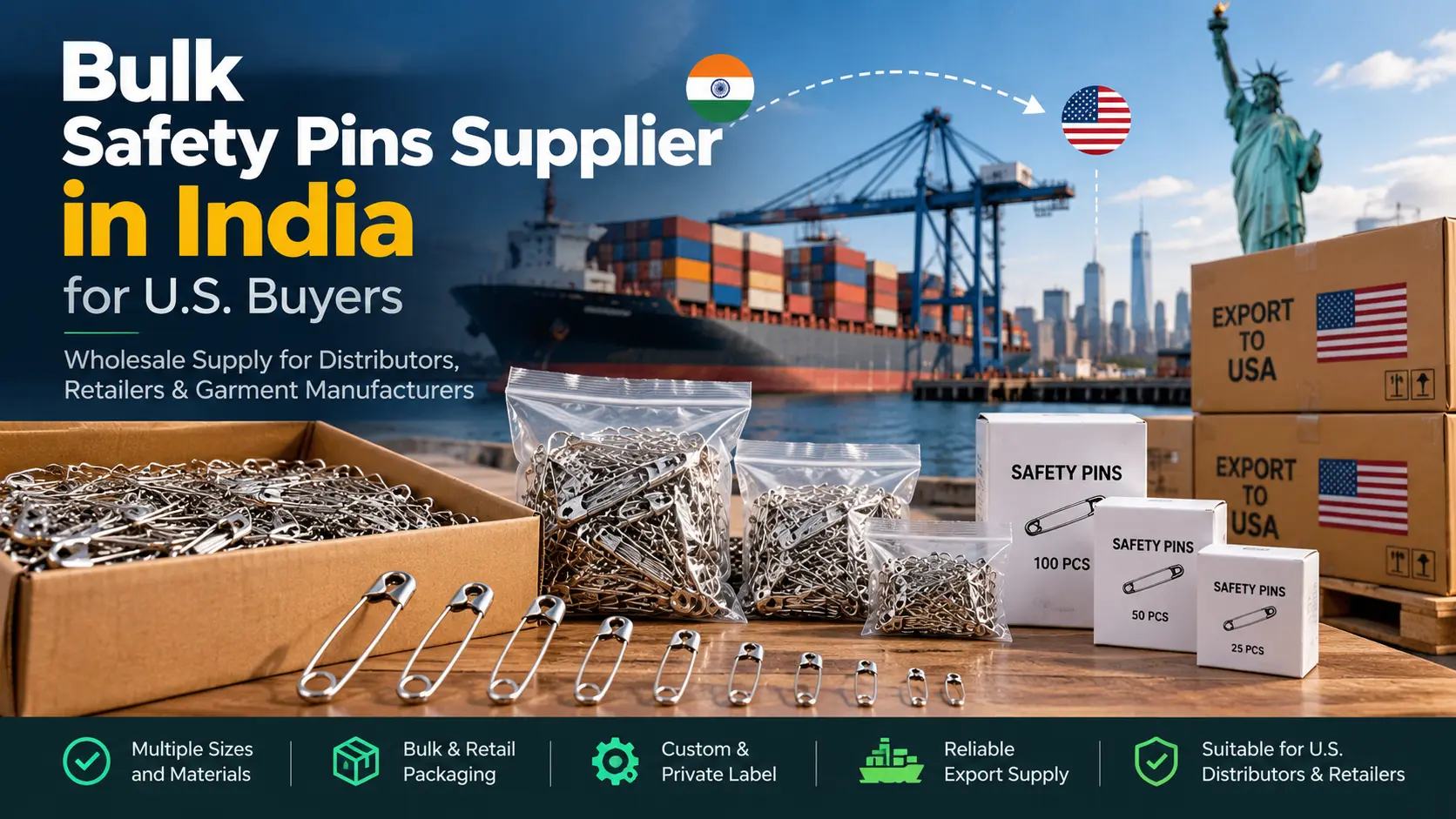
Quick answer: how do U.S. buyers source bulk safety pins from India?
U.S. importers, distributors and brands can buy bulk safety pins directly from an Indian manufacturer. The process is to define the specification, request FOB and CIF quotations, test samples, confirm MOQ, packaging and payment terms, place the order, inspect, ship and clear customs. This guide explains what U.S. buyers should check, with a focus on landed cost, packaging for U.S. channels and customs paperwork.
Suvik Overseas Pvt. Ltd. is a safety pin manufacturer and exporter based in Kolkata, India. It supplies steel and brass safety pins for wholesale, OEM and private-label orders.
Who buys bulk safety pins in the United States?
Wholesale distributors and sewing-supply companies
Garment and apparel manufacturers and textile businesses
Retail chains, craft and hobby brands
E-commerce sellers and private-label brands
Industrial and promotional product suppliers
A garment factory usually cares most about consistent size and strength. A retail brand cares more about packaging, barcode and presentation. State your channel in your enquiry.
Choose the product first
Define size, material, finish, wire thickness if it matters, pieces per box and packaging before you ask for prices. See the product range and the size and specification guide. For custom requirements, read about OEM manufacturing.
Understand MOQ and price
MOQ depends on product, packaging and customisation, and it is confirmed in the quotation. Price depends on the same factors plus quantity and Incoterm. Ask for price breaks at more than one quantity if you expect repeat orders. See safety pin MOQ explained.
For Suvik Overseas, the standard MOQ is 750 boxes, and it can be discussed and adjusted after negotiation, depending on the order.
Think in landed cost, not unit price
For U.S. buyers, the landed cost is the number that matters.
Product cost and packaging
Inland transport in India and export documents
Ocean or air freight to a U.S. port or airport
Cargo insurance, if not included
Customs brokerage and entry fees
Import duty and any additional duties in force on the date of import
Port, terminal and handling charges
Domestic trucking and warehousing
Estimated landed cost equals product cost plus packaging plus freight plus insurance plus duties and taxes plus clearance and delivery charges. Ask for FOB and CIF quotations so you can see where each cost sits.
Tariff classification and duty
Steel safety pins are commonly classified under HS heading 7319.40, and the U.S. tariff schedule has a separate subheading for safety pins within it. Duty rates and additional duties on goods from India can change, so ask your licensed customs broker to confirm the classification and the duty that applies on the day you import. Brass pins are classified differently from steel pins.
Customs and compliance checklist for the U.S.
Choose the importer of record and a licensed customs broker
Confirm tariff classification and duty with the broker
For ocean cargo, make sure the importer security filing is submitted on time
Check country-of-origin marking on goods and packaging
Check labelling rules for retail packs and marketplace requirements
Keep the commercial invoice, packing list and bill of lading consistent
See export documents for the document list.
Packaging for U.S. channels
Bulk packaging
Bulk bags or cartons suit garment factories and distributors that repack on arrival.
Wholesale packaging
Distributors often specify quantity per box, inner carton and master carton so that warehouse counts stay simple.
Retail and private-label packaging
Retailers and e-commerce brands may need printed boxes, cards or blister packs, labels and a UPC barcode that they supply. Packaging should be approved before mass production. See the packaging guide and private-label guide.
Shipping options
Sea freight is the usual choice for larger volumes, either as a full container load or a shared consolidated load. Air freight suits urgent or small shipments but costs more per kilogram. Ask for the port of loading, estimated transit time to your U.S. port, and who books freight under the Incoterm you choose. Plan total time as production or dispatch time, plus inland transport, ocean transit, customs clearance and domestic delivery. See export lead times.
Quality checks and samples
Ask for samples and check dimensions, finish, spring action, point and locking mechanism. For large orders, agree inspection criteria in advance or use a third-party pre-shipment inspection. See the sample checklist and quality control.
What to include in a U.S. RFQ
Product, size, material and finish
Quantity and unit, and pieces per box
Packaging and barcode requirement
Destination port or city, and target delivery date
Incoterm: ask for FOB and CIF
Samples, payment terms and export documents
Use the RFQ template to put these in one message.
Frequently asked questions
Can U.S. distributors buy safety pins directly from India?
Yes, subject to U.S. customs, tariff and labelling requirements. Work with a licensed customs broker.
What is the MOQ for wholesale safety pins?
It depends on the product, packaging and type of order. Send your specification and target quantity and the MOQ will be confirmed in the quotation.
Can I order private-label safety pins for the U.S. market?
Yes, private-label packaging is available. Confirm artwork, barcode and the minimum quantity for branded packaging.
What affects the wholesale price?
Series, size, material, finish, quantity, packaging, customisation and Incoterm. For imports, freight, duty and clearance affect the final landed cost.
Should I request samples first?
For a new supplier and for large or recurring orders, yes.
How do I compare quotes from different suppliers?
Compare the full offer on the same specification, unit, packaging and Incoterm. See comparing export quotations.
Request a bulk quotation
Send your size, material, quantity, packaging, private-label needs and delivery port through the Suvik Overseas enquiry form, and ask for both FOB and CIF prices. For the wider process, read how to import safety pins from India.