
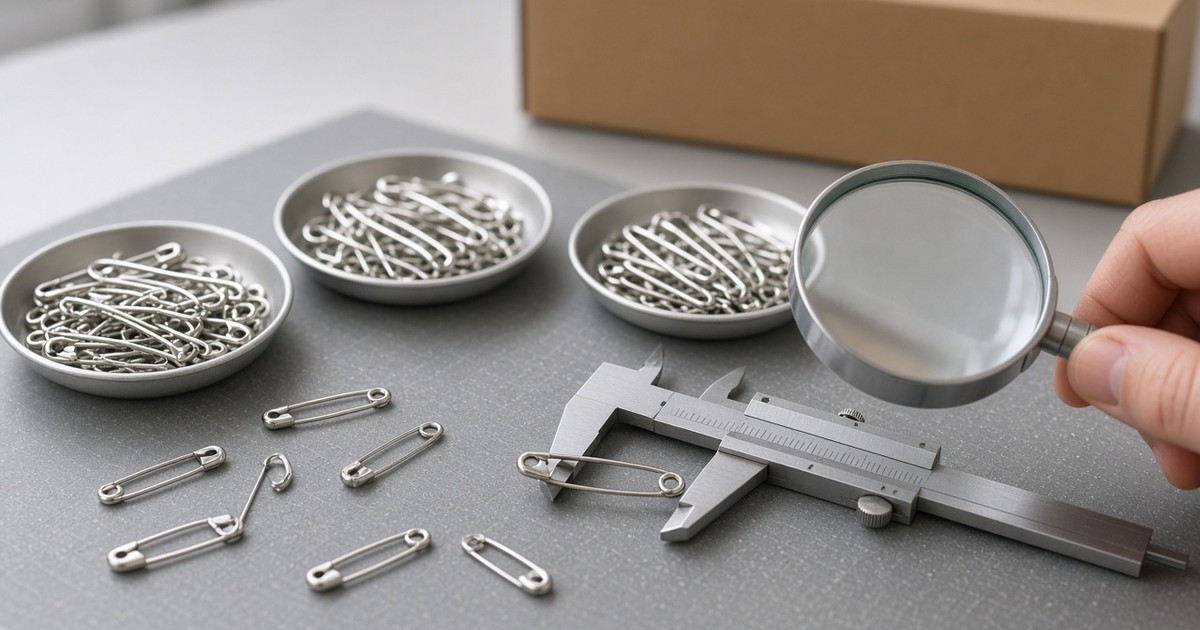
An inspector cannot reject a lot for "poor quality". The inspector can only count what your brief tells them to count. If the brief says "check the pins" and nothing else, the report will say little, and a dispute about whether a blunt point or a flaking finish is acceptable starts after the goods have shipped. The fix is a defect list, written before the order, that says what each defect is, how to check it and how serious it is.
This guide gives a starting library of safety pin defects, sorted into critical, major and minor, with a way to check each one and an explanation of how the classes connect to AQL sampling. It is for importers, wholesalers, garment factories and brand buyers who already know they want an inspection. Our guide to third-party pre-shipment inspection covers how to book and run one. This guide covers what goes into the defect list.
This is general buyer guidance, not a standard. We did not find a published standard that lists visual defects for safety pins, and ISO 2859-1 does not supply one. The classes below are a starting point for you to edit, not a limit that any inspection firm or Suvik Overseas applies automatically. The ISO pages and other sources were read on 29 November 2026.
The short answer
You write the defect list. ISO 2859-1:2026 gives the sampling system. It does not say what a good safety pin is or which flaws are serious.
Group defects into classes by seriousness. The standard talks about classes of nonconformity, such as Class A for the highest concern and Class B for the next, each with its own AQL. In the trade the classes are usually called critical, major and minor.
Give each class its own limit. A common approach is no critical defects accepted, a stricter AQL for major and a looser one for minor. The numbers are a commercial choice, not a rule of the standard.
Define how each defect is checked. "Blunt point" needs a method, such as a visual check or a trial on a named fabric, or the inspector and the factory will disagree.
Keep packing and counts separate from pin function. Short counts and carton damage are real defects, but they are found by counting and opening cartons, not by testing pins.
Put it all in the purchase order, with the edition of the standard, the lot definition and what happens if the lot fails.
Send us your inspection brief. If you already have a defect list, send it with your enquiry through the enquiry form.
What ISO 2859-1 does and does not say
ISO 2859-1:2026, third edition, published in January 2026, sets out sampling plans for inspection by attributes, indexed by acceptance quality limit (AQL). It replaces the 1999 edition and its amendments. ISO describes AQL as the maximum average percentage of defective items considered acceptable during random sampling, and says the standard uses it to determine sample sizes and acceptance and rejection thresholds.
Three points from the standard's text matter for a defect list.
Classes. In the definition of nonconformity, the standard notes that nonconformities will generally be classified by seriousness. Class A is "of the highest concern" and gets a very small AQL. Class B has "the next lower degree of concern" and can get a larger AQL, and further classes can follow. The number of classes and the AQL for each shall be appropriate to the situation. The contents list also includes a clause on a special reservation for critical classes of nonconformities. The words "critical", "major" and "minor" are trade usage for such classes.
Item or occurrence. The standard distinguishes counting nonconforming items from counting nonconformities per 100 items, and notes that an item can contain more than one nonconformity. Decide which you are counting.
AQL is not a promise. The standard notes that lots as bad as the AQL may be accepted with fairly high probability, and that setting an AQL does not suggest that level is desirable. A sample that passes does not prove the rest of the lot is free of defects. Our inspection guide makes the same point.
There is also no AQL column for zero. A rule such as "no critical defects" is something the buyer sets in the inspection protocol, and a QC provider's guide to the tables says any critical defect found puts the lot outside it.
How to define the three classes for safety pins
Use plain words that a factory inspector in any country can apply the same way.
Critical: a defect that can injure a user or a person handling the pins, or that makes the pin dangerous to use. For example, a broken wire, loose metal fragments, or a point not covered when the pin is closed.
Major: a defect that stops the pin doing its job or is likely to cause a return or a claim. For example, a pin that will not close properly, a blunt point, a size outside tolerance, or plating that flakes.
Minor: a defect that does not affect function or safety, such as a slight cosmetic variation inside the limit shown by the reference sample.
The same flaw can sit in different classes for different buyers. A pin that opens under light handling may be major for a pin used to hold a hang tag and critical for a pin worn against the skin. Decide by use, and write the use into the brief. A reference sample, sealed and signed, helps the inspector decide what "within limits" looks like.
A defect library to start from
Each entry gives what to look for, how to check it and a suggested class. The classes are our starting suggestions, not an industry list. Measure in millimetres, and take the limits from your specification.
Function
Open or non-closing pin. The point does not seat in the clasp, or the pin springs open when handled. Check by closing and opening a sample of pins several times and seeing that the point seats and the pin stays closed. Suggested class: major, or critical where the pins are worn or used on skin.
Weak or loose spring. The head or coil gives no resistance, or the pin is so stiff that it is hard to open. Check against the reference sample by hand. Suggested class: major.
Point not covered when closed. The point stands outside the clasp. Suggested class: critical.
Broken or cracked wire or head. Visible fracture or crack. Suggested class: critical.
Loose metal pieces in a pouch or box. Fragments or broken pins among good ones. Suggested class: critical.
Point and edges
Blunt, bent or hooked point. The point does not enter the intended fabric cleanly, or it catches. We did not find a single official sharpness test for safety pins, so agree a method: a visual check under good light, and for demanding uses a trial through a named fabric. Suggested class: major.
Burr or rough edge. A sharp ridge or roughness at the point, the cut end or the coil, found by visual check, with magnification if agreed. Suggested class: major, or critical if it could cut skin in the intended use.
Dimensions
Length out of tolerance. Measure the overall length of the closed pin with a calliper and compare with the millimetre figure and tolerance in your specification, not just the size number. Suggested class: major. Our size number guide explains why the size number alone is not enough.
Wire diameter out of tolerance. Measure with a micrometer or calliper at an agreed point. See what gauge is a safety pin. Suggested class: major.
Wrong size in a single-size pack, or wrong mix in an assorted pack. For example, size 1 pins in a size 0 pouch. Suggested class: major.
Finish
Plating peel, flake or blister. The finish lifts or shows base metal. Check visually in good light and compare with the reference. Suggested class: major.
Rust spots or staining. Visible rust on pins, pouches or the inside of the box. Suggested class: major. A visual check cannot prove how a finish will hold up in storage; for that you need a laboratory test, which is outside this list.
Uneven colour or gloss. Visible variation outside what the reference sample shows. Suggested class: minor, or major if the variation makes the lot look like a different product.
Light scratches or polish marks. Marks that do not expose base metal. Suggested class: minor.
Wrong material or finish. Pins of a material or finish your order does not allow. Suggested class: major, or critical if a compliance requirement is attached to the order.
Packing and counts
Short count. Fewer pieces in a pouch or box than the pack says. Count the pieces in pouches drawn from boxes in different cartons, and agree the tolerance. Suggested class: major.
Wrong pack, label, artwork or barcode. The label or printed pack differs from the approved artwork. Suggested class: major.
Torn or open pouches. Contents can escape. Suggested class: major.
Minor print scuffs. Marks on an outer carton that do not affect identification or protection. Suggested class: minor.
Cartons
Carton damage that exposes or endangers the contents. Crushed, torn or wet cartons. Suggested class: major.
Wrong or missing shipping marks. Marks that do not match the packing instructions. Suggested class: major.
Carton counts that do not match the packing list. Reconcile cartons with the packing list. Suggested class: major.
Nickel release and similar chemical or corrosion results are laboratory tests, not factory-floor checks. Our inspection guide explains the difference.
How the classes connect to AQL
Once the classes are fixed, each gets its own AQL. The sample size depends on the lot size and the inspection level, and the accept and reject numbers depend on the sample size and the AQL.
The example below is an illustration of how the tables work. It is not a recommendation and not a limit used by Suvik or any inspection firm. It follows a QC provider's reproduction of the ISO 2859-1 tables, for a lot of 3,201 to 10,000 pieces at general inspection level II, single sampling, normal inspection.
The code letter is L and the sample is 200 pieces.
For a class with AQL 2.5, the lot is accepted with up to 10 defects in the sample and rejected at 11.
For a class with AQL 4.0, the lot is accepted with up to 14 and rejected at 15.
For critical defects, the buyer's rule is zero: a single critical defect found means the lot is not accepted.
Safety pin lots can be far larger than that. By the figures on its own product page, one carton of the AROMI Size 0, 20 pouch holds 100,000 pieces (1,000 pieces per box and 100 boxes per carton). A lot of that size falls in a different row of the tables, so the sample size and the accept and reject numbers will differ. Define what a lot is in the order, and ask the inspection firm to state the plan it will use for your lot size, level and edition.
Some points to agree in writing:
What counts as one defect. One option is to count a pin with two faults once, by its most serious fault. Another is to count each fault. Agree one.
Separate samples. Pins, pouches and cartons are different things. Agree with the inspection firm how each is sampled: pins for function and finish, and inner boxes and cartons for packing and counts.
Reference sample. Seal one from the approved sample and send it to the inspector with the order.
Writing it into the purchase order
Add an annex to the purchase order with:
the defect list, with each defect, the check method and the class;
the sampling standard and edition, for example ISO 2859-1:2026, or the edition the inspection firm will apply;
the definition of a lot, the inspection level and the sampling plan type;
the AQL for each class, and the rule for critical defects;
the counting rule;
who appoints and pays the inspection firm, and when the inspection happens;
what happens to a failed lot: rework, sorting, rejection or acceptance under a written concession, and who pays for re-inspection;
the report format: photographs, sample size, defect counts by class and lot identification.
Our purchase order clauses guide, the RFQ template and the specification sheet template can help you assemble the rest.
Suvik Overseas's quality control page describes a final batch sampling audit under AQL before container loading and says third-party inspection companies can be coordinated at the facility. Ask which defect classes and AQLs the factory uses, and compare them with yours before production starts.
When defects turn up after arrival
If a problem appears after the goods arrive, keep the cartons, the pouches and the carton marks, photograph the defect, and compare it with the order, the approved sample and the inspection report. Our guide to the quality claim process for importers sets out the steps. A clear defect list makes it much easier to show what was agreed.
What this guide did not check
Any product-specific standard for safety pin defects in your market. If one applies, use it.
Brand or retailer quality manuals. Many have their own defect lists and AQLs, and they take priority.
Laboratory tests such as nickel release or corrosion testing.
The sample sizes for your lot. The tables are in the copyrighted standard, and the plan depends on your lot size and level.
Frequently asked questions
Does AQL 2.5 mean 2.5% of the pins may be defective? No. AQL sets the plan that decides whether a lot is accepted from a sample. A lot with more defects than the AQL can still pass by chance, and a passed sample does not prove the rest of the lot is free of defects.
Can I set the AQL for critical defects at zero? You can set a rule that any critical defect found means the lot is not accepted. That is a buyer's rule in the protocol, not a column in the standard.
Who decides what is critical, major or minor? You do, in the purchase order, ideally with the supplier and the inspection firm before production. The standard asks that classes and AQLs fit the situation.
Are packing defects as important as pin defects? They can be. A lot of perfect pins in damaged or mislabelled cartons can still be unsellable. Give packing and counts their own class entries.
What is the MOQ? MOQ is flexible and depends on size, finish and packaging. Tell us your quantity and we confirm.
Next step
If you are planning an order that will be inspected, send your sizes in mm, material and finish, pack format, quantity, your defect list or inspection brief, and the inspection firm if you have chosen one through the enquiry form or the contact page. Suvik Overseas manufactures safety pins and dress hooks at its factory in Howrah, West Bengal, India, and exports worldwide.
Sources
ISO, ISO 2859-1:2026, Sampling procedures for inspection by attributes, Part 1: third edition, January 2026, replaces the 1999 edition; AQL definition; sampling schemes. Read 29 November 2026.
ISO 2859-1:2026 preview, contents and introduction (ANSI Webstore): clause titles, including classification of nonconformities and the special reservation for critical classes. Read 29 November 2026.
ISO 2859-1:2026 catalogue page (iTeh Standards): extract of the terms and definitions, including the note on classes of nonconformity (Class A, Class B), the note on AQL, and the note on the term "defect". Read 29 November 2026.
MSC, AQL table and calculator: ISO 2859-1 sampling plans: reproduction of the single sampling table used in the illustration (code letter L, sample of 200; AQL 2.5 accepts 10, rejects 11; AQL 4.0 accepts 14, rejects 15), and the point that a zero-critical rule is the buyer's. A commercial QC provider's page, not the standard. Read 29 November 2026.
Suvik Overseas pages, read 29 November 2026: Quality control and the AROMI Size 0, 20 pouch product page.