
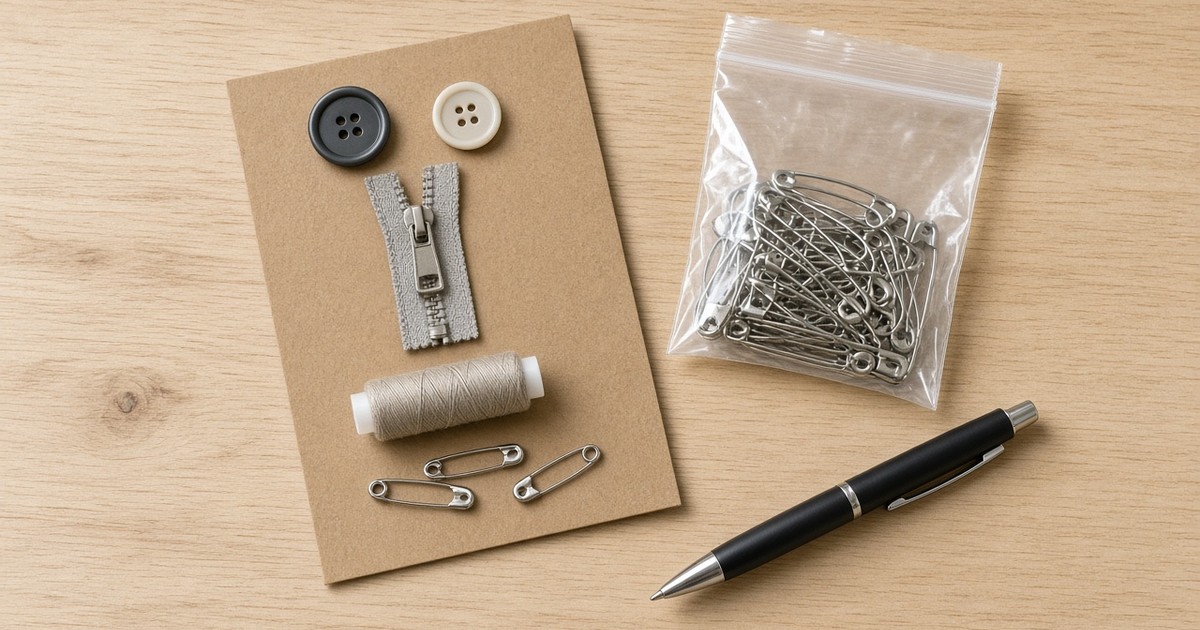
A garment factory that is told to buy its trims from a "nominated" supplier has lost a choice it normally has. The brand or buying house has decided who may supply a label, a button, a zip or, sometimes, a small metal item such as a safety pin. For a factory in Bangladesh, Vietnam, Cambodia or another garment-exporting country, that means the supplier of the pin may have to be approved before the order can be placed. For the safety pin manufacturer, it means a file, a sample, some tests and a wait.
This guide explains how that approval usually works, what a safety pin supplier should be ready to hand over, and which parts of the process are decided by the brand rather than by anyone else. It is written for garment factories, merchandisers, buying house staff and brand buyers who source safety pins from India. Our guide for garment manufacturers covers ordinary buying, and this one covers the case where a third party has to approve the supplier first.
This is general buyer information, not legal or compliance advice. Every brand and buying house has its own rules, and its own documents take priority over this guide. Suvik Overseas does not say in this guide that it is on any brand's approved or nominated list. The public documents and the merchandising guide cited below were read on 29 November 2026 and can change.
The short answer
"Nominated" means the buyer chooses the supplier. A merchandising guide for garment factories describes three levels of trim requirement: a nominated supplier, a brand standard, or "factory may source similar quality". Ask which one applies to your safety pins before you write to any supplier.
Nomination is not lot approval. A supplier can be on a list and still have each sample, each test and each bulk delivery checked.
The approved sample becomes the reference. In a typical process the buyer approves a trim card or sample, returns a signed copy, and bulk trims are judged against that copy and nothing else.
Lab tests are set by the brand. Brand chemical restriction lists differ. The AFIRM Restricted Substances List, which many apparel brands use as a base, sets a nickel release limit for metal parts in prolonged skin contact, but whether a small metal trim is in scope is the brand's call.
Any change needs fresh approval. A new plating, wire, pack or supplier is a new submission.
Send us the brand's requirements first. Tell us the brand, the buying house, the sizes in millimetres, the finish and the tests asked for through the enquiry form.
Who is involved
A nominated-trims order usually involves four parties, and it helps to know who does what before the first email.
The brand sets product and chemical requirements and decides what needs approval.
The buying house or agent, where there is one, often runs the approvals and quality checks on the brand's behalf.
The garment factory places the order for the trim, receives it, and sews or packs it into the garment.
The trim supplier, here the safety pin manufacturer, submits samples and documents and supplies the bulk.
Questions to settle in writing at the start: who places the purchase order, who pays, who receives complaints, and who carries the cost if a nominated trim is late or fails a test. These points differ between programmes, and we do not state a rule for any of them.
Step 1: Find out what is actually required
Before you submit anything, ask the factory or the buying house for:
the brand's list of approved or nominated trim suppliers, or the process for being added to it;
the brand's chemical restrictions or restricted substances list, with its version and date;
the test plan: which tests, on which materials, by which laboratories;
the approval stages and the dates by which they must be complete;
the packing, labelling and carton marking instructions for trims;
the name of the person who signs off each stage.
If the answer is "the factory may source it", you are in a normal buying situation and our specification sheet template is the best starting point.
Step 2: Prepare the supplier file
A buyer who approves a supplier will want to know who it is and what it can supply. A reasonable file for a safety pin supplier contains:
the legal name, registered office and factory location, and the registration numbers that can be checked on public registers (see our guide to checking a supplier's certificates);
a specification for each pin: length and wire diameter in millimetres with tolerances, material, finish, clasp and pack format;
photographs of the product and the packing;
material details and any test reports that exist for the pin, with the laboratory and date;
how production and final checks are organised, and whether a third-party inspection can be arranged;
the lead time and the minimum order for the size and pack.
Suvik Overseas manufactures safety pins and dress hooks at its factory in Howrah, West Bengal, India. Its company documents page lists its registrations and addresses, and its pages say material details and test reports are available on request. Its quality control page says third-party inspection companies can be coordinated at the facility before shipment. Tell us early which of these your approver needs, and which tests do not yet exist and would have to be commissioned.
A supplier that wants to be nominated should also check its pin against its own listing. For example, the AROMI Size 0, 20 pouch is listed as a 30 mm, 0.70 mm wire, nickel-plated mild steel pin, 1,000 pieces per box in 20 pouches of 50. The specification you submit should match the product page, the sample and the pack exactly.
Step 3: The sample and the trim card
Most programmes work through samples. The merchandising guide cited in the sources describes the sequence for trims in a garment order, and the same logic applies to a safety pin.
Trim card. The merchandiser attaches every trim to a card and labels it with item, size, colour, quality and supplier. A safety pin line on the card would name the length in mm, wire diameter, material, finish and pack.
Buyer review. The buyer, or the buying house quality team, checks the sample and trim card together. The usual outcomes are approved, approved with comments, or rejected.
Counter-approval. Many buyers keep one approved set and return a signed set to the factory. That signed set is the reference: bulk trims are judged against it.
Bulk only against the approved card. The purchase order to the supplier carries the approved specification in writing, with a photograph of the approved card.
No quiet substitutions. The guide says any substitute needs fresh buyer approval, however small it looks.
Bulk check on arrival. Bulk trims are checked in the factory store against the approved reference for quantity, size, appearance and function before any goes to the line.
For a safety pin supplier the practical lesson is to keep one sealed reference sample of what was approved, with the specification it was approved against, and to hold the same specification for every reorder. Our sample evaluation checklist lists what to compare when you receive a sample.
Step 4: The tests the brand asks for
This is the part most likely to differ between brands, so ask rather than assume.
Brand lists. H&M Group publishes chemical restrictions for textile products, accessories, footwear, bags and belts, and says its quality assurance covers production from raw materials to finished products and that testing is done by independent, accredited laboratories where required. Inditex's Clear to Wear 2026 standard is mandatory for garments, footwear, home textiles, fabrics and leather supplied to Inditex and for certain accessories such as handbags, belts and imitation jewellery, and it says the supplier alone is responsible for the compliance of what it supplies.
AFIRM. The AFIRM Restricted Substances List, version 11 (2026), is a shared industry list for apparel and footwear. For metal parts in prolonged skin contact it lists nickel release of 0.5 µg/cm²/week, tested to EN 12472:2020 and EN 1811:2023. AFIRM says individual brand lists may differ, that its list may also be applied to accessories, and that suppliers should check with their brand customers for the requirements.
Scope. Whether a safety pin used as a trim, a tag fastener or a packing aid falls inside any of these lists is a question for the brand. Do not assume that it does or that it does not.
Laboratory. Ask which laboratories the brand accepts and whether a test report must come from the brand's own programme. A report from a laboratory the brand does not accept may not count.
What is tested. Nickel release and similar chemical results are laboratory tests, not factory-floor checks. Our guide to third-party pre-shipment inspection explains the difference between an on-site inspection and a laboratory test.
Do not rely on a supplier's general statement that its pins "meet standards". Ask for the report, check that it names the product and the method, and check its date.
Step 5: Audit or visit
Some buyers audit a trim supplier before approving it, some rely on documents, and some do both. A supplier can ask what form the review will take and who will do it. If a visit is not practical, a live video call can fill part of the gap. Suvik's gallery page says prospective B2B clients and distributors may schedule in-person facility tours or request video demonstrations through its sales desk. Our guide to telling a manufacturer from a trading company lists what to ask when you verify who actually makes the pins.
Step 6: Pre-production and bulk
Approval stages typically lead into the garment's own pre-production sample and then into bulk. Plan the trim timeline backwards from the date the factory needs the trims in store.
Ask for the lead time from approval to delivery. Suvik's shipping policy gives ready-stock orders as dispatched within 3 to 5 business days of payment confirmation, made-to-order and custom packaging as 10 to 21 business days, and large export consignments as 15 to 30 business days including stuffing and documentation, with a peak production season from October to January. Ask Suvik to confirm which applies to your order.
Put the approved specification, the reference sample and the inspection requirement in the purchase order. Our purchase order clauses guide lists clauses worth adding.
If the brand or buying house inspects the lot, agree which inspection and which AQL, and see what an inspector checks.
Write a change clause: the supplier may not change the wire, plating, pack or place of manufacture without written approval.
Step 7: Importing the trims
Nomination does not remove the import steps. The factory, the buying house or the supplier still has to decide the Incoterm and the importer of record, and the factory's country has its own customs rules.
Read our guides for Bangladesh and Vietnam, and the Form AI guide for Vietnam.
If the importer of record is in the Philippines, read our guide to Bureau of Customs importer accreditation. It explains why accreditation comes before the first shipment.
See FOB, CIF and DDP before you agree who arranges and pays for freight.
For garment factories in the Philippines that want to know about sizes and needle-detection points, see our guide for Philippine garment exporters.
What this guide did not check
The rules of any particular brand or buying house, beyond the public documents cited. Ask for the current version of the documents that apply to your order.
Whether safety pins are listed as a trim, a packing item or an accessory in any brand's programme.
Rules for bonded warehouses, back-to-back letters of credit or other import schemes in garment-exporting countries. Ask your customs broker.
Test results for any Suvik product. This guide gives none.
Frequently asked questions
What is a nominated trims supplier? A supplier chosen or approved by the brand or buying house for a particular trim, so that the garment factory has to buy from it rather than choose freely. The details differ between brands.
Is Suvik Overseas a nominated supplier for any brand? This guide does not make that claim. If your brand or buying house asks for a safety pin supplier to be approved, send us its requirements and we will tell you what we can supply and which documents we can provide.
Does nomination mean that every delivery is accepted? No. The merchandising guide cited here says approval covers a specification, not a supplier forever, and that the first delivery of a repeat booking should be checked again.
What if the brand's test report must come from its own laboratory? Ask the brand which laboratories and test programmes it accepts before anything is submitted, and plan the time for the test.
What is the MOQ? MOQ is flexible and depends on size, finish and packaging. Tell us your quantity and we confirm.
Next step
If your brand or buying house has asked for an approved safety pin supplier, send the brand and buying house names, your sizes in mm, material and finish, pack format, quantity, the tests and laboratory required, the approval deadline and the destination country through the enquiry form or the contact page. Suvik Overseas manufactures safety pins and dress hooks at its factory in Howrah, West Bengal, India, and exports worldwide.
Sources
Textile Merchandising, Garment Trim Approval Process: Sample to Bulk Production Guide (published 23 October 2026): the three requirement levels for trims, the trim card, buyer approval outcomes, counter-approval, booking against the approved card, substitutes and bulk checks. A practitioner's guide, not an official standard. Read 29 November 2026.
AFIRM Group, Restricted Substances List, version 11 (2026): scope, legal statement on brand lists, nickel release for metal parts with prolonged skin contact (0.5 µg/cm²/week; EN 12472:2020 and EN 1811:2023). Read 29 November 2026.
H&M Group, Chemical restrictions: restriction list for textile products, accessories, footwear, bags and belts; testing by independent, accredited laboratories where required. Read 29 November 2026.
Inditex, Clear to Wear 2026: scope and supplier responsibility. Read 29 November 2026.
Suvik Overseas pages, read 29 November 2026: Company documents, Quality control, Gallery, Shipping and delivery policy and the AROMI Size 0, 20 pouch product page.