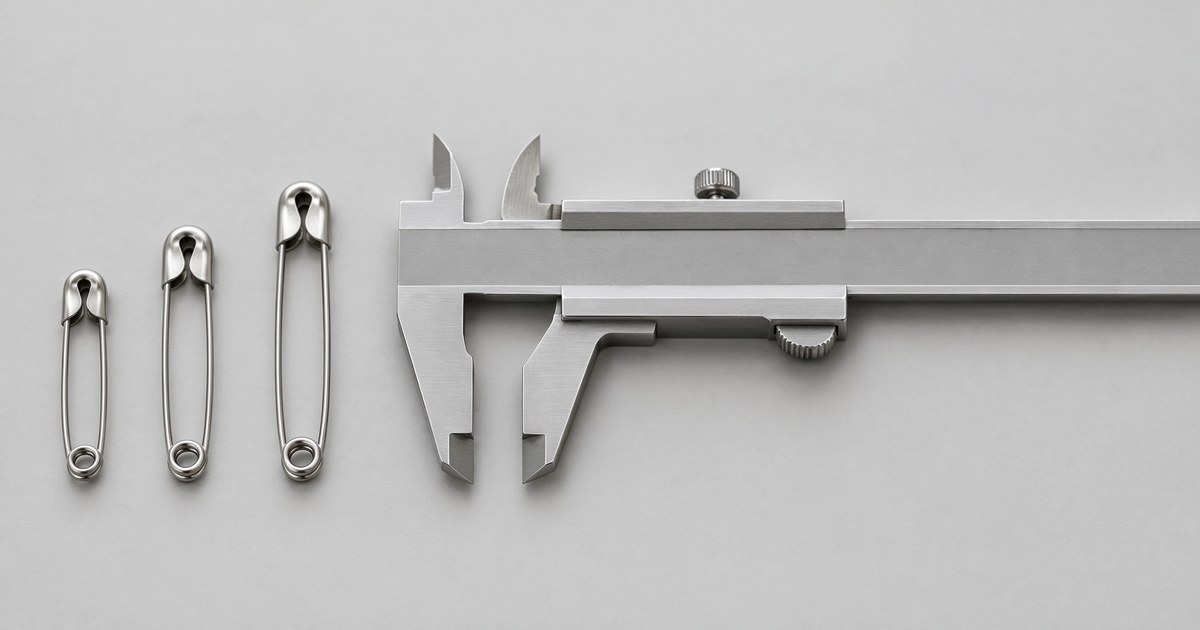
A buyer asks two suppliers for "size 0 safety pins". Both quote. Both send pins. One batch is a couple of millimetres longer than the other, the wire feels a little different, and the customer who has used the old pins for years notices at once.
Nobody made a mistake. Safety pin size numbers such as 000, 00, 0, 1, 2, 3 and 4 are a trade convention, not a measurement. They tell you roughly where a pin sits in a range. They do not tell you its exact length or wire thickness.
This article is for buyers who need to match a pin they already use, or compare pins from different suppliers. It shows real examples where one number has different lengths inside one manufacturer's own range, and gives a step-by-step method for matching a pin in millimetres.
If you only need a quick reference chart, use the safety pin sizes guide and the safety pin sizes chart in mm. This article explains what to do when your pin does not match a chart exactly.
This is general buyer guidance. Product lengths and wire thicknesses quoted below are taken from Suvik Overseas product pages checked on 16 November 2026. Specifications can change, so always confirm the current specification sheet for the series and size you are ordering before you place an order.
The short answer
A safety pin size number tells you the pin's place in a series, from the smallest (000) to the larger sizes (3 and 4). A higher number means a longer pin. That is all the number guarantees.
The length in millimetres for a given number is set by each manufacturer and, often, by each product series. Two series from the same factory can use different lengths for the same number. So for any order where size matters, write three things together:
The size number, for example "size 0".
The overall length in millimetres, for example "28 mm".
The wire diameter in millimetres, for example "0.70 mm".
Then ask the supplier to confirm those figures against its current specification sheet.
What the numbers mean (and do not mean)
A position in a range, not a dimension
The common range runs 000, 00, 0, 1, 2, 3 and 4. The extra zeros mean "smaller than 0", so 000 is smaller than 00, and 00 is smaller than 0. After 0, the numbers go up: 1, 2, 3, 4.
There is no single international standard that fixes "size 0 = X mm" for every maker. Each manufacturer builds its own series and assigns the numbers to its own lengths. Charts from different makers look broadly alike, but "broadly alike" is not good enough when a tagging line or a repeat customer expects the same pin every time.
Indicative charts versus series specifications
A general size chart gives indicative values, one length per number, to help you choose a size. Suvik's size guide, for example, lists indicative lengths of about 19 mm for 000, 23 mm for 00, 27 mm for 0, 32 mm for 1, 38 mm for 2, 46 mm for 3 and 54 mm for 4, and states that metric (mm) measurements are the primary manufacturing standard.
A product or series specification is different. It gives the length and wire thickness of a specific pin that you can order. When you are matching or reordering, the series specification is the figure that counts. The chart helps you narrow the search; the specification sheet is what you order against.
Millimetres first, inches second
Factories work in millimetres. Many buyers, especially in the United States, think in inches. The conversion is fixed: one inch is exactly 25.4 millimetres, as published by the U.S. National Institute of Standards and Technology (NIST). To convert millimetres to inches, divide by 25.4. To convert inches to millimetres, multiply by 25.4.
Inch fractions hide small differences. A 28 mm pin is about 1.10 inches and a 30 mm pin is about 1.18 inches; on a shelf label, both might be called "about 1 inch". Put the millimetre figure in your order, and add inches only as a reference if your customers need them.
Same number, different lengths: real examples from one manufacturer
The clearest way to see that the number is a convention is to look inside one manufacturer's own range. The table below uses the lengths and wire thicknesses published on Suvik Overseas product pages (checked 16 November 2026). Inch values are calculated by dividing millimetres by 25.4 and rounding to two decimals.
SizeSeries (product pages)Length (mm)Length (in, approx.)Wire (mm)000Brass (loose, black, gold, nickel-free)190.750.6600Brass (loose, black, nickel-free)230.910.6700Brass (gold)230.910.6600Liberal Gold Brass, Liberal Golden Mini230.910.670Liberal (loose), Liberal Prime, Liberal and Nilgiri assorted281.100.700AROMI, MAJOR, SALASAR301.180.701Liberal and Nilgiri assorted321.260.701AROMI, MAJOR, SALASAR assorted351.380.802Liberal and Nilgiri assorted371.460.802AROMI, MAJOR, SALASAR401.570.903Liberal441.730.904Liberal532.091.024AROMI, MAJOR, SALASAR532.091.10
Four things stand out.
1. The small sizes are the most consistent. In this range, every 000 listed is 19 mm and every 00 listed is 23 mm. If you buy the very small brass sizes, the number and the length line up closely. Even here, notice the wire: the gold-finish brass 00 page lists 0.66 mm while other 00 pages list 0.67 mm. A difference of a hundredth of a millimetre will not matter for most uses, but it shows why you read the page for the exact product, not just the size.
2. Size 0 splits into two lengths. The Liberal pages list size 0 at 28 mm. The AROMI, MAJOR and SALASAR pages list size 0 at 30 mm. Same number, same wire thickness, 2 mm apart. A buyer who reorders "size 0" without naming the series could receive either.
3. Sizes 1 and 2 differ in both length and wire. In the Liberal assorted and Nilgiri assorted packs, size 1 is 32 mm on 0.70 mm wire. In the AROMI assorted, MAJOR and SALASAR packs, size 1 is 35 mm on 0.80 mm wire. Size 2 follows the same pattern: 37 mm on 0.80 mm wire versus 40 mm on 0.90 mm wire. These pins will feel different in the hand, not just look different.
4. Same length can still mean different wire. At size 4, the Liberal size 4 and SALASAR size 4 pages both list 53 mm. But Liberal lists 1.02 mm wire and SALASAR lists 1.10 mm. For heavy fabric, laundry tagging or any use where the pin is opened and closed many times, the wire thickness can matter as much as the length.
The indicative chart values sit close to these series figures, as an indicative chart should. That is why the rule is simple: choose with the chart, order against the series specification.
Why the same number can mean different lengths
There are practical reasons why size numbers vary, even inside one company.
Series are designed for different jobs. A series made for garment factories, a series made for retail pouches and a brass series for delicate fabrics may each be built to a different length and wire for their own number.
Wire and length are set together. A slightly longer pin often uses slightly thicker wire to keep its spring. That is visible in the table: the longer size 1 and size 2 pins also use thicker wire.
Material changes the design. Brass and steel behave differently. The brass sizes in the table are the smallest in the range, while the steel series carry the larger sizes. If you want to compare the two materials, see our article on brass vs nickel-plated steel safety pins.
Wire thickness is often described as "gauge" in the trade. This article uses millimetres throughout, because gauge numbers bring their own conversion questions. When you match a pin, measure the wire in millimetres and put that figure in your order.
How to match a safety pin from another supplier: step by step
Use this method when you need to replace or second-source a pin you already buy, or when your customer sends you a pin and asks for "the same".
Step 1: Collect several pieces from current stock
Take five to ten pins, preferably from more than one box or batch, so you see the normal spread rather than one odd piece. Keep a few unopened boxes aside as your reference.
Step 2: Measure overall length with a caliper
A ruler is fine for a first look, but a caliper gives a much better reading at this scale. A basic digital or dial caliper is enough.
Close the pin and lay it flat.
Measure end to end, from the outside of the coil to the outside of the head (clasp).
Record each reading to one decimal place, for example 28.2 mm.
Note the smallest and largest readings, and the most common one.
Different suppliers may measure length slightly differently, so when you send your figure, say how you measured it ("closed pin, outside of coil to outside of head"). Ask the supplier to confirm it measures the same way.
Step 3: Measure wire diameter
Measure the wire on a straight part of the pin, away from the coil, the bend and the point. Use the caliper's outside jaws and close them gently; squeezing hard will give a low reading.
On plated pins, the figure you read includes the plating. That is fine for matching, because the supplier's finished pin will include plating too, but tell the supplier the pin is plated.
Record readings for several pins, as you did for length.
Step 4: Compare with the series specification sheet
Now compare your figures with the supplier's series specifications, not only the general chart.
If your pin measures about 28 mm with 0.70 mm wire, it sits close to a series that lists size 0 at 28 mm, 0.70 mm.
If it measures about 30 mm with 0.70 mm wire, it is closer to a series that lists size 0 at 30 mm, 0.70 mm.
If it falls between two series, or matches neither, say so. A custom specification may be possible, but confirm it in writing.
Ask the supplier for its current specification sheet for the series you are considering. On safety-pins.com, each product page shows the length and wire thickness for that product, and the catalogue lists the series.
Step 5: Check everything that is not length
Two pins with the same length and wire can still be different products. Before you call it a match, check:
Material: steel or brass. Ask the supplier to confirm it in writing.
Finish: nickel, gold, black or another finish. If your customers need nickel-controlled pins, see how to specify nickel-free safety pins.
Coil type: a standard coil or a coilless design. This changes how the pin catches threads; see coilless vs standard safety pins.
Head (clasp) shape and size: the head affects how the pin closes and how it looks on a card or tag.
Point: how sharp it is and how cleanly it enters your fabric.
Spring: how firmly the pin closes and whether it springs back after several openings.
Packing: pieces per box, boxes per carton, loose or carded. If you are comparing pack formats, our guide to order quantity in pieces, gross, boxes and cartons helps.
Step 6: Send a physical sample or a clear photo
The most reliable reference is a physical sample of your current pin, sent to the supplier with your measurements.
If you cannot send a sample, send clear photos:
Lay the closed pin flat next to a ruler marked in millimetres, with the zero mark at one end of the pin.
Shoot straight down, in good light, so the ruler and pin are in sharp focus.
Take a second photo showing the coil and head close up.
Add a photo of the box or card if the pack format matters.
A photo is less precise than a caliper reading, so send both if you can.
Step 7: Write the full specification into the RFQ
Do not write "size 0 safety pins" alone. Write the full line, for example:
Safety pin, size 0, overall length 28 mm (closed, outside of coil to outside of head), wire diameter 0.70 mm, steel, nickel finish, standard coil, packed [pieces] per box, [boxes] per carton, quantity [number], destination [port].
Adjust the figures to your own pin. Add inches in brackets only if your customers use them. Our safety pin RFQ template shows how to set out a full enquiry. When the quotes arrive, check that each supplier has quoted the same length and wire, not just the same size number; our guide to comparing safety pin export quotations covers what else to line up.
Also ask each supplier to state the dimensional tolerance it works to for length and wire, and to put it on the specification sheet. Do not assume a tolerance; get it in writing for your order.
Step 8: Approve a pre-production sample
Before bulk production, ask for a sample made to your written specification. Measure it the same way you measured your reference pins, and compare side by side. Test it on your own fabric or tag stock.
Once you are happy, sign and keep the approved sample and specification sheet. They become the reference for the bulk order and for any later reorder. Our sample evaluation checklist lists what to check, and the samples, quality and packing page explains how samples are handled. Samples are available on request; cost and lead time are shared on enquiry.
Common mistakes when matching sizes
Ordering by number alone. "Size 2" can mean 37 mm or 40 mm in one maker's own range. Always add millimetres.
Ignoring wire diameter. Two 53 mm pins can use 1.02 mm or 1.10 mm wire. The thicker wire will feel stiffer.
Using the chart as the order specification. Charts are for choosing a size. Order against the series specification sheet.
Rounding inches too early. "About 1 inch" can cover several millimetre lengths. Convert from millimetres and keep the millimetre figure on the order.
Skipping the pre-production sample. It takes a little time at the start and prevents disputes later.
Quick reference: matching checklist
CheckWhat to recordSize numberAs used by your current supplierOverall lengthmm, closed pin, how measured, readings from several pinsWire diametermm, measured on a straight sectionMaterialSteel or brass, confirmed by the supplierFinishNickel, gold, black, or other; any nickel requirementCoil and headStandard coil or coilless; head shapePackingPieces per box, boxes per carton, loose or cardedReferencePhysical sample or photo next to a mm rulerApprovalSigned pre-production sample and specification sheet
Frequently asked questions
Is size 000 smaller than size 0?
Yes. In safety pin numbering, extra zeros mean smaller. Size 000 is smaller than 00, and 00 is smaller than 0. On Suvik's product pages, brass size 000 is listed at 19 mm and brass size 00 at 23 mm, while size 0 is listed at 28 mm or 30 mm depending on the series.
How long is a size 0 safety pin in mm?
It depends on the manufacturer and the series. On Suvik's product pages, size 0 is 28 mm in the Liberal series and 30 mm in the AROMI, MAJOR and SALASAR series, both on 0.70 mm wire. Always confirm the length for the exact series you are ordering.
Are safety pin sizes standard across manufacturers?
No. The numbers 000 to 4 are a common convention, but there is no single standard that fixes the length for each number. Lengths can differ between manufacturers and between series from the same manufacturer. Specify the length and wire diameter in millimetres.
How do I convert safety pin sizes from millimetres to inches?
Divide the length in millimetres by 25.4, because one inch is exactly 25.4 millimetres. For example, 28 mm is about 1.10 inches and 53 mm is about 2.09 inches. Keep the millimetre figure as the order specification.
How do I measure a safety pin accurately?
Use a caliper. Close the pin, lay it flat and measure from the outside of the coil to the outside of the head. Measure the wire on a straight section away from the coil and point. Measure several pins and record the range.
What should I send a new supplier to match my current pin?
Send a physical sample if you can, plus your caliper measurements for length and wire diameter, the material, finish, coil type and pack format. If you cannot send a sample, send a clear photo of the pin next to a millimetre ruler. Then approve a pre-production sample before bulk production.
Next step
If you are matching a pin or comparing suppliers, send the size number, overall length and wire diameter in millimetres, material, finish, pack format, quantity and destination through the contact page or the enquiry form. A sample or photo of your current pin helps. Ask for the current specification sheet for the series that matches. Minimums are discussed per order.
Sources
U.S. National Institute of Standards and Technology (NIST), SI Units – Length, fetched 16 November 2026: the inch is exactly equivalent to 25.4 mm.
Suvik Overseas product pages, fetched 16 November 2026: lengths and wire thicknesses for the Brass, Liberal, Nilgiri, AROMI, MAJOR and SALASAR series (33 product pages; for example Brass size 000, Brass size 00, Liberal size 3).
Suvik Overseas, Safety Pin Sizes Guide, fetched 16 November 2026: indicative lengths per size number; metric as the primary manufacturing standard.
Suvik Overseas, Safety Pin Sizes: Complete Size Chart in mm, fetched 16 November 2026.
Live Suvik Overseas pages linked in the body, each checked on 16 November 2026 (see plan-2026-11/day16/linkcheck-2026-11-16.txt).