"What gauge is a safety pin?" sounds like a question with one number for an answer. It isn't. Safety pins are made from wire of different thicknesses depending on the size, the series and the material, and the word "gauge" itself means different things in different countries. A buyer in the UK may think in SWG, a buyer in the USA may think in AWG, and a factory in India or Asia will usually quote the wire in millimetres.
This guide is for importers, distributors and garment factories that buy safety pins in bulk. It explains what gauge means for a safety pin, how SWG and AWG convert to millimetres, the wire thicknesses listed for each size and series on Suvik Overseas product pages, how thickness changes performance, and how to write the wire specification so that two suppliers quote for the same pin.
Product figures in this guide (length, wire thickness, material and finish) were read from Suvik Overseas product pages on 18 November 2026. Gauge conversions use the published SWG table (BS 3737) and the AWG law in ASTM B258, with 1 inch = 25.4 mm exactly (NIST). Always confirm the current specification sheet for the series you order.
The short answer
There is no single gauge for a safety pin. Wire thickness depends on the pin's size, the series and the material.
On Suvik Overseas product pages, wire thickness runs from 0.66 mm to 1.10 mm. The smallest brass pins (size 000, 19 mm) use 0.66 mm wire. The largest steel pins (size 4, 53 mm) use 1.02 mm or 1.10 mm wire, depending on the series.
In gauge numbers, that range sits roughly between SWG 23 and SWG 18, or AWG 22 and AWG 17. Most of the listed thicknesses fall between two gauge numbers, not exactly on one.
A higher gauge number means thinner wire in both SWG and AWG, but the same number is a different diameter in each system. 20 SWG is 0.914 mm; 20 AWG is about 0.812 mm.
For export orders, specify wire thickness in millimetres, and treat any gauge number as a reference only. Send your size, length and wire diameter through the enquiry form to get a quote against a clear specification.
What "gauge" means for a safety pin
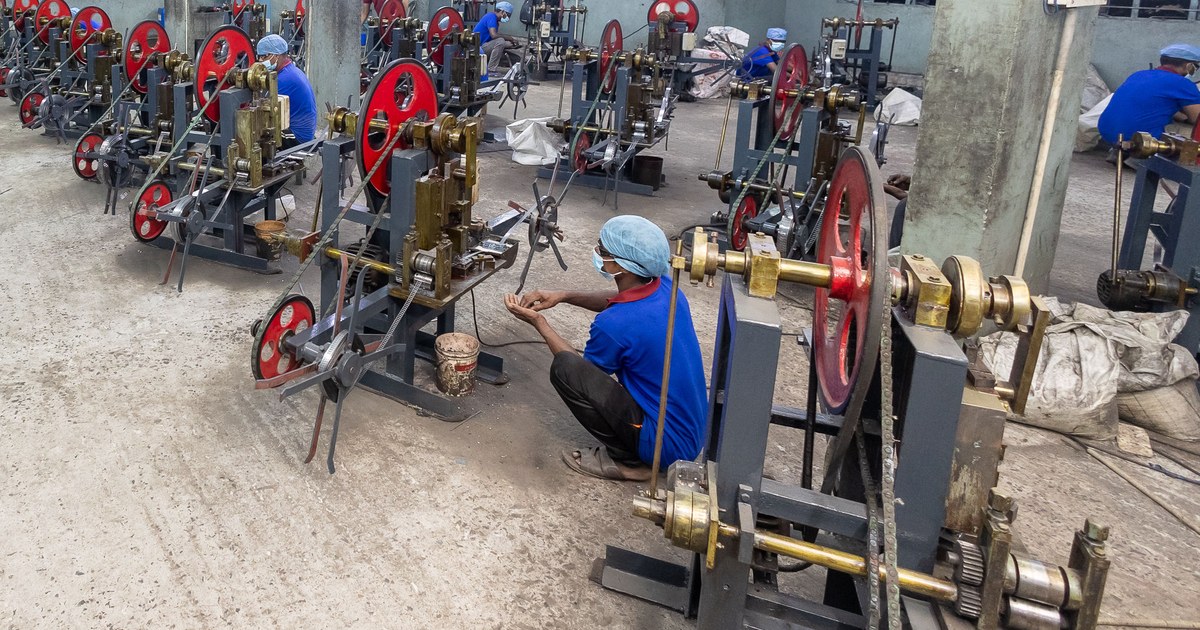
The gauge of a safety pin is the diameter of the wire the pin is formed from. A standard safety pin is made from one length of wire: one end is sharpened into the point, the wire is wound into a spring coil at the base, and the other end is held by the head (also called the clasp or cap) that covers the point when the pin is closed. The manufacturing walkthrough shows each stage, from wire drawing and cutting to coiling, head fitting and plating.
Because the coil, the shank and the point are all formed from the same wire, the wire diameter controls most of what a buyer cares about:
how stiff the pin feels and how far it bends before it springs back,
how much fabric or how many layers it can hold,
how large a hole it leaves in fabric,
how easily it pierces dense or coated materials.
Length is the other main dimension, and it is what the size number (000, 00, 0, 1, 2, 3, 4) describes. Size numbers and gauge numbers are separate systems. A size 2 pin is not "gauge 2". For more on size numbers, see what safety pin size numbers mean in millimetres.
Why gauge numbers confuse buyers
Three points cause most gauge confusion in purchase orders.
The number runs backwards
In both common systems, a higher gauge number means a thinner wire: 18 gauge is thicker than 22 gauge.
Different systems, different diameters
The two systems you are most likely to meet are:
SWG (Standard Wire Gauge, also called British Standard Wire Gauge or Imperial Standard Wire Gauge). It was fixed in the UK by Order in Council in 1883 and later defined in British Standard BS 3737:1964, which has since been withdrawn. You will still see SWG in older British, Commonwealth and South Asian trade documents.
AWG (American Wire Gauge, also called Brown & Sharpe). It is defined in ASTM B258 for solid round wires used as electrical conductors. It is common in North America, where some buyers apply it to any round wire.
The same number gives a different diameter in each. At gauge 20, SWG is 0.914 mm and AWG is about 0.812 mm, a difference of about 0.10 mm. On a safety pin, that is the difference between two neighbouring sizes in some series. Other, older gauge systems also exist, which is one more reason to keep gauge numbers off a purchase order.
Steps between gauges are coarse
Gauge numbers are steps, and safety pin wire is often drawn to a millimetre figure that falls between two steps. A wire of 0.66 mm, for example, sits almost exactly halfway between 23 SWG (0.610 mm) and 22 SWG (0.711 mm). If a buyer orders "22 gauge" and the supplier makes 0.66 mm wire, both can argue that they are right. A millimetre figure removes the argument.
Gauge to millimetre conversion: SWG and AWG
These are the standard published values for the gauge range that covers safety pin wire. SWG values are the table values in inches converted at 1 inch = 25.4 mm. AWG values are calculated from the AWG law used in ASTM B258, rounded to three decimal places.
SWG (Standard Wire Gauge) to mm
18 SWG: 0.048 in = 1.219 mm
19 SWG: 0.040 in = 1.016 mm
20 SWG: 0.036 in = 0.914 mm
21 SWG: 0.032 in = 0.813 mm
22 SWG: 0.028 in = 0.711 mm
23 SWG: 0.024 in = 0.610 mm
24 SWG: 0.022 in = 0.559 mm
AWG (American Wire Gauge) to mm
17 AWG: 0.0453 in = 1.150 mm
18 AWG: 0.0403 in = 1.024 mm
19 AWG: 0.0359 in = 0.912 mm
20 AWG: 0.0320 in = 0.812 mm
21 AWG: 0.0285 in = 0.723 mm
22 AWG: 0.0253 in = 0.644 mm
23 AWG: 0.0226 in = 0.573 mm
How the AWG numbers are calculated
AWG is a geometric series. AWG diameters follow a fixed formula, the AWG law on which the ASTM B258 table is based: the diameter of gauge n is 0.005 inch × 92^((36 − n) / 39). Each step of one gauge changes the diameter by about 12%, and six steps roughly halve it. SWG is a fixed table rather than a formula, so its steps are not perfectly even. To convert any inch figure to millimetres, multiply by 25.4.
Wire thickness by size and series on Suvik Overseas product pages
These figures are from the "Detailed Specifications" section of each live product page, read on 18 November 2026. The nearest gauge equivalents are added for reference. Where a thickness falls between two gauges, both are shown.
AROMI, SALASAR and MAJOR series (nickel-plated steel)
These three series share the same length and wire steps:
Size 0: 30 mm long, 0.70 mm wire (close to 22 SWG; between 22 and 21 AWG). See AROMI Size 0.
Size 1: 35 mm long, 0.80 mm wire (close to 21 SWG and 20 AWG). Listed in the AROMI, SALASAR and MAJOR assorted packs.
Size 2: 40 mm long, 0.90 mm wire (close to 20 SWG and 19 AWG). See SALASAR Size 2.
Size 4: 53 mm long, 1.10 mm wire (between 19 and 18 SWG; between 18 and 17 AWG). See MAJOR Size 4; the AROMI and SALASAR size 4 pages list the same figures.
LIBERAL and NILGIRI series
The Liberal series is mainly nickel-plated steel. It uses shorter lengths for the same size numbers and, at some sizes, different wire:
Size 00: 23 mm long, 0.67 mm wire (between 23 and 22 SWG; close to 22 AWG). Listed for both Liberal Golden Mini (mild steel) and Liberal Gold Brass, size 00.
Size 0: 28 mm long, 0.70 mm wire. See Liberal Size 0 (Loose).
Size 1: 32 mm long, 0.70 mm wire. Listed in the Liberal assorted pack.
Size 2: 37 mm long, 0.80 mm wire. Listed in the Liberal assorted pack.
Size 3: 44 mm long, 0.90 mm wire. See Liberal Size 3.
Size 4: 53 mm long, 1.02 mm wire (close to 19 SWG and 18 AWG). See Liberal Size 4.
The Nilgiri assorted pack lists the same steps as Liberal for sizes 0, 1 and 2: 28 mm, 32 mm and 37 mm, on 0.70 mm, 0.70 mm and 0.80 mm wire.
Brass series
The brass range covers the two smallest sizes, in silver, gold, black and nickel-free silver finishes:
Size 000: 19 mm long, 0.66 mm wire (about halfway between 23 and 22 SWG; close to 22 AWG). See Brass Size 000 (Loose).
Size 00: 23 mm long, 0.67 mm wire on the silver, black and nickel-free pages, and 0.66 mm on the gold page. See Brass Size 00 (Loose).
What these figures tell a buyer
The same size number can use different wire. Size 4 is 1.10 mm wire in AROMI, SALASAR and MAJOR but 1.02 mm in Liberal. Size 1 is 0.80 mm in AROMI but 0.70 mm in Liberal. If you only write "size 4" or "size 1", you have not fixed the wire.
Wire thickness rises with length, but not one-for-one. In Liberal, sizes 0 and 1 share 0.70 mm wire even though size 1 is 4 mm longer.
Small pins sit close together. The brass size 000 and the size 00 pins are all at 0.66 to 0.67 mm, so for tiny pins the choice is mostly about length, material and finish.
The general size chart is indicative. The safety pin sizes guide shows a typical industry-style chart of lengths and wire gauges. For ordering, use the series figures on each product page and the current specification sheet, as the size chart article also advises.
How wire thickness changes a safety pin's performance
Wire thickness is a trade-off. No published standard ties a safety pin's wire diameter to a holding force, so the points below are general engineering behaviour, not test results. Test samples on your own fabric or packaging line before you fix a specification.
Thicker wire (around 0.90 mm to 1.10 mm)
Stiffer, so the pin bends less under load and holds its shape after repeated opening.
Better for heavy or layered materials: denim, canvas, towelling, blankets and laundry nets or bags.
Leaves a larger hole, which matters on fine or coated fabrics.
Usually paired with longer pins (sizes 2, 3 and 4), adding weight per carton.
Thinner wire (around 0.66 mm to 0.80 mm)
Pierces fine fabrics with a smaller hole: shirting, silks, knits and lightweight garments.
Suits tagging, folding and attaching price tickets, where many pins go into each garment and a small, light pin is enough.
Bends more easily if it is used on heavy material or forced through thick layers.
Material and finish matter as well
Brass and steel wire of the same diameter do not behave the same way. Steel is generally stiffer, while brass does not rust. The brass vs nickel-plated pins comparison covers durability and corrosion. Plating adds a thin layer to the surface, so when you compare suppliers, ask whether the stated diameter is measured before or after plating.
Choosing wire thickness for your application
Use these as starting points for sampling, not as fixed rules:
Garment tagging, ticketing and folding in factories: small to mid sizes on 0.70 mm to 0.80 mm wire, such as size 0 or size 1. Garment exporters sourcing from India can see the factory-buyer angle in the Philippines garment exporters guide and the Vietnam import guide.
Fine fabrics, bridal, lingerie and delicate tags: the brass 000 and 00 pins on 0.66 to 0.67 mm wire, or a steel size 00.
General haberdashery and retail assortments: assorted packs that combine sizes 0, 1 and 2, so the end user gets a range of wire thicknesses from 0.70 mm to 0.90 mm in one box.
Heavy garments, upholstery and industrial uses: size 3 or size 4 on 0.90 mm to 1.10 mm wire.
Commercial laundry and textile rental: size 4 on 1.02 mm or 1.10 mm wire. The industrial laundry guide explains what else laundries should check.
Need a quote for a specific wire thickness? Send the size, length and wire diameter you need through the enquiry form. Suvik Overseas will confirm which series matches, or whether a custom specification is possible.
How to measure a safety pin's wire diameter
If you are matching a pin from another supplier, measure it rather than relying on the label.
Use a digital caliper or, better, a micrometer that reads to 0.01 mm. A ruler cannot measure wire diameter.
Measure the straight shank, midway between the coil and the head. Do not measure across the coil (that gives two thicknesses plus a gap) or near the point (which is tapered).
Measure at least five pins from different boxes and note the range, not just one figure.
Measure plated and unplated samples separately if you have both, because plating adds a small amount.
Record the closed length too, and write both figures in millimetres, for example "length 40 mm, wire 0.90 mm".
The sample evaluation checklist covers what else to check on a sample: point sharpness, closure, coil, plating and packing.
How to write wire thickness into an enquiry or purchase order
A clear wire line prevents most disputes about "wrong gauge" deliveries:
State wire diameter in millimetres first, for example "wire diameter 0.80 mm".
If you also give a gauge, name the system: "0.80 mm (approx. 21 SWG)". Never write "21 gauge" on its own.
Ask the supplier for its tolerance in writing, and whether the figure is before or after plating.
Fix the series as well as the size, because the same size number uses different wire in different series.
Reference the approved sample in the purchase order, so production is checked against a physical pin.
A ready-made layout for these points is in the safety pin RFQ template. You can also download the product catalogue to see each series and pack format before you write your enquiry.
Common mistakes
Ordering by gauge number alone, without saying SWG or AWG, or without a millimetre figure.
Comparing "size 4" quotes without checking the wire: 1.02 mm and 1.10 mm pins are different products.
Measuring across the coil or the point, which gives a wrong diameter.
Choosing the thickest wire "to be safe" for fine fabrics, which leaves visible holes.
Frequently asked questions
What gauge is a standard safety pin?
There is no single standard. On Suvik Overseas product pages, wire thickness runs from 0.66 mm (brass size 000) to 1.10 mm (steel size 4). A common mid-size pin, size 1 or size 2, uses 0.70 mm to 0.90 mm wire depending on the series, which is about 22 to 20 SWG or 21 to 19 AWG.
Is a higher gauge number thicker or thinner?
Thinner. In both SWG and AWG, the wire gets thinner as the gauge number goes up. 18 SWG (1.219 mm) is thicker than 22 SWG (0.711 mm).
What is the difference between SWG and AWG?
They are two separate gauge systems. SWG is the British Standard Wire Gauge (BS 3737) and AWG is the American Wire Gauge defined in ASTM B258. The same number gives a different diameter: 20 SWG is 0.914 mm, while 20 AWG is about 0.812 mm.
How do I convert safety pin gauge to mm?
Use a published table for the gauge system named on the document, or convert from inches by multiplying by 25.4. For example, 21 SWG is 0.032 inch, which is 0.813 mm. If the system is not named, ask the supplier for the diameter in millimetres.
Can I order a safety pin with a different wire thickness?
Ask for it in your enquiry. Suvik Overseas states on its sizes guide that it can make pins to a buyer's length, wire gauge and material specification. Feasibility, minimums and lead time for a custom wire are confirmed per enquiry.
Do brass safety pins use thinner wire than steel?
In the current range, the brass pins are the small sizes (000 and 00) and use 0.66 to 0.67 mm wire, which is similar to steel size 00 pins. Brass is chosen mainly for rust resistance and finish rather than for a different wire thickness.
Next step
If you import, distribute or use safety pins in production, send the sizes, lengths, wire diameters in millimetres, material, finish, pack format, quantities and destination port through the enquiry form. If you are matching an existing pin, include your caliper measurements or a photo next to a ruler, and ask for samples so you can test the wire on your own fabric while the quotation is prepared. Suvik Overseas Pvt. Ltd. was incorporated in 2006 and manufactures safety pins at its factory in Chamrail, Howrah, West Bengal. Minimums are discussed per order.
Sources
Suvik Overseas product pages linked above: lengths, wire thicknesses, materials and finishes from each page's "Detailed Specifications" section. Read 18 November 2026.
Standard wire gauge (Wikipedia): SWG table in inches and millimetres per BS 3737:1964, and the 1883 Order in Council. Read 18 November 2026.
ASTM B258, Standard Nominal Diameters and Cross-Sectional Areas of AWG Sizes of Solid Round Wires Used as Electrical Conductors: scope of the AWG standard. AWG diameters calculated from the AWG law, 0.005 in × 92^((36 − n) / 39). Read 18 November 2026.
NIST, SI Units: Length: 1 inch = 25.4 mm exactly. Read 18 November 2026.