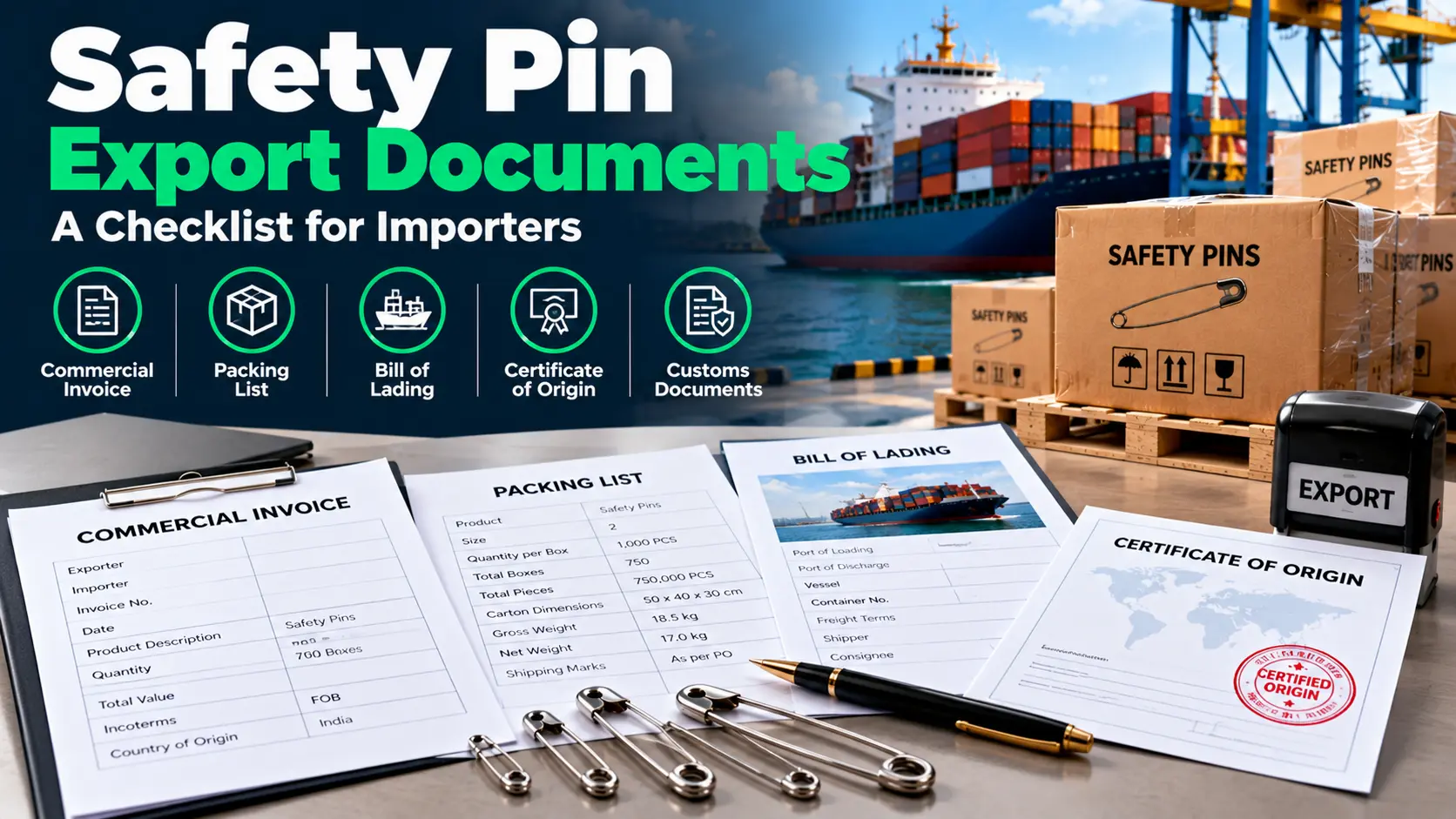
Quick answer: what documents do you need to import safety pins from India?
Most shipments need a commercial invoice, a packing list and a transport document (bill of lading for sea freight, air waybill for air freight). Many also need a certificate of origin, and some need insurance documents, a product specification sheet or inspection records. The exact list depends on the destination country, the shipping method, the Incoterm and what you agreed in the purchase order. Agree the document list with your exporter and customs broker before dispatch.
Why export documents matter
Documents tell customs what is in the shipment, who is buying and selling, how it is packed and what it is worth. If the invoice and packing list do not match, your broker may need corrections, which can delay clearance and add handling cost. Accurate paperwork is especially important for repeat orders, private-label shipments and container loads.
The core documents
1. Commercial invoice
The commercial invoice records the sale. Check the exporter and importer names and addresses, invoice number and date, product description, quantity and unit, unit price and total value, currency, country of origin and the agreed Incoterm. The product description should be specific, for example "steel safety pins, size 2, nickel-plated, packed in boxes", not just "hardware".
2. Packing list
The packing list shows how the goods are packed: number of cartons, boxes per carton, pieces per box, carton dimensions, net and gross weight and shipping marks. Pay attention to the difference between boxes, cartons, pieces and gross. They are not interchangeable. See the quantity conversion guide.
3. Bill of lading or air waybill
A bill of lading is used for sea freight. An air waybill is used for air freight. Check the consignee, notify party, port of loading, port of discharge, cargo description, package count and freight terms. Confirm how the original documents will be released to you.
4. Certificate of origin
A certificate of origin states where the goods originate. Whether you need one depends on the destination country, customs procedures and whether you are claiming a trade agreement preference. A certificate does not automatically reduce duty. Confirm the format and issuing body that your customs authority accepts.
5. Insurance document
If the shipment is on CIF or CIP terms, the seller arranges insurance. On FOB or EXW terms, you usually arrange it yourself. Confirm who insures the cargo and obtain the policy or certificate.
6. Product specification and inspection records
A specification sheet describing size, material, wire thickness, finish and packing can support your customs declaration and your own quality checks. If you need an inspection report or material certificate, agree this in the purchase order before production. See quality control and testing.
Customs classification (HS code) for safety pins
Safety pins and other pins of iron or steel are commonly classified under Harmonized System heading 7319.40 at the six-digit level. Countries then add their own digits. For example, the United States tariff schedule has a separate line for safety pins within 7319.40, and the UK Trade Tariff publishes a ten-digit commodity code for the same heading. Pins made from brass or other copper alloys are not covered by this heading.
Do not copy a code from another supplier's invoice. Your customs broker is responsible for confirming the correct classification, duty rate and any additional duties for your product, country of origin and date of import.
Country-specific points to check
United States
Tariff classification and duty, including any additional duties currently in force
Country-of-origin marking on the goods or packaging
Importer security filing for ocean shipments, handled by your broker or forwarder
Labelling for retail packs
United Kingdom and European Union
An EORI registration number for the importer
Commodity code, duty and VAT treatment
Product-safety labelling and importer details on consumer packs
Canada and Australia
Customs broker or importer account requirements
Duty and sales tax treatment (GST)
Any packaging or labelling rules for retail products
United Arab Emirates and Saudi Arabia
Importer registration, customs declaration requirements and any attested documents requested by your clearing agent
Arabic or bilingual labelling requirements for retail packs, if applicable
Africa and South-East Asia
Pre-shipment or conformity programmes that some countries require, so ask your clearing agent early
Importer registration or import licence requirements, which vary by country
These lists are a starting point, not legal advice. Requirements change, so confirm them with your broker for each shipment.
Checklist before dispatch
Product description matches the purchase order
Sizes, material and finish are correct
Box and carton counts are accurate
Commercial invoice and packing list agree with each other
Consignee and notify party are correct
Port of loading and discharge are correct
Incoterm is shown correctly
Certificate of origin requirement is confirmed
HS classification has been reviewed by your broker
Insurance arrangements are clear
Any agreed inspection report is ready
Document request template
Subject: Export documents for our safety pin order
Hello, for our order please confirm which documents you will provide: commercial invoice, packing list, bill of lading or air waybill, certificate of origin, product specification sheet, inspection records if agreed and insurance documents if applicable. Please also confirm carton quantity, pieces per box, gross and net weights, Incoterm and estimated dispatch date. Our destination is your country and port. Regards, your name and company.
Frequently asked questions
Is a certificate of origin always required?
No. It depends on the destination country, the customs procedure and whether you claim a preference. Confirm before dispatch.
Does the exporter decide the import duty?
No. Duty depends on the classification, origin and tariff of the importing country. The exporter provides the commercial and product information. Your broker confirms duty.
Does every shipment need a quality certificate?
No. It depends on your contract, your customer requirements and the rules of your market. Agree it in the purchase order if you need one.
Which Incoterm should I choose?
For sea freight, FOB and CIF are common. For containers, many buyers also consider FCA and CIP. The Incoterm decides who pays for freight and insurance and who handles export clearance, so compare quotes on the same basis. See comparing export quotations.
Next step
Share your destination, packaging and document requirements at the quotation stage through the Suvik Overseas enquiry form. Use the RFQ template to include them, and read how to import safety pins from India for the full process.