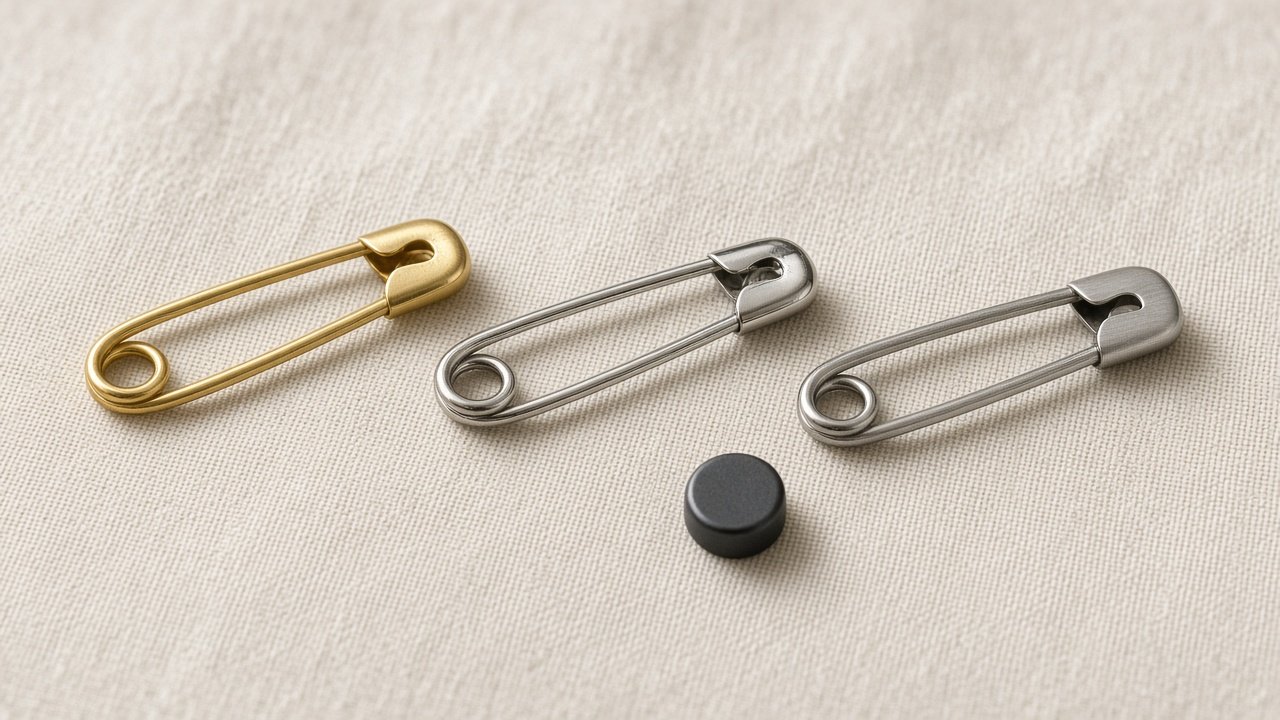
A safety pin that rusts on a stored garment, bends in thick fabric or stains a pale textile has already failed, even if it looked fine in the sample pack. Buyers choosing a material are usually trying to avoid that kind of failure, not pick a metal that "sounds premium". This guide is for wholesalers, garment factories, laundry suppliers and brand buyers who need to choose between solid brass, nickel-plated steel and stainless steel, and then write that choice into an order.
It complements our existing brass versus steel guide, which compares those two families in general terms. Here the question is narrower: which construction lasts longer in a given job, once you separate nickel-plated carbon steel from stainless steel instead of calling both "steel". For stainless grades, sizes and quoting detail, stay with the stainless steel buyer guide. For how to test a sample, use the sample evaluation checklist.
This is general materials guidance for buyers, not a laboratory report or a lifespan guarantee. The comparisons below rest on how these constructions are described on Suvik Overseas's live guides and product pages, checked on 9 November 2026, and on ordinary metal behaviour (iron can rust; a plating is a surface layer; brass contains no iron). This article does not invent hours, years, salt-spray ratings or test results. Confirm the grade, finish and any corrosion test you need with the sales team before you order.
Quick answer
There is no single longest-lasting pin. "Lasts longer" depends on whether the pin will see moisture, abrasion, heavy fabric or repeated opening, and on whether a rust stain would ruin the goods.
Nickel-plated steel is the usual workhorse for dry indoor garment tagging, haberdashery and cost-sensitive bulk packs. The steel core is strong. The nickel layer is what holds back rust. If that layer wears, chips or is scratched through, the iron underneath can rust and stain fabric.
Solid brass does not rust, because brass contains no iron. It can tarnish or take on a patina, and it is softer than steel, so it is more likely to bend or dull on thick or abrasive work. It suits wet, humid or long-storage jobs where a rust stain is unacceptable and the load is moderate. See the specialty brass range.
Stainless steel resists corrosion through the wire itself, not only a coating. Live catalogue and guide pages mention grades such as 304 and 316. It is the usual choice when you need both strength and wet-service durability (laundry, outdoor, marine canvas, many healthcare settings). Name the grade. "Stainless" is not a complete specification, and it is not the same as "nickel-free".
Do not judge a pin by colour. Steel is often plated gold or brass-coloured. A household magnet is a first check: solid brass is non-magnetic; steel (including most stainless grades used for pins) is attracted to a magnet. Confirm the written specification as well.
Write the material on the RFQ (solid brass, nickel-plated steel, or stainless with a grade), then approve a sample against that wording. Minimum order quantity is negotiable and depends on size, finish and packaging.
What "lasts longer" actually means
Buyers often ask for the pin that lasts longest as if that were one property. In practice a pin can fail in different ways.
Rust and staining. Carbon steel contains iron. Unprotected iron oxidises in moisture, sweat or humid storage and can leave a stain that will not come out of pale fabric. Nickel plating slows that down while the coating is intact. Brass cannot form iron rust. Stainless steel is alloyed so the metal itself resists corrosion, though performance still depends on the grade and the environment.
Mechanical life. A pin that never rusts but bends in canvas, loses spring in the coil or will not stay shut has not lasted. Steel (nickel-plated or stainless) is the stronger family. Brass is softer and more likely to warp or dull on heavy or repeated use, which the brass-versus-steel guide also notes.
Appearance. Some buyers care that the pin still looks bright after storage or washing. Brass may tarnish. Plated steel can dull or show base metal where the coating wears. Stainless usually keeps a consistent metallic look if the grade matches the conditions.
Reuse cycles. A single-use garment tag and a laundry pin that is opened every wash are different jobs. Repeated opening stresses the coil. The engineering and design guide describes coil fatigue and clasp wear as ways a pin can fail even when the metal has not rusted.
So the useful question is: what would make this pin fail in my customer's hands? Choose the construction that removes that failure, then specify it.
Nickel-plated steel: strong, economical, protected by a coating
Most everyday safety pins are carbon steel with a nickel (or similar) electroplated finish. Suvik's types of safety pins guide describes nickel-plated pins as a bright, smooth, affordable option for general household and retail use. The engineering guide lists nickel-plated steel as high in tensile strength with good corrosion resistance from that surface protection, typically for household use and commercial retail tagging.
Why it lasts well in the right job. The steel core gives rigidity, a durable point and a snappy coil. For dry shops, garment tagging, packing and indoor retail, that combination is usually enough, and it is the most economical of the three for bulk orders.
How it stops lasting. The rust resistance lives in the plating, not in the core. If the coating is thin, uneven, scratched in use, or worn by repeated friction (laundry, abrasive fabrics, rough handling), moisture can reach the steel. The brass-versus-steel guide puts it plainly: if plating chips or wears off, the underlying iron can rust. That rust is what stains fabric.
What this means for a buyer. Treat nickel-plated steel as a coated product. Ask for even coverage and inspect samples for bare spots, roughness or flaking, as the quality control guide recommends. If the pins will sit in humidity, go through industrial washing, or stay on stored garments for months, do not assume the coating will outlast the job. That is when brass or stainless becomes the durability choice, not a luxury upgrade.
Nickel plating is also a separate issue from nickel sensitivity. If a customer needs nickel-free pins (babywear, some medical or sensitive-skin lines), say so explicitly. A nickel-plated pin is not nickel-free, and a stainless grade such as 304 is an alloy that typically includes nickel, so "stainless" alone does not answer a nickel-free request.
Solid brass: it will not rust, but it is a softer metal
Solid brass safety pins are made from brass wire (a copper-zinc alloy), not steel with a gold wash. Because brass contains no iron, it cannot rust in the iron-oxide sense. Suvik's brass product page and the brass-versus-steel guide both describe solid brass as rust-proof through the pin, including if the surface is scratched, which is the important contrast with plated steel.
Why it lasts well in the right job. Commercial laundry, damp storage, humid climates and long-term garment holding are the classic cases. A rust stain on expensive inventory is often costlier than the extra metal. Brass is also non-magnetic, which matters in a few medical and electronics settings.
How it stops lasting. Brass can tarnish or develop a darker or greenish patina in air and moisture. That is not rust, and some craft or vintage users like it, but a brand that wants a lasting bright gold look should say so and approve a sample after handling, not only out of the box. Brass is also softer than steel. Under heavy tension, or through leather, layered canvas or repeated piercing of tough fabric, it is more likely to bend and its point can dull sooner. For those jobs, stainless (or a heavier steel pin in dry conditions) will "last" in the mechanical sense even if brass would win on rust.
Colour is not proof. Steel pins are often electroplated to look golden. The magnet test in the next section is the first screen; the order should still say solid brass, not only "gold" or "brass finish".
Stainless steel: corrosion resistance in the wire, if you name the grade
Stainless steel safety pins are formed from stainless wire rather than carbon steel with a coating. Corrosion resistance is a property of the alloy, so a scratch does not expose an iron core the way a worn nickel layer does. The types guide calls stainless (for example SS304) a combination of high tensile strength and strong corrosion resistance, used in medical environments, commercial laundries and marine applications. The engineering guide lists stainless steel 304/316 as high strength with excellent corrosion resistance for medical, marine canvas and outdoor gear.
Why it lasts well in the right job. When the pin must stay strong and stay rust-resistant in wet, outdoor or repeatedly washed use, stainless is usually the construction that covers both failure modes. That is the gap the two-way brass-versus-steel comparison leaves open: brass resists rust but is softer; ordinary plated steel is strong but depends on a coating.
Grade is part of durability. Live Suvik pages mention AISI 304 and AISI 316 as catalogue examples. Those grades are not interchangeable by name alone. 316 is commonly specified where chlorides or harsher wet service matter (the brass-versus-steel guide refers to marine-grade stainless such as SS316 for laundry or wet environments). This article does not rank them with test numbers. Specify the grade that matches the job and ask the manufacturer to confirm it, as the stainless buyer guide advises.
What stainless is not. It is not automatically nickel-free. It is not a substitute for a written specification. Different grades, finishes and wire sizes perform differently, which the sample checklist also warns: do not assume every stainless, plated or brass product has the same corrosion performance.
Head-to-head: which construction lasts in which job
Question
Nickel-plated steel
Solid brass
Stainless steel (grade as specified)
Where rust resistance comes from
A surface coating
The metal itself (no iron)
The alloy itself
What happens if the surface is scratched
Steel core can rust if the coating is broken
No iron rust; may show brass colour or later tarnish
No carbon-steel core under a coating; grade still matters
Strength and point life
High (steel core)
Moderate; more prone to bending and dulling
High
Magnetic?
Yes
No
Typically yes (common pin grades)
Typical durability fit
Dry indoor tagging, retail and everyday bulk
Humidity, laundry, long storage, moderate loads
Wet, outdoor, laundry or mixed strength-plus-corrosion jobs
Relative cost (general)
Most economical
Higher than standard steel
Higher than standard plated steel
Main way it "fails to last"
Plating wear, then rust stains
Bending, dulling or unwanted tarnish
Wrong grade for the environment, or treating the name as a full spec
This table is a buying frame, not a lab ranking. If two constructions would both survive the job, price, appearance and nickel content may decide the order. The types guide's short answer to "what material lasts the longest" points to high-grade stainless such as SS304 or SS316 as the usual balance of strength and corrosion resistance. That holds when the risk is rust and mechanical load together. For a dry, high-volume tagging line, nickel-plated steel may last for the whole commercial life of the pin at a lower cost. For stored luxury garments in humidity, brass may last in the only way that matters: it will not leave an iron stain.
The magnet test, and why colour misleads
Because steel is frequently plated to look gold or silver, colour is a poor guide to what you were shipped.
A household magnet is a practical first check. The brass-versus-steel guide notes that steel pins snap to a magnet, while solid brass does not react.
Most stainless safety-pin grades are also magnetic enough to attract a magnet, so a magnetic pin is not proof that you received cheap plated steel. It only rules out solid brass.
If you scratch a plated "gold" pin and see yellowish metal underneath, that can be a brass-coloured coating, not solid brass. Do not use destructive checks on an approved reference sample you need to keep.
The purchase order should say solid brass, nickel-plated steel, or stainless steel plus the grade. Appearance words such as gold, silver or bright nickel describe finish, not the core.
How to specify the material so the lasting choice is what you receive
Put the construction in the RFQ, not only in a conversation. The RFQ template already asks for material and finish; treat that line as a durability decision.
Include at least:
Construction: solid brass, nickel-plated steel, or stainless steel.
Grade if stainless (for example 304 or 316), rather than "stainless" alone.
Finish if it is separate from the core (nickel-plated, polished, and so on).
Size as a code and a length in millimetres. See the sizes chart.
Application: dry garment tagging, industrial laundry, outdoor canvas, long-term storage, retail pack, or other. The application tells the factory why you chose the metal.
Any nickel-free requirement, written as its own line.
Quantity, packaging and destination, so the quote matches the lot you will actually repeat.
Minimum order quantity is negotiable and depends on size, finish and packaging. Ask for a confirmed figure with the specification rather than treating any website example as a fixed rule.
How to check that the sample will last in your conditions
A visual check cannot prove long-term corrosion resistance. The quality control guide says so directly: if corrosion matters, ask what test is used (for example a salt-spray test) and what result applies to your product. Agree the method and the pass mark in writing. This article does not invent a test duration or an acceptance number.
On the sample itself, using the sample evaluation checklist and the quality guide:
Confirm the material matches the wording on the quotation (and use the magnet test as a brass screen).
Inspect plating or finish for even coverage, scratches, roughness and flaking.
Open and close a run of pins and note weak springs or clasps that will not stay shut.
Try the pin on the actual fabric, including any wet or storage condition you can safely reproduce.
Keep the approved sample as the reference for later shipments.
If you are comparing two materials, test them on the same fabric and the same handling, not by memory of how each looked in the packet.
Frequently asked questions
Which safety pin material lasts the longest?
It depends on the job. For wet or outdoor use where the pin must also stay strong, stainless steel in a suitable grade (pages on this site mention 304 and 316) is the usual longest-lasting choice. For humidity and storage where the main risk is an iron rust stain and the load is moderate, solid brass lasts in the way that matters because it cannot rust. For dry indoor tagging and everyday retail, nickel-plated steel often lasts for the commercial life of the pin if the plating is sound.
Do nickel-plated steel safety pins rust?
They can, if moisture reaches the steel core through wear, chips or thin or damaged plating. While the nickel layer is intact they resist rust much better than bare steel. They are not rust-proof in the same sense as solid brass or a suitable stainless grade.
Do brass safety pins rust?
Solid brass pins cannot form iron rust, because brass contains no iron. They can tarnish or develop a patina. A gold-coloured pin may be brass-plated steel, so confirm it is solid brass.
Is stainless steel better than brass?
Not for every job. Stainless is stronger and keeps corrosion resistance in the wire, which suits laundry, outdoor and heavy fabric in wet conditions. Brass will not rust and is non-magnetic, but it is softer and more likely to bend. Choose from the failure you need to avoid.
Does "stainless steel" mean the pin is nickel-free?
No. Common austenitic grades used for pins, including 304, contain nickel in the alloy. If you need nickel-free pins, write that as a separate requirement and ask the manufacturer to confirm what they can supply. Do not treat "stainless" as the answer to a nickel-allergy specification.
How can I tell brass, nickel-plated steel and stainless apart?
Start with the written specification and an approved sample. A magnet rules out solid brass (brass is non-magnetic) but does not separate nickel-plated steel from most stainless pin grades. Colour is unreliable because steel is often plated gold or silver. For a production order, ask the manufacturer to confirm the construction and, for stainless, the grade.
Choose the material, then make the order match it
Pick the construction from the job: nickel-plated steel for dry, high-volume work; solid brass when an iron stain is unacceptable and the load is moderate; stainless steel, with a named grade, when you need strength and corrosion resistance together. Then put that wording on the RFQ, approve a sample and keep the sample as the standard for repeat orders.
If you already know the size, material and destination, send an enquiry with that specification, or use the RFQ template to ask for a quotation.
Sources
Brass Safety Pins vs Steel Safety Pins: Which is Better? (live, checked 9 November 2026)
Engineering and Design of Safety Pins (live, checked 9 November 2026)
Types of Safety Pins: Complete Guide to Sizes, Materials and Uses (live, checked 9 November 2026)
Specialty brass safety pins (live, checked 9 November 2026)
Stainless Steel Safety Pin Manufacturer in India (live, checked 9 November 2026)
Safety Pin Sample Evaluation Checklist (live, checked 9 November 2026)
Safety Pin Quality Control and Inspection Guide (live, checked 9 November 2026)
Safety Pin RFQ Template (live, checked 9 November 2026)