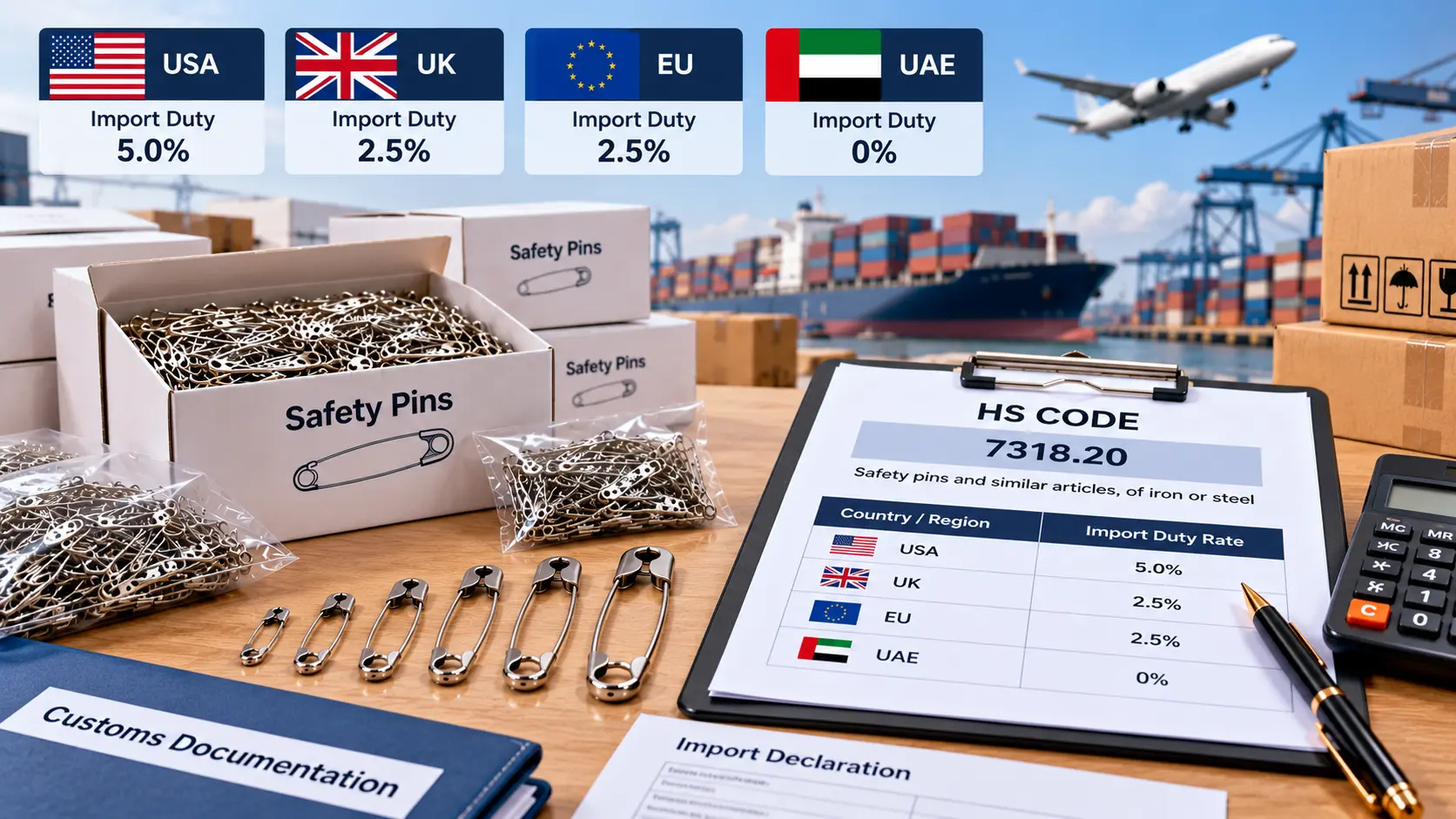
Import duty is often the line that decides whether a safety pin quotation from India works for you. It can be close to zero in one market and more than half the goods value in another. This guide gives the HS code for steel safety pins and the duty rates we read on each official tariff on 3 November 2026, for the United States, the United Kingdom, the European Union and the United Arab Emirates. It also shows what each rate is charged on, so you can put the right figure into your cost sheet. For a full line-by-line cost build for the US, see our worked example of landed cost from India to the USA.
Duty rates were read on official government tariff sources on 3 November 2026 and can change at any time. This guide is general information, not a customs ruling or legal advice. Confirm the classification and the rate for your exact product, origin and import date with a licensed customs broker or the customs authority before you order.
Duty on steel safety pins from India at a glance (3 November 2026)
United States: 4.5% general duty plus a 50% Section 232 steel duty, both on the customs value: 54.5% in total, plus CBP fees.
United Kingdom: 0% for goods that qualify as Indian origin under the UK-India trade agreement. The standard rate is 2%. Import VAT of 20% is charged as well.
European Union: 2.7%. The official EU tariff lists no preferential rate for India on this code. Import VAT is charged at the rate of the EU country of import.
United Arab Emirates: customs duty is generally 5% of the CIF value, and VAT is 5%. We could not confirm the exact line rate or the India-UAE agreement rate for safety pins (see below).
All four figures assume the pins are made of iron or steel (including stainless steel) and are of Indian origin.
The HS code for safety pins: 7319.40
At the six-digit Harmonized System (HS) level used worldwide, safety pins of iron or steel are classified under 7319.40, "Safety pins and other pins". It sits in heading 7319, which covers sewing needles, knitting needles and similar articles of iron or steel, and safety pins and other pins of iron or steel. Each country then adds its own digits:
United States (HTSUS): 7319.40.20, "Safety pins". Statistical suffixes split pins "on cards" (7319.40.20.10) from "other" (7319.40.20.50). Dressmakers' or common pins have their own line (7319.40.30), so check the line matches what you are buying.
United Kingdom (UK Trade Tariff): commodity code 7319 40 00 00, "Safety pins and other pins".
European Union (Combined Nomenclature / TARIC): 7319 40 00 00.
UAE (GCC integrated tariff): the UAE moved to 12-digit GCC codes in 2025. The first six digits are still 731940. Ask your clearing agent for the full 12-digit code.
Material matters. Heading 7319 covers pins of iron or steel only. Stainless steel is steel, so stainless safety pins normally fall here too. Solid brass safety pins are made of copper alloy and are classified in a different chapter of the tariff, with different rates. This guide does not cover brass, so ask your broker for the correct code before you order brass pins. For the documents that carry the code, see our safety pin export documents and HS code guide.
United States: 4.5% plus the 50% Section 232 steel duty
General duty: 4.5%. In the current Harmonized Tariff Schedule of the United States (2026 Revision 22, effective 30 October 2026), subheading 7319.40.20 "Safety pins" has a general duty rate of 4.5%. India is not one of the special-rate programmes listed for this line, so the general rate applies.
Section 232: plus 50% on the full value. Steel safety pins are on the US list of steel derivative articles. Subheading 7319.40.20, described as "Iron or steel, safety pins", is in Annex I-A ("50% Section 232 Tariff on Full Value") of Proclamation 11021 of 2 April 2026, and again in Annex I-A of Proclamation 11032 of 1 June 2026. The HTSUS entry for heading 9903.82.02 shows the duty for these articles as "the duty provided in the applicable subheading + 50%". So steel safety pins from India pay 4.5% + 50% = 54.5% of the customs value.
What does not apply today:
The 10% Section 301 duty on goods of India (in force since July 2026) excludes steel derivative articles that fall under heading 9903.82.02, so it does not stack on top of the Section 232 duty.
US Customs stopped collecting the earlier IEEPA tariffs from 24 February 2026.
What the duty is charged on. The US charges duty on the transaction value, which excludes international freight and insurance. In practice that is close to the FOB value.
CBP fees on top. A formal entry also pays the Merchandise Processing Fee: 0.3464% of value, with a minimum of US$34.58 and a maximum of US$670.86 in fiscal year 2027. Ocean shipments also pay the Harbor Maintenance Fee of 0.125%. Our US landed cost worked example shows how these lines add up.
United Kingdom: 0% under the UK-India agreement, if the goods qualify
Standard rate: 2%. On the UK Trade Tariff, commodity code 7319 40 00 00 has a third-country duty of 2.00%, in force since 1 July 2026.
Preferential rate for India: 0%. The UK-India Comprehensive Economic and Trade Agreement (CETA) entered into force on 15 July 2026. The UK Trade Tariff lists a 0.00% tariff preference for goods of Indian origin on this code from that date. To claim it, the goods must meet the agreement's rules of origin, and you need valid proof of origin from the exporter. For chapter 73 (articles of iron or steel), the product-specific rule in Annex 3A of the agreement is a change of tariff heading plus a minimum qualifying value content, so ask your supplier to confirm the pins qualify and which origin document they will provide. Without a valid claim, the 2% rate applies.
The tariff also lists a 0% rate for India under the UK's Developing Countries Trading Scheme (DCTS). The UK government announced on 4 September 2026 that India will leave the DCTS after a two-year transition, so plan around the trade agreement rate.
Import VAT: 20%. Import VAT is charged on top of duty. It is calculated on the customs value plus the duty and incidental costs to the first UK destination.
What the duty is charged on. The UK customs value includes transport, insurance and loading costs up to the place the goods enter the UK, so it is close to a CIF value. For the step-by-step process, see our guide to importing safety pins from India to the UK.
European Union: 2.7%, with a steel-input document to prepare
Duty: 2.7%. The EU's TARIC database (reference date 3 November 2026, last updated 30 October 2026) shows a third-country duty of 2.70% for code 7319 40 00 00. It lists no preferential rate for goods originating in India on this code. The EU-India free trade agreement was concluded in January 2026, but it has not entered into force, so it gives no duty reduction yet.
Steel-input evidence. TARIC also lists an import control on this code for all non-EU countries, linked to the EU's Russia sanctions on iron and steel products (Council Regulation (EU) No 833/2014). One of the documents listed for clearance is "evidence of the country of origin of the iron and steel inputs used for processing of the product in a third country" (code Y824). Ask your supplier in advance for a mill test certificate or a declaration showing where the steel wire came from, so your customs agent can complete the declaration.
Low-value e-commerce charges. From 1 November 2026, TARIC also lists a EUR 3 per item customs duty and a EUR 2 Union handling fee. These apply only to low-value consignments (EUR 150 or less) sold in distance sales or sent by post, not to a normal B2B commercial import.
Import VAT. Import VAT is charged at the rate of the EU country where the goods are released, usually on the customs value plus duty.
What the duty is charged on. EU customs value normally includes transport and insurance up to the point where the goods enter the EU, so it is close to a CIF value.
United Arab Emirates: generally 5% of CIF
Customs duty: generally 5%. The UAE applies the GCC common customs tariff. The UAE government portal states that customs duty in Dubai is 5% of the CIF value, except for alcohol and tobacco. It also says government tariffs range from 0 to 5%. We could not open the line-level rate for 7319.40 in the UAE's online tariff tool on 3 November 2026, so confirm the exact rate for your 12-digit code with your clearing agent or through the Federal Authority for Identity, Citizenship, Customs and Port Security (ICP) commodity search.
India-UAE CEPA. The UAE-India Comprehensive Economic Partnership Agreement has applied in Dubai since 1 May 2022 (Dubai Customs Policy 54/2022). Under it, UAE duties on Indian-origin goods are removed or cut according to the UAE's tariff schedule (Annex 2B), with a certificate of origin. We were not able to confirm from an official source whether, or how far, safety pins are covered. Ask your clearing agent whether a CEPA rate applies to your code before you rely on 5% or 0%.
VAT: 5%. The standard VAT rate in the UAE is 5%, and it applies to imports.
How to estimate the duty on your order
Fix the material and the code. For steel or stainless steel pins, start from 7319.40 and get the national line from your broker. For brass, get a separate classification.
Use the right value base. The US charges duty on the transaction value (close to FOB). The UK, the EU and the UAE charge it on a value that includes freight and insurance to the border (close to CIF). Ask your supplier to show freight and insurance separately on the invoice.
Apply the rate for Indian origin, and check the preference. Use the rate that matches the origin of the goods and whether you hold the proof needed to claim a preferential rate.
Add the extras. That means CBP fees in the US, import VAT in the UK, EU and UAE, and broker and port charges everywhere.
A simple illustration. Assume a shipment worth 10,000 in your currency on FOB terms, with 1,000 of freight and insurance. These numbers are an assumption for illustration only, not a Suvik Overseas price or a freight quote. On the rates read on 3 November 2026:
US: 54.5% of 10,000 = 5,450 in duty, before CBP fees.
UK with a valid CETA origin claim: 0 duty. Without one: 2% of 11,000 = 220. Import VAT is then due on the total.
EU: 2.7% of 11,000 = 297, plus import VAT.
UAE at the general rate: 5% of 11,000 = 550, plus 5% VAT. The rate could be lower if a CEPA preference applies to your code.
The gap between markets is wide, and so is the cost of choosing the wrong code or missing an origin document. That is why the classification and paperwork are worth agreeing before the order is placed.
Documents that change the duty you pay
Commercial invoice with a clear product description (for example "nickel-plated steel safety pins"), the HS code your supplier uses, and freight and insurance shown separately.
Proof of origin if you claim a preferential rate (UK-India CETA, India-UAE CEPA). Agree the exact document with your broker before dispatch.
Steel-input evidence for EU imports (mill test certificate or supplier declaration).
Packing list that matches the invoice, so customs can check the quantities.
Our guide on how to import safety pins from India covers the full process from RFQ to clearance.
FAQ
What is the HS code for safety pins?
Safety pins of iron or steel are classified under HS 7319.40, "Safety pins and other pins". The US line is 7319.40.20, and the UK and EU code is 7319 40 00 00. Brass safety pins are classified elsewhere, so ask your broker for their code.
What is the import duty on safety pins in the USA?
As of 3 November 2026, steel safety pins under HTSUS 7319.40.20 pay a 4.5% general duty plus a 50% Section 232 duty on the full customs value, 54.5% in total, plus CBP fees. The 10% Section 301 duty on Indian goods does not apply on top for these steel derivative articles.
Are safety pins from India duty-free in the UK?
They can be. Since the UK-India trade agreement entered into force on 15 July 2026, the UK Trade Tariff lists a 0% rate for Indian-origin goods under code 7319 40 00 00, if the goods meet the rules of origin and you hold valid proof of origin. Otherwise the standard rate is 2%. Import VAT of 20% applies in both cases.
What is the EU import duty on safety pins from India?
The EU's TARIC database shows 2.7% for code 7319 40 00 00, with no preferential rate for India as of 3 November 2026. The EU-India trade agreement has been concluded but is not yet in force. Import VAT is charged at the rate of the country of import.
What import duty does the UAE charge on safety pins?
The UAE generally charges 5% customs duty on the CIF value, plus 5% VAT. Goods of Indian origin may qualify for a lower rate under the India-UAE CEPA, depending on the UAE's tariff schedule. Confirm the rate for your exact code with your clearing agent.
What is the minimum order for safety pins from Suvik?
Suvik's MOQ is negotiable and depends on the size, finish and packaging. Share your requirements to get a confirmed figure.
Get a quotation you can cost
Send Suvik Overseas your sizes, material, finish, packaging, quantity, destination country and preferred Incoterm. The team will prepare a quotation and share the product and origin details your broker needs to confirm the code and the duty. Request a quote
Sources
All sources are official government or EU pages, checked on 3 November 2026 unless stated.
USITC, Harmonized Tariff Schedule (2026 Revision 22, effective 30 Oct 2026), 7319.40.20 Safety pins, general rate 4.5%: https://hts.usitc.gov/search?query=7319.40 (data read via https://hts.usitc.gov/reststop/search?keyword=7319.40)
USITC, Harmonized Tariff Schedule, heading 9903.82.02 ("+ 50%"): https://hts.usitc.gov/reststop/search?keyword=9903.82.02
Proclamation 11021 of 2 April 2026, 91 FR 18201, Annex I-A (7319.40.20 at p. 18214): https://www.federalregister.gov/documents/2026/04/09/2026-06960/strengthening-actions-taken-to-adjust-imports-of-aluminum-steel-and-copper-into-the-united-states
Proclamation 11032 of 1 June 2026, 91 FR 34085, Annex I-A (7319.40.20 at p. 34095): https://www.federalregister.gov/documents/2026/06/04/2026-11314/further-adjusting-the-tariff-regimes-for-imports-of-aluminum-steel-and-copper-into-the-united-states
USTR, Notice of Actions in Section 301 Investigations, 91 FR 47318 (28 July 2026), Annex I(f), p. 47362 (exclusion for 9903.82.02): https://www.federalregister.gov/documents/2026/07/28/2026-15181/notice-of-actions-in-section-301-investigations-of-acts-policies-and-practices-of-various-economies
CBP CSMS #67834313, Ending Collection of IEEPA Duties: https://content.govdelivery.com/accounts/USDHSCBP/bulletins/40b11c9
CBP User Fee Table (MPF, HMF): https://www.cbp.gov/trade/basic-import-export/user-fee-table
CBP, Customs User Fees To Be Adjusted for Inflation in Fiscal Year 2027: https://www.federalregister.gov/documents/2026/07/31/2026-15530/customs-user-fees-to-be-adjusted-for-inflation-in-fiscal-year-2027
UK Trade Tariff, commodity code 7319400000 (third-country duty 2.00% from 1 July 2026; India tariff preference 0.00% from 15 July 2026; VAT 20%): https://www.trade-tariff.service.gov.uk/commodities/7319400000
GOV.UK, Historic UK-India Free Trade Agreement is now in effect (17 July 2026): https://www.gov.uk/government/news/historic-uk-india-free-trade-agreement-is-now-in-effect
GOV.UK, UK-India CETA Annex 3A, Product Specific Rules of Origin (chapter 73): https://assets.publishing.service.gov.uk/media/687e5e378adf4250705c96db/uk_india_ceta_annex3a_product_specific_rules_of_origin.pdf
GOV.UK, Country Graduation from the Developing Countries Trading Scheme: India (4 Sep 2026): https://www.gov.uk/government/publications/country-graduation-from-the-developing-countries-trading-scheme-india
GOV.UK, Delivery costs to include in the customs value: https://www.gov.uk/guidance/delivery-costs-to-include-in-the-customs-value
GOV.UK, Working out the VAT value using the customs value of the imported goods: https://www.gov.uk/guidance/working-out-the-vat-value-using-the-customs-value-of-the-imported-goods
European Commission, TARIC measures for 7319400000, origin India, reference date 3 Nov 2026 (third-country duty 2.70%; import control CD864 with document Y824; low-value consignment duty and Union handling fee from 1 Nov 2026): https://ec.europa.eu/taxation_customs/dds2/taric/measures.jsp?Lang=en&SimDate=20261103&Area=IN&Taric=7319400000
European Commission, The EU-India trade agreement (status and next steps): https://commission.europa.eu/topics/trade/eu-india-trade-agreement_en
UAE Government portal, Customs duty and tariff (updated 28 Oct 2026): https://u.ae/en/information-and-services/finance-and-investment/taxation/clearing-the-customs-and-paying-customs-duty
Dubai Customs, Customs Policy No. 54/2022 on the UAE-India CEPA (effective 1 May 2022): https://www.dubaicustoms.gov.ae/en/PoliciesAndNotices/Policies/DCP54_2022.pdf
UAE Federal Tax Authority, standard rate of VAT: https://tax.gov.ae/en/faq.aspx?keyword=What+is+the+standard+rate+of+VAT+in+the+UAE%3F
ICP, Central Customs Tariff System (commodity search): https://icp.gov.ae/en/central-customs-tariff-system/