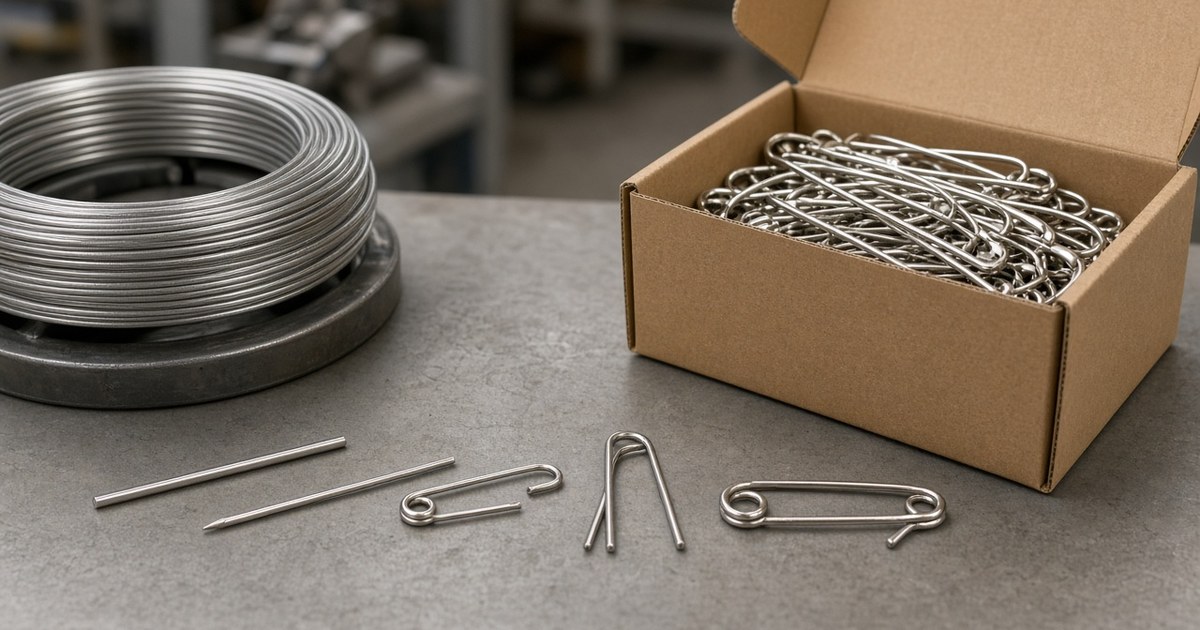
A safety pin looks simple. It is a length of wire, a spring coil, a point and a head. But every one of those parts is decided by a stage on the factory floor. Each stage also decides something a buyer cares about: how sharp the point is, how well the pin holds its spring, how long the finish lasts, and how the goods arrive in your warehouse.
This article follows a safety pin from wire coil to export carton. It uses the stages that Suvik Overseas, a safety pin manufacturer headquartered in Kolkata, India, describes on its manufacturing process page. For each stage, it explains what happens, what it changes in the finished pin, and what you can specify or check as a buyer.
It is not a factory tour, and it does not replace one. If you need to see the production floor, ask for a visit or a video walk-through when you enquire. The aim here is to help you read a specification, judge a sample and write a clearer purchase order.
This is general buyer guidance. The stage names and descriptions are taken from Suvik Overseas' published manufacturing pages (checked 15 November 2026). Capacity, test methods and test results for any order should be confirmed in writing for your specification. This article does not quote capacity or test figures, and it does not replace your own sample checks or inspection.
Why the process matters to a buyer
Most quality problems that buyers report with safety pins can be traced back to one stage of production:
A point that snags fabric usually goes back to grinding and polishing.
A pin that springs open or will not close properly usually goes back to coil forming, bending or heat treatment.
Rust spots after a few months in a humid store usually go back to the base material, plating, or cleaning and drying.
A head that comes loose goes back to head stamping and assembly.
Short counts or crushed boxes go back to packing and carton build.
Knowing the stages lets you ask better questions. "Is the quality good?" gets a vague answer. "How are points finished, and how is plating checked on each batch?" gets a useful one.
For a broader overview of the same process, see the guide to how safety pins are manufactured in India. The sections below group Suvik's published stages into six parts of the journey.
Part 1: Raw material — choosing and checking the wire
Raw material inspection
The process starts with wire. Suvik's manufacturing page lists two base materials for its safety pins: high-carbon steel wire and brass wire. Incoming coils are checked before they go to production.
What it decides for you: the base material sets the pin's strength, spring and natural rust resistance. Steel gives a stronger spring and holds tension better. Brass is softer but does not rust in the way uncoated steel can. Our article on brass vs nickel-plated steel safety pins compares the two in detail.
What to specify: state the base material in your enquiry, not only the colour. A "silver" pin can be nickel-plated steel or another finish, and a "gold" pin can be brass or gold-finished steel. If you need a nickel-controlled pin, say so at the start; our guide to nickel-free safety pins explains how to word it.
Wire selection and drawing
Wire is drawn down to the diameter needed for each pin series. Finer wire is used for small pins, heavier wire for larger and heavier-duty pins.
What it decides for you: wire gauge affects how easily the pin goes through fabric, how much it bends under load and how it feels in the hand. Two pins with the same length can feel very different if the wire is different.
What to specify: if you are matching an existing pin, send a physical sample or state the wire diameter you measure with a caliper. Size numbers alone do not fix the wire gauge. Our safety pin sizes chart and the sizes guide show how size numbers map to lengths.
Part 2: Shaping — from straight wire to a pin
Wire straightening and cutting
Coiled wire holds a curve, so it is straightened before cutting. It is then cut to the length needed for each pin size. Suvik's page gives the size range it cuts for as 000 to 4.
What it decides for you: cut length fixes the finished length of the pin. Straightness affects how evenly the point meets the head.
What to check: on a sample, measure the overall length of several pins from the same box. They should be consistent. If you are comparing suppliers, measure, rather than relying on the size number printed on the box.
Point grinding
The tip of the wire is ground to a point. Suvik's page describes this as producing a burr-free point that does not snag fabric.
What it decides for you: this is the stage buyers feel most. A good point goes through cloth cleanly. A rough or hooked point pulls threads, which matters for delicate fabrics, garment tagging and anything that touches skin.
What to check: push a sample pin through the fabric you actually use, several times, and look for pulled threads. Look at the tip under a magnifier. Our sample evaluation checklist sets out a simple routine.
Coil forming
The middle of the wire is wound to form the spring coil. This gives the pin its tension and lets it spring back after opening.
What it decides for you: the coil decides how firmly the pin closes and how well it holds that tension after repeated use. It is also the part that can catch threads in some uses. That is why some buyers choose a coilless design. Our article on coilless vs standard safety pins explains when each one makes sense.
What to check: open and close a sample pin repeatedly and see whether it still closes firmly and sits flat. A pin that loses tension quickly will not hold garments or tags reliably.
Pin bending
The wire is folded back on itself so the point lines up with where the head will sit.
What it decides for you: alignment. If the point does not meet the head squarely, the pin is harder to close and can spring open.
What to check: close the pin and look at it from the side. The point should sit inside the head, not beside it.
Part 3: The head — stamping and assembly
Head manufacturing
The head, sometimes called the clasp or cap, is made in a separate process. Suvik's page describes metal sheet being stamped into the head shape on presses.
What it decides for you: the head shields the point. Its shape and finish affect how safe the pin feels in use and how it looks on a retail card or garment.
Head assembly
The head is clamped and crimped onto the bent wire.
What it decides for you: a secure crimp keeps the head on the pin. A loose head is one of the clearest quality failures a buyer can see, and one of the most likely to cause a customer complaint.
What to check: on a sample, try to twist the head gently by hand. It should not move. Check a handful of pins from different parts of the box, not just the top layer.
Part 4: Strength and finish — heat treatment, polishing and plating
Heat treatment
Suvik's page states that assembled steel pins pass through furnaces to harden the metal and increase strength.
What it decides for you: heat treatment is what lets a steel pin keep its spring instead of bending out of shape. It is not visible on the pin, so buyers judge it through use: does the pin bend easily, and does it spring back?
What to ask: if strength matters for your use (for example, heavy fabrics, laundry tags or industrial uses), describe the use in your enquiry and ask how strength is checked for your batch. Ask for the method in writing, rather than a general statement.
Polishing (tumbling)
Pins are tumbled in rotating drums with polishing media to remove burrs and sharp edges.
What it decides for you: a smoother surface feels better, snags less and gives the plating a better base.
Electroplating
Steel pins are plated for appearance and rust resistance. Suvik's manufacturing page lists nickel as its standard steel plating, as well as a gold finish. Its product range also includes black and gold brass pins and brass nickel-free listings.
What it decides for you: plating sets the colour and much of the rust resistance of a steel pin. An uneven or thin coating can show wear or rust sooner, especially in humid storage or after washing.
What to specify: name the finish you need and the conditions the pins will face, such as humid warehouses, washing or contact with skin. If you need a specific test, such as a salt spray test to a named standard, put the standard and the pass level in the purchase order. Then ask for a report for your batch. Our guide on checking supplier certificates before ordering explains what a useful report looks like.
Final cleaning and drying
After plating, pins are cleaned to remove residues and dried.
What it decides for you: residue or moisture left on pins can cause staining or early rust in the box. This is one reason to open cartons from a new delivery and look at the pins before they go into long-term storage.
Part 5: Quality checks
Suvik's manufacturing page describes inspection of random batches and removal of deformed pins before packing. Its quality control page gives more detail on its stated approach.
As a buyer, treat any supplier's general quality statement as a starting point. What protects your order is what you agree for your batch:
Approved sample. Agree a reference sample before production and keep one yourself.
Written checks. List the checks that matter to you: dimensions, point finish, closing action, head security, finish and count per box.
Defect definitions. Say what counts as a defect, for example a loose head, a misaligned point, rust spots or a short count.
Inspection before shipment. For larger orders, consider an independent inspection before the goods leave. Our guide to third-party pre-shipment inspection explains how to set one up.
Checks on arrival. Inspect a sample of cartons when the goods reach you. See our guide to inspecting and storing a bulk safety pin shipment.
If something does go wrong, a clear record of what was agreed makes the claim simpler. Our article on the safety pin quality claim process covers what to collect.
Part 6: Packing and dispatch — from loose pins to export cartons
Counting and packing
Suvik's page describes pins being counted and packed into retail boxes, gross bunches or blister packs, depending on whether the order is wholesale or OEM. Custom and private-label packs are also offered; see custom safety pin packaging.
What it decides for you: the pack format decides how the pins reach your shelf or production line. A garment factory may want bulk loose pins, while a retailer wants counted boxes or cards that are ready to sell.
What to specify: pieces per inner pack, inner packs per carton, labelling and barcodes, and any language or market marking. If you think in gross or boxes, our article on order quantity conversion helps you state quantities clearly. The safety pin packaging guide compares the main formats.
What to check: count the pieces in a few inner packs on arrival. Short counts are easy to miss and add up across a large order.
Export dispatch
Suvik's page describes master cartons being palletised, wrapped against moisture and loaded for shipment. For a sea shipment, protection against moisture matters, because humidity in a container can affect steel pins and cardboard.
What to specify: carton marks, pallet requirements if your warehouse needs them, and any moisture protection you expect. Agree the Incoterm and the documents you need before production starts. Our guide to FOB, CIF and DDP shipping terms explains who handles what, and our article on lead time by order size explains how to plan the timeline from carton to container.
A stage-by-stage buyer checklist
Use this list when you write an RFQ or review a sample:
Raw material: Base material (steel or brass); any nickel requirement
Wire drawing: Wire diameter if matching an existing pin
Cutting: Overall length, measured on several pins
Point grinding: Clean entry into your own fabric; no hooked tips
Coil forming: Firm closing after repeated opening; coil or coilless
Bending: Point sits squarely inside the head
Head assembly: Head does not twist or come loose
Heat treatment: How strength is checked for your batch
Plating: Finish, use conditions, any named test and pass level
Cleaning and drying: No residue, staining or rust on arrival
Quality checks: Approved sample, written checks and defect definitions
Packing: Pieces per pack, packs per carton, labels and barcodes
Dispatch: Carton marks, pallets, moisture protection, Incoterm and documents
Our safety pin RFQ template turns this into a ready-to-send enquiry.
Manufacturer or trading company?
Understanding the process also helps you judge who you are buying from. A manufacturer should be able to answer stage-level questions directly: how points are finished, what plating is used, how heads are fixed and how packs are counted. A trading company may need to go back to its supplier for each answer. Neither is wrong, but you should know which one you are dealing with. Our article on safety pin manufacturer vs trading company lists the questions to ask.
You can read more about Suvik Overseas on its About page. Its office address is in central Kolkata. If you plan a visit, ask where the production facility is and arrange the visit in advance.
Frequently asked questions
What are safety pins made of?
Most safety pins are made from steel wire or brass wire. Steel pins are usually plated, commonly with nickel, for appearance and rust resistance. Brass pins are softer but do not rust in the same way as uncoated steel. Suvik's manufacturing page lists high-carbon steel and brass as its base materials.
What is the coil on a safety pin for?
The coil is the spring. It is formed by winding the wire in the middle of the pin, and it gives the pin its tension so it closes firmly and springs back after opening. Coilless pins use a different design without the loop, which some buyers choose to avoid catching threads.
Why do some safety pins rust?
Rust usually comes from the base material, thin or uneven plating, residue left after plating, or storage in humid conditions. Specify the finish and the conditions the pins will face, and check a new delivery before long-term storage.
How can I check safety pin quality before a large order?
Agree an approved sample, test it on your own fabric, check length, point, closing action, head security, finish and pack counts, and write the checks and defect definitions into the purchase order. For larger orders, consider an independent pre-shipment inspection.
Can I see how my order is made?
Ask when you enquire. A manufacturer can usually arrange a factory visit or a video walk-through by appointment. Confirm in writing which stages are done in-house for your order.
Next step
If you are preparing an order, send your specification with the base material, size, finish, pack format, quantity and destination through the enquiry form or the contact page. Ask for the checks that matter to you to be confirmed in writing for your batch. Minimum order quantity is negotiable.
Sources
Suvik Overseas, Safety Pin Manufacturing Process, fetched 15 November 2026. Stage names and descriptions (raw material inspection through export dispatch); base materials (high-carbon steel, brass); nickel and gold finishes; size range 000 to 4. Capacity, line counts and test figures on that page were not repeated.
Suvik Overseas, How Safety Pins Are Manufactured in India, fetched 15 November 2026.
Suvik Overseas, Contact, fetched 15 November 2026: headquarters address in Kolkata; production facility stated as in West Bengal.
Live Suvik Overseas pages linked in the body, each checked on 15 November 2026 (see plan-2026-11/day15/linkcheck-2026-11-15.txt).