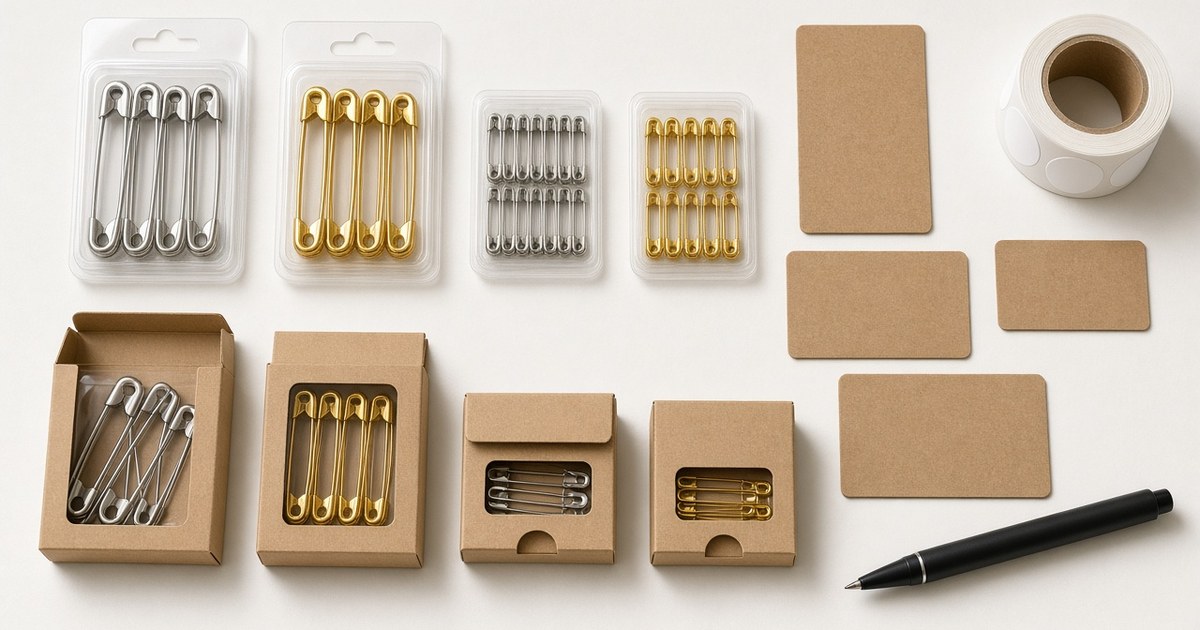
Safety pin packs sold to shoppers in Canada must carry certain information in English and French. The main federal law is the Consumer Packaging and Labelling Act and its Regulations, which the Competition Bureau enforces for non-food products. Quebec adds its own French-language rules.
This guide is for Canadian distributors, wholesalers and private-label brands buying retail packs of safety pins from India. It covers what goes on the label, what must be bilingual, how to state the pin count and name the responsible company, and how to get the text right before printing.
This is general information, not legal advice. The legal points below were read on the Justice Laws Website, the Competition Bureau, LégisQuébec and the Office québécois de la langue française (OQLF) on 20 November 2026, and they can change. Confirm your final label with a Canadian regulatory adviser or the Competition Bureau before you approve artwork. Product and packaging details are from Suvik Overseas product and packaging pages. For the import process (tariff item, duty, GST, CARM and documents), see our guide to importing safety pins from India to Canada.
The short answer
Three mandatory items: the product identity (for example, "safety pins"), the net quantity (how many pins) and the dealer's name and principal place of business (who is responsible).
Language: product identity and net quantity in English and French. The dealer's name and address can be in either language.
Placement: identity and quantity on the principal display panel, the side the shopper sees. The dealer's details can go anywhere except the bottom of the container.
Imported packs: put "Imported by / Importé par" or "Imported for / Importé pour" before a Canadian company's name, or state where the pins were made.
Quebec: every inscription on the product, its packaging and documents supplied with it must be in French, and no other language may be more prominent.
Bulk trade boxes: the federal rules cover packs ordinarily sold to consumers, and shipping cartons are excluded. Check with your adviser whether your trade boxes count.
Next step: send your pack format, counts and draft label text through the enquiry form, and ask for a proof and samples before production.
What the law covers
The Consumer Packaging and Labelling Act defines a prepackaged product as one packaged in a container so that it is ordinarily sold to, or used or purchased by, a consumer without being repackaged. A pouch of 20 pins, an assorted box or a blister card sold in a store fits that description.
The Act's definition of container excludes package liners, shipping containers and any outer box not customarily displayed to the consumer. So the master export carton is not where the consumer label goes. The pack the shopper picks up is. If you buy loose pins in bulk boxes for your own factory or laundry, the consumer rules may not apply to those boxes, but if you later repack pins for retail, the retail pack must comply.
A dealer is anyone who is a retailer, manufacturer, processor or producer, or who is in the business of importing, packing or selling a product. Section 4 of the Act says no dealer may sell, import into Canada or advertise a prepackaged product without a label carrying a net quantity declaration in the required form. In practice, the Canadian importer or brand owner is responsible for the label, even when a factory in India prints it.
Section 10 of the Act and the Regulations require each label to show:
the product's identity, by its common or generic name or its function;
the net quantity;
the identity and principal place of business of the person by or for whom the product was manufactured or produced for resale.
Bilingual requirements
Subsection 6(2) of the Consumer Packaging and Labelling Regulations requires all information the Act and Regulations call for to be shown in both official languages. The one exception is the dealer's name and principal place of business, which may be in one language. The Competition Bureau's guidance applies this as follows:
Product identity: English and French. Some words are bilingual in themselves (the Bureau's examples are "cologne" and "serviettes"), but "safety pins" is not.
Net quantity: English and French. A declaration using only numbers and metric symbols is treated as bilingual. Words such as "net" or "net contents", if used, must appear in both languages.
Dealer name and address: either English or French.
Other text, such as directions or promotional lines, does not have to be bilingual under the federal rules, though the Bureau encourages it. Quebec goes further (see below).
"Épingles de sûreté" is a common French term for safety pins, but have a Canadian French translator confirm the wording for your pack rather than relying on machine translation.
The Bureau's guide also says that where a pack has two or more principal display surfaces of equal size and prominence, the identity and quantity can appear in one language on one surface and in the other language on another. A box with two identical faces can carry English on one and French on the other. A blister card with a single front usually needs both languages on the front.
The Regulations allow limited exemptions for test market products (up to 12 cumulative months, with a notice filed six weeks before), local products sold only in qualifying local areas, and specialty products, which the Regulations define as imported products not widely used by the population as a whole in Canada and with no readily available comparable substitute made in Canada. Plain safety pins are an everyday product, so plan on bilingual labels unless your adviser confirms an exemption.
Declaring the net quantity of safety pins
Count or weight
Section 4 of the Act allows the net quantity to be declared by numerical count or by a unit of measurement, as prescribed. Section 21 of the Regulations says solids are declared by weight unless it is the established trade practice to declare them another way. The Competition Bureau lists "solids sold by item count, such as paper clips, toothpicks, and boxes of candles" as products declared by count. Safety pins are sold the same way, and Suvik's product pages describe packs by count, for example 1,000 pieces per box in 10 pouches of 100. Your adviser can confirm that a count suits your pack.
Because numbers are treated as bilingual, a bold "100" next to a bilingual product identity works, as does "100 safety pins / 100 épingles de sûreté". "One hundred pins" in English only does not. For an assorted pack, show the total count, and if you also give counts per size, make sure they add up.
Size and position
Position: on the principal display panel, clearly and prominently displayed, easily legible and in distinct contrast to other label information (Act, section 4(2)).
Bold numerals: section 14 of the Regulations requires the numbers in bold, with a minimum height set by the area of the principal display surface: 1.6 mm up to 32 cm², 3.2 mm over 32 cm² up to 258 cm², 6.4 mm over 258 cm² up to 645 cm², 9.5 mm over 645 cm² up to 25.8 dm², and 12.7 mm above that.
Other required text: at least 1.6 mm high (section 15), or 0.8 mm where the principal display surface is 10 cm² or less and all required information is on the principal display panel (section 16). Height is measured on capitals, or on a lower-case "o" for mixed text.
Measure the front of small pouches and cards early and give your designer these minimums.
When a count can be left off
Section 5 of the Regulations exempts some products usually sold by count. If the pins are visible and identifiable through the pack and there are fewer than 7, or fewer than 13 that can easily be counted without opening the pack, no net quantity is needed. Visible contents can also exempt the product identity, and a set shown accurately in a picture on the front can be exempt from both. The dealer's name and address are still required. Most retail pouches and boxes of safety pins hold more than 12 pins, so plan on a count.
Accuracy
Section 7 of the Act prohibits false or misleading label representations, including anything that qualifies the declared quantity or misdescribes the product's type, quality, origin or method of manufacture. A declaration is not misleading if the actual quantity is not less than declared, within the prescribed tolerance. Section 9 prohibits containers that could mislead a consumer about quality or quantity, such as an oversized box with few pins. Agree the count per pouch, bunch and box on your purchase order and check it on samples.
Dealer identity and "Imported by"
The label must show the identity and principal place of business of the person by or for whom the product was made for resale. The Competition Bureau reads this as a name and address sufficient for postal delivery, consistent with Canada Post addressing guidelines, not a postal box, in letters at least 1.6 mm high. Section 13 of the Regulations allows it on any part of the label except the bottom of the container.
For pins made in India and sold under a Canadian company's name, section 31(2) of the Regulations requires that name to be preceded by "imported by" ("importé par") or "imported for" ("importé pour"), unless the label states the product's geographic origin. Section 31(4) places that origin statement immediately next to the Canadian dealer's details. The Bureau summarises three acceptable options:
"Imported by / Importé par" or "Imported for / Importé pour" immediately before the Canadian dealer's name and address;
the place of origin beside the Canadian dealer's name and address; or
the name and address of the foreign dealer.
The same applies when goods are imported in bulk and then packed and labelled in Canada by someone other than a retailer (section 31(3)).
For a private-label pack, the dealer is usually the Canadian brand owner, with "Imported for / Importé pour" or "Made in India / Fabriqué en Inde" beside its address. A distributor reselling Suvik's own brands may show its name with "Imported by / Importé par". Decide before artwork, because it changes the back panel.
The Bureau notes that the Act itself does not require a country of origin marking, though the Government of Canada requires one for specific goods. Our Canada import guide explains what we found in the CBSA's marking memorandum.
Quebec: the Charter of the French language
Section 51 of the Charter of the French language, in the version in force since 1 June 2022, says every inscription on a product, its container or wrapping, or a document or object supplied with it, including directions for use and warranty certificates, must be drafted in French. Translations may accompany the French, but no other language may be given greater prominence or be available on more favourable terms.
In practice this goes beyond the federal rules:
All text needs French, not just the three mandatory items: directions, cautions, finish descriptions and inserts.
French at least as prominent. The OQLF explains that other-language text must not stand out more than the French, and consumers must not have to make extra effort to read the French.
On trademarks, the OQLF says a recognised trademark under the Trademarks Act may appear only in another language, but if a French version is registered with the Canadian Intellectual Property Office, the French version must be used. Since 1 June 2025, generic or descriptive words in a trademark (the OQLF's examples include colour, scent and other product characteristics) must also appear in French on the product or a medium permanently attached to it. The product name as marketed and the company name can stay in another language. The OQLF lists transition arrangements to 1 June 2027 for certain products made before set dates.
For a safety pin brand, words such as "Assorted", "Gold finish" or "Nickel-free" inside a logo block also need French; the brand name itself can stay in English. The OQLF adds that a product display counts as commercial advertising, which follows a rule of marked predominance of French, so check shelf strips and counter displays separately. The Charter has other exceptions not covered here; if Quebec is a big market for you, ask a Quebec adviser or the OQLF to review your artwork.
A bilingual pack, panel by panel
An outline to discuss with your adviser and designer, not a pre-approved label:
Front: your brand name; "Safety pins / Épingles de sûreté" (confirmed by your translator); the count in bold at the required height; the length in millimetres, such as "28 mm" or "30 / 35 / 40 mm" for an assorted pack (metric symbols are treated as bilingual).
Back or side: "Imported for / Importé pour" or "Imported by / Importé par" with your company name and full Canadian street address, or "Made in India / Fabriqué en Inde" beside the address; any directions or cautions in both languages; a barcode if your retailer asks for one.
For Quebec: every line in French, with no other language more prominent, and descriptive words in the brand block translated.
Getting it right with an Indian supplier
Choose the pack format. Suvik's custom packaging page lists printed retail boxes, hanging blister packs with a euro-hole punch, wholesale polybags, plastic organiser boxes and bulk export cartons, plus custom logo printing, UPC/EAN barcodes on retail packs, multi-language labelling and country-of-origin stickers. Our safety pin packaging guide compares the formats.
Fix the count and sizes. Base the label on a real pack. Suvik's product pages list, for example, AROMI size 0 (10 pouch) (30 mm, 0.70 mm wire, mild steel, 1,000 pieces per box in 10 pouches of 100), SALASAR assorted (50 pouch) (30, 35 and 40 mm, 1,000 pieces per box in 50 pouches of 20), LIBERAL size 4 (53 mm, 300 pieces per box in 30 bunches of 10) and brass size 00 nickel-free (23 mm, 1,000 pieces per packet). If the shopper buys a pouch of 20 or 100, that pouch carries the consumer label. Our guide to safety pin size numbers in millimetres helps you state lengths.
Supply the label text. As the Canadian dealer, you own the label, so send the final wording in both languages, your name and address with the "imported by/for" or origin statement, and any Quebec French. Suvik's packaging page says buyers provide the artwork and it prints the logo, brand colours and contact details on the retail packaging.
Approve a proof and a sample. Check both languages for identity and count, numeral size, a full street address, French prominence for Quebec, and the actual count. Our sample evaluation checklist covers the pins, and samples, quality checks and packing explains how samples work.
Put it in the purchase order. Record the approved artwork version, count per pack and carton marks. Our private-label guide covers the full process.
Common mistakes
French only in the brand block. Identity and count need French; in Quebec, all text does.
Quantity in English words only. Use numerals or both languages.
A PO box as the address, or dealer details on the bottom of the box.
Labelling the master carton instead of the pack the shopper buys.
Approving artwork after production starts, which means reprints and delay.
Frequently asked questions
Do safety pin packs sold in Canada need French?
Yes, for consumer packs. Product identity and net quantity must be in English and French; the dealer's name and address can be in either. In Quebec, all text must be in French, with no other language more prominent.
Who is the dealer on a private-label pack?
Usually the Canadian brand owner or importer, shown with "Imported for / Importé pour" or "Imported by / Importé par", or with the country of origin beside the address.
Does this cover product safety rules?
No. This guide covers packaging and labelling under the Consumer Packaging and Labelling Act and Quebec's language rules. Other laws may apply, so ask your adviser what applies to your range.
Buying labelled packs from the factory
Suvik Overseas Pvt. Ltd. is a manufacturer of safety pins and dress hooks, incorporated in 2006 and registered as an MSME manufacturing enterprise, with its registered office in Kolkata and its factory at Chamrail, Howrah, West Bengal. Buying from the manufacturer means your pack format, counts, label text and carton marks are agreed directly with the people close to production. To get a price, use the quote request form with your pack format and Canadian city. See also bulk safety pins for distributors and private label safety pins.
What to put in your enquiry
Company name, province, and whether you're a distributor, retailer or private-label brand.
Products: material, finish, size number and length in mm.
Retail pack format and count per pack.
Whether packs will be sold in Quebec.
Draft label text in English and French, and who appears as the dealer.
Barcode needs, quantity per line, Incoterm and destination city.
Whether you want a proof and samples first.
Our RFQ template gives a fuller format. Minimums are discussed per order; see the MOQ guide and lead time by order size.
Next step
If you're planning safety pin packs for Canadian shelves, send your pack format, counts, sizes and draft bilingual label text through the enquiry form or the contact page. Ask for a printed proof and samples at the same time, so your adviser can review the label while the quotation is prepared.
Sources
Consumer Packaging and Labelling Act, R.S.C. 1985, c. C-38 (Justice Laws, current to 29 October 2026): definitions (s. 2); net quantity by count or unit and display (s. 4); misleading representations and tolerance (s. 7); misleading containers (s. 9); mandatory label information (s. 10). Read 20 November 2026.
Consumer Packaging and Labelling Regulations, C.R.C., c. 417 (Justice Laws, current to 29 October 2026): count exemptions (s. 5); bilingual rule and exemptions (s. 6); label placement (ss. 7 to 13); type heights (ss. 14 to 16); manner of declaring net quantity (s. 21); imported products (s. 31). Read 20 November 2026.
Competition Bureau, Guide to the Consumer Packaging and Labelling Act and Regulations (modified 12 February 2026). Read 20 November 2026.
Competition Bureau, What must be on the label: bilingual symbols, count exemptions, dealer address, "imported by/for", products sold by count. Read 20 November 2026.
Competition Bureau, Packaging and labelling requirements. Read 20 November 2026.
Charter of the French language, CQLR c. C-11, section 51 (LégisQuébec): version in force since 1 June 2022. Read 20 November 2026.
OQLF, Entreprises : marque de commerce sur les produits (in French): product inscriptions, trademarks since 1 June 2025, transition to 1 June 2027, displays. Read 20 November 2026.
Suvik Overseas, Custom Safety Pin Packaging and the product pages linked above. Read 20 November 2026.