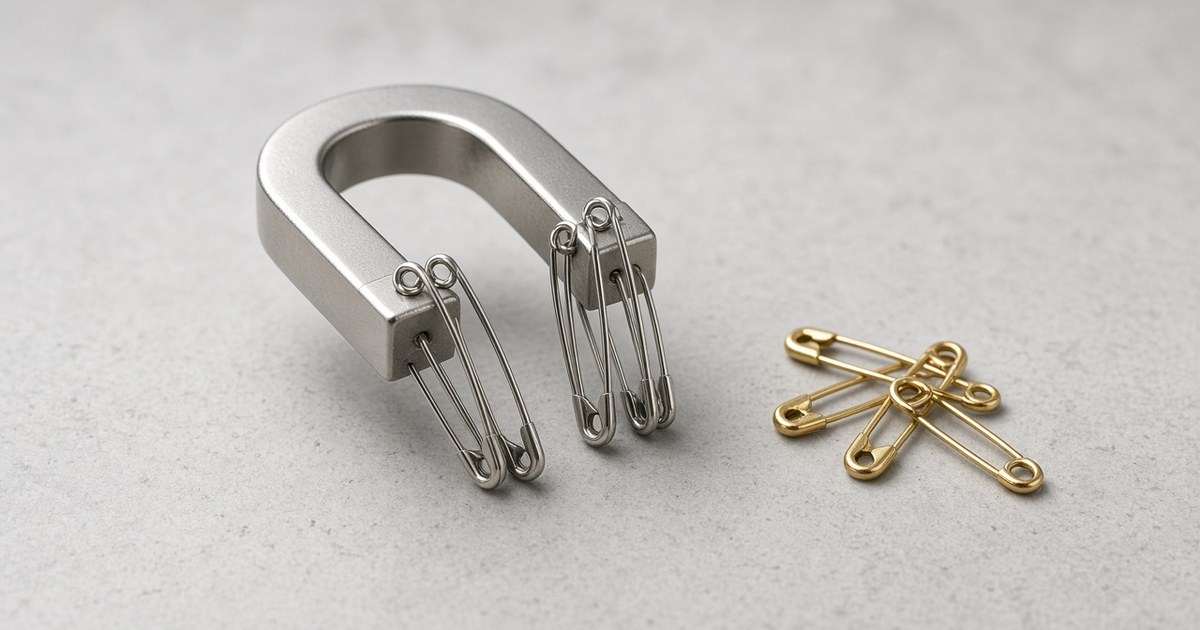
Hold a magnet over a box of ordinary safety pins and most of them will jump to it. Try the same with brass pins and nothing happens. For a buyer, that difference matters. It decides whether a pin left in a garment is caught by a needle detector, whether a pin is allowed near an MRI room, and whether the "brass" pins you received really are brass.
This guide is for importers, distributors, garment factories and brand buyers who buy safety pins in bulk. It explains why some pins are magnetic and others are not, what to expect from steel, brass, plated and stainless pins, where magnetism matters in real buying decisions, and how to write it into an order.
This is general buying information, not a laboratory report or a medical safety rating. Facts about magnetism come from the British Stainless Steel Association, the Copper Development Association, Encyclopaedia Britannica, the US Food and Drug Administration and two needle-detector manufacturers, all read on 20 November 2026. Product details (materials, finishes, sizes and wire thickness) were read from Suvik Overseas product pages on the same day. Suvik's product pages do not publish magnetic test values, so if magnetism is a requirement for your order, agree the test and approve a sample before production.
The short answer
Steel safety pins are magnetic. Steel is an alloy made mostly of iron, and iron is strongly attracted to a magnet. Nickel-plated mild steel pins, the most common type, will stick to a magnet.
Solid brass safety pins are not magnetic. Brass is a copper-zinc alloy, and copper alloys are generally non-magnetic.
Stainless steel depends on the grade. The common "austenitic" grades are close to non-magnetic when annealed but can become slightly magnetic after cold working, such as bending and coiling wire. Other stainless families are magnetic.
Plating can change the result a little. Nickel is itself a magnetic metal, so a nickel-plated brass pin may show a faint pull.
Colour tells you nothing. A golden pin can be steel, and a silver pin can be brass.
If it matters, put it in writing. State the material of the whole pin, the finish, and the test you will use. Then send your requirement through the enquiry form and ask for samples.
Why some metals stick to a magnet
The strong pull you feel between a magnet and a pin is called ferromagnetism. Encyclopaedia Britannica describes it as a kind of magnetism associated with iron, cobalt, nickel and some alloys containing one or more of those elements. Ferromagnetic materials are "magnetized easily", which is why a pin made from them jumps to a magnet.
So the question "is a safety pin magnetic?" really means "what is this pin made of?" A pin is magnetic if it is made from, or coated with, enough of a ferromagnetic metal.
Steel safety pins: magnetic
Britannica defines steel as an alloy of iron and carbon, with carbon up to 2 percent, and notes that the major component of steel is iron. Iron is ferromagnetic at room temperature, so ordinary steel is magnetic.
Most safety pins sold for garment tagging, packing, laundry and retail are steel. On Suvik Overseas product pages, the Aromi, Salasar, Major and Nilgiri series and all but one Liberal pin are listed as mild steel, and almost all of them are nickel plated. For example:
Aromi Size 0 (10 pouch): 30 mm, 0.70 mm wire, mild steel, nickel plating.
Liberal Loose Size 0: 28 mm, 0.70 mm wire, mild steel, nickel plating.
Salasar Size 4: 53 mm, 1.10 mm wire, mild steel, nickel plating.
All of these will be attracted to a magnet. The nickel layer does not stop that, because the steel core underneath is magnetic, and nickel itself is magnetic too. Britannica notes that nickel is ferromagnetic at ordinary temperatures, though not as strongly as iron.
For a buyer, this is often useful. A magnet will pick up dropped steel pins from a work table or floor (it will not pick up brass ones), and a garment needle detector can find a steel pin, as covered below.
Brass safety pins: non-magnetic, with two things to check
Brass is an alloy of copper and zinc. The Copper Development Association (copper.org) describes brasses as "copper zinc alloys". In its guide to working with copper alloys, it states that copper and copper alloys are "generally nonmagnetic". A solid brass pin should therefore not stick to a hand magnet.
Suvik Overseas lists solid brass pins in its brass range in two small sizes:
Size 000: 19 mm long, 0.66 mm wire.
Size 00: 23 mm long, 0.66 to 0.67 mm wire.
Each size is listed in four finishes: loose (silver colour), black, gold plated and nickel-free silver plating, packed 1,000 pieces per packet. The site also lists a Liberal Gold Brass Size 00 pin: brass, 23 mm, 0.67 mm wire, with nickel plating.
Two things can make a "brass" pin react to a magnet, so check them before you rely on it.
1. The plating
A plating is a thin layer, but it is still metal. If a brass pin is nickel plated, the nickel layer is a ferromagnetic metal, and you may feel a faint pull. One needle-detector maker, Hashima, makes the same point about garment trims. It says brass and aluminium accessories are used so that they do not react to needle detectors. But they may react if the metal contains impurities, if many of them are used together, or because of "the material that coats the surface".
If you need a pin that shows no magnetic response at all, ask which plating is used on the brass pin. Test the plated sample, not only an unplated one.
2. Every part of the pin
A safety pin has a shaft, a coil, a point and a head (clasp). When you specify "brass", say that it applies to every part of the pin. Then check each part with a magnet on the sample. If the head or coil pulls and the shaft does not, the pin is not all brass.
Brass's other trade-offs (no rust, but softer than steel and prone to tarnish) are covered in our guide to brass, nickel-plated steel and stainless steel pins and which lasts longer.
Stainless steel safety pins: it depends on the grade
Many buyers assume stainless steel is non-magnetic. The British Stainless Steel Association (BSSA) says that "is not strictly true and the real situation is rather more complicated".
According to the BSSA:
Austenitic stainless steels (the BSSA lists grades 304 and 316 in this family) are usually described as non-magnetic, because their response to a hand-held magnet is negligible. In the fully annealed condition, their relative magnetic permeability is generally 1.003 to 1.05. A value of 1.0 means no magnetic response at all.
In practice, a fully non-magnetic structure is rarer than people think. Typical values for standard austenitic grades can be about 1.05 to 1.1.
Cold working can raise the magnetism. It can turn part of the steel into martensite, which is ferromagnetic, so a cold-worked austenitic part can show "a degree of pull" towards a magnet. The BSSA says this usually shows up at sharp corners, sheared edges or machined surfaces.
Ferritic, martensitic, duplex and most precipitation-hardening stainless steels are magnetic.
High-nickel or nitrogen-bearing grades (the BSSA names 304LN, 316LN and 310) tolerate more cold work before their magnetism rises.
A safety pin is made by winding wire into a spring coil and bending it to form the point and head. That shaping is the kind of cold work the BSSA describes, and the BSSA says only full solution annealing (around 1,050 to 1,120 °C with rapid cooling) reverses its effect. So a stainless pin can show anything from almost no pull to a noticeable pull, depending on the grade and how the pin was made. The coil and the bends are the places most likely to react.
What this means for buying:
A magnet cannot tell you whether a pin is stainless steel or nickel-plated mild steel, because both may be attracted.
A magnet can tell you a pin is not solid brass.
If you need a stainless pin with low magnetism, "stainless" is not enough. Name the grade and agree a limit and a test with the supplier.
The live Suvik product pages list mild steel and brass pins. If you are considering stainless, see our stainless steel safety pin buyer guide and ask the sales team what can be supplied for your quantity.
Colour tells you nothing about magnetism
Finish and colour are surface choices. They do not show what the pin is made of.
Two examples from Suvik's own product pages make the point:
The Liberal Golden Mini Size 00 is described as golden pins for hang tags and premium retail presentation. Its material is listed as mild steel, so it is magnetic.
The Brass Size 00 (Nickel Free) pin is silver in colour. Its material is listed as brass, so it should not be attracted to a magnet.
So a gold pin is not proof of brass, and a silver pin is not proof of steel. Write the material on the order, not only the colour. If nickel content matters to your customer, that is a separate question from magnetism. Our nickel-free safety pins guide explains how to specify it.
When magnetism matters to a buyer
For most tagging and retail orders, nobody checks. In a few situations it becomes the deciding point.
Garment factories with needle detectors
Hashima, a needle-detector maker, explains that a sewing needle can break during sewing, so finished clothing is checked for needles at the final stage of manufacturing, sometimes again at the distribution warehouse. Needle detectors work with magnetism.
Hashima's guide to needle detectors says they "generally detect only magnetic metals such as iron". They do not detect non-magnetic metals such as aluminium and copper.
Sanko Electronic Laboratory's manual for its SK-2200 needle and iron-piece detector says that materials such as stainless steel, brass and aluminium "which do not stick to a magnet can not be detected". It specifically warns that some pins made of stainless or brass will not be detected.
This works in two directions, and both matter to a factory:
Steel pins will be found. A steel safety pin left in a packed garment is likely to set off the detector and stop the line. If pins must stay in the finished pack, for example to hold a fold or a tag, agree the pin material with the brand buyer first.
Brass pins may not be found. If a brass pin falls into a garment by mistake, a needle detector may not catch it. If you switch to brass to pass detection, you need another way to count pins in and out on the line.
Whatever the material, test the actual pins, with their plating, on your own detector at your own sensitivity setting. We covered this from the garment exporter's side in our guide for garment exporters in the Philippines. There is more on choosing pins for production lines in safety pins for garment manufacturers.
Hospitals, clinics and MRI rooms
The FDA says the strong magnetic field of an MRI scanner "will attract magnetic objects". It names small items such as keys and phones and large ones such as oxygen tanks, which can become dangerous projectiles. People and objects entering the MR environment must be screened carefully.
A steel safety pin is a magnetic object, so it should not go near an MRI scanner unless the facility's own safety rules allow it.
A brass pin is not magnetic, but that does not make it "MRI safe". The FDA defines an MR Safe item as one that is non-magnetic, contains no metal and does not conduct electricity. A brass pin is metal and conducts electricity. The FDA also says the radiofrequency energy used in a scan can cause heating. Any item with an unknown MRI safety status should be treated as MR Unsafe.
If you supply healthcare customers, do not describe any metal safety pin as MRI safe.
Products that must be "non-magnetic"
Some technical buyers ask for non-magnetic pins, for example near sensitive instruments. The BSSA notes that, where low magnetism really matters, customers and suppliers often agree a maximum magnetic permeability figure, sometimes as low as 1.004. "Non-magnetic" on its own is open to argument. A measured limit with a test method is not.
If your requirement is that strict, say so when you send your enquiry. A hand magnet is a screening check, not a measurement.
How to check a sample or a shipment with a magnet
A household or fridge magnet is enough for a first screen.
Test several pins from different boxes or packets, not just one from the top of the carton.
Test each part separately: the shaft, the coil and the head. Hold the magnet close and feel for a pull, or see whether the pin lifts.
Read the result against the material ordered. Solid brass: no lift; a faint pull may come from the plating, so ask about it, and a strong pull on any part means that part is not brass. Steel: every pin should lift easily. Stainless: the result depends on the grade, so do not accept or reject on the magnet alone; rely on the supplier's grade confirmation and your agreed test.
Keep the approved reference sample untouched. Do not scratch or file it to look at the metal underneath.
Our sample evaluation checklist covers points, clasps, finish and pack counts. For bulk deliveries, see how to inspect and store a bulk safety pin shipment. If an inspector checks the goods before shipment, add the magnet test to the brief described in our guide to third-party pre-shipment inspection.
How to write magnetism into your RFQ and purchase order
If magnetism matters for your use, these lines stop it from becoming a dispute later.
Material of every part: for example, "solid brass, including coil and head" or "mild steel, nickel plated".
Finish or plating: name it, because plating can affect a magnet test and a needle detector.
Magnetic requirement, in plain words: for example, "must not lift with a hand magnet", "must be detectable by our needle detector at our setting", or "must not trigger our needle detector".
Test method: which magnet or detector is used, by whom, and on how many pins. For a strict requirement, a permeability limit agreed with the supplier.
Approved sample: the order refers to a sample approved against these points.
Size and wire: the size code, length in millimetres and wire thickness. Our gauge and wire thickness guide explains how to write these, and the size numbers guide converts size codes to millimetres.
Our RFQ template already has lines for material and finish. Once the quote is agreed, our guide to purchase order clauses for importers shows how to carry the specification and the approved sample into the PO.
Which pins suit which need
Based on the materials listed on Suvik Overseas product pages:
You want pins to be found by a needle detector, or picked up with a magnet: nickel-plated mild steel, for example in the Liberal and Aromi series, listed from 28 to 53 mm long.
You want pins that do not react to a magnet: solid brass in size 000 (19 mm) or 00 (23 mm), from the brass range. Confirm the plating, and test it on your detector.
You need low magnetism and steel strength: discuss a stainless option and its grade with the sales team, and agree the test.
Not sure which fits? Describe your use in the enquiry form and ask for samples of the options.
Frequently asked questions
Is a safety pin magnetic?
Usually, yes. Most safety pins are made of steel, which is mostly iron, so they are attracted to a magnet. Solid brass safety pins are not magnetic. Stainless steel pins may or may not react, depending on the grade and how the wire was formed.
Are brass safety pins magnetic?
Solid brass is not magnetic, because copper alloys are generally non-magnetic. A plated brass pin can show a slight pull if the plating is a magnetic metal such as nickel. A strong pull usually means that part of the pin is not brass.
Are stainless steel safety pins magnetic?
It depends. The common austenitic grades, such as 304 and 316, are close to non-magnetic when annealed. Cold forming can make them slightly magnetic, especially at bends. Ferritic and martensitic stainless steels are magnetic.
Will brass safety pins pass a garment needle detector?
Needle detectors are generally designed to find magnetic metals, so solid brass pins are usually not detected. But plating, impurities and the number of pins can change the result, so test the actual pins on your own detector.
Are safety pins safe near an MRI scanner?
Steel pins are magnetic and can be pulled by the scanner's field. Brass pins are not magnetic but are still metal, so they do not meet the FDA's description of MR Safe. Follow the facility's MR safety rules.
Next step
Tell us how the pins will be used and checked: tagging, packing, laundry or retail, and whether your line uses a needle detector or a magnet test. Send your sizes, material, finish, pack format, quantities and destination through the enquiry form or the contact page. Ask for samples at the same time so you can test them while the quotation is prepared. Minimums are discussed per order.
Sources
Encyclopaedia Britannica, Ferromagnetism: ferromagnetism associated with iron, cobalt, nickel and their alloys; nickel ferromagnetic at ordinary temperatures. Read 20 November 2026.
British Stainless Steel Association, Classification of stainless steel: 1.4301 (304) and 1.4401 (316) listed as austenitic grades. Read 20 November 2026.
Encyclopaedia Britannica, Steel: steel is an alloy of iron and carbon (carbon up to 2 percent), mainly iron; iron is ferromagnetic below 770 °C. Read 20 November 2026.
Copper Development Association, Brasses: brasses are copper-zinc alloys. Read 20 November 2026.
Copper Development Association, A Guide to Working With Copper and Copper Alloys: copper and copper alloys are generally nonmagnetic. Read 20 November 2026.
British Stainless Steel Association, Is stainless steel non-magnetic?, Magnetic properties of austenitic stainless steels and Effect of cold work and heat treatment on the magnetic permeability of austenitic stainless steels: permeability values, cold work and martensite, magnetic stainless families, agreed permeability limits. Read 20 November 2026.
US Food and Drug Administration, MRI Benefits and Risks: attraction of magnetic objects, projectile risk, screening, RF heating, MR Safe and MR Conditional definitions. Read 20 November 2026.
Hashima, Needles Guide Book: needle detectors generally detect only magnetic metals; non-ferrous accessories may react because of impurities, quantity or surface coating. Read 20 November 2026.
Sanko Electronic Laboratory, SK-2200 Needle and Iron Piece Detector instruction manual: stainless steel, brass and aluminium that do not stick to a magnet cannot be detected. Read 20 November 2026.
Suvik Overseas product pages linked above: lengths, wire thicknesses, materials, finishes and pack counts. Read 20 November 2026.