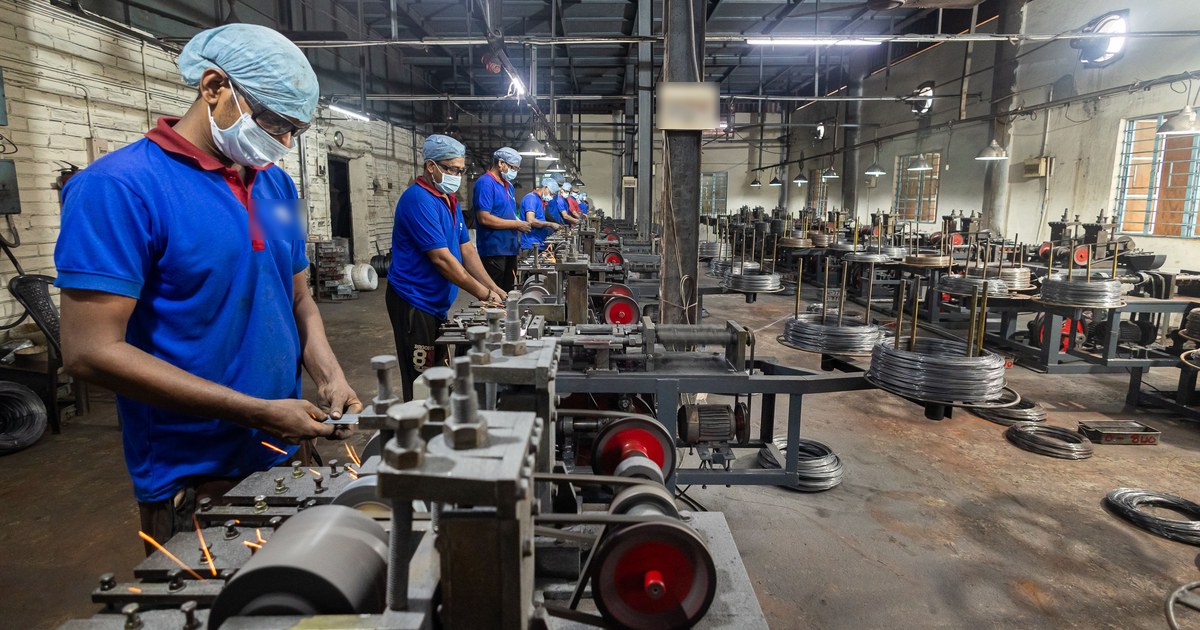
Nigeria's garment and uniform makers, tailors, haberdashery traders and supermarkets all use safety pins. India is a practical source: you can buy directly from a manufacturer and ship by sea from Kolkata to Lagos.
Nigeria's import process has more steps than most. Before your supplier ships, you need a SONCAP Product Certificate, an approved Form M from your bank, and a SONCAP Certificate for the shipment. This guide explains each step in order, plus the tariff, payment, documents, ports and what to put in your enquiry.
This is general information, not a customs ruling, tax or banking advice. Procedure facts were read on official Central Bank of Nigeria, Nigeria Customs Service and Standards Organisation of Nigeria publications on 19 November 2026, and Nigerian rules and portals change often. Confirm the classification, the duty and levies for your arrival date, and the documents with your licensed Nigerian customs agent and your bank before you order. Product details are from Suvik Overseas product pages and its published shipping policy.
The short answer
Tariff line: steel safety pins fall under HS subheading 7319.40 ("Safety pins and other pins"). Nigeria applies the ECOWAS Common External Tariff (CET), with ten-digit codes such as 7319.40.00.00.
Duty: the CET has five duty bands (0%, 5%, 10%, 20% and 35%), and Nigeria adds some national levies. Get the current rate for 7319.40 from your customs agent or the tariff on the Nigeria Trade Portal before you cost the order.
SONCAP: SON-regulated goods need a Product Certificate (PC) to open Form M and a SONCAP Certificate (SC) for customs clearance, both issued before shipment by a SON-approved Independent Accredited Firm (IAF).
Form M: anyone importing goods into Nigeria must first process Form M through an Authorised Dealer Bank, whatever the value and whether or not payment is involved. Your supplier ships only after the Form M is registered by Nigeria Customs.
Terms: the CBN Foreign Exchange Manual says imports into Nigeria are on a CFR (Cost and Freight) basis. Ask for a CFR Lagos quotation.
First step: send your sizes, pack format, quantities and destination through the enquiry form, and ask for samples at the same time.
Who in Nigeria buys safety pins from India
Garment, uniform and school-wear makers, who use pins for tagging, fitting and packing.
Haberdashery importers and market wholesalers supplying tailors and retail traders.
Supermarkets, pharmacies and retail brands who want pins in pouches or boxes under their own name.
Factories usually want loose pins in bulk boxes, market wholesalers want boxes of pouches that traders can sell without splitting, and retail brands want private-label packs. Our Africa market page gives a general overview of supply to African buyers; this article is the step-by-step process for Nigeria.
Step 1: Register to trade
The Nigeria Customs Service (NCS) guide to customs valuation sets out the registration chain:
Incorporate your company with the Corporate Affairs Commission (CAC).
Get a Tax Identification Number (TIN) from the Nigeria Revenue Service (formerly the Federal Inland Revenue Service).
Register to trade on the Single Window Trade Portal with your TIN and a valid email, and select an Authorised Dealer Bank.
Declare: open the Form M, generate the PAAR and lodge the goods declaration on the NCS Unified Customs Management System, known as B'Odogwu, which replaced NICIS II.
SON's FAQ adds that SONCAP certificates can't be processed without a TIN registered on the trade portal, and a certificate issued on one TIN can't be moved to another.
Step 2: The SONCAP Product Certificate
The Standards Organisation of Nigeria Conformity Assessment Programme (SONCAP) is an offshore, pre-shipment certification scheme for SON-regulated products. SON's FAQ says imported goods are verified and tested in the exporting country by one of the approved IAFs, which issue test reports and certificates. Goods that arrive without a SONCAP certificate "shall be subject to detention, testing, and possible destruction at the expense of the importer".
The SON exemption list in its FAQ covers food, medicines, some medical items and raw chemicals for food and drug makers, contraband and most used products. Safety pins aren't on it, so plan on SONCAP.
What the Product Certificate is
The Product Certificate (PC) shows that the product conforms to the applicable standards. It is issued to the exporter and is used to open the Form M. There are three types:
PC1 (Unregistered): valid for six months, single use.
PC2 (Registered): valid for 12 months, multiple use.
PC3 (Licensed): valid for 12 months, multiple use, after an audit of the manufacturer's factory.
For a first order expect PC1, which involves inspection, sampling and testing to the applicable standard.
Who issues it
SON's FAQ lists eight IAFs that manage the SONCAP offshore process, and an SGS guide for the trade lists a different group of firms. The list changes over time, so check the current IAF list on SON's website and agree with your supplier which firm will handle the shipment from India.
Fees and timing
SON's FAQ says PCs and SCs are generated within 96 hours once all documents and test reports are in, or within 24 hours in some cases. Published fee scales differ between SON's FAQ and IAF guides, so ask the IAF for a written quote and agree in the contract who pays.
The National Single Window
From 27 March 2026, SON moved import permits and SONCAP defaults to the National Single Window (nsw.gov.ng). IAFs still issue Product and SONCAP Certificates on the SON portal, but SON's notice says activating them for Form M, PAAR and cargo clearance must now be done on the National Single Window. Make sure your profile there is up to date.
Step 3: Form M through your bank
The Central Bank of Nigeria Foreign Exchange Manual (4th edition) sets the rules for Form M in its memorandum on imports:
Anyone importing physical goods must process Form M through any Authorised Dealer Bank, "irrespective of the value and whether or not payment is involved".
The completed Form M is submitted electronically with the pro forma invoice, an insurance certificate (local insurance) and regulatory certificates or permits, such as the SON Product Certificate.
The pro forma invoice has a validity of 90 days.
For general merchandise, an approved Form M is valid for 360 days, with a possible 180-day extension by the bank.
Supporting documents are marked "Valid for Forex" or "Not Valid for Forex", depending on whether a foreign-exchange payment is involved.
The Form M is valid for importation only after registration by the NCS. Once it is registered, the importer tells the supplier to ship.
The allowed shortfall or excess on a shipment is plus or minus 10% of the CFR value on the Form M.
In practice: get the pro forma invoice and the Product Certificate from your supplier first, open the Form M, and confirm "Form M registered" to the supplier before loading. Keep the pro forma invoice in line with what will actually ship.
Step 4: The SONCAP Certificate and the PAAR
The SONCAP Certificate (SC) is issued to the importer for each consignment after shipment verification, and it's used to process the Pre-Arrival Assessment Report (PAAR). SON's FAQ is clear on three points:
An SC covers one consignment only; you repeat the process for every shipment.
It can't be processed after the goods have left the country of origin.
The penalty for missing it is a SONCAP default charge of 20% of the CIF value or 2 million naira, whichever is higher.
SON's sequence after the PC: Form M with the PC attached, SC through the IAF, PAAR with the SC attached, the NCS Single Goods Declaration (SGD), then SON port clearance.
Tariff, duty and levies
Classification
Nigeria implements the ECOWAS CET. A US Commercial Service guide notes that Nigeria began applying it on 1 January 2015 and moved to the 2022 edition of the CET in April 2022, adopting all tariff lines with few adjustments. Steel safety pins are in subheading 7319.40, "Safety pins and other pins". Brass pins are a copper alloy, not iron or steel, so ask your agent how to classify brass lines.
The duty rate
The ECOWAS CET 2022 edition has five bands: 0% for essential social goods, 5% for goods of primary necessity, raw goods and capital goods, 10% for intermediate goods and inputs, 20% for final consumption goods and 35% for specific goods for economic development. Nigeria can adjust individual lines by national measures, so we don't state a rate here. Check the tariff on the Nigeria Trade Portal or ask your customs agent for the duty on 7319.40.00.00 for your arrival date.
Levies, VAT and exchange rate
The same US guide notes supplemental levies on selected imports on top of the tariff, and VAT and port charges apply too. Use your agent's assessment.
Two rules from the official sources help with costing:
Exchange rate: the NCS guide says foreign-currency invoices are converted at the official CBN exchange rate applicable when your declaration is submitted, and the CBN manual says the daily rate on the date of the duty assessment applies.
Customs value: the NCS guide says the customs value starts from your invoice (transaction value) and adds costs such as transport to Nigeria and insurance where they're not already in the price. The CBN manual says imports are assessed at the CFR value. Ask your agent how the value is built for your entry.
Paying your supplier
The CBN manual describes payment under a letter of credit and bills for collection, with documents routed through the banks. Your bank has to receive the shipping documents within 21 days of shipment, and the supplier sends two sets of the original certificate of origin, transport documents and packing list to their bank.
Suvik's published policy is that orders are processed after a confirmed purchase order and advance payment as agreed. Discuss the payment method that works with your Form M before you place the order. Our guide to payment terms for safety pin imports compares advance payment, documentary collection and letters of credit.
Documents for a Nigeria shipment
The CBN manual says all imports must be accompanied by:
a certificate of origin showing the Form M number, a detailed description of the goods, the port of destination, shipment identification, the date of shipment, the country of origin and the country of supply;
the final or commercial invoice;
the packing list;
the shipped, clean on board bill of lading or airway bill;
the manufacturer's certificate of production, and test certificates for regulated products where applicable.
It also says shipping lines must ensure that the Form M number is shown on the bill of lading. Add the SONCAP Certificate to the list.
Suvik's shipping policy lists the commercial invoice, packing list, bill of lading or airway bill, certificate of origin and GST/IGST documents as standard, plus country-specific certificates as required. Put "Form M No. ___ on all documents; SONCAP PC and SC required" in your purchase order. For more on each document, see export documents for safety pin orders.
Shipping from Kolkata to Lagos
Suvik Overseas loads export orders at Kolkata (INKOL) by sea and Kolkata Airport (CCU) by air, and its shipping policy lists Africa among the regions it exports to.
Lagos ports: most sea cargo for Nigeria comes in through the Lagos port complex at Apapa, Tin Can Island, and the newer Lekki Deep Sea Port. Your shipping line and agent will tell you which terminal your service calls at.
Air freight into Lagos suits samples and urgent top-up orders.
Transit: ask your forwarder for routing and transit time.
Choosing the Incoterm: Suvik usually quotes FOB Kolkata or CIF to the destination port, and can arrange DDP on request. For Nigeria, the CBN manual says imports are on a CFR basis and the Form M needs a local insurance certificate. So ask for a CFR Lagos price, with freight to Lagos included and cargo insurance bought in Nigeria. If you have your own forwarder, FOB Kolkata can still work; check the Form M terms with your bank. Our guide to FOB, CIF and DDP for safety pins explains the risk and cost split.
Sea, air or LCL? A trial of a few cartons can go by air or LCL, and regular orders as LCL or a full container. See LCL, FCL or air freight for bulk safety pins. Lagos is hot and humid, so ask for polybags or pouches inside inner cartons, as the shipping policy describes, and store cartons dry.
Choosing the product
Here is what Suvik's product pages listed when checked on 18 November 2026. Every item below is mild steel with nickel plating unless marked brass.
Size 0, 28–30 mm, 0.70 mm wire: the general-purpose size for tagging and light fabric. Available as LIBERAL loose size 0 (28 mm, 1,000 pieces per box, 100 boxes per carton) or AROMI size 0 (30 mm, 1,000 pieces per box in 10 pouches of 100, 100 boxes per carton).
Sizes 1 and 2, 35–40 mm, 0.80–0.90 mm wire: for thicker fabric, for example AROMI, MAJOR or SALASAR size 2 at 40 mm.
Assorted boxes (sizes 0, 1 and 2): for market wholesalers and shops, for example SALASAR assorted, 50 pouch (30, 35 and 40 mm; 1,000 pieces in 50 pouches of 20; 75 boxes per carton).
Size 4, 53 mm, 1.02–1.10 mm wire: for heavy fabric and uniforms, for example LIBERAL size 4 (53 mm, 1.02 mm wire, 300 pieces per box in 30 bunches of 10, 60 boxes per carton).
Brass sizes 000 and 00, 19 mm and 23 mm: small pins for fine fabric and finishing, in silver, gold, black and nickel-free finishes, 1,000 pieces per packet, for example brass size 00 nickel-free (23 mm, 0.67 mm wire).
Size numbers differ between manufacturers, so write the length in millimetres on your purchase order, pro forma invoice and SONCAP request. See what safety pin size numbers mean in millimetres. Garment factories should also read safety pins for garment manufacturers. The catalogue page has downloadable catalogues for each range.
Buying direct from the factory
Suvik Overseas Pvt. Ltd. is a manufacturer of safety pins and dress hooks, incorporated in 2006 and registered as an MSME manufacturing enterprise, with its registered office in Kolkata and its factory at Chamrail, Howrah, West Bengal. Buying from the manufacturer means you discuss sizes, finishes, pack counts, carton marks and SONCAP paperwork directly with the people close to production. To get a price, use the quote request form with your sizes, pack format and "CFR Lagos" as the terms.
Samples, minimums and lead times
Samples: available on request; cost and lead time are shared on enquiry. See samples, quality and packing and the sample evaluation checklist.
Minimums: discussed per order, depending on product and packaging. See the MOQ guide.
Lead times: the published policy gives 3–5 business days for ready stock after payment confirmation, 10–21 business days for made-to-order or custom packaging, and 15–30 business days for large FCL/LCL export consignments, including stuffing and documentation. Peak season (October–January) can extend these. SONCAP, Form M registration and the sea passage come on top. See lead time by order size.
What to put in your enquiry
Your company name, city, and whether you're a factory, wholesaler or retail brand.
Products: material, finish, size number and length in mm.
Pack format: loose bulk, pouches in a box, assorted box or private label.
Quantity per line, and how often you expect to reorder.
Terms (CFR Lagos, FOB Kolkata or DDP) and your port or final city.
"SONCAP PC and SC required", and which IAF you want to use, if you have one.
Your bank and payment method, so the pro forma invoice fits your Form M.
Whether you want samples first.
Our RFQ template gives a fuller format.
Common mistakes
Shipping before the Form M is registered. The CBN manual says Form M is only valid for importation after NCS registration.
Leaving SONCAP until the goods have sailed. The SC can't be issued after shipment, and the default charge is 20% of CIF value or 2 million naira, whichever is higher.
Mismatched documents. HS code, quantity or value on the PAAR that differ from the Product Certificate can get the PAAR activation rejected, according to SON.
Missing the Form M number on the bill of lading or certificate of origin.
Ordering by size number only. Write the length in mm and the wire thickness.
Frequently asked questions
What is the import duty on safety pins in Nigeria?
Safety pins are classified under HS 7319.40 in the ECOWAS CET that Nigeria applies. Get the current rate, together with VAT and levies, from your customs agent or the Nigeria Trade Portal tariff.
Do safety pins need SONCAP?
Yes, unless SON tells you otherwise. Safety pins aren't on SON's exemption list, so you need a Product Certificate for Form M and a SONCAP Certificate for each shipment.
Does the same apply to other West African countries?
Other ECOWAS members that apply the CET have their own national procedures, so check locally. For East Africa, see our guide to importing safety pins into Kenya. For Asia, see Vietnam, and for general steps, the guide to importing safety pins from India.
Next step
If you import or use safety pins in Nigeria, send your sizes, pack format, quantities, terms and destination through the enquiry form or the contact page. Say that you need SONCAP certificates and a pro forma invoice for Form M, and ask for samples at the same time so you can test the pins while the quotation is prepared. Minimums are discussed per order.
Sources
Central Bank of Nigeria, Foreign Exchange Manual, 4th edition (2026), Memorandum 9: Imports: CFR basis, Form M through Authorised Dealer Banks, validity, 90-day pro forma, NCS registration, documents, certificate of origin content, Form M number on the bill of lading, 21-day document rule, LC and bills for collection, exchange rate for duty. Read 19 November 2026.
Nigeria Customs Service, Customs Valuation in Nigeria: A Practical Guide for Traders (2026): registration chain (CAC, TIN, Single Window Trade Portal, Authorised Dealer Bank), B'Odogwu UCMS, transaction value and additions, CBN exchange rate. Read 19 November 2026.
Standards Organisation of Nigeria, SONCAP FAQ: PC and SC, PC1/PC2/PC3 validity, IAFs, processing time, exemptions, SC per consignment, SONCAP default charge, TIN, process sequence, PAAR rejection reasons. Read 19 November 2026.
SON public notice, migration of SONCAP and import permit processes to the National Single Window, effective 27 March 2026. Read 19 November 2026.
SGS, SONCAP guidelines for the trade: routes A, B and C and certificate types. Read 19 November 2026.
US International Trade Administration, Nigeria Country Commercial Guide: Import Tariffs: ECOWAS CET adoption (2015) and migration to the 2022 edition (April 2022), supplemental levies. Read 19 November 2026.
ECOWAS Commission, "The ECOWAS Common External Tariff (CET) 2022 Edition" (summary document, as published by tralac): the five duty bands. Read 19 November 2026.
Suvik Overseas, Shipping & Delivery Policy: Incoterms, ports of loading, documents, lead times and packing. Read 19 November 2026.
Suvik Overseas product pages linked above: lengths, wire thicknesses, materials, finishes, pack counts and carton quantities. Read 18 November 2026.