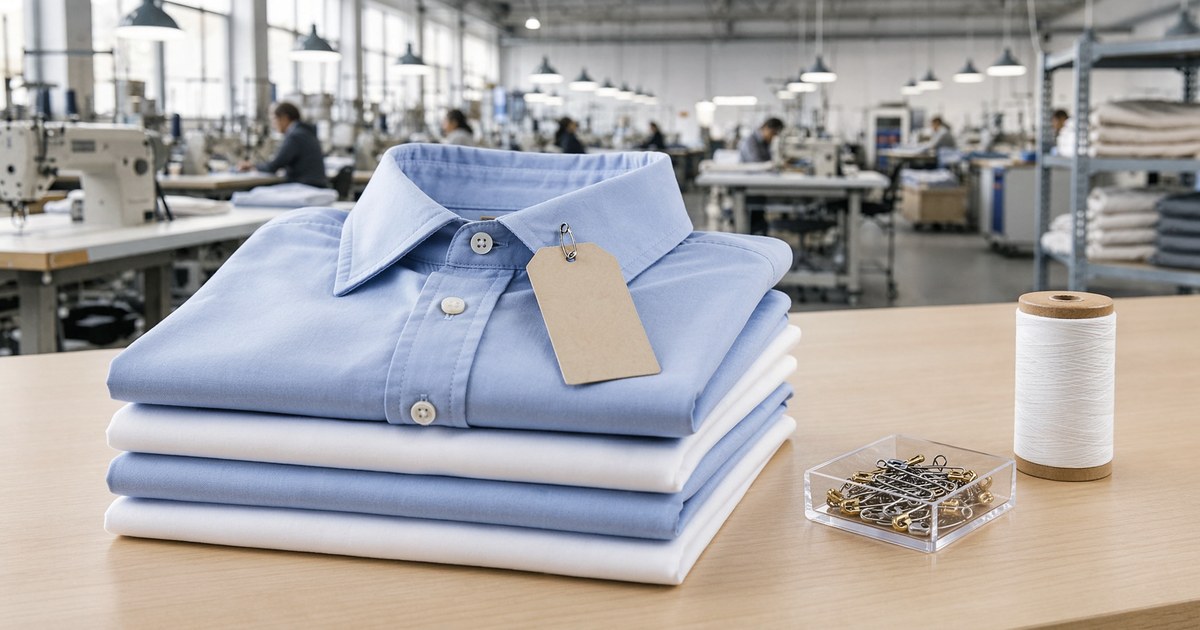
Garment and apparel makers in the Philippines use safety pins in small quantities per garment but large quantities per year: for tagging, holding folds, pressing, bundling and packing. Because each pin is cheap, the line rarely gets much attention until something goes wrong. A batch springs open on a pressed shirt, a brand's quality team rejects a carton because a pin went through the fabric where it shouldn't, or the metal detector at the end of the packing line keeps stopping.
This guide is for garment manufacturers and exporters in the Philippines, inside or outside economic zones, and for the trims suppliers who serve them. It covers where pins are used in a garment plant, how to specify them, which pack formats work on a production floor, what your brand customers may ask about pins, and the duty points that matter to an exporter buying from India. It isn't a full import guide for distributors. For the general process of buying from India, see how to import safety pins from India.
This is general buyer guidance, not customs, tax or legal advice. Tariff and incentive facts were read on official and published sources on 17 November 2026 and can change. Confirm your classification, rates and incentive conditions with your licensed customs broker and your investment promotion agency before ordering. Product details come from Suvik Overseas product pages, checked on 17 November 2026.
The short answer
Specify by length and wire, not just size number. On Suvik's product pages, size 0 steel pins are 28 mm or 30 mm with 0.70 mm wire, depending on the series.
Match the pack to the work station. Loose boxes of 1,000 or bunches of 10 suit production lines. Pouches suit trims stores that issue small quantities.
Ask your brand customers about metal first. Many brands check packed garments with a needle (metal) detector, and some restrict metal accessories in packing. Agree whether pins may stay in the finished pack.
Use the duty routes open to exporters. Under the ASEAN–India agreement, the Philippines' schedule lists safety pins at 0% with a valid Form AI certificate of origin. Registered export enterprises may also have duty exemption on raw materials and accessories for their registered activity.
Buy samples first. Samples are available on request; cost and lead time are shared on enquiry.
Where safety pins are used in a garment plant
A typical export garment factory uses safety pins in several places:
Tagging and ticketing. Some garment types and some buyers still use a pin to attach hang tags, price tickets or swing tags, especially where a plastic tag fastener would damage the fabric.
Bundle tickets and work-in-progress. Cutting rooms and sewing lines use pins to hold bundle tickets, size labels or cut parts together between operations.
Folding and pressing. Shirts, blouses and formal wear are often pinned to hold the fold, the collar or a sleeve in place after pressing.
Packing. Pins can hold a garment on its card or board, or keep accessories together in the polybag.
Sampling and fitting. Sample rooms and fit sessions use pins on prototypes and fit samples.
Each use needs a different pin. Tagging and pressing on fine shirting need a small, sharp pin with a clean finish. Heavier fabrics such as denim, workwear or outerwear need a longer pin with thicker wire. Our general guide to safety pins for garment manufacturers covers buying for these uses in more detail. This article stays on what is different for exporters in the Philippines.
Specifying the pin
Write the specification your buyer and your supplier can both check. For each line, state the following.
Length in mm. Size numbers are a convention, so the length is what you control. Our guide to safety pin size numbers in millimetres explains why.
Wire thickness in mm. Thicker wire holds better in heavy fabric but leaves a bigger hole.
Material and finish. Steel with nickel plating is the common choice. Brass pins are softer and non-ferrous, in silver, gold, black or nickel-free finishes.
Point and clasp. The point should go through cleanly without snagging, and the clasp should hold.
Coil type. For tagging, compare coilless and standard pins. See coilless vs standard safety pins for garment tagging.
Sizes from Suvik's product pages
Checked on 17 November 2026:
Brass size 000: 19 mm, 0.66 mm wire, 1,000 pieces per packet. Silver, gold, black and nickel-free finishes.
Brass size 00: 23 mm, 0.66–0.67 mm wire, 1,000 pieces per packet. The same finishes. See brass size 00.
Steel size 0: 28 mm (Liberal) or 30 mm (AROMI, SALASAR, MAJOR), 0.70 mm wire. See Liberal loose size 0: 1,000 pieces per box, 100 boxes per carton.
Steel size 1: 32 mm (Liberal, Nilgiri) or 35 mm (AROMI, SALASAR, MAJOR), 0.70–0.80 mm wire.
Steel size 2: 37 mm (Liberal, Nilgiri) or 40 mm (AROMI, SALASAR, MAJOR), 0.80–0.90 mm wire. See AROMI size 2, 20 pouch.
Steel size 3: 44 mm, 0.90 mm wire (Liberal size 3).
Steel size 4: 53 mm, 1.02–1.10 mm wire.
All the steel lines above are listed as mild steel with nickel plating.
For most export garment work, a plant needs only two or three lines: a small pin for fine fabric and tagging (brass 000/00 or steel size 0), a medium pin for general use (size 1 or 2), and possibly a larger pin for heavy garments. Fewer lines mean fewer mix-ups on the floor.
Pack formats for the production floor
How the pins are packed matters as much as the pin itself.
Loose boxes of 1,000. These suit a trims store that issues pins by weight or count to the lines. The Liberal loose size 0 box and the brass packets of 1,000 work this way.
Bunches of 10. Several series pack pins in bunches of 10 inside a box, for example the Liberal assorted box: 100 bunches of 10 pieces. Bunches are easy to count out at a work station and reduce loose pins on the floor.
Pouches. Pouches of 20, 25, 50 or 100 pieces inside a box suit plants that issue small, counted quantities to each line.
Count the selling or issuing unit per carton before you set reorder points. For example, a Liberal loose size 0 carton holds 100 boxes of 1,000, which is 100,000 pins. For conversions between pieces, gross, boxes and cartons, see the order quantity conversion guide. For packing options, including private label for trims suppliers, see the safety pin packaging guide.
What your brand customers may ask about pins
Export garment makers answer to their brand and retail customers, and those customers often have rules about accessories. Ask before you order, not after a shipment is held.
Metal detection and "no pins" rules
Many brands require packed garments to pass a needle detector, a metal detector that looks for broken needles and other metal left in the garment. These detectors are commonly set to find ferrous metal (iron and steel). A steel safety pin left in a packed garment will trigger the detector, and a garment that fails may be rejected.
So agree three things with each buyer:
Can pins be used in packing at all? Some buyers ban metal accessories in certain products, especially children's wear.
If pins are allowed, which material? Brass is non-ferrous. Whether a brass pin passes depends on the detector and its settings, so test it on your own line and get the buyer's written approval.
If pins are only used on the floor, how do you make sure none stay in the garment? Many factories control sharp tools with issue-and-return logs. Do the same for pins.
Whatever the material, test your own pins on your own detector before you decide.
Finish and nickel
If pins touch the garment where they could mark fabric, ask for samples and leave them pinned to your actual fabric for a few days. If a buyer restricts nickel, read how to specify nickel-free safety pins before you list a pin as nickel-free. Suvik's brass 000 and 00 nickel-free pages list a "Nickel Free Silver" plating. Get written confirmation for the exact item you order.
Documents your buyer may want
Some brands ask for supplier details or test reports for every trim. Ask your buyer exactly what they need for safety pins, and ask the supplier which of those documents they can provide. Don't assume a certificate exists. Our guide to checking supplier certificates explains what each type of document does and doesn't prove.
Duty points for exporters buying from India
AIFTA and Form AI
India and the Philippines are both parties to the ASEAN–India Trade in Goods Agreement. In the Philippines' AIFTA schedule of tariff commitments, safety pins of iron or steel were phased down from a base rate of 10% to 0% at the end of 2019. To claim the AIFTA rate, the goods must meet the AIFTA rules of origin, and you need a valid Form AI certificate of origin, issued in India by an authorised agency.
Without a Form AI, the Philippines' MFN rate for the line applies. Check the current MFN and AIFTA rates for your exact AHTN line in the Tariff Commission's Philippine Tariff Finder. Steel safety pins fall under heading 7319.40. Ask your broker how brass pins are classified.
Tell the supplier in your enquiry that you need a Form AI, and make sure the product description and HS code match on the invoice, the packing list and the certificate.
If you're a registered export enterprise
Under the CREATE MORE Act (Republic Act No. 12066), registered business enterprises, including registered export enterprises, may have duty exemption on importation of capital equipment, raw materials, spare parts or accessories directly attributable to their registered project or activity, for the registration period. Registered export enterprises may also have VAT exemption on importation of goods directly attributable to the registered activity. Whether safety pins for your tagging and packing count as directly attributable is a question for your investment promotion agency (for example PEZA) and your customs broker. Get it confirmed before you rely on it.
If your factory isn't in an economic zone, ask your broker about the other arrangements for export manufacturers, such as customs bonded manufacturing warehouses.
VAT
If no exemption applies, import VAT is 12%, charged on the customs value plus duty and other charges before release. See the BIR's VAT regulations and the summary in the sources below.
Shipping, lead times and documents
Suvik Overseas loads export orders at Kolkata (INKOL) by sea and Kolkata Airport (CCU) by air. Its shipping policy lists Southeast Asia among its export regions, and orders typically go on FOB Kolkata or CIF [your port], with DDP on request. Buyers may nominate their own forwarder. That's useful for garment exporters who already bring fabric or trims from India through a consolidator. Name your port in the enquiry: Manila, Cebu, Subic, Batangas or Davao. Ask your forwarder for the routing and transit time.
The published lead times are:
Ready stock: dispatched within 3–5 business days of payment confirmation.
Made-to-order or custom packaging: 10–21 business days.
Large FCL/LCL export consignments: 15–30 business days, including stuffing and documentation.
Peak production season (October–January) can extend these, and sea or air transit comes on top. Plan pin stock around your production calendar, not the day you run short. See lead time by order size and LCL, FCL or air freight.
The standard export documents in the shipping policy are the commercial invoice, packing list, bill of lading or airway bill, certificate of origin and GST/IGST documents, plus country-specific certificates as required. See export documents for safety pin orders.
Samples and approval
Build pin approval into your trims approval process:
Request samples of each line you plan to use. Samples are available on request; cost and lead time are shared on enquiry. See samples, quality and packing.
Test them on your own fabrics and your own needle detector, not on a desk.
Check closing, point, finish and pack count with the sample evaluation checklist.
Get your buyer's approval in writing if pins stay in the packed garment.
Keep approved samples as the reference for every reorder. If you use an inspection agency in India, see third-party pre-shipment inspection.
About the supplier
Suvik Overseas Pvt. Ltd. is a manufacturer of safety pins and dress hooks. It was incorporated in 2006, has its registered office in Kolkata and its factory in Howrah, West Bengal. Product catalogues for the AROMI, LIBERAL, SALASAR, MAJOR and loose safety pin ranges are on the catalogue page, and the safety pins for the garment industry page summarises the garment range. Minimums are discussed per order and depend on the product and packaging.
What to put in your enquiry
Your company, location (and economic zone, if any) and the garments you make.
Each pin line: material, finish, length in mm, wire thickness and coil type.
Pack format: loose 1,000, bunches of 10, or pouches.
Annual or monthly usage per line, and the first order quantity.
Any buyer rules: metal detection, nickel restrictions, documents.
Incoterm and port, and "Form AI certificate of origin required" if you'll claim the AIFTA rate.
Whether you want samples first.
Frequently asked questions
Which safety pin size is best for tagging garments?
For most tagging on light and medium fabrics, a small pin works: brass 000 or 00 (19–23 mm) or steel size 0 (28–30 mm). Heavy fabrics may need size 1 or 2. Test on your own fabric before you choose.
Will steel safety pins set off a needle detector?
Yes, they usually will. Steel is ferrous, and garment needle detectors are commonly set to detect ferrous metal. If pins must stay in the packed garment, agree the material with your buyer and test it on your detector.
What is the duty on safety pins from India to the Philippines?
In the Philippines' ASEAN–India tariff schedule, steel safety pins are listed at 0% with a valid Form AI certificate of origin. Without it, the MFN rate applies. Check the current rates for your line in the Philippine Tariff Finder, and note that 12% import VAT applies unless you're exempt.
Can ecozone exporters import safety pins duty-free?
Registered export enterprises may have duty and VAT exemption on importation of raw materials and accessories directly attributable to their registered activity. Confirm with your investment promotion agency and broker that safety pins qualify for your project.
Can I get samples before ordering?
Yes. Samples are available on request; cost and lead time are shared on enquiry.
Next step
If you make or export garments in the Philippines, send your pin lines, pack format, monthly usage, port and any buyer rules through the enquiry form or the contact page. Ask for samples at the same time, so you can test them on your fabrics and your needle detector while the quotation is prepared.
Importing for Vietnam? See how to import safety pins from India to Vietnam.
Sources
ASEAN–India FTA, Schedule of Tariff Commitments: Philippines (Enterprise Singapore): safety pins, base rate 10%, 0% from 31 December 2019. Read 17 November 2026.
Tariff Commission, Philippine Tariff Finder (AIFTA schedule): current MFN and FTA schedules by AHTN code. Read 17 November 2026.
Fiscal Incentives Review Board, Available Incentives: duty exemption on importation and VAT exemption for registered export enterprises under CREATE MORE. Read 17 November 2026.
Republic Act No. 12066 (CREATE MORE Act), DTI copy. Read 17 November 2026.
BIR Revenue Regulations No. 16-2005 (VAT) and PwC Worldwide Tax Summaries, Philippines: other taxes: 12% VAT on importation. Read 17 November 2026.
Suvik Overseas, Shipping & Delivery Policy: Incoterms, ports of loading, documents, lead times and packing. Read 17 November 2026.
Suvik Overseas product pages linked above: lengths, wire thicknesses, materials, finishes and pack counts. Read 17 November 2026.