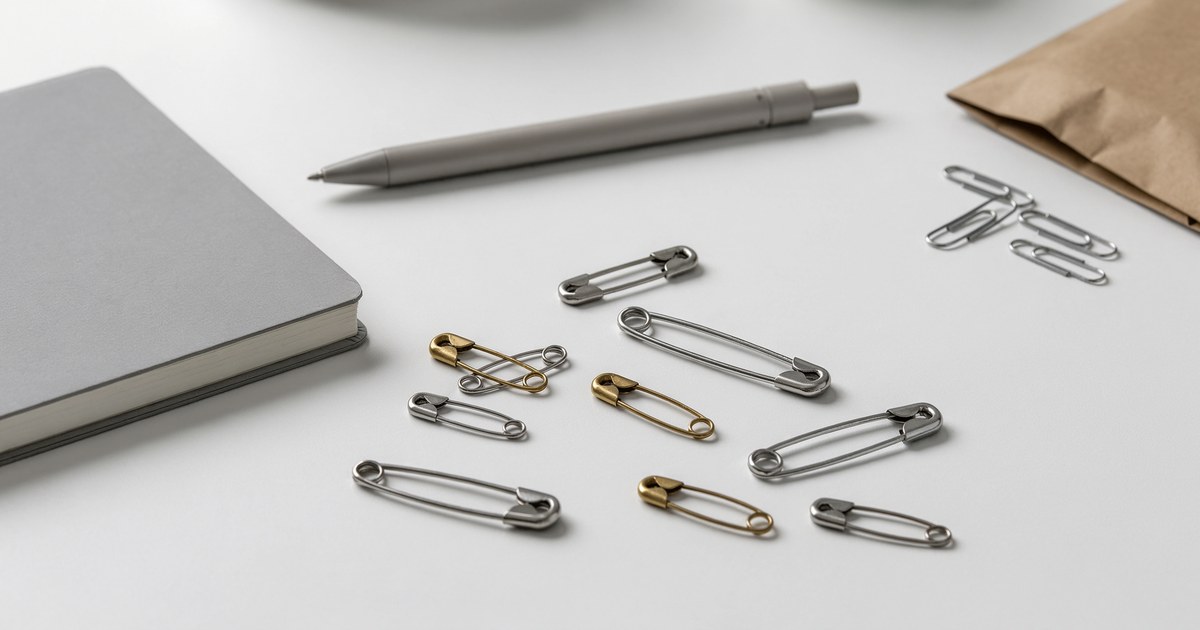
Safety pins are a small line in an office-supply catalogue, but they cause more trouble than their size suggests. A contract stationer lists "safety pins, assorted" and gets three different pack counts from three suppliers. A wholesaler orders a pin that suits a tailoring shop and finds it too heavy for a name badge. An online seller receives cartons whose markings do not match what its warehouse system needs.
This guide is for office-supply importers, stationery wholesalers and distributors, contract stationers who supply companies, schools and events, and online sellers of office products. It explains how to choose an office safety pin supplier, which sizes and packs make sense for a stationery range, how to turn a factory pack into a catalogue item, and what to put in your enquiry so the quotation is useful the first time.
Where a topic is covered in detail elsewhere on this site, such as MOQ, packaging types or RFQ wording, this article links to it and stays on what is different about the office and stationery channel. For a short summary of Suvik Overseas' office range, see the office safety pin supplier page.
This is general buyer guidance. Product sizes, wire thicknesses, pack counts and carton details quoted below are taken from Suvik Overseas product pages checked on 17 November 2026. Specifications can change, so confirm the current specification sheet for each item before you place an order.
The short answer
An office or stationery buyer usually needs three things from a safety pin supplier:
A short, clear size range. Most office uses are covered by small and medium pins, plus an assorted pack.
Packs that can be sold as they arrive. Pouches inside a box, or a box of mixed sizes, are easier to list and sell than loose bulk.
Product data your system can use. Length and wire thickness in millimetres, pieces per pack, packs per box, boxes per carton, carton size and carton markings.
Get those right, test samples and agree the shipping term before you compare prices.
Who buys safety pins through the office and stationery channel
Safety pins reach offices through several kinds of buyer, and each one needs a slightly different pack.
Office-supply importers and distributors bring in full cartons and sell boxes on. They need stable pack counts and clear carton data.
Contract stationers supply companies, schools and public bodies from a fixed catalogue, so they want lines that stay the same for years.
Stationery wholesalers sell boxes to small shops and need a pack a shop can sell without splitting.
Online office-supply sellers need packs that ship well and a barcode if the marketplace asks for one.
Event and promotional suppliers use safety pins to attach badges, ribbons and fabric name tags. They often want small brass pins in a neat finish.
If you serve more than one of these groups, keep a separate line for each rather than one pack that suits nobody. Distributors who also sell into retail and garment trades may find the wholesale assortment guide useful for planning the wider range.
How safety pins are used in offices
Office use is light compared with garment factories or laundries, but it is varied. Common jobs include:
attaching visitor badges, fabric name tags and event ribbons;
holding fabric swatches, samples or small tags to a card or folder;
keeping a few loose papers or receipts with a file where a staple would tear or mark them;
quick repairs to a hem, cuff or strap during a working day.
So the pin should close securely, go through card and light fabric without tearing it, and keep a clean finish that does not mark paper or clothing. For badges and ribbons, a gold or black finish can look better than plain steel. None of this needs heavy pins: most office demand sits in the smaller sizes.
Choose a small, clear size range
Safety pin size numbers are a convention, not a measurement, and the same number can mean different lengths in different series. Our article on what safety pin size numbers mean in millimetres explains this in detail, and the safety pin sizes guide and size chart in mm give reference values. For a stationery range, the point is simple: list every item by length in millimetres as well as by size number.
The table below shows the sizes on Suvik's product pages that suit typical office uses. Wire thickness is listed because it affects how the pin feels and how easily it goes through card or fabric.
Typical office useSizeExample product pageLength (mm)Wire (mm)Badges, ribbons, light fabric tags000Brass, loose (silver, gold, black or nickel-free finish)190.66Badges, ribbons, light fabric tags00Brass, loose (silver, black or nickel-free finish)230.67General desk use0Liberal Prime (40 pouch)280.70General desk use0AROMI size 0 (10, 20 or 40 pouch)300.70Mixed desk box0, 1, 2AROMI or SALASAR assorted (50 pouch)30, 35, 400.70, 0.80, 0.90Thicker fabric, heavier tags2AROMI, MAJOR or SALASAR size 2 (20 pouch)400.90Occasional heavy use4AROMI size 4 (bunch)531.10
A sensible starting range is one small brass line for badges, one size 0 line in pouches and one assorted box. Add a larger size only if customers ask for it; every extra line adds stock and catalogue work.
Brass pins appear only in the smallest sizes in this range, while the steel series cover the larger sizes. If some of your customers need to avoid nickel, read how to specify nickel-free safety pins before you list a product as nickel-free. The brass 000 and 00 nickel-free pages list a "Nickel Free Silver" plating, and you should ask for written confirmation for the exact item you order.
Match the pack to how the pin will be sold
In the stationery channel, the pack often decides whether a line sells. Suvik's product pages show three main pack types that matter to office buyers.
Pouches inside a box
Several steel series are packed as a box of 1,000 pieces split into small pouches. The pouch count changes the unit you can sell:
AROMI size 0, 40 pouch: 40 pouches of 25 pieces.
AROMI size 0, 20 pouch: 20 pouches of 50 pieces.
AROMI size 0, 10 pouch: 10 pouches of 100 pieces.
Liberal Prime, 40 pouch: 40 pouches of 25 pieces, size 0 at 28 mm.
A pouch of 25 pieces suits a desk drawer or a small shop counter. A pouch of 100 pieces suits a reception desk, a school office or an event team. If you sell to both, two pouch counts of the same pin can sit side by side in your catalogue.
Assorted boxes
An assorted box puts three sizes in one product, which saves the end user from choosing. The AROMI assorted 50 pouch and SALASAR assorted 50 pouch pages both list 1,000 pieces per box in 50 pouches of 20 pieces, with sizes 0, 1 and 2 at 30, 35 and 40 mm. Assorted boxes in bunches of 10 pieces are also listed, such as the Liberal assorted box with sizes at 28, 32 and 37 mm.
Before you list an assorted pack, ask how the sizes are split inside the box and whether the split is the same in every box. Your catalogue description should say what the customer will find inside.
Loose packets
The small brass pins are listed as loose packets of 1,000 pieces, for example brass size 000, nickel-free and brass size 00, gold. Loose packets work well for event suppliers and badge makers who use pins in volume. For retail stationery, you may want them repacked into smaller units, which is a packaging question to raise at the start.
The full range of packaging types, including retail boxes and blister packs, is covered in the safety pin packaging guide and on the custom safety pin packaging page. If you want your own brand on the pack, see private label safety pins. Custom packs take longer than standard packs, as shown in the lead time section below.
Turn the supplier's pack into a catalogue item
A safety pin line needs the same item data as any other stationery product, and it is easier to collect before the first order than after the goods arrive.
For each line, build a short item record from the supplier's specification:
Description: material, finish, size number and length in mm, for example "Steel safety pins, nickel finish, size 0, 30 mm".
Selling unit: the pouch, box or packet you will sell, and how many pieces it holds.
Inner pack: how many selling units sit in one box.
Carton: boxes per carton and carton dimensions.
Carton markings: what is printed or labelled on each carton.
Barcode: whether the pack carries one, and who supplies the number.
Here is a worked example using one product page. The AROMI size 0, 40 pouch page lists 1,000 pieces per box (40 pouches of 25 pieces), 100 boxes per carton, and a carton size of 29 x 16 x 16 inches. From those figures:
one carton holds 100 boxes, or 100,000 pieces;
one carton holds 4,000 pouches of 25 pieces.
If you sell by the pouch, one carton gives you 4,000 selling units; if you sell by the box, 100. Do this for every line before you set reorder points, because the carton is what you order and receive. For more on converting between pieces, gross, boxes and cartons, see the order quantity conversion guide.
Carton counts are not the same across the range. The assorted 50 pouch boxes, for example, are listed at 75 boxes per carton, and the Liberal Prime 40 pouch at 60 boxes per carton. Check each product page rather than assuming one carton count for all.
Suvik's shipping policy states that pins are packed in polybags or branded pouches, consolidated in inner cartons, then in double-wall corrugated outer cartons, and that each carton is labelled with product details, quantity, batch number and destination address. If your warehouse needs a specific label layout or a barcode on the outer carton, include that in your enquiry.
Barcodes, labels and your own brand
Many retailers and marketplaces ask for a barcode on every selling unit. Decide early whether the pin will be sold under the series name or your own brand, whether each pouch or box needs a barcode (and who holds the numbers), and what the pack must say in your market and language. Retail labelling rules differ by country, and the importer usually carries the responsibility for meeting them, so give the supplier the exact wording and artwork you need.
Samples and checks before you list a line
Do not add a safety pin line to a catalogue without handling the actual product. Samples are available on request; cost and lead time are shared on enquiry. The samples, quality and packing page sets out how samples and checks work, and the sample evaluation checklist gives a full method.
For an office range, pay particular attention to these points when the samples arrive:
Closing and holding. Open and close several pins many times. The pin should hold firmly in the clasp and not spring open in a pocket or bag.
Point and edges. Push the pin through card, a fabric badge and a ribbon. It should go through cleanly without tearing, and there should be no rough edges.
Finish on paper. Leave a few pins on white paper or light fabric for a while and check for marks. Compare the finish across several pouches.
Pouch and box counts. Count the pieces in a few pouches. If you sell by the pouch, a short count becomes a customer complaint.
Pack appearance. Look at the pack as a customer will see it on a shelf or in a photo.
Keep approved samples as your reference for reorders. If you are comparing several suppliers, the guide on how to evaluate a safety pin supplier covers what to check beyond the product itself.
Order quantities and minimums
Stationery buyers often want several lines in modest quantities, rather than a large quantity of one item. Minimums are discussed per order, and they can depend on the product and the packaging you choose. Custom or private-label packs can change the minimum. The safety pin MOQ guide explains how minimums are expressed and what affects them.
When you ask about minimums, say which lines you want together. A first order that combines a size 0 pouch line, an assorted box and a brass line lets you test the whole range in one shipment.
Lead times and planning around the stationery year
Office and school supply demand is not flat. Many stationery businesses see busy periods around the start of a school or financial year, and around the end of the calendar year. Peak periods differ by country, so plan from your own sales history.
Suvik's published shipping policy gives these standard timelines:
Ready stock orders: dispatched within 3–5 business days of payment confirmation.
Made-to-order or custom packaging: 10–21 business days, depending on quantity and specifications.
Large export consignments (FCL/LCL): 15–30 business days, including stuffing and documentation.
The policy also notes that lead times may vary during peak production seasons (October to January) and that the sales team confirms updated timelines when an order is confirmed. These timelines cover production and dispatch, not sea or air transit to your country, so add transit time on top. For stock planning ahead of a busy period, see planning safety pin stock for peak season.
Shipping terms and getting the goods to you
The shipping policy states that export orders are typically shipped on FOB Kolkata or CIF port of destination terms, that DDP can be arranged on request, and that buyers may nominate their own freight forwarder. This matters to office-supply importers who already bring in stationery from several sources, because your own forwarder may be able to combine shipments.
Import duties, taxes and customs clearance charges at the destination are the buyer's responsibility under the policy. If you are unsure which term to choose, read FOB, CIF and DDP shipping terms for safety pins before you ask for prices, so that the quotes you collect can be compared on the same basis.
What to put in your enquiry
A clear enquiry gets a clear quotation. For office and stationery buyers, include:
Your business type (importer, distributor, contract stationer, online seller) and your country.
The lines you want, each with size number, length in mm, material and finish.
The pack for each line: pouch count, assorted or single size, loose packet, or a custom pack.
Whether you need your own brand, barcodes or market-specific wording on the pack.
Estimated quantity per line, in boxes or cartons.
Your carton and labelling requirements for your warehouse.
Your preferred shipping term (FOB, CIF or DDP) and destination port.
Whether you want samples first.
The safety pin RFQ template gives a fuller format you can copy.
Common mistakes stationery buyers make
Listing by size number only. "Size 0" can mean 28 mm or 30 mm in different series. Put the length in mm in the item description.
Too many lines too early. Start with a small range, learn what sells, then add sizes.
Ignoring the carton. The carton count decides how much stock you hold. Calculate selling units per carton before you set reorder points.
Approving from photos. Handle real samples and keep them to check reorders against.
Forgetting transit time. Dispatch timelines do not include sea or air transit. Plan backwards from the date you need stock on the shelf.
Frequently asked questions
Which safety pin sizes suit office use?
Most office jobs are covered by small and medium pins. On Suvik's product pages, the small brass pins are 19 mm (size 000) and 23 mm (size 00), and size 0 steel pins are 28 mm or 30 mm depending on the series. An assorted box with sizes 0, 1 and 2 covers general desk use.
Can I buy safety pins in small pouches for resale?
Yes. Several series are packed as boxes of 1,000 pieces split into pouches, for example 40 pouches of 25 pieces, 20 pouches of 50 pieces or 10 pouches of 100 pieces. Choose the pouch count that matches the unit you want to sell.
Can safety pins be packed under my own stationery brand?
Private-label and custom packaging options are offered. Send your artwork needs, barcode details and the wording your market requires with your enquiry. Custom packaging has a longer lead time than ready stock.
What is the minimum order for office safety pins?
Minimums are discussed per order and depend on the product and packaging. Tell the supplier which lines you want to combine in the first order.
Can I get samples before listing a line in my catalogue?
Yes. Samples are available on request; cost and lead time are shared on enquiry. Test the closing, the point, the finish and the pouch counts before you list the item.
Next step
If you supply offices, schools or stationery shops in your country, send your planned lines, pack types, quantities and destination through the enquiry form or the contact page. You can also browse the catalogue first and name the products you want to quote. Ask for samples at the same time, so you can test the pins while the quotation is prepared. Minimums are discussed per order.
Sources
Suvik Overseas product pages, fetched 17 November 2026: lengths, wire thicknesses, materials, finishes, pack counts, boxes per carton and carton sizes for the AROMI, Liberal, MAJOR, SALASAR, Nilgiri and Brass series (33 product pages; for example AROMI size 0, 40 pouch, AROMI assorted, 50 pouch, Brass size 000, nickel-free).
Suvik Overseas, Shipping & Delivery Policy, fetched 17 November 2026: lead times, peak season note, Incoterms, forwarder nomination, packing and carton labelling.
Suvik Overseas, Samples, Quality Checks and Packing, fetched 17 November 2026: sample availability.
Live Suvik Overseas pages linked in the body, each checked on 17 November 2026 (see plan-2026-11/day17/linkcheck-2026-11-17.txt).