
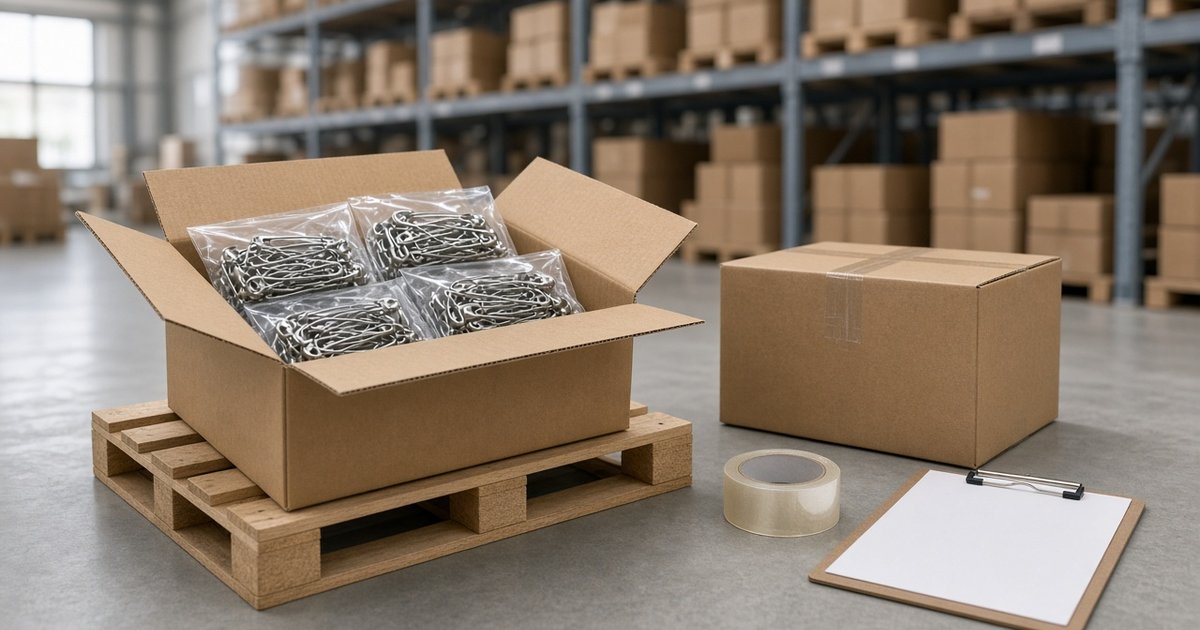
Dubai is a natural staging point for safety pins made in India and sold on to buyers in East Africa, West Africa and the wider Gulf. A trading company can bring a container into a free zone such as Jebel Ali, split it, hold stock, and re-export smaller lots to several countries, without first clearing the goods into the UAE mainland.
This guide is for those trading companies. It covers how goods move into and out of a Dubai free zone, what happens to origin and duty, which documents you need, and how Incoterms should be set on each leg. It is not a guide to selling inside the UAE. Wholesalers who clear pins into Dubai or the other emirates for local customers should use our wholesale guide for Dubai and the UAE.
This is general buyer information, not customs, tax or legal advice. The rules below were read on official Dubai Customs, Dubai Chambers and GCC Customs Law texts on 25 November 2026 and can change. Confirm the treatment of your own shipments with a UAE customs broker and, for the onward country, with a broker there. Product and shipping details are from Suvik Overseas product pages and its published shipping policy, checked the same day.
The short answer
In the free zone, UAE import duty is not usually due. Under the GCC Common Customs Law, foreign goods may be brought into a free zone and taken out of the country again without being subject to customs duties or taxes, as long as they stay in the zone until they are re-exported.
If the pins enter the UAE mainland, they are treated as foreign goods and must be cleared in the normal way. Our Dubai wholesale guide and HS code and duty guide cover that route, including the India–UAE CEPA preference.
Origin stays Indian. Storing or splitting cartons in a free zone does not make the pins UAE goods. Dubai Chambers issues a separate certificate for foreign commodities intended for re-export; the invoice must state the country of origin.
A preference at the final destination is not automatic. An India–UAE CEPA certificate helps only when the goods enter the UAE. A preferential rate in Kenya, Nigeria, Saudi Arabia or elsewhere usually needs the certificate that that country requires, issued in India, and must also satisfy that agreement's rules on transhipment. Ask the destination broker before you promise a reduced rate.
Jebel Ali procedure (from 30 September 2026): Dubai Customs Notice 18/2026 allows goods stored in Jebel Ali Free Zone to be exported from Jebel Ali Port or Al Maktoum International Airport under an FZ Transit Out declaration without a duty guarantee, if they leave from the same customs office, are exported within 30 days, and the declaration is closed within 45 days.
First step: send your sizes, pack formats, the free zone you will use and the countries you will re-export to through the enquiry form.
How a free-zone re-export works
A typical flow looks like this:
India to the free zone. You buy from the factory on FOB Kolkata or CIF Jebel Ali. The container is discharged at Jebel Ali and declared into the free zone, not into the UAE mainland.
Storage and splitting. You hold the cartons, count them, and if needed split a container into smaller lots for different buyers. The GCC law does not set a time limit on how long foreign goods may remain in a free zone.
Onward sale. You invoice the buyer in, say, Nairobi, Lagos, Jeddah or Muscat, and agree the Incoterm for that second leg.
Exit. You file a free-zone exit or re-export declaration with Dubai Customs, and the goods leave by sea or air for the destination country.
Clearance at destination. The buyer's broker clears the pins under that country's rules, using the origin and documents you supply.
The two legs are separate contracts. The factory's invoice covers the move to Dubai; your invoice covers the move to the final buyer. Keep both sets of documents complete and consistent.
Duty inside the zone, and what changes if goods go inland
Article 78 of the GCC Common Customs Law says that, subject to the following articles, all foreign goods of whatever kind or origin may be brought into free zones and duty-free shops, and taken out from them to outside the country or to other free zones, without being subject to customs duties or taxes. Goods in the zone are not subject to a time limit (Article 78(c)).
Article 85 is the counterpart: goods taken out from the free zone into the customs office (that is, into the UAE mainland) are treated as foreign goods, even if they incorporate local materials. At that point the normal UAE import rules apply, including duty, VAT and any CEPA claim. If part of a consignment will be sold in the UAE and part re-exported, treat those portions as two different customs paths and talk to your broker before the goods arrive.
This article does not restate the UAE duty or CEPA figures; they are in the duty guide and the Dubai wholesale guide. Confirm VAT on any local sale, and the VAT treatment of free-zone supplies and re-exports, with your tax adviser.
Leaving Jebel Ali: Customs Notice 18/2026
On 30 September 2026, Dubai Customs issued Customs Notice No. 18/2026, which took effect the same day. It applies to goods stored in certain free zones and exported to destinations outside the UAE from the same customs office, and it removes the need to present a cash or bank guarantee equal to the customs duty for that move.
The notice applies to:
Jebel Ali Free Zone, for exportation from Jebel Ali Port or Al Maktoum International Airport;
Dubai Logistics City Free Zone, from the same two gateways;
Dubai International Airport Free Zone, for exportation from Dubai International Airport.
The practical conditions are:
goods are exported under an FZ Transit Out declaration;
they leave from the same customs office that handled the zone;
they are exported within 30 days from the date the customs declaration is processed;
within 45 days of the declaration being registered, you file an electronic request to close it, with a copy of the FZ Transit Out declaration and an exit/entry certificate signed and stamped to show that the goods have left the UAE.
If the declaration is not closed in time, duties, penalties and other amounts can be imposed. Your clearing agent should build these deadlines into the re-export plan. Procedures in other UAE free zones, or exports that leave from a different customs office, may still need a guarantee; confirm with the agent.
Origin: the pins stay Indian
A safety pin made in Howrah does not become a UAE product because it sat in a Jebel Ali warehouse. That matters in two ways.
On your commercial invoice and packing list, the country of origin should remain India. Dubai Chambers' Board of Directors Resolution No. (7) of 2024, which sets the rules for certificates of origin issued by the Chambers, requires the invoice to state the country of origin, and says that a reference to an economic community or regional organisation is not acceptable in place of a country.
The certificate itself. The same resolution provides two types of certificate: a non-preferential certificate for domestic commodities intended for export, and a certificate of origin for foreign commodities intended for re-export. Pins made in India and re-exported from Dubai fall under the second type. The exporter must be an active member of Dubai Chambers, and the details on the application must match the invoice. This certificate confirms the original country of manufacture; it is not a claim that the goods are of UAE origin, and it is not by itself a preferential certificate under another country's trade agreement with India.
Do not describe the pins as "Made in UAE" on packs, invoices or certificates. If you relabel in the zone, keep "Made in India" (or the equivalent required by the destination) on the pack the end buyer receives.
Preferential duty at the final destination
This is the point that most often goes wrong.
India–UAE CEPA can reduce or remove UAE duty when Indian-origin pins enter the UAE. It does not travel with the goods when they are re-exported to a third country.
AIFTA Form AI, UK CETA, African or other Indian agreements are issued in India for a named importing country, in the form that agreement requires. Our certificate of origin guide explains how to ask for the right document, and notes that transhipment without the proof an agreement requires is a common reason for rejection.
If you already have the goods in Dubai and only then find a buyer in, say, Kenya, you may not be able to obtain a new preferential certificate that the Kenyan customs authority will accept, because many agreements expect the certificate to be issued around the time of export from India and to show a through bill of lading or equivalent. Ask the destination broker before you price a duty-free or reduced-duty sale.
For the import process in onward markets, see our guides for Kenya, Nigeria, South Africa, Saudi Arabia and the Gulf and HS codes and duty. Hijab and abaya retailers in the Gulf are covered in a separate buying guide.
Ready to set up a free-zone shipment?
Send the enquiry form with your sizes in mm, pack formats, quantity, the free zone you will use, and the countries you expect to re-export to. Tell us whether you want the first leg on FOB Kolkata or CIF Jebel Ali, and whether you need a preferential certificate for any onward market.
Incoterms on each leg
The Incoterms rules, published by the International Chamber of Commerce, say who arranges and pays for each stage, and where risk passes. Set them separately for each contract:
India to Dubai: FOB Kolkata (you arrange the main freight) or CIF Jebel Ali (the factory arranges freight and insurance to the port). DDP into a free zone is unusual and should be spelled out with your broker.
Dubai to the final buyer: often FCA or ex-works at the free-zone warehouse if the buyer appoints the forwarder, or CIF or DAP at the destination port or city if you arrange the onward freight.
See FOB, CIF and DDP for safety pin orders. Do not assume that a DDP quote from India to a city in Africa can be delivered via a Dubai free zone without extra terms covering the second clearance.
Documents to keep in one file
For the India–Dubai leg:
commercial invoice and packing list from the manufacturer, showing Indian origin and the HS code;
bill of lading or airway bill to Jebel Ali;
any preferential or non-preferential certificate of origin issued in India, if you will need it later;
the free-zone entry declaration.
For each re-export:
your commercial invoice and packing list to the onward buyer, still showing Indian origin;
the Dubai Chambers certificate for foreign goods intended for re-export, if the destination or the bank requires it;
the FZ Transit Out declaration and the stamped exit/entry certificate (and close the declaration within the 45-day window);
the onward bill of lading or airway bill;
copies of the original Indian documents, which the destination broker may ask to see.
Suvik's shipping policy lists the commercial invoice, packing list, bill of lading or airway bill, certificate of origin and GST/IGST documents as standard on the export from India. Ask in the purchase order if you need a named preferential certificate. See export documents.
Planning stock and packs
A free-zone operation works best if the first shipment already matches how you will resell:
combine two to four of your main sizes in one container, so one set of India–Dubai freight costs covers several lines;
choose pouch or bunch packs that you can split without opening every inner bag;
agree carton marks that still make sense when a carton is sent on to a third country;
if you will relabel, agree the "Made in India" line and any language or barcode the destination requires before production. See custom packaging.
Examples of nickel-plated mild steel pins from Suvik's product pages include 28 mm LIBERAL Prime, 30 mm AROMI size 0, 35 mm AROMI size 1, 40 mm MAJOR size 2 and 53 mm MAJOR size 4. Order by length in millimetres; see the sizes chart.
Suvik's shipping policy gives 3–5 business days for ready stock, 10–21 business days for made-to-order or custom packaging, and 15–30 business days for large FCL or LCL consignments, plus transit, from Kolkata (INKOL) or Kolkata Airport (CCU). Peak season is October to January. MOQ is flexible and depends on size, finish and packaging. See LCL, FCL or air freight and lead time by order size. For a first container, see planning a first trial order.
Buying direct from the factory
Suvik Overseas Pvt. Ltd. manufactures safety pins in Howrah, India. The company was incorporated in 2006 and supplies buyers in 35+ countries. For a free-zone trader, buying from the manufacturer keeps the origin trail short: one invoice, one set of carton marks and one certificate application in India, rather than a chain of traders. That is the cleanest starting point if you later need to prove Indian origin to a destination customs authority.
Common mistakes
Treating a free-zone arrival as a UAE import. Duty and CEPA only arise if the goods enter the mainland.
Calling the pins UAE origin. They remain Indian. Use the Chambers' re-export certificate, not a domestic-origin certificate.
Promising the final buyer a preferential rate you have not confirmed with that country's broker, especially after the goods have already arrived in Dubai.
Missing the 30-day export or 45-day closure window under Notice 18/2026 for Jebel Ali, Dubai Logistics City and Dubai International Airport Free Zone.
Vague second-leg Incoterms. Say clearly who arranges onward freight and who is the importer at destination.
Frequently asked questions
Do I pay UAE duty on pins I will re-export from Jebel Ali?
Under the GCC Common Customs Law, foreign goods may enter a free zone and leave the country again without being subject to customs duties or taxes, provided they are not withdrawn into the UAE mainland. Confirm the declarations with your Dubai broker.
Can I sell some cartons in the UAE and re-export the rest?
Yes, but the portion that enters the mainland is a normal UAE import and must be cleared as such. Split the consignment with your broker before you move any cartons inland.
Will my African or Gulf buyer get a duty preference because the pins came from India via Dubai?
Only if that buyer's country has an agreement with India that applies to the goods, the correct certificate was issued, and the agreement's transhipment rules are met. A Dubai re-export certificate does not by itself create that preference. Ask the destination broker first.
What is Customs Notice 18/2026?
A Dubai Customs notice, in force from 30 September 2026, that lets goods stored in Jebel Ali Free Zone, Dubai Logistics City Free Zone or Dubai International Airport Free Zone be exported from the same customs office without a duty guarantee, subject to a 30-day export deadline and a 45-day declaration-closure deadline.
Can I get samples before I ship a container to the zone?
Yes. Samples are available on request; cost, courier and lead time are shared when you enquire.
Next step
If you trade from a Dubai free zone and supply buyers in Africa or the Gulf, send your sizes, pack formats, quantity, free zone and onward countries through the enquiry form or the contact page. We can help you plan the India–Dubai leg and the documents your onward buyers will need.
Sources
GCC Common Customs Law (English text published by Dubai Customs): Article 78 (foreign goods into and out of free zones without customs duties or taxes; no time limit in the zone); Article 85 (goods taken out into the customs office treated as foreign goods). Read 25 November 2026.
Dubai Customs, Customs Notice No. (18/2026): FZ Transit Out without a duty guarantee from the same customs office; Jebel Ali Free Zone (Jebel Ali Port or Al Maktoum International Airport), Dubai Logistics City Free Zone, Dubai International Airport Free Zone; 30-day export; 45-day closure with FZ Transit Out copy and stamped exit/entry certificate; in force 30 September 2026. Read 25 November 2026.
Dubai Chambers, Board of Directors Resolution No. (7) of 2024, certificates of origin: types of certificate, including certificates for foreign commodities intended for re-export; invoice must state the country of origin. Read 25 November 2026.
International Chamber of Commerce, Incoterms rules. Read 25 November 2026.
Suvik Overseas, Shipping & Delivery Policy. Read 25 November 2026.
Suvik Overseas product pages linked above. Read 25 November 2026.