
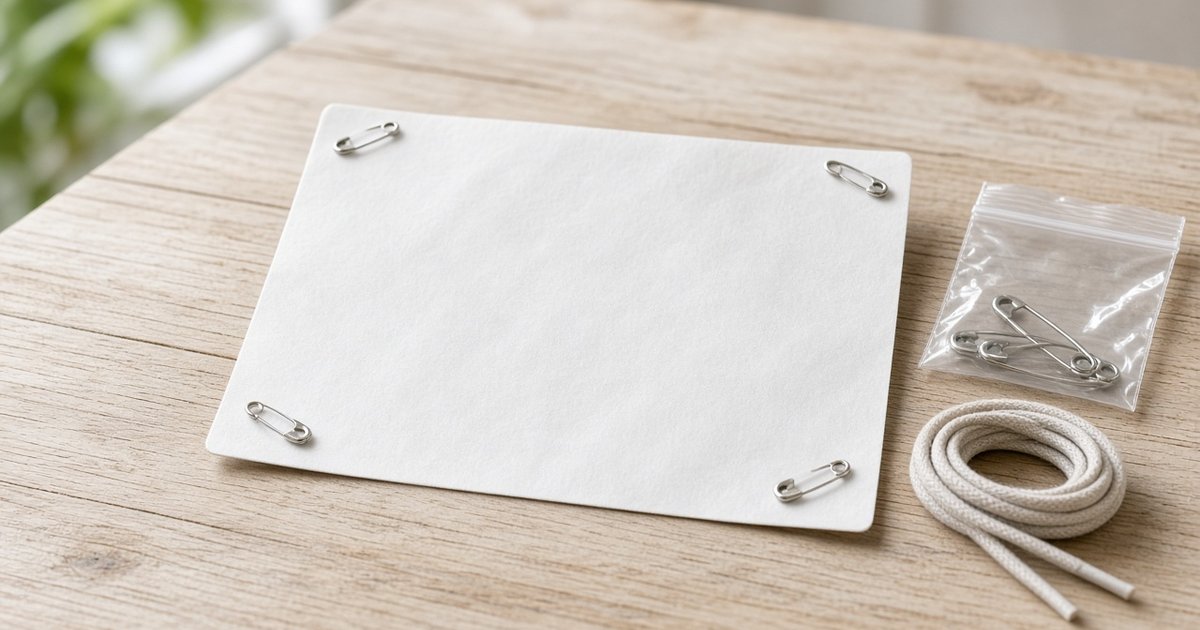
Race organisers buy safety pins for a simple job: attaching a bib to a runner's shirt at each corner. A marathon, a school sports day or a charity 10K may need only four pins per person, but that adds up quickly once you multiply by the size of the field, plus spares for the registration desk and for pins that go missing on the start line.
This guide is for event organisers, timing companies, schools and sports wholesalers in the United States, the United Kingdom and Australia who buy pins in bulk. It covers how to choose a size, what to check on a sample, pack formats (including bags of four), when to order so the pins arrive before race day, and the import points that matter in each of those three markets.
This is general buyer information, not customs or legal advice. U.S. duty figures were re-checked on official USITC pages on 25 November 2026 and can change. Confirm the classification and duty for your own shipment with a licensed customs broker. Product and shipping details are from Suvik Overseas product pages and its published shipping policy, checked the same day.
The short answer
A common pack is four pins per bib, one for each corner. Order the number of runners, plus a spare allowance for the registration desk and lost pins.
Sizes to sample: 28 mm and 30 mm nickel-plated mild steel pins suit most paper or Tyvek-style bibs. A 35 mm pin can help on thicker fabric or winter layers. Test two sizes on your actual bib stock.
What to check: a smooth point that does not tear the bib, a head that covers the point fully, and a spring that stays closed while the runner moves.
Packs: pouches of 20 or 25 inside a box of 1,000, which volunteers can count from, or a custom bag of four if you want a race-ready pack. Confirm custom counts with our team.
Order early. Ready stock is dispatched in 3–5 business days, custom packs in 10–21 business days, plus transit from Kolkata. Peak season (October to January) can extend these times.
U.S. duty (read 25-11-2026): HTSUS 7319.40.20 "Safety pins" has a 4.5% general duty, and steel safety pins also carry the 50% Section 232 duty on full value. Small parcels are no longer duty-free.
First step: send your size in mm, pack format (including whether you want bags of four), quantity and destination country through the enquiry form, and ask for samples.
Who buys pins for race bibs
Marathon, half-marathon and road-race organisers who pack a bib and pins for every registered runner.
Timing companies and event contractors that supply bibs and pins as part of a race package.
Schools, universities and sports associations that run sports days, cross-country and inter-school events.
Charity and fun-run organisers that may only need pins once or twice a year.
Sports and event wholesalers that sell bib kits to many smaller events.
Each of these buyers needs the pins to be cheap enough to give away, consistent enough that volunteers can attach them quickly, and delivered in time for pack-out, which is often days or weeks before the event.
How bibs are pinned
Most running bibs are attached at four corners so the number sits flat on the chest and does not flap. Some events use two pins on a smaller bib, or a different method such as bib clips or a race belt; this guide is about safety pins.
The pin has to go through the bib and the runner's shirt (and sometimes a jacket) and close securely. It should not tear the bib, leave a large hole, or open while the runner is moving. Because runners pin the bib themselves at registration or at home, the pin also has to be easy to open and close with cold or hurried hands.
Choosing the size
There is no official "race bib size". Size numbers also vary between factories, so order by length in millimetres. See the safety pin sizes chart and, if your brief is written in gauge, what gauge a safety pin is.
These nickel-plated mild steel examples from Suvik's product pages are a practical starting set:
28 mm, 0.70 mm wire: LIBERAL Prime, 40 pouch (1,000 pieces per box in 40 pouches of 25, 60 boxes per carton) or LIBERAL size 0, loose (1,000 loose pieces per box). A short pin that sits neatly on a standard bib corner.
30 mm, 0.70 mm wire: AROMI size 0, 10 pouch or SALASAR size 0, 10 pouch (1,000 pieces per box in 10 pouches of 100).
35 mm, 0.80 mm wire: AROMI size 1, 20 pouch, useful if your bibs are pinned through a jumper or vest as well as a shirt.
A 23 mm pin may be too short for some shirts and jackets; a much longer pin can poke or look bulky on a bib. The reliable method is to sample two sizes on the bib stock you will actually issue, including the thickest garment you expect runners to wear, and order the size that holds and closes cleanly.
Point, closure and finish
On samples, check:
The point. It should pass through the bib and a shirt without tearing the bib paper or snagging the fabric.
The closure. The head should cover the point fully, so a pin that has been knocked on a crowded start line does not scratch the runner.
The spring. The pin should stay closed when the bib is pulled or when the runner bends.
The finish. The steel lines above are listed as nickel-plated. The plating should be even, without rough patches that catch on fabric. Suvik's product pages describe these pins as rust-resistant and list anti-corrosion testing among the quality checks. If you store pins from one year to the next in a damp room, say so in the enquiry.
Other finishes or materials are not covered in this guide. If you need a particular finish, ask in your enquiry and confirm with our team what can be supplied, then compare samples.
Ready to compare samples?
Send the enquiry form with your size in mm, pack format (standard pouches or bags of four), quantity and destination country. Ask for samples at the same time so you can test them on your bibs while the quotation is prepared.
Pack formats, including bags of four
How you issue pins on the day decides the pack:
Pouches of 25 (for example LIBERAL Prime) or pouches of 20 or 100 are easy for a registration team to count from. A volunteer can take four pins from a pouch for each runner.
Loose boxes of 1,000 suit a packing line that is already counting pins into bib envelopes.
A bag of four is a race-ready pack: one bag per runner, dropped into the race pack with the bib. That count is not a standard catalogue item on the product pages, so treat it as a custom pack. Suvik's custom packaging page lists polybags, printed retail boxes, hanging packs and barcodes. Tell us the count, bag type and any event branding, and confirm with our team whether it can be made and how that changes the lead time.
Add a spare allowance. A practical approach is to order for every registered runner, plus a margin for the registration desk, late entries and pins that are dropped or opened by mistake. The right margin is yours to set; this guide does not suggest a fixed percentage.
Our guide to converting pieces, gross, boxes and cartons helps when you are translating a runner count into boxes and cartons.
When to order so the pins arrive before race day
Work backwards from the day you pack race bags, not from race day itself.
Suvik's published shipping policy gives:
Ready stock: dispatched within 3–5 business days of payment confirmation.
Made-to-order or custom packaging: 10–21 business days, depending on quantity and specification.
Large export consignments (FCL/LCL): 15–30 business days, including stuffing and documentation.
Peak season (October to January) can extend these, and transit time from Kolkata comes on top. Goods ship FOB Kolkata or CIF port of destination, with DDP on request, from Kolkata (INKOL) by sea or Kolkata Airport (CCU) by air. Buyers may nominate their own forwarder. Import duties and clearance at destination are the buyer's responsibility unless DDP is agreed.
Sea freight suits a planned annual or seasonal order. Air freight or courier suits a late top-up, but it costs more per pin and, in the United States, a small parcel is no longer duty-free. See LCL, FCL or air freight, lead time by order size and planning stock and reorders.
If this is your first order from India, our guide to planning a first trial order shows how to approve samples, combine lines and check the first shipment before you commit to a season's volume.
Importing into the USA, the UK and Australia
United States
In the current Harmonized Tariff Schedule of the United States (checked on the official USITC search on 25 November 2026), subheading 7319.40.20 "Safety pins" has a 4.5% general duty. Steel safety pins are also derivative steel articles under Section 232: heading 9903.82.02 adds "the duty provided in the applicable subheading + 50%", so steel pins currently pay 4.5% plus 50% of the customs value. Confirm both lines with your broker on the date of entry. Our HS code and duty guide and U.S. landed cost worked example explain how the lines stack.
Duty-free de minimis treatment for shipments of $800 or less has been suspended. A small courier top-up for a late race still needs a proper entry. See importing small safety pin shipments after the end of de minimis.
Imported packs must be marked with the English name of the country of origin so the ultimate purchaser can see it. Agree "Made in India" (or the equivalent your broker specifies) on the bag or box before production.
United Kingdom
For classification, duty and the step-by-step import process, use our guide to importing safety pins from India to the UK. Haberdashery and craft retailers, whose needs sometimes overlap with smaller events, are covered in a separate UK buying guide. Confirm the current duty with your UK freight forwarder or broker.
Australia
See importing safety pins from India to Australia and wholesale safety pins for Australia. Confirm the current duty and any biosecurity or labelling point with your broker.
In all three markets, Suvik's shipping policy lists the commercial invoice, packing list, bill of lading or airway bill, certificate of origin and GST/IGST documents as standard. See export documents and FOB, CIF and DDP.
Buying direct from the factory
Suvik Overseas Pvt. Ltd. manufactures safety pins in Howrah, India. The company was incorporated in 2006 and supplies buyers in 35+ countries. Buying from the manufacturer means you agree the size, the pack count (including a bag of four, if confirmed), carton marks and documents directly with production. MOQ is flexible and depends on size, finish and packaging, which helps a once-a-year race as well as a timing company that orders several times a season.
What to put in your enquiry
Your organisation name, country, and the type of event (or whether you supply many events).
The size in mm you want to sample, and the bib material (paper, Tyvek-style or fabric).
Quantity: number of runners, pins per bib, and any spare allowance.
Pack format: pouches, loose boxes, or a custom bag of four, with any event branding.
The date you need the pins in your warehouse (pack-out date, not just race day).
Terms (FOB Kolkata, CIF or DDP) and the destination port or city.
Whether you want samples first.
Our RFQ template and purchase order clauses give a fuller format.
Common mistakes
Ordering by size number. Use millimetres, and test the pin on your actual bib.
Ordering only for the field, with no spare pins at registration.
Leaving custom bags of four until late. Custom packaging takes longer than ready stock.
Working back from race day, not pack-out day. Add production, transit and clearance.
For U.S. buyers, budgeting only the 4.5% duty and forgetting the Section 232 line, or assuming a late courier parcel will enter duty-free.
Frequently asked questions
How many safety pins does each runner need?
Most events use four, one at each corner of the bib. Some use two on a smaller bib, or none if they issue a race belt. Order for the method you will actually use, plus spares.
What size safety pin is best for a race bib?
There is no single standard. Sample 28 mm and 30 mm pins, and 35 mm if runners will pin through a jacket, on the bib stock you will issue.
Can you pack four pins in a bag for each runner?
That is a custom pack, not a standard catalogue count. Tell us the bag type, any print and the quantity, and we will confirm whether it can be made and the lead time.
When should I order for a spring marathon?
Work back from your pack-out date, including production (longer for custom packs), peak-season delays if you order between October and January, transit and customs clearance. If in doubt, order earlier and store the pins dry.
What duty will I pay in the United States?
As read on 25 November 2026, HTSUS 7319.40.20 has a 4.5% general duty, and steel safety pins also pay a 50% Section 232 duty on full value. Confirm with your broker on the day of import.
Can I get samples before the main order?
Yes. Samples are available on request; cost, courier and lead time are shared when you enquire.
Next step
If you organise races, school sports or charity events, or you supply bib kits, send your size in mm, pack format, quantity and destination country through the enquiry form or the contact page. Ask for samples so you can test the pins on your bibs before you order for race day.
Sources
USITC, Harmonized Tariff Schedule search, 7319.40: 7319.40.20 "Safety pins", general duty 4.5%. Read 25 November 2026.
USITC, Harmonized Tariff Schedule search, 9903.82.02: derivative steel articles, "the duty provided in the applicable subheading + 50%". Read 25 November 2026.
Suvik Overseas, Shipping & Delivery Policy: lead times, Incoterms, ports of loading, documents, packing, MOQ, buyer's responsibility for import duties. Read 25 November 2026.
Suvik Overseas, Custom safety pin packaging: polybags, printed packs, barcodes; MOQ flexible. Read 25 November 2026.
Suvik Overseas, Samples, quality checks and packing. Read 25 November 2026.
Suvik Overseas product pages linked above: lengths, wire thicknesses, material, plating, pack counts and carton quantities. Read 25 November 2026.