
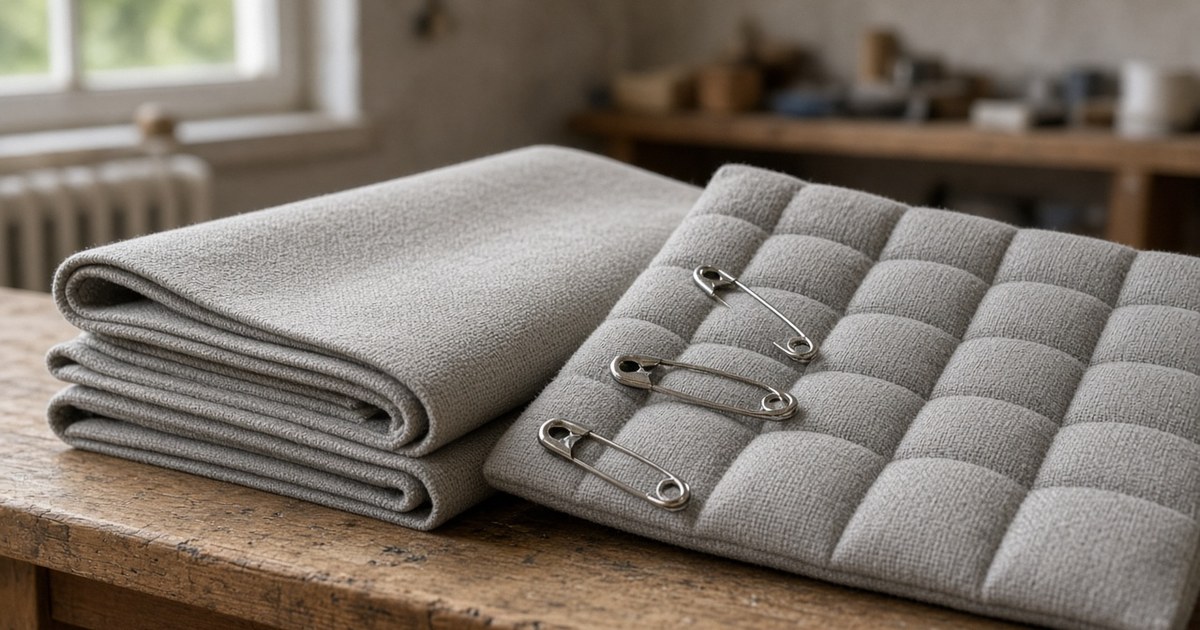
Upholstery workshops and home-textile factories hold cloth in place all day: a cover over a cushion form, a lining along a seam, a curtain heading before it goes under the needle, a blanket folded for a label. Many of them use a safety pin for the temporary hold, because it needs no machine, can be moved in seconds and can be taken out again without marking the cloth. The pin that suits a cotton shirt is rarely the one that suits canvas, a quilted cover or a thick blanket, though.
This guide is for buyers at upholstery shops, home-textile makers (bedding, curtains, cushions, blankets, throws) and the distributors who supply them. It explains which of Suvik Overseas' pins are listed for heavy cloth, what the product pages actually state, how to choose between 40 mm, 44 mm and 53 mm, how to write the order, and what to check in a sample before you commit to a carton.
This is general buyer information. Product details come from the Suvik Overseas product pages and published shipping policy, read on 27 November 2026. Suvik's pages describe pins for temporary fastening and do not publish load, strength or test values, so if your process needs one, agree the test and approve a sample first. Duty and customs rules for your country are not covered here; confirm them with your customs broker.
The short answer
Pins that the product pages list for heavy cloth: the 53 mm Size 4 pins (AROMI, LIBERAL, MAJOR and SALASAR lines) and the 44 mm LIBERAL Size 3, with 40 mm Size 2 as the lighter heavy-cloth option. All are listed as nickel-plated mild steel.
Wire thickness: 0.90 mm on the 40 mm and 44 mm pins, 1.02 mm on LIBERAL Size 4 and 1.10 mm on the AROMI, MAJOR and SALASAR Size 4 pins, as shown on each product page.
Pack formats: bunches of 10 pins per box (250 to 500 pieces per box on the heavy sizes), or 1,000 pieces in 20 pouches of 50 for the 40 mm size. Cartons hold 60 to 100 boxes.
Use them as temporary fasteners. They hold fabric while you cut, fit and sew. They are not a substitute for a stitched or stapled seam.
Always test on your own cloth. Pale, loosely woven or heavily coated fabrics can show a pin mark that dark canvas does not.
First step: send your fabrics, lengths in mm, wire thickness, pack format and yearly quantity through the enquiry form, and ask for samples at the same time.
What upholstery and home-textile workshops use safety pins for
This guide does not claim any statistic for how many upholstery shops use pins. The uses below are the ones the product pages point to and that a workshop can check for itself.
Holding covers and linings in place
When a loose cover is fitted over a form, or a lining is laid inside a cushion shell, the fitter may need to pin along the seam line to check the fit before sewing. A longer pin reaches through two or three layers; a heavier wire does not bend when the cloth is pulled.
Curtains, drapes and headings
Curtain makers can pin pleats, linings and heading tape at the start, and again when a finished curtain is hung for a final check. Pins here go through thick cloth and sometimes through a backing as well.
Blankets, throws and quilted goods
Blanket and quilt makers may fold and pin layers together before binding or edging, and use pins to hold a label or ticket in a corner. The Suvik product pages list the 40 mm and 44 mm sizes for "thick textiles, blankets, quilting" and the 53 mm size for "heavy textiles", "upholstery" and "heavy canvas".
Labels and tickets on rolls, bales and finished goods
A paper ticket or a small tag may be pinned to a roll end, a folded blanket or a packed set. Here the pin is a handling aid, not a structural fastener, so a standard pouch pack and a medium size are usually enough.
Which sizes suit which cloth
Size numbers differ between factories, so always order by length in millimetres. Our safety pin sizes chart and the guide to size numbers 000, 00 and 0 in millimetres explain how a size number maps to a length, and the gauge guide explains wire thickness.
These are the lines worth sampling for heavy cloth. All are nickel-plated mild steel on the Suvik product pages:
40 mm, 0.90 mm wire: AROMI Size 2, 20 pouch, MAJOR Size 2, 20 pouch or SALASAR Size 2, 20 pouch. Each box holds 1,000 pieces in 20 pouches of 50, with 75 boxes per carton. The AROMI page lists it for thick textiles, blankets and quilting.
44 mm, 0.90 mm wire: LIBERAL Size 3. Each box holds 500 pieces in 50 bunches of 10, with 60 boxes per carton. Listed for thick textiles, blankets and quilting.
53 mm, 1.02 mm wire: LIBERAL Size 4. Each box holds 300 pieces in 30 bunches of 10, with 60 boxes per carton. Listed for heavy textiles, industrial laundry and upholstery.
53 mm, 1.10 mm wire: AROMI Size 4 (bunch), MAJOR Size 4 or SALASAR Size 4. Each box holds 250 pieces in 25 bunches of 10, with 100 boxes per carton. The AROMI page says "Designed for upholstery, heavy canvas, and industrial fastening needs"; the MAJOR page lists it for upholstery and thick textiles. SALASAR Size 4, 25 pouch has the same length and wire in pouches of 10.
A simple way to choose: start with the 53 mm pin for canvas and thick quilted covers, the 44 mm for blankets and heavier curtains, and the 40 mm for general home-textile work where the cloth is medium weight. If you work with one fabric most of the time, a single size and one pack format keeps your stock simple.
Why wire thickness matters more than length for heavy cloth
A longer pin reaches further, but on a thick fabric the pin bends or springs open when the cloth is pulled. That is a wire problem, not a length problem. Compare 0.90 mm with 1.02 mm and 1.10 mm side by side on your own cloth before you choose. Ask for the wire thickness to be written on the quotation as well as the length, as our specification sheet template shows.
Finish, marking and keeping pins out of finished goods
Nickel-plated mild steel and light fabrics
Suvik's product pages describe the heavy sizes as mild steel with nickel plating, with a rust-resistant finish. Loose steel can rust in damp storage, and plating can leave a mark on some cloth. Before you commit, do two simple checks on your own fabrics and storage:
pin a swatch of your palest cloth and leave it for a few days in your normal storage conditions;
look for a mark at the pin hole and along the shaft when you take it out.
Write the result into your specification. If a particular fabric will not tolerate a mark, tell us in your enquiry and we will confirm what can be supplied. This guide does not cover other finishes or materials.
Keeping pins out of finished goods
A loose pin left in a cushion, a mattress topper or a folded blanket is a complaint waiting to happen, and that risk belongs to your quality process, not to the pin. Steel pins are magnetic, which gives you a simple tool: nickel-plated mild steel is attracted to a magnet. Counting pins out at the start of a shift and back in at the end, and sweeping benches and tables with a magnet, are simple controls you can add to your own routine. Suvik's product pages do not publish magnetic test values, so agree the test with us if it matters to your customers.
Packing in bunches or in pouches
Bunches of 10 suit workshops that pick up a handful at a time. Pouches of 50 or 100 suit teams that issue pins to individual stations and want to count them. Ask for the format your team will actually use. Custom packaging and private labels are available to your specification, as described in the shipping policy.
How to write the order
A clear order saves a second round of samples. Include:
Length in mm and wire thickness in mm, not only a size number.
Material and finish: for the heavy sizes, nickel-plated mild steel, as on the product page.
Pack format: bunches of 10 or pouches, pieces per box and boxes per carton.
Your fabrics, so we can tell you which line is closest. A photo or a swatch description helps.
Quantity per year and per shipment, and the destination port. The MOQ is flexible and depends on size, finish and packaging.
Samples first. Use our sample evaluation checklist and the first trial order guide so the sample you approve is the one that ships.
Lead times, shipping and documents
Under Suvik's published shipping policy, ready stock is dispatched within 3 to 5 business days of payment confirmation, made-to-order or custom-packed lines take 10 to 21 business days, and large export consignments take 15 to 30 business days including stuffing and documentation. Peak production season (October to January) can lengthen these times. Goods are loaded at Kolkata (INKOL) by sea or Kolkata Airport (CCU) by air, and the usual terms are FOB Kolkata or CIF to your port, with DDP possible on request. Cartons are labelled with product details, quantity and batch number.
For the documents an importer normally needs, see our guide to export documents for safety pin orders, and for duty and customs in your own country see the import duty guide as a starting point, then confirm with your broker.
Common mistakes
Choosing by size number and not by length and wire thickness.
Buying a light pin for thick cloth and then blaming the supplier when it bends.
Skipping the sample test on pale fabric.
Letting pins leave the workshop in finished goods because there is no count-out and count-in routine.
Treating a safety pin as a permanent fastener.
Asking for a "heavy-duty" pin without saying what cloth, how many layers and how it will be used.
Frequently asked questions
Are safety pins suitable for upholstery?
As temporary fasteners, yes: the heavy-size product pages describe the 53 mm and 44 mm pins as suitable for upholstery, heavy textiles and thick fabrics. They hold cloth while you fit, cut and sew. They are not a replacement for stitching, stapling or other permanent fixing. Suvik does not publish strength or load values.
Which size is best for heavy canvas?
The 53 mm Size 4 pins, with 1.02 mm to 1.10 mm wire, are the longest and thickest of the steel pins covered in this guide. The AROMI Size 4 page lists them for heavy canvas. Test a sample on your own canvas first.
Can I get the pins in bunches instead of loose?
Yes. The Size 3 and Size 4 pages list bunches of 10, and the Size 2 pages list pouches of 50. Tell us the pack you want in your enquiry.
Do you make pins in other materials or finishes for home textiles?
This guide covers only the nickel-plated mild steel pins listed above. If you need something else, ask in your enquiry and we will confirm what can be made.
Can I order private-label packaging?
Custom and private-label packaging is available to buyer specifications, with a longer lead time than ready stock. See the shipping policy.
What is the minimum order?
The MOQ is flexible and depends on size, finish and packaging. Send your quantity and we will confirm.
Next step
If you make or supply upholstery or home textiles and want samples of the heavy-cloth sizes, send your fabrics, lengths in mm, wire thickness, pack format, yearly quantity and destination port through the enquiry form or the contact page. Suvik Overseas manufactures safety pins and dress hooks at its factory in Howrah, West Bengal, India, and exports worldwide.
Sources
Suvik Overseas product pages linked above: AROMI Size 2, 20 pouch, LIBERAL Size 3, LIBERAL Size 4, AROMI Size 4 (bunch), MAJOR Size 4, SALASAR Size 4. Lengths, wire thickness, plating, pack sizes and carton quantities as listed. Read 27 November 2026.
Suvik Overseas, Shipping & Delivery Policy: lead times, ports, Incoterms, packaging and documents. Read 27 November 2026.
Suvik Overseas guides linked above.