
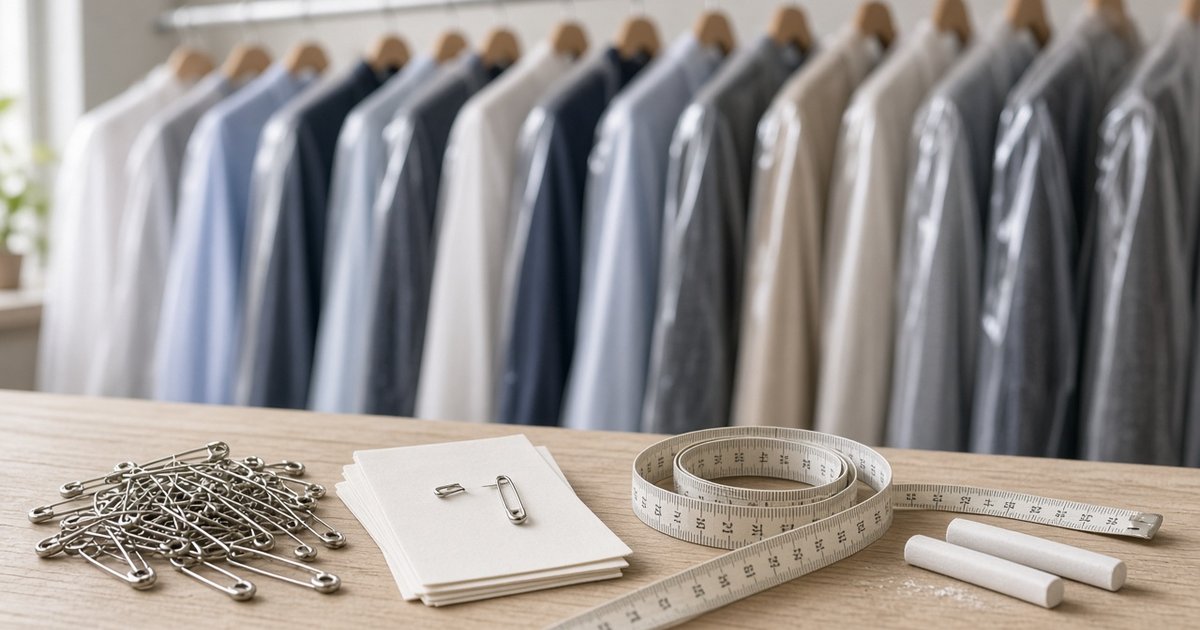
Dry cleaners across the United States go through a steady supply of safety pins. Counter staff pin paper tickets to garments at drop-off, plant staff pin small parts and loose trims during cleaning, and alteration tailors pin hems and seams before they sew. Many of those pins reach the shop through a dry-cleaning or tailoring supply distributor that buys them by the carton.
This guide is for those distributors, and for larger cleaning chains that buy direct. It covers how cleaners and tailors use safety pins, which sizes and pack formats suit each job, what a U.S. importer needs to know about duty and customs in November 2026, and what to put in your enquiry so the samples and the quotation match what your customers actually use.
This is general buyer information, not customs or legal advice. U.S. duty rates and customs rules were read on official USITC, CBP and eCFR pages on 24 November 2026 and can change at any time. Confirm the classification, duty and entry type for your own shipment with a licensed customs broker. Product details are from Suvik Overseas product pages and its published shipping policy, checked the same day.
The short answer
Main uses: tagging garments at drop-off, pinning paper tickets and small parts through the plant, and pinning hems and seams for alterations.
Typical sizes to sample: 28 mm to 30 mm pins for tickets and light fabric, 35 mm to 40 mm for general plant use, and 53 mm for heavy coats, blankets and multi-layer items. All are nickel-plated mild steel on Suvik's product pages.
Packs: loose boxes of 1,000 for high-volume counters, pouches of 25 to 100 inside a box of 1,000 for smaller shops, and bunches of 10 for retail resale.
U.S. duty (read 24-11-2026): HTSUS 7319.40.20 "Safety pins" carries a 4.5% general duty, and steel safety pins are also subject to the 50% Section 232 steel duty on full value. Your broker confirms the total on the day of entry.
De minimis is suspended: low-value parcels no longer enter duty-free, so even a small sample or top-up shipment needs a proper entry.
First step: send your sizes in mm, pack format, yearly quantity and U.S. port through the enquiry form, and ask for samples at the same time.
How dry cleaners and tailors use safety pins
Garment tagging at the counter
At drop-off, many cleaners attach a paper or card ticket to each garment so the item can be matched to the customer's order after cleaning. Some use plastic tag guns or heat-seal labels, but safety pins remain common because they are cheap, need no machine, leave only a small hole, and can be reused for tickets on delicate items where a tag gun would mark the fabric.
For this job the pin needs to pass easily through a paper ticket and a seam or label, close securely, and stay closed through tumbling and pressing. A short, fine pin is usually enough.
Pinning in the plant
Inside the plant, staff pin loose belts, ties, detachable collars and small accessories to the main garment so they are not lost, pin pairs of items together, and sometimes pin a note about a stain or a repair. Pins here need a little more length and a slightly thicker wire, because they often go through two layers.
Product pages for Suvik's steel lines list laundry services among the places where the pins are used, alongside garment factories, tailoring and packaging.
Alterations and tailoring
Alteration tailors use safety pins to hold hems, take in seams for a fitting, and keep linings in place before sewing. A tailoring supply distributor will often sell the same pins to independent tailors, uniform shops and costume workrooms. Fine wire and a sharp point matter most here, so the pin does not leave a visible mark in suiting or silk.
Heavy items
Duvets, blankets, curtains, coats and rugs often need a longer pin with thicker wire. A 53 mm pin holds a ticket through dense fabric and doesn't bend when the item is folded or bagged.
Sizes that suit cleaning and tailoring work
Size numbers vary between factories, so always order by length in millimetres. Our safety pin sizes chart and the guide to size numbers 000, 00 and 0 in millimetres explain how the numbers map to lengths. If your existing specification is written in gauge, see what gauge a safety pin is.
These are examples from Suvik's product pages, all nickel-plated mild steel:
28 mm, 0.70 mm wire: LIBERAL Prime, 40 pouch (1,000 pieces per box in 40 pouches of 25, 60 boxes per carton) or LIBERAL size 0, loose (1,000 loose pieces per box, 100 boxes per carton). A good fit for tickets on shirts, blouses and light fabric.
30 mm, 0.70 mm wire: AROMI size 0, 10 pouch or SALASAR size 0, 10 pouch (1,000 pieces per box in 10 pouches of 100, 100 boxes per carton).
35 mm, 0.80 mm wire: AROMI size 1, 20 pouch (1,000 pieces per box in 20 pouches of 50, 75 boxes per carton). A general plant pin.
40 mm, 0.90 mm wire: AROMI size 2, 20 pouch, MAJOR size 2, 20 pouch or SALASAR size 2, 20 pouch.
53 mm: MAJOR size 4 (1.10 mm wire, 250 pieces per box in 25 bunches of 10) or LIBERAL size 4 for coats, blankets and multi-layer items.
Assorted boxes: for tailoring supply catalogues that sell a mixed pack, for example SALASAR assorted, 50 pouch.
A simple way to choose: send two or three sizes to your largest customers as samples and ask which ones they would reorder. Counter staff usually have a firm view.
Finish and rust resistance
Cleaning plants are warm and humid, and pins may meet steam, moisture and cleaning solvents. Suvik's product pages describe the nickel-plated mild steel pins as rust-resistant and list anti-corrosion testing among their quality checks. If your customers need a particular test, such as a humidity or salt-spray duration, put the method and pass level in your enquiry and confirm with our team whether a report can be supplied. Other finishes or materials are not covered in this guide; if you need one, ask in your enquiry and we'll confirm what can be made.
Point and closure
For tagging, the point should be smooth enough not to snag delicate fabric, and the head should cover the point fully so a pin doesn't open in a machine or a bag. Check both on samples before you order a full container.
Pack formats for distributors and cleaning chains
How you sell decides the pack:
Loose boxes of 1,000: the lowest-cost format per pin, suited to high-volume counters and plants that refill a tray.
Pouches of 25, 50 or 100 inside a box of 1,000: easier to hand out to individual counters, branches or tailors, and easier for a distributor to split.
Bunches of 10: suit small retail resale, such as a tailoring supply shop that sells pins over the counter.
Retail packs: Suvik's custom packaging page lists printed retail boxes, hanging blister packs with a euro-hole, plastic organiser boxes, polybags and bulk export cartons, with UPC or EAN barcodes printed on retail packs. If you sell to cleaners under your own brand, see the private label page.
The policy says pins are packed in polybags or pouches, consolidated in inner cartons, then in double-wall corrugated outer cartons labelled with product details, quantity, batch number and destination. Our guide to converting pieces, gross, boxes and cartons helps when your customers order in gross and your supplier quotes in boxes.
Country of origin marking
U.S. rules require imported articles, or their containers, to be marked with the English name of the country of origin so the ultimate purchaser can see it (19 CFR 134.11). For pins sold in boxes, pouches or retail packs, that usually means "Made in India" or similar on the pack the end user receives. Agree the marking with your broker before production, and put it in the purchase order. Suvik's custom packaging page lists country of origin stickers among its options.
Ready to compare samples?
Send the enquiry form with your sizes in mm, pack format, quantity per year and U.S. port or delivery city. Ask for samples at the same time so your counter and tailoring customers can try them while the quotation is prepared.
U.S. duty and customs in November 2026
Classification and duty
In the current Harmonized Tariff Schedule of the United States (2026 Revision 23, in effect from 10 November 2026), subheading 7319.40.20 "Safety pins" has a 4.5% general duty. India is not one of the special programmes listed for that line, so the general rate applies to pins made in India.
Steel safety pins are also derivative steel articles under Section 232. HTSUS heading 9903.82.02 adds "the duty provided in the applicable subheading + 50%", so steel safety pins currently pay 4.5% plus 50% of the customs value. Our guide to HS codes and import duty for safety pins explains how these lines stack and which other duties do not apply, and the U.S. landed cost worked example shows how to budget a shipment.
Duty rates and trade measures change often. Ask your licensed customs broker to confirm the classification and every duty that applies on the date you import.
Customs fees
CBP's user fee table lists a Merchandise Processing Fee for formal entries of 0.3464% of value, with a minimum of $34.58 and a maximum of $670.86, and fixed informal entry fees of $2.77, $8.30 or $12.45 depending on how the entry is prepared. Sea shipments also pay the Harbor Maintenance Fee of 0.125% of value. Your broker's own fees come on top.
Small shipments: de minimis is suspended
Before August 2025, many small parcels under $800 entered the United States duty-free. That is no longer the case. CBP's rules now indefinitely suspend duty-free de minimis treatment for shipments valued at $800 or less, arriving by any mode, including mail. Shipments of $2,500 or less may generally use informal entry if they are eligible; above that, formal entry is required. Our separate guide on importing small safety pin shipments after the end of de minimis covers samples, courier parcels and top-up orders in more detail.
For a distributor, the practical point is simple: a small courier top-up order costs proportionally more in duty and fees than a planned sea shipment, so build enough stock to avoid frequent emergency parcels.
Planning stock for a distribution business
Dry-cleaning demand is steady through the year, which makes pins easy to plan. A few habits help:
Track usage by size. Most distributors find two or three sizes make up most of their volume.
Order by sea for the base volume. Suvik's shipping policy lists sea freight from Kolkata (INKOL) and air freight from Kolkata Airport (CCU). See LCL, FCL or air freight for bulk safety pins.
Allow for lead time. The policy gives 3–5 business days for ready stock, 10–21 business days for made-to-order or custom packaging, and 15–30 business days for large FCL or LCL consignments, plus transit. Peak season (October to January) can extend these. See lead time by order size.
Keep a reorder point. Our guide to planning stock for peak season and reorders gives a simple method.
Inspect on arrival. See how to inspect and store a bulk shipment, and keep the quality claim process to hand.
If this is your first order from India, start with our guide to planning a first trial order.
Terms, payment and documents
Incoterms: Suvik ships FOB Kolkata or CIF port of destination, with DDP on request, and buyers may nominate their own forwarder. See FOB, CIF and DDP for safety pin orders.
Duties: the shipping policy says import duties, taxes and clearance at destination are the buyer's responsibility unless DDP is agreed.
Documents: the policy lists the commercial invoice, packing list, bill of lading or airway bill, certificate of origin and GST/IGST documents as standard. See export documents for safety pin orders.
Payment: see payment terms for safety pin imports.
Buying direct from the factory
Suvik Overseas Pvt. Ltd. manufactures safety pins in Howrah, India. The company was incorporated in 2006 and supplies buyers in 35+ countries. Buying from the manufacturer means you agree sizes, pack counts, carton marks, origin marking and documents directly with production rather than through a trading layer. MOQ is flexible and depends on size, finish and packaging. Our page on how safety pins are made shows the process from wire to packed carton.
What to put in your enquiry
Your company name, U.S. state, and whether you distribute to cleaners and tailors, run a cleaning chain, or sell retail.
Sizes: the length in mm for each size, and the share of volume for each.
Pack format: loose boxes, pouches (and how many per pouch), bunches or retail packs.
Quantity per order and per year.
Any test or document your customers ask for, such as a corrosion test or inspection report.
Origin marking and any barcodes or private-label artwork.
Terms (FOB Kolkata, CIF or DDP) and your U.S. port or delivery city.
Whether you want samples first.
Our RFQ template, specification sheet template and purchase order clauses give a fuller format.
Common mistakes
Ordering by size number. Size 2 at one factory is not size 2 at another. Use millimetres.
One size for everything. Ticket pins and coat pins do different jobs; two or three sizes usually cover a plant.
Forgetting the Section 232 duty. Budget on 4.5% plus 50%, then confirm with your broker.
Relying on small parcels. With de minimis suspended, frequent courier top-ups add duty and fees each time.
No origin marking on the retail pack. Agree the marking before production, not after the goods arrive.
Skipping samples. Let counter staff and tailors test the pins before you commit to a container.
Frequently asked questions
What size safety pin do dry cleaners use for tags?
There is no fixed rule. Many cleaners use short pins of around 28 mm to 30 mm for paper tickets on light garments and a longer pin for coats and heavy items. Sample two sizes with your customers before you order in bulk.
Are safety pins better than tag guns for dry cleaning?
They do different jobs. Tag guns are fast on sturdy fabric, while safety pins need no machine, can be reused and are often preferred on delicate items. Many cleaners use both.
What is the U.S. import duty on safety pins from India?
As read on 24 November 2026, HTSUS 7319.40.20 has a 4.5% general duty, and steel safety pins also carry the 50% Section 232 duty on full value. Confirm with your customs broker on the day of import.
Can I import a small box of samples duty-free?
Generally no. CBP has indefinitely suspended duty-free de minimis treatment for shipments of $800 or less. Apart from narrow exceptions such as genuine gifts, duties and fees apply, so ask your broker how the sample parcel will be entered.
Do you supply private-label packs for U.S. distributors?
Suvik's custom packaging and private label pages describe retail boxes, blister packs and barcodes. Tell us your artwork, count per pack and quantity, and we'll confirm what can be made and the lead time.
Can I get samples before ordering?
Yes. Samples are available on request; cost, courier and lead time are shared when you enquire.
Next step
If you supply dry cleaners, laundries or tailors in the United States, send your sizes in mm, pack format, yearly quantity and U.S. port through the enquiry form or the contact page. Ask for samples at the same time so your customers can test the pins while the quotation is prepared.
Sources
USITC, Harmonized Tariff Schedule search, 7319.40: 7319.40.20 "Safety pins", general duty 4.5%; 2026 HTS Revision 23. Read 24 November 2026.
USITC, Harmonized Tariff Schedule search, 9903.82.02: derivative steel articles, "the duty provided in the applicable subheading + 50%". Read 24 November 2026.
White House, Annex I-A (June 2026), 50% Section 232 tariff on full value: lists 7319.40.20 "Iron or steel, safety pins". Read 24 November 2026.
CBP, User Fee Table: MPF for formal and informal entries; Harbor Maintenance Fee. Read 24 November 2026.
CBP, E-Commerce Frequently Asked Questions: indefinite suspension of de minimis for shipments of $800 or less; informal entry generally up to $2,500. Read 24 November 2026.
eCFR, 19 CFR 134.11, Country of origin marking required. Read 24 November 2026.
Suvik Overseas, Shipping & Delivery Policy: lead times, Incoterms, ports of loading, documents, packing, MOQ, buyer's responsibility for import duties. Read 24 November 2026.
Suvik Overseas, Custom safety pin packaging: retail boxes, blister packs, barcodes, origin stickers. Read 24 November 2026.
Suvik Overseas product pages linked above: lengths, wire thicknesses, material, plating, pack counts and carton quantities. Read 24 November 2026.