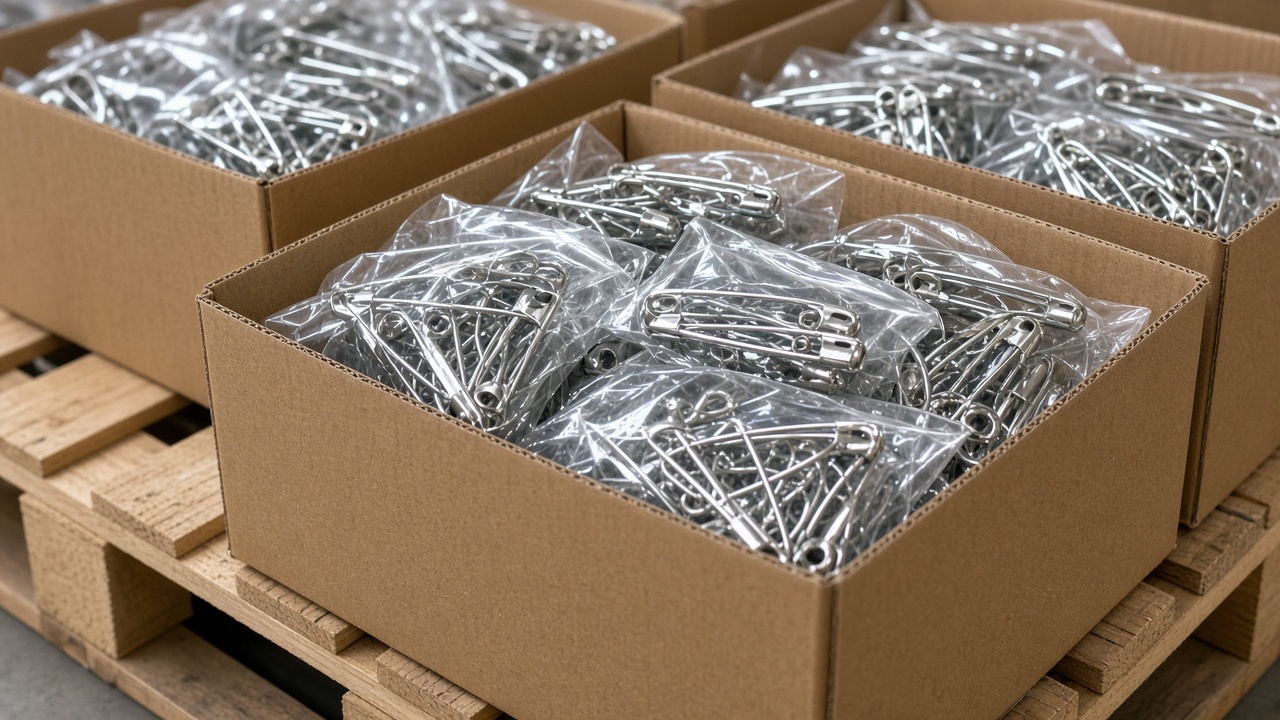
Australian wholesalers, garment distributors and craft or retail buyers often buy safety pins through a local importer or trading house. Buying direct from a manufacturer in India can remove a layer of margin and give you control over sizes, finishes and private-label packaging, but you then place the order, agree the Incoterm and clear the goods. This guide is for buyers who want a factory-direct wholesale relationship with an Indian exporter in Kolkata. It covers when direct sourcing beats a trader, Kolkata shipping, Australian duty and GST on steel safety pins, documents and packaging, and how this relates to our existing Australia import process guide.
This guide is general information, not a customs ruling or tax advice. Tariff and GST facts were read on official Australian sources on 6 November 2026 and can change. Every figure in the worked example is an EXAMPLE for illustration only, not a Suvik Overseas price, a freight quote or a duty assessment. Confirm the Australian classification, the live rate and the documents with a licensed Australian customs broker before you order. For the step-by-step import process (ABN readiness, declaration, biosecurity and inspection), use our companion guide: How to import safety pins from India to Australia.
Quick answer
Angle of this article: wholesale and factory-direct sourcing (specification, packaging, Incoterms, when to skip the local trader). The companion article covers the import process.
HS code (steel/iron pins): 7319.40, Australian Working Tariff line 7319.40.00, "Safety pins and other pins". The general rate shown on the Australian Border Force (ABF) Working Tariff is Free.
Customs duty: for iron or steel safety pins classified to 7319.40.00, the Schedule 3 general rate is Free, so a preferential claim under the Australia–India Economic Cooperation and Trade Agreement (ECTA) does not usually change the duty line for this product. Confirm your exact line and any other charges with your broker.
GST: import GST is 10% of the value of the taxable importation (customs value + any duty + international transport and insurance to the place of consignment in Australia, plus wine tax if any). Home Affairs collects it unless you use GST deferral.
Route: Suvik Overseas loads at Kolkata (INKOL) by sea or Kolkata Airport (CCU) by air, typically on FOB Kolkata or CIF named Australian port, with DDP on request. Name Melbourne, Sydney, Brisbane, Fremantle or another port in the quotation.
MOQ: discuss with the factory. Suvik's shipping policy describes a standard MOQ that can be adjusted after negotiation; treat any figure as subject to confirmation on your quotation, not a fixed public promise.
How this guide differs from our Australia import article
This article answers whether to buy direct from an Indian factory and how to set up that wholesale supply (spec, packaging, Incoterms, documents). The companion guide walks the import process itself: ABN readiness, broker, declaration, biosecurity and inspection. Duty and GST here are a short verified snapshot for landed-cost planning; the companion tells you to confirm live rates with ABF, the ATO or your broker.
Read both if you are new to importing and switching from a local trader: import safety pins from India to Australia.
Why Australian buyers source direct from India
Buying through a local trader is convenient for small top-ups. Factory-direct sourcing from Kolkata makes more sense when you need:
Specification control. Choose size, material (nickel-plated steel, stainless steel or brass) and finish, approve a sample in writing, and hold it against bulk. See our sample evaluation checklist.
Your own brand. OEM and private-label packs, barcodes and carton marks are set at the factory. See custom safety pin packaging.
A clean invoice trail. Invoice, packing list and certificate of origin from the same manufacturer simplify clearance.
Fewer middle margins. Direct supply does not remove freight, GST or broker fees, but it can improve unit cost once volumes are steady.
Trade-offs: larger orders, lead times, payment before or at shipment, and an Australian importer of record (usually via a licensed customs broker). See also bulk safety pin distributors and wholesale safety pin manufacturer in India.
Shipping wholesale volumes from Kolkata to Australia
Sea freight is the usual mode for wholesale cartons. Safety pins are dense, so many orders move as LCL rather than a full container; FCL suits large seasonal fills. Air freight from CCU suits samples and urgent gaps. Our guide to LCL, FCL or air explains the choice.
Ports of loading. According to the Suvik Overseas shipping policy, cargo loads at Kolkata (INKOL) for sea and Kolkata Airport (CCU) for air. Buyers may nominate their own forwarder.
Ports of discharge. Wholesale cargo commonly clears through Melbourne, Sydney, Brisbane or Fremantle, among others. Name the port on the purchase order (for example "CIF Melbourne"). Ask your forwarder about direct versus transhipped services and transit times; this article does not quote transit days.
Lead times (Suvik shipping policy). Ready stock: 3 to 5 business days after payment. Made-to-order or custom packaging: 10 to 21 business days. Large FCL/LCL: 15 to 30 business days. Peak seasons (October to January) can run longer. Transit is additional.
Choosing FOB, CIF or DDP for an Australian wholesale order
Suvik Overseas typically quotes FOB Kolkata or CIF port of destination, and states that DDP can be arranged on request.
FOB Kolkata suits buyers with an established forwarder on the India–Australia lane. You control the main freight and insurance after the goods are on board in India.
CIF named Australian port suits a first direct order: the seller books the freight and minimum insurance to the named port; you (or your broker) clear the goods and pay GST and port charges in Australia.
DDP can look like a single delivered price. Confirm in writing who is the importer of record, whether Australian GST and broker fees are included, and how any preference claim would be handled. Suvik's shipping policy also states that import duties, taxes and clearance charges at destination are normally the buyer's responsibility unless agreed otherwise — so treat DDP as a special arrangement, not the default.
For a full Incoterms comparison, see FOB, CIF or DDP? Choosing shipping terms for safety pins from India. For the clearance sequence after the vessel arrives, return to the Australia import process guide.
Australian classification and duty: HS 7319.40 is Free
The code. At the six-digit Harmonized System level, safety pins of iron or steel fall under 7319.40, "Safety pins and other pins". The ABF Combined Australian Customs Tariff (Working Tariff), Schedule 3, Chapter 73, lists:
7319.40.00 — Safety pins and other pins — rate Free
7319.90.00 — Other (within heading 7319) — rate Free
Stainless steel pins normally stay in this heading. Solid brass pins are not iron or steel and fall outside 7319.40; get a separate Australian classification before you order brass. The general rate for brass lines was NOT VERIFIED in this research pass.
What "Free" means for planning. On the official Working Tariff page read on 6 November 2026, the Schedule 3 general rate for 7319.40.00 is Free. That means customs duty on correctly classified iron or steel safety pins is not the cost driver for this line — GST, freight, insurance, broker and port charges are. Always have your broker confirm the full Australian classification for your packing and material; do not copy a code from an old invoice.
Australia–India ECTA. The agreement entered into force on 29 December 2022. DFAT states that eligible Australian imports from India may enter duty free under ECTA when origin rules and documentation are met. Because 7319.40.00 is already Free under Schedule 3, an ECTA claim typically does not change the duty outcome for this steel-pin line. A certificate of origin can still help with origin trail, customer requirements or other lines on a mixed shipment — ask your broker. For multi-market HS context, see our import duty and HS code guide.
Australian import GST: 10%
The Australian Taxation Office and the Australian Border Force both state that GST on taxable importations is 10% of the value of the taxable importation. That value is the sum of:
the customs value of the goods
any customs duty payable
the amount paid or payable to transport the goods to their place of consignment in Australia
the insurance cost for that transport
any wine equalisation tax (not relevant to safety pins)
Home Affairs collects GST at clearance unless you use the deferred GST scheme. GST-registered businesses that import for a creditable purpose may claim a GST credit, subject to ATO rules. For a registered wholesaler, GST is often a cash-flow item if recoverable; it still belongs in your landed-cost worksheet.
EXAMPLE: duty and GST on one Australian wholesale shipment
Assume a shipment of nickel-plated steel safety pins with:
customs value 10,000 (currency units for illustration)
international transport and insurance to the Australian place of consignment 2,000
classification 7319.40.00 at the Schedule 3 general rate Free
This is an EXAMPLE only, not a Suvik Overseas price or a freight quote. Broker fees, import processing charges, biosecurity fees and inland haulage are left out.
EXAMPLE calculation:
Customs duty: Free → 0
Value of taxable importation: 10,000 + 0 + 2,000 = 12,000
GST at 10%: 1,200
If the same shipment had carried a non-zero duty rate, GST would be calculated on a base that already includes that duty. For a full landed-cost method you can adapt, see our USA landed cost worked example and swap in Australian Free duty and 10% GST. For Gulf comparisons where duty is not Free, see importing to Saudi Arabia and the Gulf and wholesale for Dubai and the UAE.
Documents and packaging for a direct Australian order
Suvik's shipping policy lists commercial invoice, packing list, bill of lading or air waybill, certificate of origin, GST/IGST documents and any country-specific certificates. For an Australian wholesale PO, check that:
Commercial invoice clearly describes the goods (for example "nickel-plated steel safety pins, 27 mm"), with quantity, price, currency, Incoterm, named place and origin (India). On CIF, ask for freight and insurance to be shown separately.
Packing list matches carton counts, contents and weights.
Transport document names the correct consignee and Australian port or airport.
Certificate of origin matches the invoice. Ask your broker whether a general COO or an ECTA preferential certificate is needed.
Agree carton marks, retail artwork, barcodes and "Made in India" wording before printing. See safety pin packaging guide and export documents. Australia has strict biosecurity rules for timber packing; confirm current DAFF requirements with your forwarder (more detail in the import process guide).
Buy direct or from an Australian trader?
Buy direct from an Indian factory when you buy steadily by the carton or pallet, want private-label or a locked specification, can plan several weeks ahead, and have (or will appoint) an Australian customs broker.
Buy from a local Australian trader when you need a small quantity this week, are testing a new size or finish, or do not want to handle import clearance yet.
Many wholesalers do both: factory-direct for core SKUs, a trader for gaps. To compare factory offers, see how to compare safety pin export quotations. For payment structures, see import payment terms.
What Suvik Overseas offers Australian wholesale buyers
Suvik Overseas is a safety pin manufacturer and exporter in Kolkata. Per its shipping policy, it ships FOB Kolkata or CIF destination (DDP on request), loads at INKOL or CCU, supplies commercial invoice, packing list, bill of lading or air waybill and certificate of origin, and offers samples plus OEM/private-label packaging. MOQ is described as a standard figure that can be adjusted after negotiation — confirm on your quotation. Phone: +91 6293 155 550, or enquiry form.
FAQ
Is customs duty charged on steel safety pins imported into Australia from India?
On the ABF Working Tariff read on 6 November 2026, Schedule 3 line 7319.40.00 (Safety pins and other pins) shows a general rate of Free. Correctly classified iron or steel safety pins therefore do not attract Schedule 3 customs duty at that general rate. Confirm the classification for your exact product and packing with a licensed customs broker. Brass pins sit outside 7319.40; their rate was not verified here.
Do I still pay GST if the duty rate is Free?
Yes. Import GST is 10% of the value of the taxable importation, which includes customs value plus international transport and insurance (and any duty, which is zero when the rate is Free). GST-registered importers may be able to claim a credit subject to ATO rules.
Should I claim Australia–India ECTA preference for safety pins?
Because 7319.40.00 is already Free under Schedule 3, an ECTA claim usually does not change the duty outcome for this steel-pin line. Your broker may still want origin evidence for other reasons. Follow ABF and DFAT guidance on certificates of origin and rules of origin if you claim preference on any line.
When should an Australian wholesaler buy direct from an Indian factory instead of a local trader?
Buy direct for regular carton volumes, private-label packaging and a fixed specification. Use a local trader for small or urgent top-ups, or while you are still setting up broker and freight arrangements.
Which Australian port should I name on a CIF quotation?
Name the port your forwarder and warehouse actually use — commonly Melbourne, Sydney, Brisbane or Fremantle for container cargo. Suvik loads at Kolkata (INKOL); air samples leave from CCU. Put the named place in the purchase order.
What is the minimum order for Australian wholesale buyers?
Treat MOQ as negotiable and product-dependent. Suvik's shipping policy describes a standard MOQ that can be adjusted after negotiation. Ask for a confirmed figure on your quotation rather than assuming a published number.
Request an Australian wholesale quotation
Send Suvik Overseas your sizes, material, finish, packaging (bulk or private label), quantity, preferred Australian port and whether you want FOB Kolkata, CIF or a discussed DDP arrangement. Mention that you will clear through an Australian customs broker, and ask which certificate of origin format they will supply. Request a quote.