
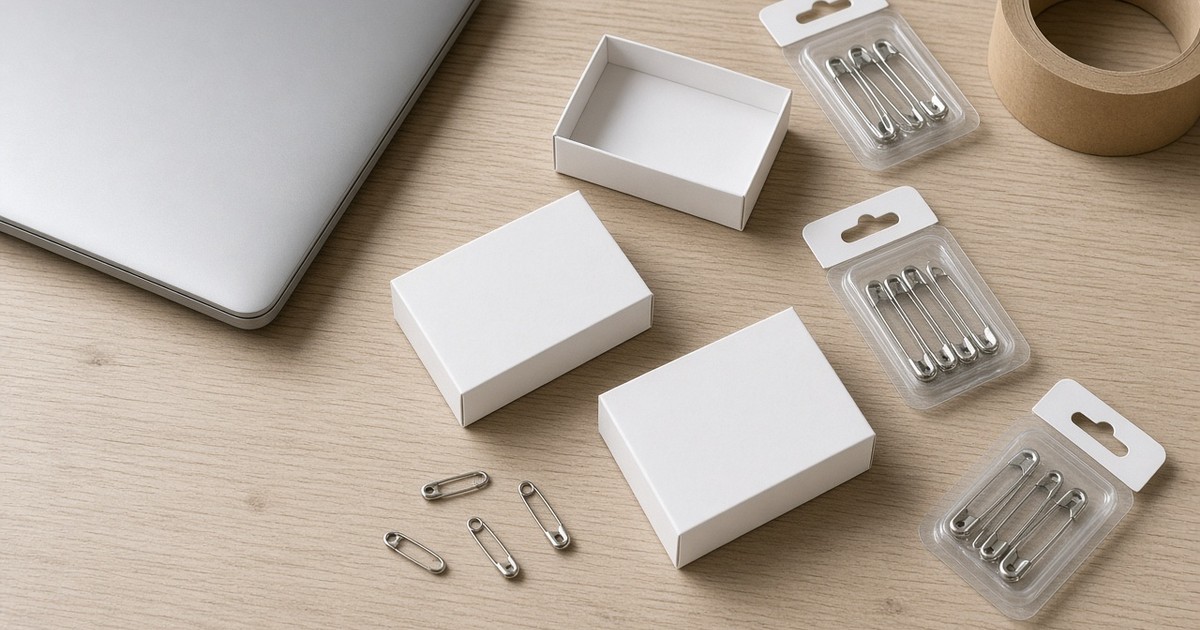
A UK online seller who puts a brand on a pack of safety pins takes on more than a design job. The moment your name is on the pack, you may be treated as the producer under UK product safety law, you need a barcode strategy that the marketplace accepts, you need a trade mark if you want brand protection, and you need to decide who imports the goods and who is named on the label. The pins themselves are the easy part.
This guide is for people who sell, or plan to sell, branded safety pins through Amazon, eBay, Etsy, a Shopify shop or a similar online store in Great Britain. It is not a general private-label primer. Our general private-label guide already explains the private-label process and barcode formats by region, and our private label page summarises the service. This guide covers the UK-specific parts: who is responsible for a branded pack, what must go on it, what a marketplace asks for, and what to check before you commit to a first order.
This is general buyer information, not legal, tax or customs advice. Rules were read on GOV.UK, the UK Trade Tariff and Amazon UK's seller pages on 28 November 2026 and can change. UK product safety rules for online marketplaces are under reform and were not final when this was written. Confirm your own obligations with Trading Standards, HMRC or a qualified adviser.
The short answer
Brand on the pack, producer on the hook. GOV.UK's guidance on the General Product Safety Regulations 2005 (GB) defines a producer to include a UK-established manufacturer or anyone presenting themselves as the manufacturer by affixing their name, trade mark or other distinctive mark, and, where the manufacturer is outside the UK, the UK person that places the product on the GB market.
Traceability on the pack. Producers must, where reasonable, show their name and address and a product reference or batch on the product or its packaging. A temporary alternative for importers (details on shipping documents, invoices or outer cartons) ends on 31 December 2027.
Duty and VAT. The UK Trade Tariff, read on 28 November 2026, lists commodity code 7319 40 00 00 ("Safety pins and other pins") at a 2.00% third-country duty and 0.00% for India under the UK–India trade agreement, which entered into force on 15 July 2026. Import VAT is 20%. The 0% needs a proof of origin.
Barcodes. Amazon UK's seller guide says most listings need an EAN or UPC from GS1, with a GTIN exemption route for products that have no standard barcode.
Trade mark. GOV.UK says registering a UK trade mark costs at least £205 and usually takes about 3 to 4 months from application to grant.
Packaging rules. UK packaging producer responsibility can apply to a brand owner whose filled branded packaging is imported by someone else, but only above stated thresholds.
First step: send your pack idea, steel size, pieces per pack, first quantity and the UK port or warehouse through the enquiry form, and ask for samples of both the pin and the packaging.
What makes UK online private label different
The US-facing material on private label leans on a retailer relationship: a store chain and its UPC. A UK online seller usually works the other way round. You are the brand, the importer and often the warehouse. So you are the legal face of the product (if the pack carries your name, Trading Standards, the marketplace and the customer will all look at you, not the factory in India), the listing is part of the product (marketplace rules decide how you identify it and whether you can protect the brand), and small first orders are normal, which makes the pack format and the way you test demand matter more than unit price.
Step 1: Choose the pin and the pack
Start with what you will actually sell. Suvik Overseas makes nickel-plated mild steel safety pins and lists the sizes and pack counts on its product pages. For a first online range, most sellers pick one or two sizes rather than a full set. Our safety pin sizes chart and the guide to size numbers 000, 00 and 0 in millimetres explain how a size number maps to a length. Always specify the pin by length in millimetres.
Some starting points from the live product pages, all listed as mild steel with nickel plating:
Size 0, 30 mm, 0.70 mm wire: AROMI Size 0, 20 pouch holds 1,000 pieces per box in 20 pouches of 50, with 100 boxes per carton. The 10-pouch and 40-pouch versions use the same pin.
Size 1, 35 mm, 0.80 mm wire: AROMI Size 1, 20 pouch, 1,000 pieces per box in 20 pouches of 50, 75 boxes per carton.
Mixed sizes 0, 1 and 2 (30, 35 and 40 mm): AROMI Assorted, 50 pouch holds 1,000 pieces in 50 pouches of 20, 75 boxes per carton. This is the natural base for a "mixed sizes" consumer pack.
Size 0, 28 mm, 0.70 mm wire: LIBERAL Prime 40 packs 1,000 pieces in 40 pouches of 25, 60 boxes per carton.
Those are factory pack formats, meaning the pouch and box the factory packs. What your customer sees is a separate decision. The custom packaging page lists printed retail boxes, hanging blister packs, polybags and export cartons, and says the logo, brand colours and contact details can be printed on the pack. Our safety pin packaging guide explains the trade-offs.
Two practical points for online sellers: check the finished pack's thickness and weight with your courier before you finalise the design (this guide gives no postage rates, because they differ by carrier), and ask for photos of the finished sample pack early, because product images carry a listing.
Step 2: Understand your role under UK product safety law
Safety pins sold to consumers are consumer products. For Great Britain, the General Product Safety Regulations 2005 apply to products intended for or likely to be used by consumers, according to the GOV.UK guidance. These are the points that matter most to a brand owner:
Producer. The guidance's glossary says a producer is the manufacturer when established in the UK and any other person presenting themselves as the manufacturer by affixing their name, trade mark or other distinctive mark. Where the manufacturer is not established in the UK, it is the manufacturer's UK representative or, failing that, the person established in the UK that places the product on the GB market. If you import the goods and put your brand on them, expect to be treated as the producer.
Safe product. Before placing a product on the GB market, the producer must ensure it is safe: under normal or reasonably foreseeable use it presents no risk or only the minimum risk compatible with the product's use.
Information on risks. The producer must give consumers the information they need to assess risks that are not immediately obvious, and to take precautions. A safety pin has a sharp point. Ask your adviser whether your pack or listing needs a warning, for example about young children. This guide does not tell you what wording is required.
Traceability. The producer must, where reasonable, indicate on the product or its packaging the producer's name and address and the product reference or batch.
Monitoring. The producer must adopt measures to be informed of risks, including, where reasonable, sample testing marketed products and keeping a register of safety complaints.
Reporting. Where a producer knows a product poses risks incompatible with the general safety requirement, it must notify an enforcement authority in writing, which in GB is normally the local Trading Standards service. The guidance says the most serious offences can carry a fine of up to £20,000 or up to 12 months in prison, or both.
The label alternative that ends on 31 December 2027
GOV.UK sets out a time-limited alternative for importers who find it unreasonable to put their name and address on each product or pack. They can make each product traceable through other means, such as the importer's address on shipping documents, on the invoice to the GB customer or on the label of the outer packaging. The guidance says these options may not be used after 31 December 2027 and encourages importers to make sure individual items carry the importer's address where required before then.
For a private-label brand that is about to design its first pack, the practical answer is simple: design the name and address and the batch or reference area into the pack now, rather than relying on a temporary option.
Northern Ireland is different
GOV.UK says Regulation (EU) 2023/988 on general product safety applies in Northern Ireland from 13 December 2024. If you also sell into Northern Ireland, read our EU GPSR guide for safety pin importers and ask your adviser which rules apply to your pack.
Marketplace rules are being reformed
In July 2025 the Government announced that the Product Regulation and Metrology Act had received Royal Assent, with powers aimed at holding online marketplaces to account for dangerous products. On 31 March 2026 it published three consultations on updating product safety rules, closing on 23 June 2026. This guide did not find a final set of rules in the sources it read. Check GOV.UK for the outcome before you launch, because the duties of both marketplaces and sellers may change.
Step 3: Barcodes and marketplace listings
Amazon UK's seller guide says you need an EAN (13 digits) or UPC (12 digits) from GS1 to create most listings, and that if you sell your own unbranded products, handmade items or products with no standard barcode you can apply for a GTIN exemption instead. The page calls GTIN issues the most common reason new listings fail.
What this means for a private-label order:
Decide before you print. Whether you will buy barcodes or apply for an exemption changes your artwork. Decide first, then send artwork to the factory.
Print what the listing needs. If you use barcodes, confirm the exact number, format and position on the pack, and ask the factory to print a proof. The packaging page lists UPC/EAN barcodes printed on retail packs as part of private-label service; confirm it in your quotation.
This guide describes Amazon UK only. eBay, Etsy and other platforms have their own rules, which we have not read.
Step 4: Protect the brand
A private-label pack is only worth building if the brand name is yours to use. GOV.UK says registering a trade mark lets you take legal action against anyone who uses your brand without permission, including counterfeiters, and lets you use the ® symbol. It costs at least £205, usually more depending on how many classes of goods or services you protect, and takes around 3 to 4 months from application to grant if there are no issues. A UK trade mark protects your brand in the UK and the Isle of Man only.
A practical order of work: search for the name, apply for the trade mark, then print.
Step 5: Work out who imports, and the paperwork
If you bring the goods into Great Britain yourself, you will usually need an EORI number. GOV.UK says you may need one if you move goods between Great Britain and another country, and that your business usually needs premises in the country you are importing to or from. If you would rather not clear the goods yourself, ask a customs agent or freight forwarder to do it and tell them exactly who the importer of record is.
Duty, VAT and the India agreement
The duty figures above come from the UK Trade Tariff page for commodity code 7319 40 00 00, read on 28 November 2026. The page shows the standard third-country duty at 2.00%, a tariff preference of 0.00% for India, and import VAT of 20%. Our HS code and duty guide and our certificate of origin guide cover the numbers and the documents in more detail, so we keep it short here.
What matters for a private-label seller:
The 0% is conditional. GOV.UK and business.gov.uk say the preference needs a proof of origin: an origin declaration, a certificate of origin from an issuing authority in India, or the importer's own knowledge backed by evidence. The agreement text says an origin declaration or certificate is valid for 12 months.
The rule for the goods is a test, not a promise. GOV.UK's copy of the agreement's product-specific rules lists one rule for the whole of Chapter 73, articles of iron or steel: a change in tariff heading plus a minimum qualifying value content (50% of the ex-works price, 55% of the free-on-board value, or 45% on the build-up method). Whether a particular order meets it depends on the origin and cost of the materials. Do not build the 0% into your first price until the supplier has confirmed its origin position in writing for your order.
Import VAT is separate. The tariff page says import VAT can be due even when duty is 0%.
Suvik's shipping policy states that all import duties, taxes and customs clearance charges at the destination are the buyer's responsibility, and that it typically ships on FOB Kolkata or CIF port-of-destination terms, with DDP on request. See our guides to FOB, CIF and DDP, export documents and the full UK import guide.
Step 6: Packaging producer responsibility
UK packaging rules (extended producer responsibility, or EPR, for packaging) can catch private-label brands, because a brand owner is a producer of packaging when filled packaging is supplied under its brand. GOV.UK lists activities that make a business a producer, including supplying filled packaging under your own brand, importing goods in packaging and selling filled packaging to an end user. It also says you remain a producer if you ask another organisation to import your filled branded packaging into the UK.
The obligations apply to an organisation established in the UK that supplied or imported more than 25 tonnes of packaging in the previous year and has annual worldwide turnover of £1 million or more, according to the GOV.UK guidance. Smaller businesses still need to check whether they are a producer. If you think you are close to either figure, read the GOV.UK guidance and ask an adviser.
Step 7: Order in a way that tests demand
You do not have to place a container-sized order on day one. A sensible sequence:
Samples first. Ask for samples of the pin and, separately, of the packaging. Use our sample evaluation checklist, and read samples from India for UK buyers for courier points.
A first small run. Ask what MOQ applies to the pin and what to the packaging. Suvik's pages say MOQ is flexible and depends on size, finish and packaging; tell us your quantity and we confirm it.
Check what arrives. Count cartons against the packing list and inspect a sample before you ship to customers; see how to inspect a bulk shipment.
Plan the reorder. The shipping policy gives ready stock 3 to 5 business days after payment confirmation, made-to-order and custom packaging 10 to 21 business days, and large export consignments 15 to 30 business days. Peak production season is October to January.
Compare quotes on landed cost. Use our guide to comparing export quotations and the RFQ template.
What to put in your first enquiry
A short, complete brief gets a usable quote: your target market (Great Britain, Northern Ireland or both) and whether you will import yourself; the pin length in millimetres and pouch count; the pack format, pieces per pack and packs per carton; your artwork format and barcode route; the label content (trading name and address, reference or batch position, any warning text your adviser requires); whether the supplier can provide an origin declaration or certificate for your order; the first and repeat quantities; and the Incoterm and delivery point.
Frequently asked questions
Who is responsible for the safety of a private-label pack in the UK? GOV.UK's glossary treats a person who presents themselves as the manufacturer by affixing their name or trade mark, and a UK importer where the manufacturer is abroad, as a producer. Ask your adviser how this applies to you.
Do I need barcodes? Amazon UK's seller guide says most listings need an EAN or UPC from GS1, with a GTIN exemption route for products without a standard barcode. Other platforms differ.
Are Indian safety pins duty-free in the UK? The UK Trade Tariff shows 0.00% for India on code 7319 40 00 00 against a 2.00% standard rate, plus 20% import VAT. The 0% needs a valid proof of origin and goods that meet the rules of origin.
What is the MOQ? MOQ is flexible and depends on size, finish and packaging. Tell us your quantity and we confirm.
Next step
If you are planning a branded range of steel safety pins for UK sale, send your target market, pin size in mm, pack format, pieces per pack, first quantity and delivery point through the enquiry form or the contact page, and ask for pin and packaging samples together. Suvik Overseas manufactures safety pins and dress hooks at its factory in Howrah, West Bengal, India, and exports worldwide.
Sources
UK Integrated Online Tariff, commodity code 7319400000, "Safety pins and other pins": third-country duty 2.00%, India tariff preference 0.00% (2026 No. 36), import VAT 20%, shown for imports from India on 28 November 2026.
GOV.UK, General Product Safety Regulations 2005: Great Britain: scope, producers and importers, the manufacturer definition, traceability, the alternative that ends on 31 December 2027, notification of risks. Read 28 November 2026.
GOV.UK, Product safety advice for businesses: responsibilities of those who make, import, distribute or sell consumer products; Regulation (EU) 2023/988 in Northern Ireland from 13 December 2024.
GOV.UK, Tough new laws to make online marketplaces safer (21 July 2025) and Major updates to product safety laws (31 March 2026): the Product Regulation and Metrology Act and the consultations.
GOV.UK, Historic UK–India Free Trade Agreement is now in effect (17 July 2026): in force 15 July 2026.
GOV.UK, Get proof of origin for your goods and business.gov.uk, Tariffs and customs for imports from and exports to India: proof-of-origin options and rules-of-origin routes.
GOV.UK, UK–India CETA Annex 3A, Product Specific Rules of Origin (Chapter 73 rule) and Chapter 3, Rules of Origin (Article 3.15, 12-month validity).
GOV.UK, Get an EORI number and GOV.UK, Register a trade mark: who needs an EORI; the £205 minimum fee, 10-year term and 3 to 4 months to grant.
GOV.UK, Extended producer responsibility for packaging: who is affected and what to do: producer activities and the 25-tonne and £1 million thresholds.
Amazon UK, How to create a listing: EAN or UPC from GS1, GTIN exemption.
Suvik Overseas, Shipping & Delivery Policy, Custom Safety Pin Packaging and the product pages linked above. Read 28 November 2026.