
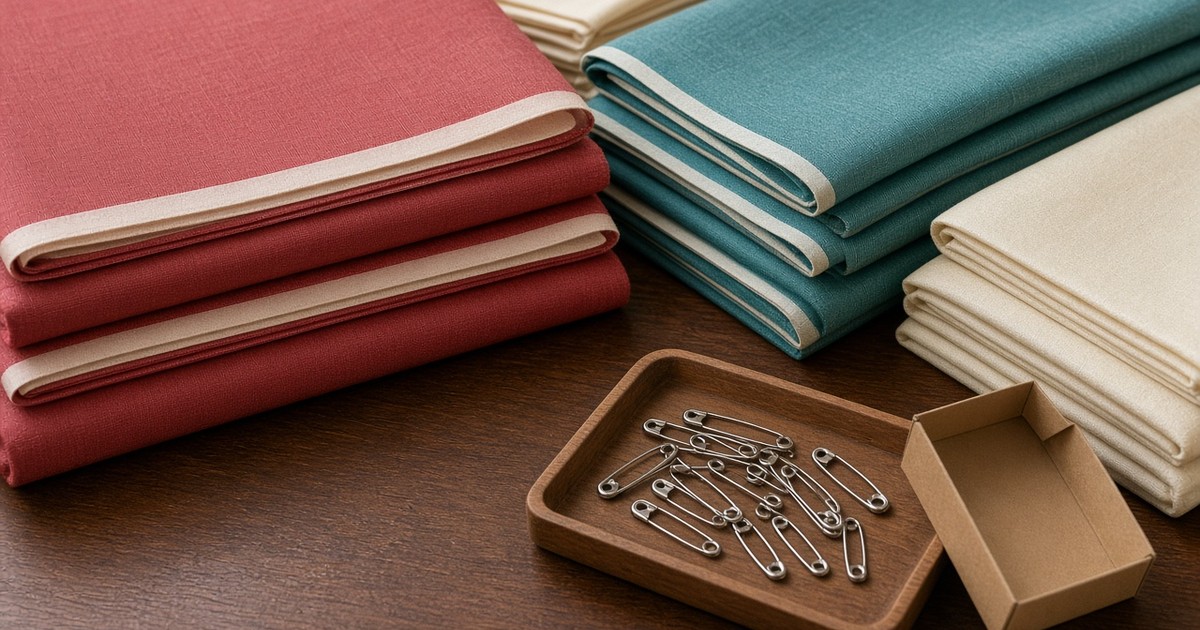
An Indian ethnic-wear store abroad sells sarees, blouses, dupattas and lehengas to customers who sometimes want a safety pin on the day: to hold the pleats, to fix the pallu at the shoulder, to settle a petticoat. A small tray of pins by the till is an easy add-on sale, if the pins are the right size and do not mark the fabric.
This guide is about sourcing saree pins wholesale from an Indian manufacturer, for shop owners, small importers and the distributors who supply them in the UK, the USA, Canada, the UAE and other markets. It is deliberately narrow. It covers plain nickel-plated mild steel safety pins from the Suvik Overseas product pages and nothing else. Decorative saree brooches and jewellery-style pins are a different product; Suvik's product pages do not list them and this guide does not cover them.
This is general buyer information. Product details come from the Suvik Overseas product pages and shipping policy, read on 28 November 2026. Draping and pinning advice comes from the sources listed at the end. Suvik's pages do not publish strength or test values for these pins, so approve a sample on your own fabrics before you stock them. Duty, tax and labelling rules differ by country and are not covered in detail; confirm them with your customs broker.
The short answer
Which pins: the small steel sizes. On the product pages these are size 0 (28 to 30 mm, 0.70 mm wire), size 1 (32 to 35 mm, 0.70 to 0.80 mm wire) and size 2 (37 to 40 mm, 0.80 to 0.90 mm wire), all listed as mild steel with nickel plating.
Pack formats: pouches of 20 to 100 pins or bunches of 10, and mixed-size assortments of sizes 0, 1 and 2, packed 1,000 pieces to a box.
A pin is a convenience, not a necessity. Google Arts & Culture's sari guide says a sari needs no safety pins and that overusing them makes the garment more rigid. Sell pins as reassurance and for practical drapes, not as a must-have.
Fine fabrics need care. A retailer's pinning guide warns that holes in fine, sheer or metallic weaves can stay for good, and advises against pinning through zari, embroidery or sequins. Print that advice on your counter card.
Test before you stock. Pin your own cotton, chiffon and silk samples, and check a sample for rust and snagging yourself.
First step: send your sizes in mm, pack format, first quantity and delivery country through the enquiry form, and ask for samples.
What a saree counter actually needs
A sari is traditionally a single piece of unstitched cloth, and Google Arts & Culture notes that it ranges from 3.5 yards to 9 yards in length and that there are hundreds of ways to drape one, most of them regional. So there is no single "saree pin" size. What the pin has to do depends on the drape and the fabric.
For the common Nivi drape, the Karnataka Silk Industries Corporation, a Government of Karnataka body, describes using a safety pin at the first tuck and to pin the pleats to the petticoat. A saree retailer's step-by-step guide published in October 2026 gives a fuller picture. It places the pins as you drape: one through the pleats from the inside, one through the pallu folds into the blouse at the shoulder and one a little lower on the pallu pleats, one at the left waist, and, for a long evening, one at the back. It suggests three pins for an office day, four for most outings and five to six for weddings and slippery fabrics such as chiffon.
You do not need to repeat any of this to your customers, and you should not oversell it. The same Google Arts & Culture guide is clear that pins are not actually needed, and that too many make the drape stiff. What it means for stock is simple: customers buy a few pins at a time, of a few small sizes, and want them to be smooth and not to rust in the drawer.
Sizes: what the product pages list
Always order by length in millimetres, because size numbers differ between factories. Our safety pin sizes chart and the guide to size numbers 000, 00 and 0 in millimetres explain the mapping, and the gauge guide explains wire thickness.
The small steel lines worth sampling for a saree counter, all listed on the product pages as mild steel with nickel plating:
Size 0, 30 mm, 0.70 mm wire: AROMI Size 0, 10 pouch (1,000 pieces per box in 10 pouches of 100), AROMI Size 0, 20 pouch (20 pouches of 50) and AROMI Size 0, 40 pouch (40 pouches of 25). Cartons hold 100 boxes. SALASAR Size 0, 10 pouch has the same pin and pack.
Size 0, 28 mm, 0.70 mm wire: LIBERAL Size 0, loose (1,000 pieces per box, 100 boxes per carton) and LIBERAL Prime 40 (40 pouches of 25, 60 boxes per carton).
Size 1, 35 mm, 0.80 mm wire: AROMI Size 1, 20 pouch, 20 pouches of 50, 75 boxes per carton.
Mixed sizes 0, 1 and 2: AROMI Assorted, 50 pouch (30, 35 and 40 mm; wire 0.70, 0.80 and 0.90 mm; 50 pouches of 20), AROMI Assorted, bunch (100 bunches of 10), SALASAR Assorted, MAJOR Assorted, LIBERAL Assorted (28, 32 and 37 mm) and NILGIRI Assorted (28, 32 and 37 mm). All hold 1,000 pieces per box in bunches of 10 or pouches.
The 53 mm size 4 pins on the product pages are listed for heavy cloth, so this guide does not recommend them for sarees.
Pick two sizes at first. The saree retailer's guide suggests a medium pin for hidden structural points such as pleats and the left waist, and a fine pin for anything close to the surface of fine fabrics. In Suvik's range that points towards sampling a 35 or 40 mm pin and a 28 to 30 mm pin side by side.
Finish: steel and nickel plating
Suvik's product pages describe these pins as mild steel with nickel plating and call them rust-resistant. That is the whole of the finish range covered here. For a saree shop, two honest points follow:
Store them dry. Steel pins can rust if they sit in a damp stockroom or an open tray in a humid shop. Keep them in their pouches until you sell them.
Some customers react to nickel. If a customer asks for nickel-free pins, our guide on nickel-free safety pins explains how to specify them. This guide does not claim any nickel test result for the steel pins.
Testing a sample on your own fabrics
You know your stock better than any datasheet does. Before you order a carton, ask for samples and do four simple checks. Our sample evaluation checklist covers the general method; for a saree counter add these:
Pin your fabrics. Use offcuts or a sample saree in cotton, chiffon and silk. Pin through two or more layers of plain cloth, from the inside, and open and close the pin several times.
Look for snags. Check the thread around the entry hole, and again after you remove the pin.
Check the finish. Look for a rough head, a burr on the point or a coil that catches fabric. Compare two sizes side by side.
Check the pouch. A pouch that is easy to open and close, and keeps the pins from tangling, matters more at the counter than in a factory carton.
Record what you saw and tell the supplier. A written pass or fail on a sample is a useful record for both sides.
How to pack and sell them
Suvik's factory pack formats are pouches and bunches packed 1,000 to a box, as listed above. For a shop that sells ten or twelve pins at a time, the retail pack is your own decision. Options:
Repack small counts in your shop. A shop can do this at the counter with its own pouches or small envelopes. If you repack under your own name, you may take on the responsibilities of the product's "producer" in your country. For Great Britain, GOV.UK's guidance on the General Product Safety Regulations 2005 says a producer includes anyone presenting themselves as the manufacturer by affixing their name, trade mark or other distinctive mark to the product, and that producers should, where reasonable, show their name and address and a product reference or batch on the product or packaging. Ask your own adviser what applies in your country.
Ask the factory for retail packs. The custom packaging page lists printed retail boxes, hanging blister packs and polybags, with MOQ depending on size, finish and packaging. A distributor or a chain of stores is more likely to use this route than a single shop. Our packaging guide compares the formats.
Add a card. A small counter card that says "pin through folds, away from zari and embroidery" costs almost nothing and helps customers avoid marking fine fabric. It also keeps your shop from suggesting that a saree cannot be worn without a dozen pins.
Buying direct or through a distributor
Suvik's shipping policy describes bulk B2B supply to wholesalers, distributors, garment manufacturers and export houses. A single shop that needs a few thousand pins a year may be better served by a regional distributor or an importer who already brings in stock, or by a group buying together. A chain, an importer or a distributor can order directly. MOQ is flexible and depends on size, finish and packaging; tell us your quantity and we confirm it.
On the shipping side, the policy says Suvik typically ships on FOB Kolkata or CIF port-of-destination terms, with DDP on request, and that all import duties, taxes and customs clearance charges at the destination are the buyer's responsibility. Lead times are 3 to 5 business days for ready stock after payment confirmation, 10 to 21 business days for made-to-order and custom packaging, and 15 to 30 business days for large export consignments, with a peak production season from October to January.
Import duty and tax depend on the country. We keep that in separate guides rather than repeat figures here: the HS code and duty guide, the UK import guide, the Canada import guide, the UAE wholesale guide and the US landed-cost example. If you only need small quantities, read how to inspect a shipment before you stock it.
Where the demand is
This guide does not claim a market size for the saree trade. For one example of how large the community behind it can be, the 2021 Census counted 1.9 million people in England and Wales who identified with the Indian ethnic group, 3.1% of the population, according to GOV.UK's Ethnicity facts and figures. That is not a count of saree buyers, and we have not cited equivalent official figures for the USA, Canada or the UAE.
What to put in your enquiry
A short brief gets a quote: the sizes in millimetres (for example one pin of about 30 mm and one of about 35 to 40 mm), the pouch count you prefer, whether you want assortment packs, the first quantity and a likely repeat quantity, your delivery country and port, the Incoterm, and whether you want retail packaging or plain pouches. Ask for samples with the quote, and say which fabrics you will test them on.
Frequently asked questions
Do you supply decorative saree pins or brooches? No. The Suvik product pages list safety pins. This guide covers plain nickel-plated steel safety pins only.
What size is a saree pin? There is no single size. The pages list small steel pins of 28 to 40 mm, and the right one depends on the fabric and the drape. Sample two sizes.
Will steel pins rust? The product pages describe the pins as nickel-plated and rust-resistant. Steel can still rust if stored damp, so keep pins dry and check a sample.
Can I get small quantities for one shop? MOQ is flexible and depends on size, finish and packaging. Tell us your quantity and we confirm. A local distributor may suit a very small shop.
Next step
If you run or supply an ethnic-wear store and want plain steel safety pins for the saree counter, send your sizes in mm, pouch count, quantity, delivery country and Incoterm through the enquiry form or the contact page, and ask for samples with the quote. Suvik Overseas manufactures safety pins and dress hooks at its factory in Howrah, West Bengal, India, and exports worldwide.
Sources
Google Arts & Culture, 9 Facts You Might Not Know About The Sari: definition, 3.5 to 9 yards, many drapes, and "zero safety pins" required. Read 28 November 2026.
Karnataka Silk Industries Corporation Limited (Government of Karnataka), How to wear a saree: safety pin at the tuck and at the pleats.
MAYIN, How to Pin a Saree: How Many Pins and Where (14 October 2026): a saree retailer's guide to pin positions, pin counts by occasion, where not to pin, and pin types. A retailer's guidance, not a standard.
GOV.UK, General Product Safety Regulations 2005: Great Britain: producer definition and traceability.
GOV.UK Ethnicity facts and figures, Population of England and Wales: 2021 Census, 1.9 million people in the Indian ethnic group (3.1%).
Suvik Overseas, Shipping & Delivery Policy, Custom Safety Pin Packaging and the product pages linked above (sizes, wire thickness, material, plating, pack counts and carton quantities). Read 28 November 2026.