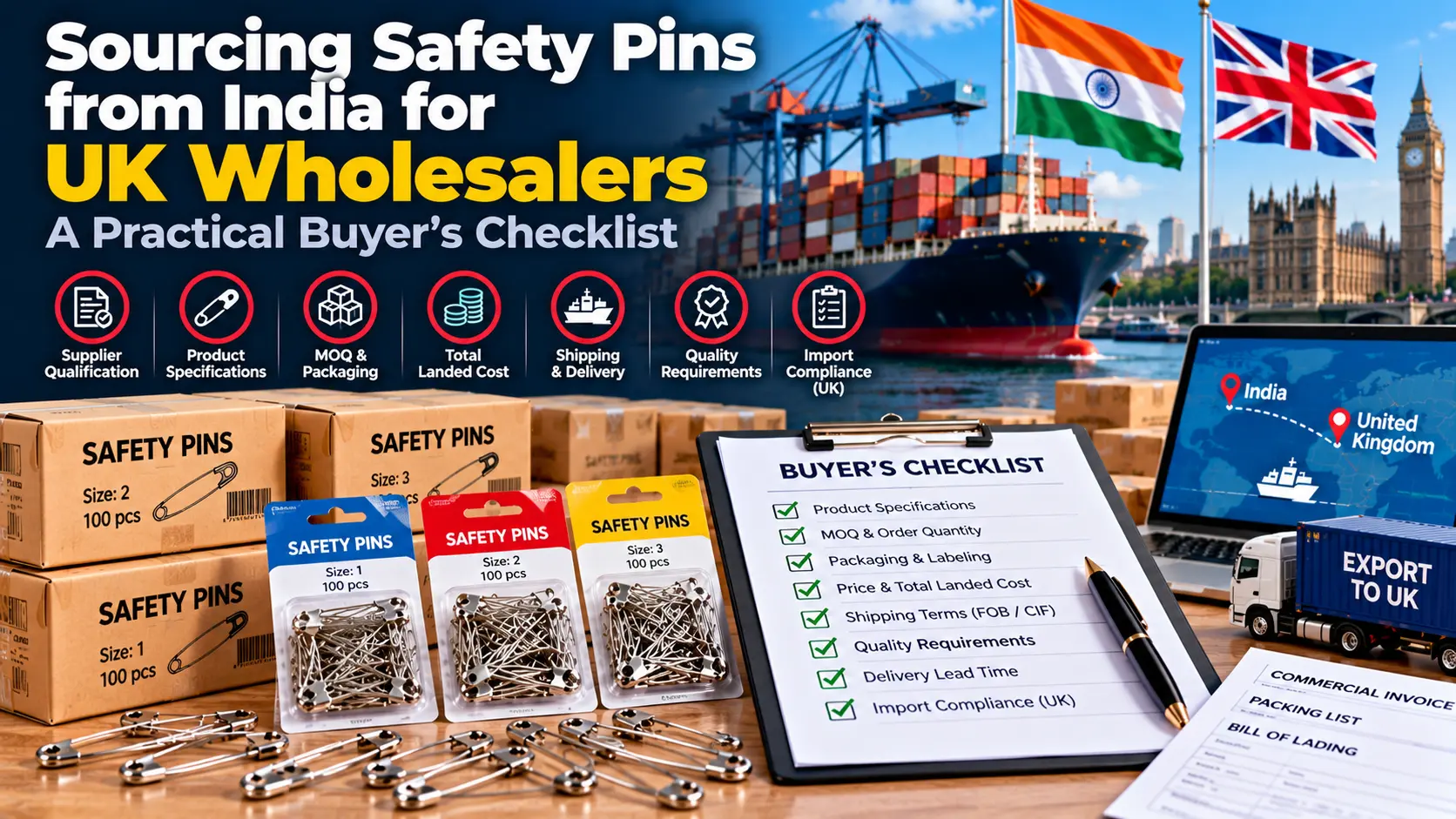
UK businesses can buy safety pins directly from an Indian supplier, but the buyer also takes on a set of UK-side tasks: registering to import, classifying the goods, valuing the shipment and accounting for tax. This guide helps UK wholesalers, haberdashery and craft retailers, uniform suppliers and online sellers decide what to confirm with a supplier and what to check with official UK sources before placing a first order.
Quick Answer
UK wholesalers considering safety pins from India should evaluate suppliers on product specification, order quantity, packaging, quality requirements, delivery terms and total landed cost. Before placing a bulk order, confirm the exact product configuration, request a written quotation, agree acceptance criteria and check UK import requirements with your customs agent.
Import rules, duty, VAT and product requirements can change and depend on your business and the goods. This article gives general information only: for every legal, customs, duty or VAT point, check official UK government sources (GOV.UK). For the official step-by-step process, see Import goods into the UK: step by step on GOV.UK.
Which UK Buyer Are You?
The same supplier checklist applies to every UK buyer, but the priorities differ.
Wholesalers and distributors: consistent specifications between orders, carton configuration and repeat supply. See also how to choose a wholesale assortment.
Haberdashery and craft retailers: ready-to-display pack formats and assortments. The UK bulk buying page outlines retail and private-label options.
Uniform and workwear suppliers: pack sizes and quantities that match your supply calendar. See safety pins for school uniform suppliers.
Online sellers and own-brand ranges: branded packaging, artwork approval and labelling. See private-label safety pins.
Why UK Buyers Consider Overseas Safety Pin Suppliers
Safety pins are used across garment production, sewing supplies, craft retail, general merchandise and packaging applications. Buyers often need several sizes, materials and packaging formats to serve different customers.
When evaluating an overseas supplier, UK buyers need to consider more than the unit price. Key considerations include:
Consistency of product specifications between orders.
Availability of the sizes and materials you need.
Minimum order quantity and purchasing budget.
Retail-ready or bulk packaging requirements.
Production and international shipping lead times.
Documentation and import arrangements.
Supplier communication and repeat-order capability.
What Changes When You Import from India to the UK
When you buy from an overseas supplier, you become responsible for getting the goods into the UK lawfully, either yourself or through someone you appoint. The tasks below follow the structure of the official GOV.UK process. Rules and eligibility depend on your business, so check official UK government sources (GOV.UK) for each one.
Import registration. Businesses that move goods between Great Britain and other countries may need an EORI number. GOV.UK explains who needs an EORI number and when you will need it.
Customs agent or transporter. GOV.UK notes that most businesses that import goods use a transporter or customs agent to deal with customs. Decide who will make the import declaration before you agree shipping terms.
Commodity code. The commodity code is used on the import declaration and works out the rate of Customs Duty and import VAT. GOV.UK provides the Trade Tariff lookup and guidance on finding commodity codes. It also advises checking any code supplied by an overseas supplier, because the treatment may not be the same in the UK.
Customs value. The value of the goods is needed on the import declaration. GOV.UK has guidance on working out the customs value of your imported goods, including delivery costs and converting foreign currency amounts.
Import VAT. GOV.UK explains how VAT on imports works, including options for VAT-registered businesses such as postponed VAT accounting.
Records. GOV.UK states that you must keep records of commercial invoices and customs paperwork, so ask your supplier for accurate, consistent documents from the start.
For a full walk-through of the process for this product, see how to import safety pins from India and the safety pin export documents checklist.
1. Define Your UK Market Requirements Before Contacting Suppliers
Start by identifying the customers you intend to serve and the products they need. A wholesaler supplying independent sewing shops may need a different assortment from a distributor supplying garment makers or retail chains.
Prepare a product brief that answers the following questions:
Which safety pin sizes do your customers require?
Do you need steel, stainless steel, brass or another specified material?
What surface finish is required?
Will the products be sold loose, in bulk boxes or in retail packaging?
Do you require your own branding?
What quantity do you expect to buy initially, and how often will you reorder?
What delivery date or replenishment schedule do you need?
If you do not yet know the ideal specification, ask suppliers to show the available options for evaluation. Avoid committing to a large assortment before you know which products your customers actually want.
2. Check Whether the Supplier Is a Manufacturer or a Trading Company
Both manufacturers and trading companies can serve international buyers, but you should understand who is responsible for production, quality, packaging and order coordination. Our guide to manufacturer versus trading company compares the two models.
When evaluating a manufacturer, ask:
Where is production carried out?
Which manufacturing stages are handled internally?
Which materials and sizes are available?
How are product specifications controlled?
Can the supplier explain its inspection process?
Can it support repeat orders to an agreed specification?
Who handles export documentation and shipment coordination?
Request evidence where needed, such as catalogues, samples, quality documentation and a formal quotation. Do not rely only on the supplier's description of itself. Verify business details and confirm that the supplier can fulfil your specific order. Our checklist on how to evaluate a safety pin supplier covers this in more detail, and the wholesale safety pin manufacturer page gives background on Suvik Overseas.
3. Confirm the Product Specification in Writing
A product name alone does not show that two suppliers are quoting equivalent goods. Your written specification should identify:
Product type: the required safety pin design.
Size: the size designation and the actual length, as stated by the supplier.
Material: steel, stainless steel, brass or another specified material.
Wire thickness: the required diameter or gauge.
Finish: the required surface finish or coating.
Locking mechanism: agreed design and performance requirements.
Packaging: bulk, retail box, blister pack or custom configuration.
Quantity: pieces, boxes or cartons, with each unit clearly defined.
If you need a particular stainless steel grade, ask the supplier to confirm the grade and provide supporting documentation rather than relying on a general description such as rust-resistant. If appearance or function matters to your customers, evaluate a physical sample before approving the bulk specification.
4. Establish the Minimum Order Quantity and Packaging Configuration
Minimum order quantity (MOQ) affects whether a supplier suits your business. A large MOQ may be reasonable for an established distributor but unsuitable for a retailer testing a new range.
Before proceeding, ask the supplier to confirm:
The MOQ for each selected product.
Whether several sizes can be combined in one order.
Whether different materials or finishes have separate minimums.
The number of safety pins per box.
The number of boxes per export carton.
Whether custom packaging changes the MOQ.
Whether repeat orders can follow the same specification.
Suvik Overseas lists a standard MOQ of 750 boxes. The minimum can be discussed and adjusted after negotiation, depending on the order. Buyers should confirm the applicable minimum for their chosen products and packaging configuration before making purchasing decisions. Always distinguish between boxes, individual pieces, gross and shipping cartons, because these units are not interchangeable. See safety pin MOQ explained and order quantity conversion for pieces, gross, boxes and cartons.
5. Request a Quotation That Reflects the Full Purchase
A competitive unit price does not always mean a competitive total cost. Ask the supplier to state the quotation currency, product quantity, packaging costs, delivery terms, payment conditions and any exclusions.
Depending on the transaction, your cost assessment may need to include:
Product purchase price.
Export packing and labelling.
Inland transport in India.
Export handling and clearance.
International freight.
Cargo insurance, where applicable.
UK port and handling charges.
Customs agent or brokerage fees.
Customs Duty and import VAT, if applicable.
Transport from the UK port to your warehouse.
Estimate the landed cost
A useful starting formula is:
Estimated landed cost = product cost + freight and insurance + applicable import charges + other logistics costs
Divide the total by the number of saleable units to estimate the cost per unit received. Use actual quotations and the expected shipment configuration. The final amount depends on the agreed shipping terms, product classification, customs value and applicable UK rules.
Clarify shipping terms and currency
Ask which Incoterm is being quoted and which named location applies. FOB and CIF quotations, for example, cover different costs and risk-transfer points, so do not compare them directly without adjusting for the difference. Agree who will handle UK customs clearance and who pays UK port and delivery charges.
Also confirm the currency and the payment terms. See how to compare safety pin export quotations, payment terms for importing safety pins and LCL, FCL or air freight for bulk safety pins.
6. Check UK Import and Product Compliance Requirements
Before placing an order, work out which requirements apply to your product, its intended use and your import arrangements. Rules and rates change, so check official UK government sources (GOV.UK) or confirm with a qualified customs agent or compliance adviser. In particular, verify:
The correct commodity code. Use the Trade Tariff lookup on GOV.UK and, if unsure, ask a customs agent.
How the customs value of your shipment is worked out, including delivery costs and currency conversion.
How import VAT applies to your business.
Whether you need an EORI number and who will make the import declaration.
Whether the supplier can provide the documents your agent asks for.
Any product, labelling or packaging rules that apply to what you plan to sell.
Do not assume that every safety pin or every shipment is treated identically. Where material composition, coatings or intended use raise specific questions, ask the supplier for technical documentation and confirm the requirements with a qualified adviser.
Raise documents and product details early, rather than waiting until the goods are ready to ship.
7. Evaluate Product Quality Before Approving Bulk Production
Your quality criteria should reflect how the safety pins will be sold or used. Depending on the specification, buyers may evaluate:
Dimensional consistency.
Wire thickness and material requirements.
Point finish and visible defects.
Surface smoothness.
Spring action and closure performance.
Locking-head fit.
Finish consistency.
Packaging accuracy and quantity.
Agree acceptance criteria before production. Where needed, arrange a sample review or a documented pre-shipment inspection. If corrosion resistance matters, specify the material or finish and agree how it will be verified. See the sample evaluation checklist and the quality control and testing guide.
8. Choose Packaging for Your Distribution Model
The right packaging depends on how you will sell or distribute the products. Our safety pin packaging guide covers the options in more detail.
Bulk packaging
Bulk packaging may suit distributors, industrial buyers and businesses that repack goods themselves. Confirm quantities, inner packaging, carton strength and labelling.
Retail packaging
Retail packaging may suit sewing shops, craft retailers and general merchandise sellers that need ready-to-display products. Confirm pieces per pack, pack dimensions, artwork, labelling and any barcode requirements set by your retailer or sales channel.
Private-label packaging
Private-label orders may involve branded cards, printed boxes and custom artwork. Approve the artwork and packaging specification before production, and confirm any extra cost or lead-time effect. Explore custom safety pin packaging and private-label safety pins for more information.
9. Plan Production and Delivery Around Your Inventory
International buying needs planning beyond the date the order is placed. Ask the supplier to clarify the expected time for:
Final specification approval.
Sample approval, if required.
Production.
Quality inspection.
Packaging and export preparation.
Shipment booking and dispatch.
Your freight forwarder can help estimate transit, port handling and delivery to your warehouse. Build contingency into your inventory plan, because shipping schedules, customs procedures and production requirements can change. Avoid promising a fixed delivery date to your own customers until the milestones are confirmed. See safety pin export lead times, and plan how you will check the goods when they arrive using how to inspect and store a bulk shipment.
10. Use a Supplier Qualification Checklist
Before approving a new supplier, review these points:
Business identity: verified company and contact details.
Manufacturing capability: product range and production information.
Product specifications: written technical requirements.
MOQ: confirmed quantity and order configuration.
Quality: samples and agreed acceptance criteria.
Packaging: approved format, quantities and labels.
Quotation: price, currency and stated exclusions.
Delivery: production estimate and shipping terms.
Documentation: agreed commercial and export documents.
Payment: written terms and payment milestones.
Communication: clear answers and documented commitments.
Not every buyer needs a formal factory audit, but every buyer should verify the information that matters to the order's value, complexity and risk.
11. Prepare Your First Export Enquiry
A detailed enquiry helps the supplier prepare a relevant quotation. Include:
Company name and UK business location.
Required safety pin type and sizes.
Material and surface finish.
Initial order quantity.
Packaging format.
Private-label requirements, if applicable.
Delivery location or UK port.
Who will act as importer or appoint a customs agent.
Target delivery date.
Quality or documentation requirements.
Preferred shipping terms and quotation currency, if known.
If you are still comparing options, say so and ask the supplier to suggest suitable alternatives separately. You can also adapt our safety pin RFQ template.
Example enquiry
Subject: Wholesale safety pin enquiry, United Kingdom
Dear Export Sales Team, we are evaluating suppliers of wholesale safety pins for distribution in the United Kingdom. Please review our preliminary requirements: product type and sizes [specify]; material and finish [specify]; estimated order quantity [specify]; packaging [bulk, retail or private label]; delivery location or UK port [specify]; target delivery schedule [specify]. Please confirm the available specifications, applicable MOQ, packaging options, quotation currency, production lead time, payment terms and shipping arrangements. Please also advise whether samples and relevant product or quality documentation can be provided for evaluation. Kind regards, [Name], [Company], [Business email], United Kingdom.
12. Source Safety Pins from Suvik Overseas
Suvik Overseas Pvt. Ltd. is a safety pin manufacturer and exporter based in Kolkata, India, and manufactures at its factory in Kolkata. Its product and service offering includes wholesale safety pins, OEM manufacturing and private-label options, subject to the requirements of the order. UK businesses can send their specifications, expected quantity, packaging requirements and delivery destination for review. The export team can then confirm product availability, MOQ, commercial terms and shipping arrangements for the proposed order. The UK bulk safety pins page summarises the product categories and packaging formats for UK retail, fashion and textile buyers.
Frequently Asked Questions
Can UK wholesalers buy safety pins directly from India?
Yes. UK businesses can explore direct sourcing from Indian manufacturers, subject to supplier terms, product requirements and applicable import procedures. Buyers should verify supplier details and estimate the total landed cost before placing an order.
Do I need an EORI number to import safety pins into the UK?
Businesses that import goods into Great Britain commonly need an EORI number to make customs declarations, and many appoint a customs agent or transporter to handle the declaration. Whether you need one depends on your business, so check official UK government sources (GOV.UK) or ask your customs agent.
Who handles UK customs clearance and import VAT?
That depends on the shipping terms and on who you appoint. Many UK businesses appoint a customs agent or transporter to make the import declaration, and VAT-registered businesses may have options for accounting for import VAT. Agree in writing with your supplier and freight forwarder who handles each step, and check official UK government sources (GOV.UK).
What should I check before choosing a safety pin supplier?
Check business identity, product specifications, MOQ, quality criteria, packaging, quotation details, lead time, payment terms and export documentation. Request samples when they are useful for evaluating the product.
What is the MOQ for safety pins from Suvik Overseas?
Suvik Overseas lists a standard MOQ of 750 boxes. The minimum can be discussed and adjusted after negotiation, depending on the order. The applicable minimum should be confirmed for the selected product and packaging configuration before ordering.
How can I calculate the cost of importing safety pins into the UK?
Start with the product quotation, then add freight, insurance, port and handling charges, customs brokerage, any duty and import VAT, and delivery to your warehouse, according to the agreed shipping terms. Commodity classification, customs value and import VAT should be checked on official UK government sources (GOV.UK) or with a qualified customs agent.
Can I get a quotation in GBP?
Quotation currency is agreed for each order, so ask the supplier to state the currency, the validity period and the payment terms in the quotation. If amounts are in a foreign currency, GOV.UK has guidance on converting them when working out customs value, so check with your customs agent.
Can I order safety pins with my own brand and packaging?
Private-label options may be available depending on the product, artwork, packaging configuration, MOQ and production arrangements. Confirm these requirements with the supplier before approving the order.
Should I request samples before a bulk order?
Samples are useful when you need to evaluate dimensions, finish, locking performance or packaging. Agree on the required specifications and acceptance criteria before placing the production order.
What documents should I request from an Indian safety pin exporter?
The documents depend on the transaction and applicable requirements. Discuss the commercial invoice, packing list, transport documentation, origin documentation where required and any relevant product or quality documents with the supplier and your customs agent.
Conclusion
Buying safety pins from India for the UK market takes careful supplier qualification, a clear written specification, realistic cost planning and coordinated import arrangements. Before placing a bulk order, verify the supplier, compare equivalent quotations, approve the product and packaging requirements, and confirm who will handle UK customs, duty and VAT. For each of those UK points, check official UK government sources (GOV.UK).
Request a Wholesale Safety Pin Quotation for the UK
If you are a UK wholesaler, retailer, uniform supplier or online seller evaluating a new supplier, the most practical next step is a detailed enquiry. Share your specifications, target quantity, packaging needs and UK delivery location through the export enquiry page to discuss available options and applicable commercial terms.
This article provides general sourcing information and is not legal, tax or customs advice. Product availability, commercial terms, lead times and applicable import requirements should be confirmed for each transaction.